Bony vs Boney: Which Is Correct? Meaning, Examples & Usage

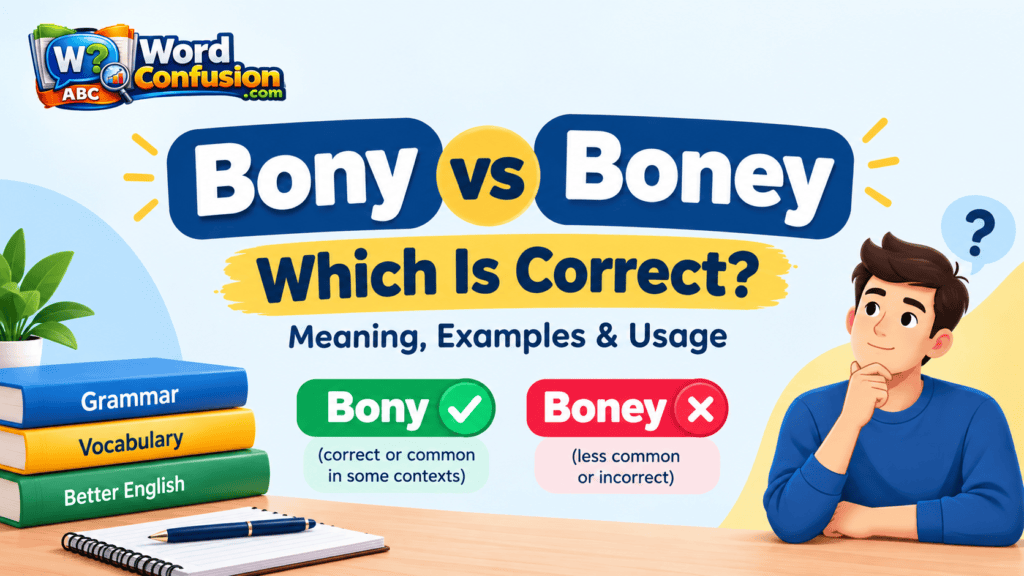
If you’re wondering whether bony or boney is the correct spelling, the answer has a little more nuance than simply calling one right and the other wrong. Bony is the standard and much more common spelling in modern English, while boney is also recognized as a variant. Both can describe something related to bones or something with prominent bones, but bony is the form you will normally want in everyday, academic, and professional writing. Cambridge Dictionary lists boney as another form of bony, and American Heritage identifies boney as a variant.
For more practical English spelling and vocabulary guides, you can also explore WordConfusion.
Bony or Boney: The Quick Answer
Bony is the standard spelling you should normally use.
Boney is also a recognized variant, but it is much less common.
| Word | Status | Meaning |
|---|---|---|
| bony | Standard and preferred | Related to bone, containing many bones, or having prominent bones |
| boney | Recognized variant | Essentially the same basic adjective meaning |
So, if you’re writing an email, essay, article, report, or school assignment, bony is the safest and most natural choice.
Examples
- She has a bony face.
- The dog had a bony frame.
- The fish was tasty but very bony.
- The doctor examined the bony structure of the foot.
You may also encounter boney in dictionaries or real-world writing. That does not mean the word has no status at all. Cambridge lists boney as another form of bony, while American Heritage defines it as a variant.
What Does Bony Mean?
Bony is an adjective with several related meanings.
Bony Meaning: Thin or With Prominent Bones
When describing a person or animal, bony usually means very thin in a way that makes the bones noticeable.
For example:
- He had a bony face.
- Her long, bony fingers rested on the table.
- The stray dog looked thin and bony.
- The old horse had a bony frame.
Cambridge defines this sense as being very thin so that the bones show under the skin.
Importantly, bony does not automatically mean unhealthy. It describes appearance. The surrounding context determines whether the description is neutral, sympathetic, or negative.
Bony Meaning: Related to Bone
Bony can also mean relating to, made of, or resembling bone.
For example:
- The surgeon examined the bony structure of the joint.
- The skull provides a bony protective structure around the brain.
- The scan showed a small bony growth.
This use is common in anatomy, medicine, and other scientific contexts. Cambridge gives examples involving bony deformities, bony plates, and bony tissue.
Bony Meaning: Containing Many Bones
You can also use bony for food, particularly fish that contain many bones.
For example:
- The fish was delicious but very bony.
- Some types of fish are more bony than others.
- Be careful because this fish is quite bony.
This meaning is especially common in everyday descriptions of fish.
Is Boney a Correct Word?
Yes, boney is a recognized English word, but it is much less common than bony.
This is an important distinction.
It would be inaccurate to say that boney is never a word. Cambridge Dictionary lists boney as another form of bony, and American Heritage Dictionary describes boney as a variant of bony.
However, when you’re choosing a spelling for normal modern English, bony is the better choice.
Standard Writing
Prefer:
The horse looked bony after the long journey.
Rather than:
The horse looked boney after the long journey.
The first version uses the much more familiar standard form.
Why Do People Write Boney?
The spelling boney is understandable because the word comes from bone.
People naturally see:
bone → boney
and assume the final e should remain.
But the established spelling is:
bone → bony
This kind of spelling confusion is common in English. For another example of a word where pronunciation or the base word can make the spelling seem less obvious, see our guide to Shakey or Shaky.
Bony vs Boney: What’s the Difference?
The main difference is spelling frequency and standard usage, not basic meaning.
| Feature | Bony | Boney |
|---|---|---|
| Part of speech | Adjective | Adjective |
| Standard form | Yes | Variant |
| Meaning | Related to bone, containing bones, or visibly prominent bones | Same basic meaning |
| Frequency | Much more common | Less common |
| Pronunciation | /ˈboʊni/ US; /ˈbəʊni/ UK | Same basic pronunciation |
| Everyday writing | Preferred | Less common |
| Academic/professional writing | Preferred | Usually better replaced with bony |
| British English | Used | Variant |
| American English | Used | Variant |
Cambridge gives UK and US pronunciations for bony and lists boney as another form, rather than presenting it as a completely separate word.
So if your question is:
Which spelling should I use?
Choose bony.
If your question is:
Is boney a word?
Yes, but it is a less common variant.
Why Is Bony Spelled Without the E?
The spelling bony can look surprising because the base word is bone.
You might expect:
bone + y = boney
But English spelling does not always preserve a final silent e when a suffix is added.
The established adjective is:
bone → bony
You can see a similar pattern in words such as:
- stone → stony
- ice → icy
- noise → noisy
- taste → tasty
This is useful as a spelling pattern, but it should not be treated as an absolute rule for every English word.
For example, English has many exceptions and historical spellings, which is why dictionary evidence is still useful when you’re unsure.
If spelling-rule questions interest you, our guide to Hopeing or Hoping explains another situation involving a final silent e and suffix formation.
How to Use Bony in a Sentence
The easiest way to understand bony is to see it in different contexts.
Describing a Person
Use bony when someone’s bones are especially noticeable.
- The elderly man had a bony face.
- She had long, bony fingers.
- His bony shoulders were visible beneath his shirt.
- The character was described as tall and bony.
The word focuses on the visibility or prominence of bones rather than simply saying that someone is thin.
Describing an Animal
Bony can describe an animal with a thin or prominent bone structure.
- The rescued dog looked weak and bony.
- The horse had a narrow, bony frame.
- The cat’s bony ribs were easy to see.
Again, context matters. A naturally lean animal is not necessarily unhealthy simply because it has a bony appearance.
Describing Body Structure
In medical, anatomical, and scientific contexts, bony often means relating to bone.
- The scan showed a bony abnormality.
- The skull is a complex bony structure.
- The doctor examined the bony part of the joint.
- The researchers studied the animal’s bony anatomy.
This is a more technical use of the adjective. Cambridge specifically records the “made of bone or a substance like bone” sense as specialized/medical.
Describing Fish or Food
Bony can also describe fish that contain many bones.
- The fish was flavorful but very bony.
- I don’t usually buy that type of fish because it is too bony.
- The children were warned to be careful because the fish was bony.
This is one reason the word can describe something that has nothing to do with a person’s appearance.
Bony vs Skinny: What’s the Difference?
Bony and skinny can overlap, but they are not identical.
Skinny primarily describes someone as unusually thin.
Bony emphasizes the appearance or prominence of bones.
Compare:
She is skinny.
This tells us about her body size.
She has a bony face.
This tells us that her facial bones are noticeable or prominent.
Someone can be thin without looking particularly bony. Likewise, someone can have a naturally prominent bone structure without being extremely thin.
Other words such as slim, slender, lean, scrawny, and skeletal also have different shades of meaning, so they should not automatically be treated as interchangeable with bony.
Bony vs Bone
Another common mistake is confusing the noun bone with the adjective bony.
Bone
Bone is a noun.
It names the hard structures that form the skeleton.
The doctor examined the bone.
Bony
Bony is an adjective.
It describes something related to or characterized by bone.
The doctor examined the bony structure.
A simple way to remember it is:
bone = the thing
bony = describes the thing
Bony vs Bonny
Don’t confuse bony with bonny.
Bony
Bony relates to bones or describes someone or something with prominent bones.
The animal had a bony frame.
Bonny
Bonny is a different word. It can mean attractive, pretty, or pleasing, particularly in British and Scottish usage.
She was a bonny child.
So:
bony = related to bones
bonny = attractive or pleasing
This distinction is useful because adding or removing one letter can completely change the word’s meaning.
Is Bony Used in British and American English?
Yes.
Bony is used in both British and American English. The spelling does not have a major UK-versus-US difference.
The pronunciation varies slightly:
- UK: /ˈbəʊ.ni/
- US: /ˈboʊ.ni/
Cambridge gives both pronunciations for the word.
The spelling bony remains the normal form in both varieties.
Common Mistakes With Bony and Boney
Mistake 1: Assuming Boney Is Always Wrong
This is the biggest misconception.
It is more accurate to say:
Bony is the standard and preferred spelling. Boney is a recognized variant.
Major dictionary evidence supports that distinction.
Mistake 2: Writing Boney Because the Base Word Is Bone
The connection is understandable:
bone → boney
But the established spelling is:
bone → bony
Remembering the established form is more useful than trying to reconstruct the spelling every time.
Mistake 3: Thinking Bony Only Describes People
It doesn’t.
You can describe:
- people
- animals
- fingers
- faces
- body structures
- anatomical features
- fish
- objects made of or resembling bone
Mistake 4: Treating Bony and Skinny as Exact Synonyms
They overlap when describing appearance, but bony emphasizes bones while skinny emphasizes thinness.
Mistake 5: Confusing Bony With Bonny
These are separate words with different meanings.
If you enjoy comparing easily confused English spellings, our guide to Grimey or Grimy covers another example where a familiar-looking variant can cause spelling confusion.
You can also explore Shinning or Shining, where the two spellings are both real words but have different meanings.
How to Remember the Correct Spelling
Use this simple pattern:
BONE → BONY
Think of the adjective as bony, without the extra e.
A useful mental sentence is:
Bones are bony.
That makes it easier to remember the spelling when you’re writing quickly.
For more examples of common English spelling mistakes, see Finaly or Finally.
Bony: Comparative and Superlative Forms
When comparing degrees of the adjective, you may see:
- bony
- bonier
- bonier-looking
- boniest
For example:
His hands looked bonier after he lost weight.
That was the boniest animal in the group.
In ordinary writing, however, the basic form bony is by far the most common.
Quick Examples: Bony in Everyday English
Here are some natural examples to make the meaning clear:
- The old man had a bony face.
- Her bony fingers wrapped around the cup.
- The dog looked thin and bony.
- The horse had a narrow, bony frame.
- The doctor examined the bony structure of the knee.
- The fish was tasty but extremely bony.
- The skull is a strong bony structure.
- His bony shoulders showed through his shirt.
- The animal’s bony ribs were visible.
- The scan revealed a small bony growth.
These examples show why the meaning of bony depends on context.
FAQs
Is it bony or boney?
Bony is the standard and much more common spelling. Boney is also a recognized variant, but it is less common. For ordinary modern English writing, bony is the preferred choice.
Which spelling is correct, bony or boney?
Bony is the standard spelling. Boney is a recognized variant rather than simply a nonexistent word. If you need the normal spelling for an essay, email, article, or professional document, use bony.
Is boney a real word?
Yes. Boney is recorded as a variant of bony in major dictionaries. It has the same basic adjective meaning, but it is much less common than bony.
What does bony mean?
Bony can mean very thin with prominent bones, related to or made of bone, or containing many bones. For example, you can have a bony face, a bony anatomical structure, or a bony fish.
What does boney mean?
Boney is a variant spelling of bony. Its basic meaning is the same, but the spelling is much less common.
Is it bony or boney hands?
Bony hands is the standard choice.
For example:
She had long, bony hands.
Does boney have a different meaning from bony?
Generally, no. Boney is a variant of bony, so the basic meaning is the same. The main difference is that bony is much more common and is the preferred form in standard modern writing.
Does bony mean skinny?
Not exactly. Bony can describe someone who is very thin, but it emphasizes the visibility or prominence of bones. Skinny focuses more directly on body size.
Is bony an adjective?
Yes. Bony is an adjective.
It describes something related to bones, containing many bones, or having prominent bones.
Is bony used in American English?
Yes. Bony is standard in American English. Cambridge gives the US pronunciation as /ˈboʊ.ni/.
Is bony used in British English?
Yes. Bony is also standard in British English. Cambridge gives the UK pronunciation as /ˈbəʊ.ni/.
What is the difference between bone and bony?
Bone is a noun that names a skeletal structure.
Bony is an adjective that describes something related to bone.
For example:
The bone was fractured.
The doctor examined the bony structure.
What does bony fish mean?
A bony fish is a fish with a skeleton made primarily of bone, and in everyday usage bony can also describe a fish that contains many noticeable bones. Cambridge records “bony fish” as an established use of the adjective.
Final Answer: Bony or Boney?
If you’re choosing between bony and boney, use bony in normal modern English writing.
The important point is that boney is not simply a made-up spelling. It is recognized as a variant of bony, but it is considerably less common.
So the easiest rule is:
Bony = standard and preferred
Boney = recognized but less common variant
When describing prominent bones, something related to bone, or a fish containing many bones, bony is the spelling most readers will expect.
Written by
 Muhammad Bilal
Latest posts
 What Does PG Mean in Text? Meaning, Examples & Usage
 What Does OFCC Mean in Text? Meaning, Uses & Examples
 What Does MSG Mean in Text? Meaning, Examples & Usage
 What Does STY Mean in Text? Meaning, Examples & Usage
 What Does “Twin” Mean in Slang? Meaning, Text & Examples
 What Does LMC Mean in Text? Meaning, Examples & Usage