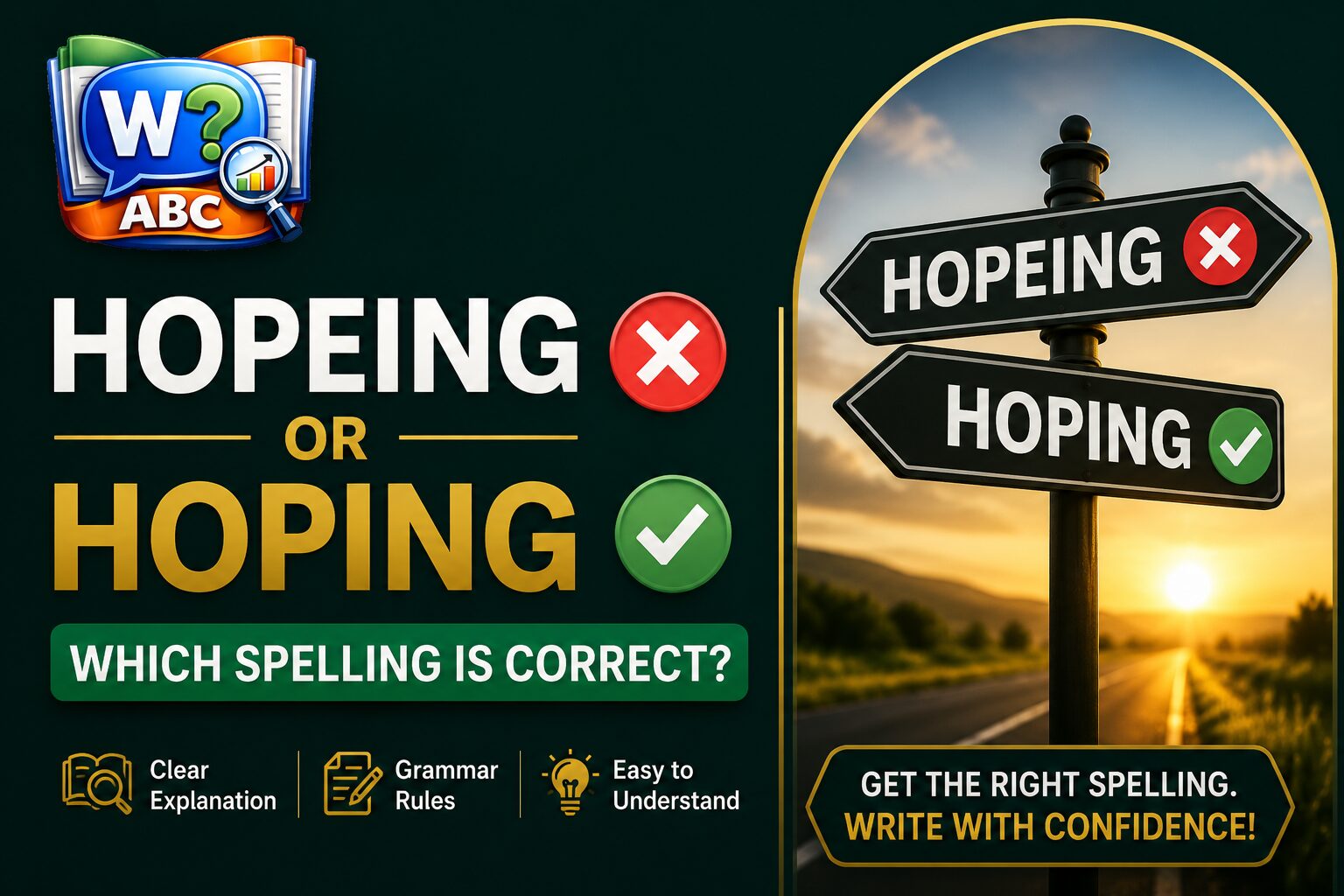
Have you ever typed hopeing and wondered whether it was correct? You’re not alone. Many English learners and even native speakers get confused when adding -ing to the verb hope.
The simple answer is that hoping is the correct spelling, while hopeing is incorrect. This spelling follows a common English grammar rule where the silent e at the end of a verb is usually dropped before adding -ing.
In this guide, you’ll learn the difference between hopeing and hoping, why one spelling is correct, how to use hoping in sentences, and an easy trick to remember the rule.
Quick Answer: Hopeing or Hoping?
| Word | Correct? | Meaning |
| Hoping | ✅ Yes | The present participle form of hope |
| Hopeing | ❌ No | Incorrect spelling |
Hoping is the correct spelling because the final silent e in hope is removed before adding -ing.
✅ I am hoping for good news.
❌ I am hopeing for good news.
Featured Snippet Answer
The correct spelling is hoping, not hopeing. When the verb hope changes to its -ing form, the silent e is dropped before adding -ing. This follows a standard English spelling rule. For example, “I am hoping to hear from you soon” is correct, while “I am hopeing to hear from you soon” is incorrect.
What Does Hoping Mean?
Hoping is the present participle and gerund form of the verb hope.
It means:
- Wanting something good to happen
- Expecting a positive outcome
- Looking forward to a desired result
Simple Definition
The word hoping means feeling hopeful about something that may happen in the future.
Hoping Pronunciation
In pronunciation, hoping is spoken as:
/ˈhoʊ.pɪŋ/
It sounds like:
HOPE-ing
Even though the word is pronounced with the sound of hope, the spelling drops the final silent e.
Is Hopeing a Word?
No, hopeing is not a standard English word.
You will not find hopeing listed as the accepted spelling in major dictionaries because it is simply a misspelling of hoping.
Why Is Hopeing Incorrect?
The mistake happens because people try to add -ing directly to hope without applying the spelling rule.
Many learners assume:
Hope + ing = Hopeing
However, English spelling rules require the silent e to be removed first:
Hope → Hoping
What Dictionaries Say
Major English dictionaries recognize hoping as the correct form of the verb hope.
The spelling hopeing is considered a common writing mistake and should be avoided in formal and informal writing.
Why Does Hope Become Hoping?
The answer lies in a basic English spelling rule.
The Silent E Rule
When a verb ends with a silent e, the e is usually dropped before adding -ing.
Examples:
| Base Verb | -ing Form |
| Hope | Hoping |
| Make | Making |
| Take | Taking |
| Write | Writing |
| Come | Coming |
Following this rule:
Hope → Hoping
Not:
Hope → Hopeing
Why English Uses This Rule
Dropping the silent e makes words easier to spell and keeps spelling patterns consistent across English vocabulary.
Without the rule, English would contain many unnecessary letter combinations.
Hopeing vs Hoping Comparison Table
| Feature | Hoping | Hopeing |
| Correct English spelling | ✅ | ❌ |
| Dictionary word | ✅ | ❌ |
| Used by native writers | ✅ | ❌ |
| Accepted in academic writing | ✅ | ❌ |
| Accepted in professional writing | ✅ | ❌ |
| Standard English usage | ✅ | ❌ |
How to Use Hoping in Sentences
The word hoping appears in everyday conversations, emails, books, academic writing, and professional communication.
Everyday Examples
- I am hoping for sunny weather this weekend.
- She is hoping to pass her driving test.
- We are hoping everything goes well.
- They are hoping to visit their grandparents soon.
- I’m hoping you can help me.
Professional Examples
- We are hoping to finalize the agreement next week.
- The company is hoping to increase sales this year.
- I am hoping to discuss the project during our meeting.
- Our team is hoping for positive feedback from clients.
- We are hoping to launch the product soon.
Academic Examples
- Researchers are hoping to discover new treatments.
- Students are hoping for excellent examination results.
- The university is hoping to expand its programs.
- Scholars are hoping for further evidence.
- Scientists are hoping to improve existing methods.
Creative Writing Examples
- She stood by the window, hoping for his return.
- The young sailor sailed onward, hoping to find land.
- He waited patiently, hoping destiny would favor him.
- The villagers watched the sky, hoping for rain.
- The child smiled, hoping his wish would come true.
Common Mistakes With Hoping
Mistake 1: Writing Hopeing
This is the most common error.
❌ I am hopeing to hear from you.
✅ I am hoping to hear from you.
Mistake 2: Forgetting the Silent E Rule
Many people remember the base word hope but forget to remove the silent e.
Always check whether the original verb ends with a silent e before adding -ing.
Mistake 3: Confusing Hope and Hoping
Some writers use the wrong form.
❌ I hoping this works.
✅ I am hoping this works.
❌ I hopeing this works.
✅ I am hoping this works.
Similar Words That Follow the Same Rule
Learning similar examples can help you remember why hoping is correct.
Making
Make → Making
❌ Makeing
✅ Making
Taking
Take → Taking
❌ Takeing
✅ Taking
Writing
Write → Writing
❌ Writeing
✅ Writing
Coming
Come → Coming
❌ Comeing
✅ Coming
Living
Live → Living
❌ Liveing
✅ Living
Notice that all these words drop the silent e before adding -ing.
Easy Trick to Remember the Correct Spelling
Try this simple memory trick:
“If a verb ends in a silent e, drop the e before adding -ing.”
Examples:
- Hope → Hoping
- Make → Making
- Take → Taking
- Write → Writing
Whenever you feel tempted to write hopeing, remind yourself:
Drop the silent e first.
Commonly Misspelled Words Similar to Hopeing
Many English learners make similar mistakes with other words.
| Incorrect | Correct |
| Hopeing | Hoping |
| Makeing | Making |
| Writeing | Writing |
| Liveing | Living |
| Comeing | Coming |
Understanding one spelling rule can help you avoid several common writing mistakes.
Practice Exercises
Exercise 1: Fill in the Blank
Choose the correct word.
- I am _____ for good news.
- She is _____ to travel next month.
- We are _____ for success.
Answers:
- hoping
- hoping
- hoping
Exercise 2: Multiple Choice
Which spelling is correct?
A. Hopeing
B. Hoping
Answer:
✅ B. Hoping
Exercise 3: Correct the Mistake
Find and correct the error.
- I am hopeing to win.
- She is hopeing for rain.
- They are hopeing to arrive early.
Correct Answers:
- I am hoping to win.
- She is hoping for rain.
- They are hoping to arrive early.
Why Learning This Difference Matters
Using the correct spelling improves:
- Professional communication
- Academic writing
- Email writing
- Blog posts
- Social media content
- Overall English fluency
Small spelling mistakes can reduce credibility, especially in business and educational settings.
Understanding the difference between hopeing and hoping helps you write more confidently and accurately.
Frequently Asked Questions
Is hopeing a real word?
No. Hopeing is not recognized as a standard English word. It is a misspelling of hoping.
How do you spell hoping correctly?
The correct spelling is hoping, with one p and without the final e from hope.
Why is hopeing wrong?
It violates the English spelling rule that requires dropping a silent e before adding -ing.
What does hoping mean?
Hoping means wishing, expecting, or wanting something positive to happen.
Is hoping grammatically correct?
Yes. Hoping is the correct present participle and gerund form of the verb hope.
How is hoping pronounced?
It is pronounced HOPE-ing and written as /ˈhoʊ.pɪŋ/.
Why is the e removed in hoping?
English spelling rules generally remove a silent e before adding -ing.
When should I use hoping?
Use hoping whenever you need the -ing form of the verb hope.
Example:
“I am hoping to see you soon.”
Final Thoughts
When comparing hopeing or hoping, only hoping is correct.
The word follows a common English spelling rule: when a verb ends in a silent e, remove the e before adding -ing. That’s why hope becomes hoping, not hopeing.
If you’re ever unsure, remember this simple rule:
Drop the silent e, then add -ing.
Using hoping correctly will make your writing clearer, more professional, and grammatically accurate.
If you’re learning English vocabulary and commonly confused words, you may also enjoy our guides on Channel vs Chanel, Finaly or Finally, and Using or Useing. Understanding these distinctions will make your writing clearer, more accurate, and more professional.