Finaly or Finally: Which One Is Correct and How to Use It
 Abdul Moeed
Introduction
Have you ever typed “finaly” and wondered if it was correct? You’re not alone. Many English learners and native speakers accidentally misspell finally because of its double L. This common spelling mistake appears in emails, essays, social media posts, and everyday writing.
The good news is that the answer is simple: finally is the correct spelling, while finaly is incorrect.
In this guide, you’ll learn the difference between finaly vs finally, their meanings, pronunciation, examples, common mistakes, and easy tricks to remember the correct spelling.
Quick Answer
Is It Finaly or Finally?
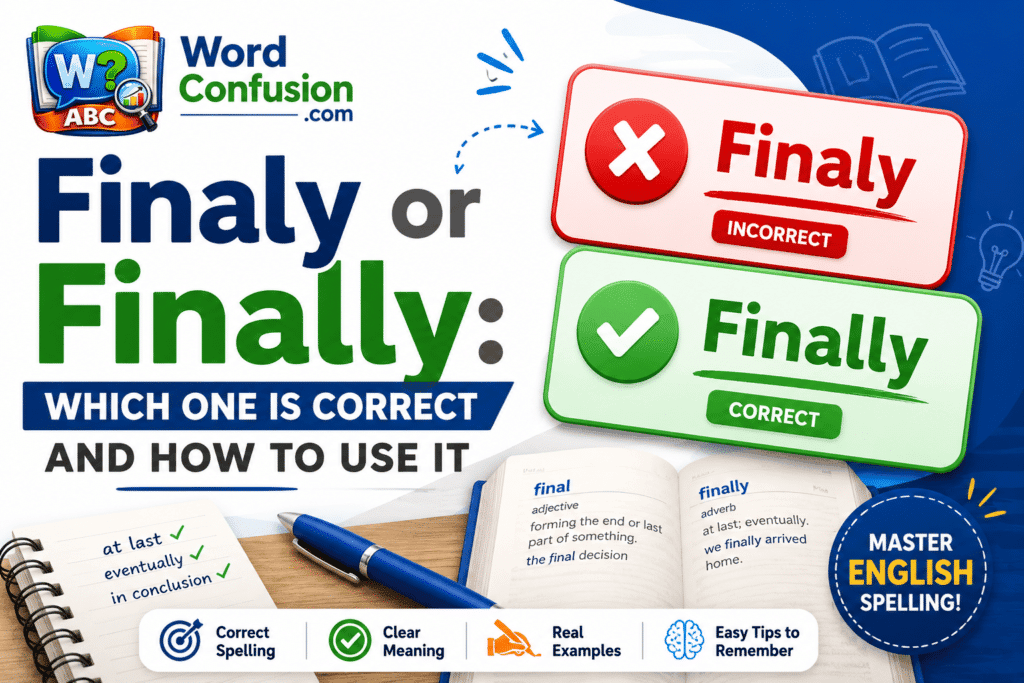
Finally is the correct spelling.
❌ Finaly – Incorrect spelling
✅ Finally – Correct spelling
The word finally means at last, eventually, or in conclusion. It is commonly used when something happens after a long wait or when introducing the last point in a discussion.
Examples
- ✅ We finally reached our destination.
- ✅ She finally finished her project.
- ❌ We finaly reached our destination.
Featured Snippet Answer
Finally is the correct spelling, while finaly is a misspelling. The word finally means at last, eventually, or in conclusion. It is used when something happens after a period of waiting or to introduce the final point in a discussion.
Finaly vs Finally Comparison Table
| Word | Correct? | Meaning |
| Finally | ✅ Yes | At last, eventually, in conclusion |
| Finaly | ❌ No | Misspelling of finally |
The comparison is straightforward: finally is the only accepted spelling in standard English.
What Is the Correct Spelling?
The correct spelling is:
F-I-N-A-L-L-Y
Notice that the word contains two letter Ls before the Y.
Many people mistakenly remove one L and write finaly, but dictionaries, grammar guides, and spell-check tools recognize only finally as correct.
Why Finally Is Correct
The word comes from:
final + ly = finally
Since the adjective final already ends with L, adding the suffix -ly creates a word with a double L.
Why Finaly Is Incorrect
The spelling finaly breaks the standard word formation rule. It is not listed as a valid English word and should always be corrected to finally.
What Does Finally Mean?
Finally is an adverb with several closely related meanings.
Finally Meaning
The word can mean:
- At last
- Eventually
- After a long delay
- In conclusion
- As the final point
Examples
- We finally found the missing keys.
- After several interviews, she finally got the job.
- Finally, I’d like to thank everyone for attending.
Finally as an Adverb
In grammar, finally functions as an adverb because it modifies verbs, clauses, or entire sentences.
Examples
- The train finally arrived.
- They finally agreed on a solution.
- Finally, the meeting came to an end.
How to Pronounce Finally
American Pronunciation
/ˈfaɪ.nə.li/
Sounds like:
FYE-nuh-lee
British Pronunciation
/ˈfaɪ.nə.li/
The pronunciation is very similar in both British and American English.
Pronunciation Tip
Say the word slowly:
fi – na – lly
Hearing the final “lee” sound can help you remember the -ly ending.
Why Do People Misspell Finally as Finaly?
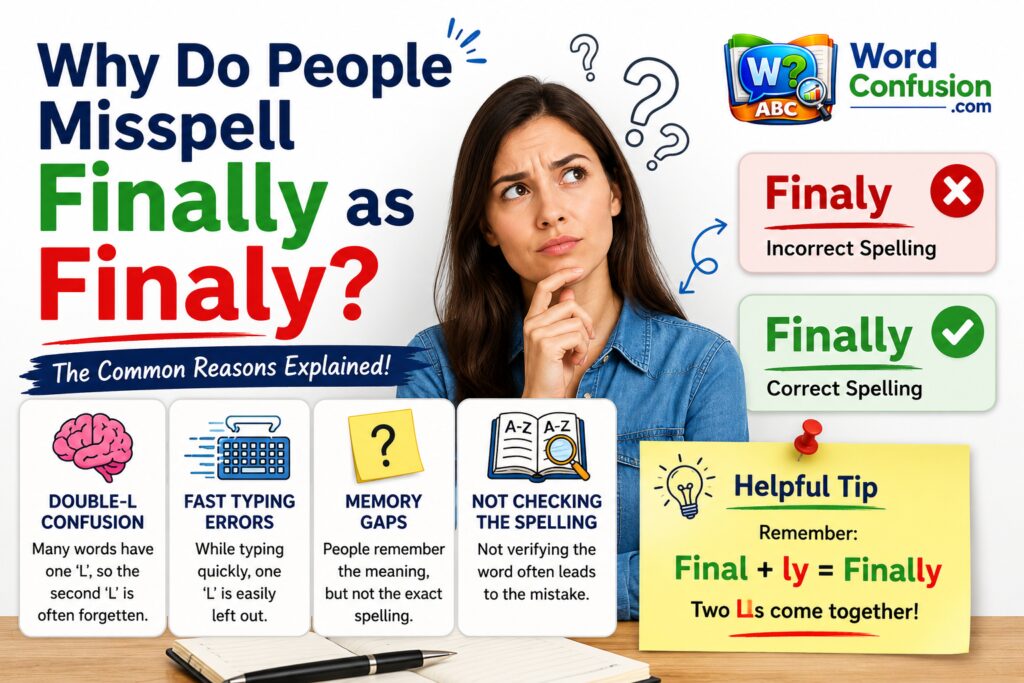
The mistake usually happens for simple reasons.
Double-L Confusion
Many English words contain only one L, so writers sometimes assume finally follows the same pattern.
Fast Typing Errors
When typing quickly, it’s easy to leave out one of the letters.
Memory Gaps
Some people remember the word’s meaning but forget the exact spelling.
Because finaly looks close to the correct version, it often slips past writers until spell-check catches it.
Why Does Finally Have Two Ls?
Understanding the spelling rule makes the word easier to remember.
Word Formation Rule
The adjective:
final
becomes the adverb:
finally
by adding the suffix:
-ly
Breakdown
| Base Word | Suffix | Result |
| Final | -ly | Finally |
Since final ends with L and -ly begins with L, the finished word naturally contains LL.
Final vs Finally
Many learners also confuse final and finally.
Meaning of Final
Final is an adjective.
Examples:
- This is the final chapter.
- We made the final decision.
Meaning of Finally
Finally is an adverb.
Examples:
- We finally completed the project.
- She finally answered the question.
Key Differences
| Word | Part of Speech | Meaning |
| Final | Adjective | Last or ending |
| Finally | Adverb | At last, eventually |
How to Use Finally in Sentences
Finally at the Beginning
- Finally, the truth came out.
- Finally, we can begin the celebration.
Finally in the Middle
- We finally reached an agreement.
- She finally understood the lesson.
Finally at the End
- The storm ended finally. (Less common)
- Everything worked out finally. (Less natural)
Most writers place finally at the beginning or middle of a sentence.
Finally Examples in Everyday English
Conversation Examples
- I finally got a new phone.
- We finally met after years of talking online.
- He finally arrived at the party.
Email Examples
- I finally completed the report.
- We finally received approval from management.
- The issue has finally been resolved.
Academic Examples
- The researchers finally reached a conclusion.
- The experiment finally produced consistent results.
- Students finally submitted their assignments.
Common Mistakes With Finally
Mistake #1: Writing Finaly
❌ Finaly
✅ Finally
Mistake #2: Confusing Finally and Finale
Finale refers to the ending of a performance or event.
Examples:
- The concert ended with a spectacular finale.
- Finally, the concert was over.
Mistake #3: Using Lastly When Finally Is Better
While both words can introduce a final point, they are not always interchangeable.
Example:
✅ Finally, I would like to thank my team.
✅ Lastly, I would like to thank my team.
Both work here, but finally often sounds more natural in everyday communication.
Commonly Misspelled Variations of Finally
Here are several mistakes writers make:
| Incorrect Spelling | Correct Form |
| Finaly | Finally |
| Finalley | Finally |
| Finallly | Finally |
| Finlly | Finally |
| Finaily | Finally |
If you’re unsure, use a dictionary or spell-check tool.
Synonyms of Finally
Depending on context, you can replace finally with:
- Eventually
- At last
- In the end
- Ultimately
- After a while
Examples
Original:
- We finally solved the problem.
Alternative:
- We eventually solved the problem.
Original:
- She finally arrived.
Alternative:
- She arrived at last.
Word Origin and History of Finally
The word finally comes from the adjective final, which traces back to Latin roots related to endings and limits.
Over time, English speakers added the suffix -ly to create the adverb finally, meaning “at the end” or “after everything else.”
This structure follows a common English pattern:
- Quick → Quickly
- Slow → Slowly
- Final → Finally
Pro Tips to Remember the Correct Spelling
The Double-L Trick
Remember:
Final + Ly = Finally
The two Ls meet in the middle.
Memory Shortcut
Think:
“The final step is adding -ly.”
This instantly reminds you that the word contains LLY.
Visual Memory
Picture the word like this:
finaLLy
The double L stands out and becomes easier to remember.
Quick Quiz: Finaly or Finally?
Choose the correct answer.
- We ______ reached the airport on time.
- She ______ completed her training.
- ______, I want to thank my family.
Answers
- finally
- finally
- Finally
If you answered all three correctly, you’ve mastered the spelling.
Frequently Asked Questions
Is finaly a word?
No. Finaly is not a recognized English word. It is simply a misspelling of finally.
How do you spell finally correctly?
The correct spelling is:
F-I-N-A-L-L-Y
Does finally have two Ls?
Yes. The word contains two consecutive L letters because it is formed from final + ly.
What part of speech is finally?
Finally is an adverb.
Can finally start a sentence?
Yes.
Example:
Finally, we found the answer.
Is finally formal or informal?
It works in both formal and informal writing.
Is finally used in academic writing?
Yes. Academic writers often use it when presenting the last point in an argument or discussion.
What is the difference between final and finally?
Final is an adjective meaning last.
Finally is an adverb meaning at last, eventually, or in conclusion.
Conclusion
When choosing between finaly or finally, the correct spelling is always finally.
The word finaly is a common spelling mistake and should not be used in formal or informal writing. Remember that finally contains two Ls because it is formed from final + ly.
Whenever you want to express the idea of at last, eventually, or in conclusion, use finally with confidence. Keeping this simple spelling rule in mind will help you write more accurately and avoid one of the most common English spelling errors.
If you’re learning English vocabulary and commonly confused words, you may also enjoy our guides on Using or Useing, Investor vs Investee, and Dought vs Doubt. Understanding these distinctions will make your writing clearer, more accurate, and more professional.