SOS Meaning: Origin, Text Slang, Phone Alerts & Examples

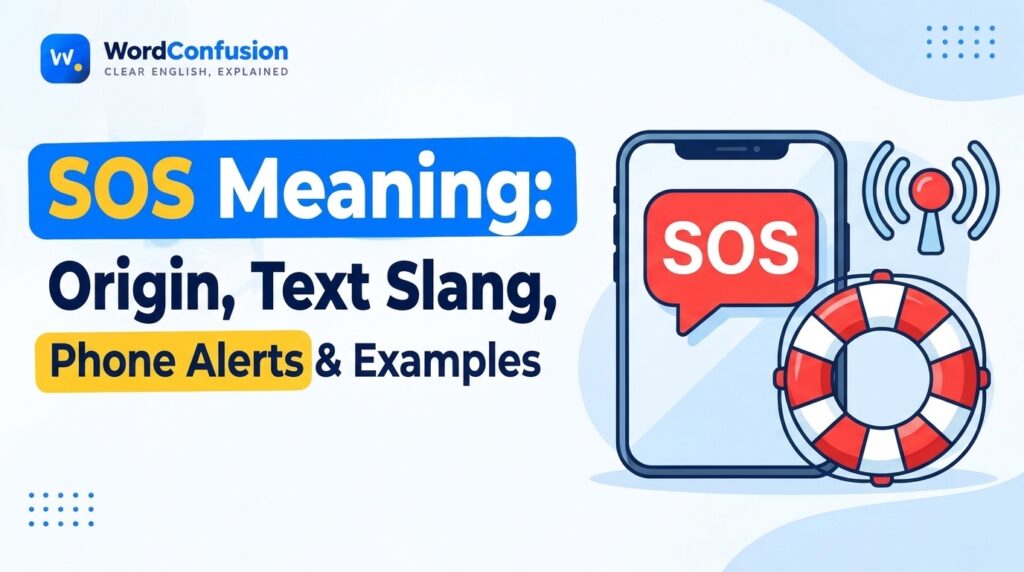
A friend texts three capital letters late at night, and the message simply reads SOS. The SOS meaning feels obvious at first, yet the letters carry more history than most people expect. They started as a radio signal and now appear in group chats and phone settings.
Our guide on btw meaning in text showed that short letters often hide long stories. This article explains what SOS means in Morse code, in texting, and on modern phones. It also covers the real origin, the famous myths, and the difference between SOS and Mayday.
Each section answers one question, so readers can jump straight to the meaning that matches their situation.
Quick Answer: What Is the SOS Meaning?
SOS is the international distress signal that means a person, ship, or group needs urgent help. It began as a Morse code pattern in the early 1900s and was never a true abbreviation. In texting, SOS means “help me” or “I need support right now,” usually in a lighter tone.
SOS Meaning at a Glance
The letters change slightly in tone and purpose depending on where they appear. The table below sums up the main uses before the detailed sections begin.
| Context | What SOS means | Tone |
|---|---|---|
| Morse code and radio | International distress call | Serious emergency |
| Texting and social media | Help me or I need advice | Casual to urgent |
| iPhone status bar | Only emergency calls work right now | Technical notice |
| Phone emergency feature | Shortcut that calls emergency services | Serious emergency |
| Ground signals | Visual call for rescue from the air | Serious emergency |
| Prescriptions in South Asia | Take the medicine only when needed | Medical instruction |
The context almost always tells readers which SOS meaning the writer intends.
What Does SOS Stand For?
Many people believe SOS stands for Save Our Souls or Save Our Ship. Both phrases sound neat, but neither one explains why the signal exists. SOS does not stand for anything, because radio operators chose it for its simple sound pattern.
The popular phrases are backronyms, which means people invented words to fit letters that already existed. Backronyms spread easily because they turn an abstract code into a memorable story. Films and quiz shows repeated Save Our Souls so often that many readers treat it as fact.
The true reason for the choice lies in the structure of Morse code itself. The next section explains why those three letters work so well over a weak and noisy radio channel.
Why Was SOS Chosen as the Distress Signal?
In Morse code, the letter S equals three short signals, and the letter O equals three long signals. Operators send SOS as one continuous pattern with no gaps between the letters. The result sounds like three short beeps, three long tones, and three short beeps again.
dit dit dit dah dah dah dit dit dit
This pattern stands out clearly through static, faint signals, and crowded radio bands. Even a tired or untrained listener can recognize the rhythm after hearing it once or twice. The same pattern also works with flashlights, mirrors, whistles, car horns, and knocks on a wall.
In simple words, SOS won the job because it is easy to send and almost impossible to misread.
The History of the SOS Signal
The story of SOS starts with the early wireless radio companies of the twentieth century. Different companies used different distress calls, which created dangerous confusion for ships at sea. International meetings then tried to agree on one signal that every ship would understand.
The CQD Signal Came First
The Marconi Company introduced CQD as its distress call in the early 1900s. CQ was a general call to all stations, and the D was added for distress. Many British and American operators kept using CQD for several years afterward.
The 1906 Berlin Convention
Germany had already used a similar three short, three long, three short pattern in its own rules. Delegates at the International Radiotelegraph Convention in Berlin named SOS as the global standard in 1906. The rule took effect in 1908, though old habits lasted for some time after that.
The Titanic and SOS
The Titanic sank in April 1912 after striking an iceberg in the North Atlantic. Its radio operators sent the older CQD call first and then added SOS. The disaster gave the new signal huge public attention and sped up its use worldwide.
SOS in Modern Times
Ships stopped relying on Morse distress calls when the Global Maritime Distress and Safety System arrived in 1999. Satellite beacons and digital radio now send distress alerts with exact locations. The letters SOS still survive in daily language, phone features, and survival training.
| Year | Event |
|---|---|
| Early 1900s | Marconi operators use CQD as a distress call |
| 1906 | Berlin convention approves SOS as the international signal |
| 1908 | SOS rules take effect for international radio traffic |
| 1912 | Titanic operators send both CQD and SOS |
| 1999 | GMDSS replaces Morse distress calls at sea |
The timeline shows how SOS moved from a technical code to a word everyone recognizes.
What Does SOS Mean in Texting?
In texts and social media, SOS usually means the sender needs quick help or advice. The tone ranges from playful panic to real worry, so readers should check the rest of the message. Most of the time, SOS in chats signals a small crisis instead of a true emergency.
A student might text SOS before an exam because they forgot the chapter topics. A friend might send SOS while shopping because they cannot pick between two jackets. A coworker might write SOS when a shared spreadsheet suddenly breaks before a meeting.
These uses borrow the urgency of the original signal and apply it to daily problems. The drama often adds humor, which explains why the term fits so well in casual chats.
Examples of SOS in Text Messages
Real messages show how the term works in daily life between friends and coworkers. The table below lists common message patterns along with their most likely meanings:
| Message | Likely meaning |
|---|---|
| SOS, my phone is at two percent | I need a charger fast |
| Group project SOS, who has the slides | Someone please send the file |
| SOS, what do I wear tonight | Help me pick an outfit |
| Kitchen SOS, the rice is burning | I need cooking advice now |
| SOS, I locked my keys in the car | I need real practical help |
Most texting examples involve small problems that the sender wants solved quickly by a friend.
How to Reply to an SOS Text
The best reply depends on how serious the message sounds to the reader. A playful SOS about outfits deserves a quick opinion or a fun reaction. A message about a car breakdown or a lost wallet deserves a call or clear practical steps.
Do not ignore an SOS text that mentions danger, injury, or fear, even if the sender usually jokes. A short call settles any doubt in seconds and shows the sender that someone cares.
What Does SOS Mean on an iPhone?
iPhone users sometimes see “SOS” or “SOS only” in the top corner of the screen. This label means the phone cannot reach its own carrier but can still place emergency calls. The phone may connect to another network that allows emergency calls only.
The label often appears in rural areas, basements, lifts, and places with weak coverage. It also appears when a SIM card has a problem or the carrier account has an issue. Moving to an open area or restarting the phone usually brings the normal signal back.
Emergency SOS on iPhone
Emergency SOS is a separate feature that calls local emergency services from the phone. Users usually press and hold the side button with either volume button to start the countdown. The phone can also alert chosen emergency contacts with the user’s current location.
Newer iPhone models also offer Emergency SOS via satellite in supported countries. This feature lets users text emergency services when no cell signal or WiFi exists. Settings and button steps change between models, so users should check the phone’s own settings menu.
Emergency SOS on Android
Many Android phones include a similar Emergency SOS feature under safety settings. Users often press the lock button five times quickly to trigger the alert. The phone then calls emergency services, shares location, or records video, depending on the brand.
| Phone label or feature | What it means |
|---|---|
| SOS or SOS only in status bar | No carrier service, emergency calls only |
| Emergency SOS feature | Shortcut that calls emergency services |
| Emergency SOS via satellite | Emergency texting without cell service |
| Android Emergency SOS | Brand specific alert and call shortcut |
The status bar label is a network notice, while the feature is an action users trigger themselves.
SOS vs Mayday: What Is the Difference?
People often mix up SOS and Mayday because both signal a life threatening emergency. The main difference lies in the communication channel that each signal uses. SOS belongs to Morse code and visual signals, while Mayday belongs to spoken radio calls.
| Feature | SOS | Mayday |
|---|---|---|
| Form | Morse code pattern and written letters | Spoken word |
| Origin | Berlin radio convention, 1906 | Based on French “m’aider,” meaning help me |
| Main use | Telegraphy, light, sound, ground signals | Voice radio for ships and aircraft |
| Correct repetition | Sent as one continuous pattern | Said three times in a row |
Both signals carry the same urgency, but each one fits a different communication tool.
Radio operators also use “Pan Pan” for urgent situations that do not threaten life yet. A ship with engine trouble but no immediate danger would call Pan Pan instead of Mayday. These levels help rescue teams decide how fast and how strongly to respond.
Other Meanings of SOS
Outside emergencies and texting, the letters SOS appear in several specialist fields. These meanings rarely cause confusion because their settings look nothing like a chat.
SOS on Prescriptions
Doctors in India, Pakistan, and nearby countries often write SOS on prescriptions. Here it comes from the Latin phrase si opus sit, which means if necessary. A painkiller marked SOS means the patient should take it only when pain appears.
SOS in Sports
Sports analysts use SOS as a short form for the phrase strength of schedule. This number shows how tough a team’s opponents were across a season. College football and basketball rankings often mention SOS when comparing teams with similar records.
SOS as a Ground Signal
Hikers and survivors sometimes write SOS on beaches, snow, or open fields. Large letters made from rocks, logs, or clothing help rescue pilots spot people from above. Survival guides suggest making each letter several meters tall with strong color contrast.
How to Signal SOS Without a Phone
Survival trainers teach several ways to send SOS when phones fail or lose signal. Each method follows the same three short, three long, three short rhythm.
Step 1: Choose a Signal Tool
Pick a tool that rescuers can see or hear, such as a flashlight, mirror, or whistle. Bright light works best at night, while sound and mirrors work better during the day.
Step 2: Send Three Short Signals
Make three quick flashes, blasts, or knocks with brief pauses between each one. Keep each short signal clearly shorter than the long ones that come next.
Step 3: Send Three Long Signals
Hold the light or sound for about three times longer than the short signals. Long signals form the letter O, which sits in the middle of the pattern.
Step 4: Repeat the Short Signals and Pause
Finish with three more short signals, then wait a few seconds before starting again. Steady repetition helps rescuers confirm the pattern instead of dismissing it as random noise.
Our guide on ttyl meaning in text covers another common sign off used in chats. Both terms show how short letter groups carry clear meaning in fast conversation.
Is SOS an Acronym, Abbreviation, or Initialism?
Grammar fans often ask how to classify SOS because it looks like a typical acronym. An acronym is a set of initials that people pronounce as a word, such as NASA. An initialism is a set of initials that people read letter by letter, such as FBI.
SOS fits neither label perfectly, because its letters never stood for any words at all. Most dictionaries simply call it a signal or a noun that people read letter by letter. In casual writing, many people still call it an acronym, and readers rarely object.
The backronym stories make the confusion worse, because they invent words for each letter. Writers who want precise language can call SOS a distress signal and avoid the debate entirely.
SOS vs Similar Text Slang
Several short forms in texting carry a similar sense of urgency or need. Each one fits a slightly different mood, so picking the right term keeps messages clear. The table below compares SOS with its closest cousins in daily chat language.
| Term | Meaning | Urgency level |
|---|---|---|
| SOS | Help me now | Medium to high |
| ASAP | As soon as possible | Medium |
| PLS or PLZ | Please | Low |
| HELP | A plain request for help | Medium to high |
| 911 | Emergency, call me now | High |
SOS sits between a polite request and a true emergency call, which explains its popularity in chats.
ASAP focuses on speed, while SOS focuses on the feeling of being stuck or overwhelmed. A message saying “send the file ASAP” sounds like a deadline, not a cry for rescue. A message saying “SOS, the file vanished” sounds more stressed and personal.
Some American teens once used 911 in pager messages to mean call me right now. That use faded, but it shows how emergency language slides into casual chat. SOS followed the same path, though it kept a lighter and more playful tone.
Why Do People Use SOS in Texts?
People reach for SOS because three letters express urgency faster than a full sentence. Typing speed matters in chats, especially when the sender feels rushed or stressed. The letters also stand out in a busy group chat full of longer messages.
Humor plays a large role in the casual SOS messages that friends send each other. Calling a fashion choice or a burnt dinner an emergency turns a small problem into a shared joke. The exaggeration invites friends to respond quickly and warmly instead of ignoring the message.
Social media pushed this playful use further through captions, comments, and short video titles. Creators write SOS in captions when they face a funny problem and want audience suggestions. This public use keeps the term familiar to younger readers who never learned Morse code.
Real World Example: A Hiker Uses SOS
Consider a fictional hiker named Sara who twists her ankle on a quiet mountain trail. Her phone shows SOS in the status bar, so regular calls and messages fail. She remembers that emergency calls can still reach any nearby network in the area.
Sara triggers the Emergency SOS feature, and the phone calls local emergency services. The call drops after sharing her location, so she adds a backup plan for rescuers. As dusk arrives, she flashes her flashlight in the three short, three long, three short pattern.
A rescue team spots the repeating light from the valley road within an hour. The example is invented, but it shows how old and new SOS methods work together. Knowing both methods gives hikers two separate chances to reach help in remote places.
SOS in Movies, Music, and Pop Culture
Pop culture keeps SOS familiar long after ships stopped using Morse code. The Swedish group ABBA released a hit song titled SOS in 1975, and many listeners still know it. Rihanna later released a different song with the same title in 2006, which reached a new generation.
Films about shipwrecks, plane crashes, and desert islands often show characters writing SOS on beaches. These scenes taught generations of viewers the idea of a giant ground signal. Cartoons and comics also use SOS in bottles, flags, and smoke signals as quick visual shorthand.
This constant exposure explains why nearly every reader recognizes the letters on sight. Even people who never learned the history can guess that SOS means someone needs help.
How to Use SOS in a Sentence
Seeing SOS inside full sentences helps readers use it naturally in their own writing. The examples in the table below cover historical, casual, technical, and sports settings:
| Setting | Example sentence |
|---|---|
| History | The radio operator tapped out SOS as the ship took on water. |
| Survival | The stranded campers spelled SOS in rocks across the open meadow. |
| Texting | SOS, can someone explain tonight’s math homework before nine? |
| Phones | My screen showed SOS, so I walked outside to find a signal. |
| Sports | Analysts praised the team because its SOS ranked near the top. |
Each sentence shows how nearby words reveal the intended SOS meaning without extra explanation.
Writers usually place SOS at the start of a casual message to grab attention quickly. In formal writing, SOS works as a noun, as in the phrase the ship sent an SOS. Some writers also treat it like a verb in speech, though style guides rarely accept that use.
What Does SOS Mean From a Friend?
When a friend sends SOS, the message usually means they want someone on their side right away. The problem might involve homework, family plans, a broken gadget, or a tough decision. Friends tend to send SOS to the people they trust most for quick and honest advice.
A sibling might send SOS when parents ask about a forgotten chore. A classmate might send SOS when a group project deadline suddenly moves forward by a day. In both cases, a fast and calm reply usually solves most of the stress behind the message.
Is SOS Formal or Informal?
The answer depends on the setting where the letters appear and who reads them. In maritime law, survival guides, and phone manuals, SOS is a formal and serious term. In chats and social media captions, SOS works as informal slang with a playful edge.
Workplace emails sit somewhere in between, and writers should choose their words with care. A subject line reading SOS may alarm managers who expect a real crisis. Clear phrases such as “urgent request” or “need help by noon” usually work better in professional messages.
Academic writing should avoid the casual slang use of SOS in every assignment. Essays that discuss the history of radio or maritime safety can still use the formal distress signal meaning.
SOS Around the World
Because SOS became an international standard, people in many countries recognize the letters instantly. Travelers can use the same signal in any region without learning a new language. This shared meaning makes SOS valuable for hikers, sailors, and pilots who cross borders.
Texting slang spreads unevenly, though, so the casual chat meaning feels strongest among English speakers. Many non English speakers still understand SOS in chats because global media uses it widely. Phone makers also label their emergency features SOS in many different language settings.
Benefits of Knowing SOS Signals
Learning the basics of SOS offers practical value for almost every reader:
- Hikers can signal rescuers with lights or whistles when phones lose service in remote areas.
- Phone users can read the SOS status label correctly and still place emergency calls.
- Parents can teach children one simple pattern that works with lights, sounds, and knocks.
- Travelers can call for help in any country without learning a new emergency word first.
- Friends can judge the tone of an SOS text and respond with the right level of urgency.
Common Mistakes With SOS
People misuse SOS in a handful of predictable ways across texts, phones, and radio. The five mistakes below cause the most confusion for readers and listeners.
1. Claiming SOS Stands for Save Our Souls
This claim repeats a popular myth instead of the real history behind the signal. SOS has no official expansion, and operators picked it purely for its sound pattern.
2. Writing S.O.S. With Periods
Adding periods suggests an abbreviation, which SOS never was in its original form. Style guides usually prefer the plain capital letters SOS without any punctuation.
3. Sending SOS for Tiny Problems at Work
Casual SOS messages can confuse coworkers who read them as real emergencies. Formal workplace messages should state the problem plainly and explain how urgent it is.
4. Ignoring the SOS Label on a Phone
Some users assume the phone works normally while SOS shows in the status bar. Regular calls and data usually fail until the phone reconnects to its carrier.
5. Mixing Up SOS and Mayday on Radio
Speaking “SOS” on a voice radio channel is not the standard distress call. Pilots and sailors should say Mayday three times when life is in danger.
Tips for Using SOS in Messages
Five simple habits keep SOS messages clear, kind, and useful for everyone involved:
- Add a short reason after SOS so friends know the problem right away.
- Save playful SOS messages for close friends who know the sender’s sense of humor.
- Use plain words instead of SOS when writing to teachers, managers, or new contacts.
- Call emergency services directly when real danger exists instead of texting friends first.
- Check the rest of an SOS text carefully before deciding how quickly to reply.
SOS Meaning Checklist
Readers can use this quick checklist to decode any SOS they meet:
- Check whether the SOS appears in a text, a phone screen, a prescription, or a sports article.
- Read the words after SOS to judge whether the problem sounds playful or serious.
- Treat any SOS that mentions injury, danger, or fear as a real emergency first.
- Keep in mind that SOS on an iPhone status bar means emergency calls only for now.
- Recall that SOS has no official expansion, whatever the popular Save Our Souls story claims.
- Use Mayday instead of SOS when speaking on a voice radio distress channel.
Frequently Asked Questions
What is the SOS meaning in text?
The SOS meaning in text is a request for quick help, advice, or support from friends. The tone often feels playful, but the sender may also face a real problem.
Does SOS stand for Save Our Souls?
No, SOS does not stand for Save Our Souls or Save Our Ship. The SOS meaning comes from an easy Morse code pattern, and those phrases came later.
What does SOS mean on an iPhone?
SOS on an iPhone status bar means the phone has no carrier service right now. The device can still place emergency calls through any available network in the area.
When did SOS become the official distress signal?
The Berlin radio convention approved SOS as the international distress signal in 1906. The rule took effect in 1908, and ships slowly replaced the older CQD call.
What is the difference between SOS and Mayday?
SOS is a Morse code and visual distress signal, while Mayday is the spoken radio version. Both carry the same urgency, but each fits a different communication channel.
How is SOS sent in Morse code?
Senders make three short signals, three long signals, and three short signals in one pattern. The same SOS meaning works with light, sound, radio, or knocks on a surface.
Is SOS still used today?
SOS still appears in survival training, phone features, ground signals, and daily texting. Ships now rely on satellite and digital distress systems instead of Morse code.
What does SOS mean on a prescription?
On South Asian prescriptions, SOS means the patient should take the medicine only when needed. This medical SOS meaning comes from the Latin phrase si opus sit.
Is it rude to send SOS in a text?
Sending SOS in a text is not rude among friends who share a casual tone. In formal messages, plain words explain the problem more clearly than the SOS shortcut.
What does SOS mean in sports?
In sports, SOS means strength of schedule, which measures how tough a team’s opponents were. Analysts use this SOS meaning when they compare teams with similar win records.
Key Takeaways
- SOS is the international distress signal that asks for urgent help from anyone listening.
- Operators chose SOS for its simple Morse pattern of three short, three long, three short.
- SOS never stood for Save Our Souls or Save Our Ship, which are later backronyms.
- The Berlin radio convention approved SOS in 1906, and the rule took effect in 1908.
- The Titanic sent both CQD and SOS calls during its sinking in April 1912.
- In texting, SOS usually means the sender needs quick help, advice, or moral support.
- SOS on an iPhone status bar means the phone can make emergency calls only.
- Emergency SOS features on iPhone and Android call emergency services through a button shortcut.
- Mayday is the spoken radio distress call, while SOS fits Morse code and visual signals.
- On South Asian prescriptions, SOS means take the medicine only when the patient needs it.
- Sports writers use SOS as a short form for a team’s strength of schedule.
- Context around the letters almost always reveals which SOS meaning the writer intends.
Final Thoughts
The SOS meaning started as a clever radio pattern and grew into a word nearly everyone knows. Today it helps sailors, hikers, phone users, students, and friends ask for help in seconds. Reading the context around the letters tells readers whether to laugh, advise, or call for real help.
Explore more slang and text meaning guides on Word Confusion.
Written by
 Bilal Internee
Latest posts
 Durian Meaning: Definition, Origin, Smell, Idioms & Examples
 Narcissist Meaning: Definition, Signs, Types, and Examples
 Prejudice Meaning: Definition, Types, Examples & Legal Use
 AI Detection vs Plagiarism Checking: Why Students Need Both?
 What Are Peptides: Meaning, Types, Uses & Safety Facts
 Furlough Meaning: Definition, Examples, Pay & Layoff Rules