Shinning or Shining? Which One Is Correct?

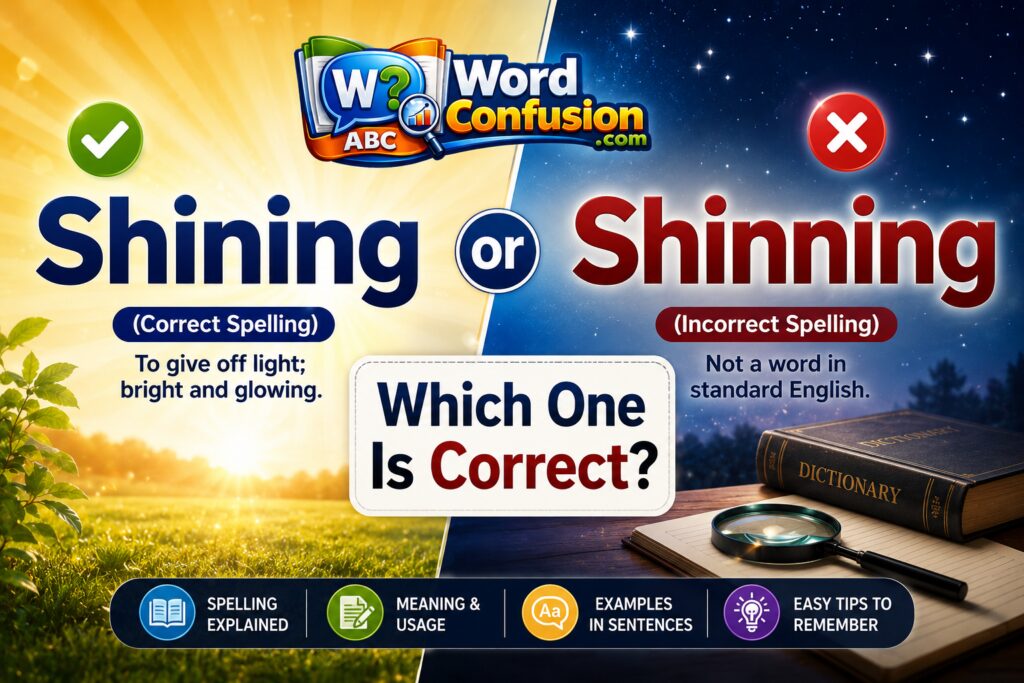
If you have ever wondered whether “shinning” or “shining” is the correct spelling, the short answer is that shining is usually the word you need. It is the present participle of the verb shine and is used to describe something that gives off light, looks bright, or stands out positively.
Although shinning is a real English word, it has a completely different meaning. It refers to climbing by gripping something with your hands and legs, such as a rope, tree, or pole. Because this usage is rare, many people mistakenly write shinning when they actually mean shining.
Quick Answer: Is It Shinning or Shining?
Shining is the correct spelling when talking about light, brightness, excellence, or the present participle of the verb shine.
Shinning is also a real word, but it means climbing up or down an object by gripping it with the arms and legs. It is rarely used in everyday writing.
Shining vs Shinning at a Glance
| Word | Meaning | Common Usage |
| Shining | Giving off light, bright, excellent, outstanding | Very common |
| Shinning | Climbing by gripping with hands and legs | Rare |
Which Spelling Is Correct?
For almost all everyday situations, shining is the correct choice.
Examples:
- The sun is shining brightly today.
- She gave a shining performance in the competition.
- His shoes were shining after being polished.
Using shinning in these sentences would be incorrect because the word does not relate to brightness or light.
What Does Shining Mean?
Shining is the present participle of the verb shine. It can be used both literally and figuratively.
Literal Meaning of Shining
When something is shining, it is producing or reflecting light.
Examples:
- The stars were shining in the night sky.
- A shining flashlight guided us through the dark room.
- The moon was shining above the mountains.
Figurative Meaning of Shining
The word can also describe someone or something that is exceptionally good, successful, or noticeable.
Examples:
- She is a shining example of hard work.
- His kindness was the shining quality everyone admired.
- The student had a shining academic record.
Shining in Everyday English
You will commonly see shining in:
- Conversations
- Books
- News articles
- Academic writing
- Business communication
Examples:
- The future looks shining and bright.
- Her talent is truly shining.
- The polished table was shining.
What Does Shinning Mean?
Many people are surprised to learn that shinning is actually a legitimate English word.
Definition of Shinning
Shinning means climbing by gripping an object with the hands and legs.
Examples of objects that can be shinned:
- Trees
- Poles
- Ropes
- Posts
Why Shinning Is Rare
The word belongs to a specialized action that most people rarely discuss. As a result, it appears infrequently in modern writing.
Most English speakers never use the word in everyday conversation.
Examples of Shinning
- The child was shinning up the tree.
- The firefighter practiced shinning down the pole.
- He spent the afternoon shinning up a rope.
Is Shinning a Real Word?
Yes, shinning is a real word.
However, it is not an alternative spelling of shining.
This is where many writers become confused.
Correct
- The sun is shining.
- Her smile was shining.
Incorrect
- The sun is shinning.
- Her smile was shinning.
Correct Use of Shinning
- The boy was shinning up the tree trunk.
Why Is Shining Spelled With One N?
The answer comes from a common English spelling rule.
The Silent E Rule
When a verb ends in e, the final e is usually dropped before adding -ing.
Examples:
| Base Verb | -ing Form |
| Make | Making |
| Write | Writing |
| Drive | Driving |
| Shine | Shining |
Since shine ends in a silent e, we remove the e and add -ing.
Shine → Shining
Present Participle Formation
The present participle is often formed by adding -ing to the base verb.
Examples:
| Verb | Present Participle |
| Run | Running |
| Walk | Walking |
| Shine | Shining |
| Read | Reading |
Why the N Is Not Doubled
The final consonant is typically doubled only in specific situations.
Examples:
| Verb | Correct Form |
| Run | Running |
| Sit | Sitting |
| Begin | Beginning |
However, shine does not follow the consonant-doubling pattern.
Therefore:
✅ Shining
❌ Shinning (when referring to brightness)
Shine Verb Forms Explained
Understanding verb forms makes the spelling easier to remember.
Verb Forms Table
| Form | Word |
| Base Verb | Shine |
| Present Tense | Shine / Shines |
| Present Participle | Shining |
| Past Tense | Shone |
| Past Participle | Shone |
Present Tense
Examples:
- The stars shine at night.
- The diamond shines beautifully.
Present Participle
Examples:
- The stars are shining.
- The diamond is shining.
Past Tense and Past Participle
Examples:
- The sun shone through the clouds.
- The trophy had shone under the lights.
Difference Between Shining and Shinning
Meaning
Shining: Producing light or being outstanding.
Shinning: Climbing using hands and legs.
Usage
Shining appears in everyday English.
Shinning appears mainly in specialized contexts.
Frequency
Shining is extremely common.
Shinning is comparatively rare.
Examples
| Shining | Shinning |
| The sun is shining. | He is shinning up the pole. |
| Her future looks shining and bright. | The child was shinning down the rope. |
| The floor is shining. | The worker practiced shinning techniques. |
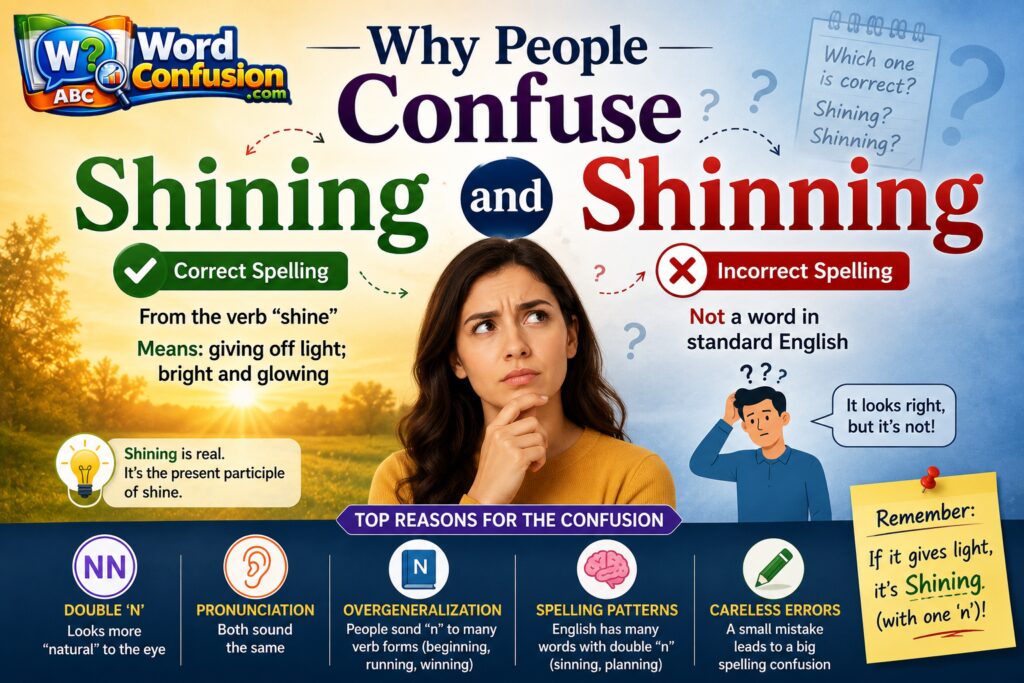
Why People Confuse Shining and Shinning
Pronunciation Confusion
The pronunciation can make people think the word should contain a double n.
Because of this assumption, many writers accidentally type shinning.
Double-Letter Habits
English contains many words where the final consonant doubles before -ing.
Examples:
- Run → Running
- Sit → Sitting
- Begin → Beginning
Writers sometimes incorrectly apply the same pattern to shine.
Autocorrect and Typing Errors
Fast typing often leads to accidental double letters.
This causes some people to write shinning even when they know shining is correct.
Shining in a Sentence
Everyday Examples
- The sun was shining all afternoon.
- Her eyes were shining with excitement.
- The lake looked beautiful under the shining moonlight.
Academic Examples
- The researcher became a shining example of scientific integrity.
- The student’s work was a shining achievement.
Professional Examples
- The company remains a shining leader in the industry.
- She delivered a shining presentation during the conference.
Shinning in a Sentence
Correct Usage Examples
- The child was shinning up the tree.
- The climber practiced shinning up the rope.
- The firefighter demonstrated shinning down the pole.
Shining in British and American English
American English
In American English, shining is the standard spelling for brightness or light.
Examples:
- The sun is shining.
- The silver was shining after polishing.
British English
British English follows the same spelling.
Examples:
- The stars were shining tonight.
- The car was shining after being washed.
There is no British-versus-American difference here.
Both varieties use “shining.”
Common Mistakes With Shining
Writing Shinning Instead of Shining
Incorrect:
- The stars are shinning.
Correct:
- The stars are shining.
Keeping the Silent E
Incorrect:
- Shineing
Correct:
- Shining
Incorrect Verb Forms
Incorrect:
- Shineing
- Shinning
Correct:
- Shining
Similar Spelling Confusions in English
Many spelling mistakes happen because writers apply the wrong grammar rule.
Hoping vs Hopping
- Hoping = expecting
- Hopping = jumping
Aging vs Ageing
- Aging is preferred in American English.
- Ageing is commonly used in British English.
Coming vs Comming
Correct:
- Coming
Incorrect:
- Comming
These examples show why understanding spelling patterns is important.
Easy Trick to Remember Shining
Use this simple rule:
If the word comes from shine, remove the silent e and add -ing.
Shine → Shining
Think of similar words:
- Drive → Driving
- Write → Writing
- Make → Making
The same rule applies.
Why Correct Spelling Matters
Correct spelling helps:
- Improve clarity
- Build credibility
- Strengthen academic writing
- Enhance professional communication
Using shining correctly demonstrates a strong understanding of English grammar and spelling conventions.
Even a small spelling mistake can affect how readers perceive your writing.
Frequently Asked Questions
Is shining spelled with one N?
Yes. Shining is spelled with one n and is the correct present participle form of shine.
Is shinning a real word?
Yes. Shinning is a real word that means climbing by gripping with the hands and legs.
Why is shining correct?
It follows the standard rule of dropping the silent e before adding -ing.
What is the present participle of shine?
The present participle of shine is shining.
What is the past tense of shine?
The past tense of shine is shone.
Can shinning ever be correct?
Yes. It is correct when referring to the act of climbing a rope, pole, tree, or similar object using the hands and legs.
How do I remember the correct spelling?
Remember the pattern:
- Shine → Shining
- Write → Writing
- Drive → Driving
Drop the silent e and add -ing.
Is shining used in British English and American English?
Yes. Both British English and American English use shining as the standard spelling.
Conclusion
When choosing between shinning and shining, shining is almost always the correct spelling for everyday writing. It is the present participle of shine and describes something bright, illuminated, or outstanding.
While shinning is a real word, it refers to climbing using the hands and legs and is rarely used outside specific contexts.
If you are talking about sunlight, stars, success, polished surfaces, or anything bright, always choose shining. Doing so will keep your writing accurate, professional, and grammatically correct.
If you’re learning English vocabulary and commonly confused words, you may also enjoy our guides on Beautiful Inside and Out, Spoilt vs Spoiled, and Bricked Up Meaning. Understanding these distinctions will make your writing clearer, more accurate, and more professional.
Written by
 Abdul Moeed
Abdul Moeed is a professional content writer and SEO link-building specialist with 5+ years of experience. He creates search-optimized content and develops effective SEO strategies that improve website visibility, authority, and organic growth.
View LinkedIn profileLatest posts
 What Does PG Mean in Text? Meaning, Examples & Usage
 What Does OFCC Mean in Text? Meaning, Uses & Examples
 What Does MSG Mean in Text? Meaning, Examples & Usage
 What Does STY Mean in Text? Meaning, Examples & Usage
 What Does “Twin” Mean in Slang? Meaning, Text & Examples
 What Does LMC Mean in Text? Meaning, Examples & Usage