Unenroll vs Disenroll: Which One Is Correct?

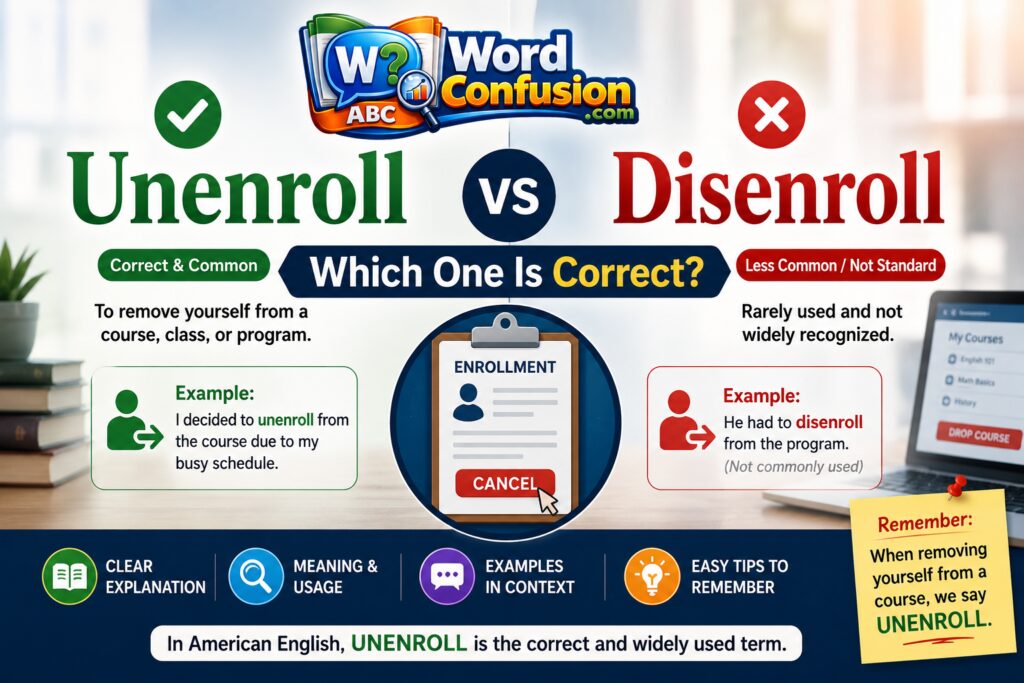
Have you ever wondered whether unenroll or disenroll is the correct word to use when someone leaves a class, program, or insurance plan? The confusion is understandable because both words relate to ending an enrollment. However, their usage often depends on the context.
In this guide, you’ll learn the meanings of unenroll and disenroll, the differences between them, when to use each one, and practical examples to help you choose the right term with confidence.
Quick Answer: Unenroll vs Disenroll
Both unenroll and disenroll are correct English words.
- Unenroll usually means to voluntarily withdraw from a class, course, school, or program.
- Disenroll often refers to being removed from enrollment through an administrative process, especially in healthcare, insurance, or government programs.
The correct choice depends on the situation and the terminology used by the organization.
Featured Snippet Answer
Both unenroll and disenroll are correct words. Unenroll commonly refers to voluntarily leaving a class, course, or program, while disenroll is frequently used in healthcare, insurance, and administrative settings when enrollment is canceled or terminated. The preferred term depends on the context and organization involved.
Unenroll vs Disenroll Comparison Table
| Feature | Unenroll | Disenroll |
| Meaning | Withdraw from enrollment | Remove from enrollment |
| Common Usage | Education and training | Healthcare, insurance, government programs |
| Usually Initiated By | Student or participant | Organization or administrative authority |
| Tone | Less formal | More formal and administrative |
| Common in Schools | Yes | Sometimes |
| Common in Insurance | Rarely | Very common |
What Does Unenroll Mean?
Unenroll means to withdraw from a course, school, program, membership, or service after previously enrolling.
In most cases, the person who is enrolled chooses to leave.
Unenroll Definition
Unenroll (verb): To remove oneself from a course, class, program, or service.
Examples of Unenroll
- I decided to unenroll from the online course because I no longer had enough time.
- She chose to unenroll from the training program before it began.
- Students may unenroll from a class before the deadline without penalties.
- He plans to unenroll from the workshop next week.
Unenroll in Education
The word unenroll is especially common in educational settings.
Examples:
- Unenroll from a university course
- Unenroll from a certification program
- Unenroll from an online class
- Unenroll from a language course
What Does Disenroll Mean?
Disenroll means to remove someone from enrollment or terminate enrollment in a program, plan, or service.
The action is often administrative rather than voluntary.
Disenroll Definition
Disenroll (verb): To officially remove a person from an enrolled status.
Examples of Disenroll
- The insurance company may disenroll members who fail to meet eligibility requirements.
- Participants can be disenrolled from the program if they violate its rules.
- The agency decided to disenroll inactive members.
- Patients may be disenrolled from a healthcare plan under certain circumstances.
Disenroll in Administrative Contexts
The term disenroll commonly appears in:
- Medicare plans
- Healthcare programs
- Government assistance programs
- Insurance policies
- Membership systems
Why Do Both Words Exist?
Many English learners wonder why two similar words exist.
The answer lies in English prefixes.
The Prefix “Un-“
The prefix un- generally means:
- Reverse an action
- Remove a condition
- Undo something
Examples:
- lock → unlock
- tie → untie
- enroll → unenroll
The Prefix “Dis-“
The prefix dis- often means:
- Remove
- Separate
- Reverse
- Negate
Examples:
- connect → disconnect
- approve → disapprove
- enroll → disenroll
Because both prefixes can indicate reversal, both forms developed and became accepted in English.
The Key Difference Between Unenroll and Disenroll
Although the meanings overlap, the key difference is usually who initiates the action.
Unenroll
Typically suggests voluntary withdrawal.
Example:
A student chooses to leave a course.
Disenroll
Often suggests official removal by an organization or system.
Example:
An insurance provider removes a member from coverage.
Quick Memory Rule
- Unenroll = You leave
- Disenroll = The system removes you
This rule won’t apply in every situation, but it helps in most cases.
Which Word Is More Common?
Usage varies by industry.
In Education
Unenroll is generally more common.
Examples:
- Unenroll from a class
- Unenroll from school
- Unenroll from a course
In Healthcare
Disenroll is more common.
Examples:
- Disenroll from Medicare
- Disenroll from a healthcare plan
- Disenroll from insurance coverage
In Government Programs
Administrative documents frequently use disenroll.
Examples:
- Disenroll beneficiaries
- Disenroll participants
- Disenroll members
Unenroll vs Disenroll in Education
Educational institutions often use both terms, but unenroll is usually preferred when students voluntarily leave.
Examples
- Students may unenroll before the semester begins.
- She unenrolled from the course after changing majors.
- The university allows learners to unenroll online.
Some schools may use disenroll when the institution removes a student because of policy violations or administrative issues.
Example:
- The school may disenroll students who fail to meet attendance requirements.
Unenroll vs Disenroll in Healthcare and Insurance
Healthcare organizations often favor the term disenroll.
Examples
- Members can request to disenroll from a Medicare plan.
- The insurer may disenroll individuals who lose eligibility.
- Beneficiaries may be disenrolled automatically under certain conditions.
In these contexts, disenroll sounds more formal and administrative.
Unenroll vs Disenroll Examples in Sentences
Unenroll Examples
- I need to unenroll from my evening class.
- She chose to unenroll from the workshop.
- We decided to unenroll our child from the program.
- Students can unenroll without penalty before the deadline.
- He plans to unenroll from the course next month.
Disenroll Examples
- The company may disenroll inactive members.
- Participants were disenrolled from the program after failing eligibility checks.
- Medicare can disenroll beneficiaries in specific situations.
- The agency decided to disenroll applicants who no longer qualified.
- Some members were automatically disenrolled at the end of the year.
Related Enrollment Terms
Understanding related vocabulary can make these terms easier to remember.
| Term | Meaning |
| Enrollment | The act of registering or joining |
| Enroll | To register for a course or program |
| Unenrollment | The process of withdrawing from enrollment |
| Disenrollment | The process of being removed from enrollment |
| Registration | Official sign-up process |
| Withdrawal | Leaving a course or program |
| Deregistration | Removal from a registration system |
Common Mistakes People Make
Using the Words Interchangeably
Although both words are correct, context matters.
Better Practice:
- Education → often use unenroll
- Healthcare and insurance → often use disenroll
Ignoring Industry Terminology
Different organizations may have preferred wording.
Always follow the terminology used by:
- Schools
- Universities
- Insurance providers
- Government agencies
Assuming One Word Is Incorrect
Some people believe only one of the two words is valid.
In reality, both are recognized English words.
Choosing the Wrong Context
Using disenroll in a casual educational conversation may sound overly formal.
Likewise, using unenroll in official insurance documentation may sound unusual.
Pro Tips to Remember the Difference
Think About Who Starts the Action
Ask yourself:
Who is ending the enrollment?
- The student → usually unenroll
- The organization → often disenroll
Remember the Context
- School → unenroll
- Insurance → disenroll
- Government programs → disenroll
Use the Enrollment Trick
Think:
“I unenroll myself, but an organization may disenroll me.”
This simple memory trick works in most situations.
Frequently Asked Questions
Which is correct, unenroll or disenroll?
Both are correct. The preferred word depends on context. Unenroll is common in education, while disenroll is often used in healthcare, insurance, and administrative settings.
Is unenroll a real word?
Yes. Unenroll is a recognized English verb meaning to withdraw from enrollment in a course, program, or service.
Is disenroll a real word?
Yes. Disenroll is a legitimate English word that means to remove someone from enrollment, usually through an administrative process.
What is the difference between unenrollment and disenrollment?
Unenrollment usually refers to voluntarily withdrawing from a program, while disenrollment often refers to official removal from enrollment by an institution or organization.
Which term is more common in schools?
Unenroll is generally more common in educational settings when students choose to leave a class or program.
Is disenroll used in healthcare?
Yes. Healthcare providers, insurance companies, and Medicare programs frequently use the term disenroll.
What is the opposite of enroll?
The opposite may be unenroll, disenroll, withdraw, or deregister, depending on the context.
Can the words be used interchangeably?
Sometimes, but not always. Certain industries strongly prefer one term over the other.
Conclusion
The debate over unenroll vs disenroll isn’t about right versus wrong—both words are correct. The real difference lies in how they’re used.
Unenroll is most commonly associated with voluntarily leaving a course, class, or program. Disenroll is often used in formal administrative settings such as healthcare, insurance, and government programs where enrollment is removed or terminated.
When choosing between the two, consider the context, the organization involved, and who initiates the action. Doing so will help you use the correct term naturally and accurately.
If you’re learning English vocabulary and commonly confused words, you may also enjoy our guides on Shinning or Shining, Beautiful Inside and Out, and Spoilt vs Spoiled. Understanding these distinctions will make your writing clearer, more accurate, and more professional.
Written by
 Abdul Moeed
Abdul Moeed is a professional content writer and SEO link-building specialist with 5+ years of experience. He creates search-optimized content and develops effective SEO strategies that improve website visibility, authority, and organic growth.
View LinkedIn profileLatest posts
 What Does PG Mean in Text? Meaning, Examples & Usage
 What Does OFCC Mean in Text? Meaning, Uses & Examples
 What Does MSG Mean in Text? Meaning, Examples & Usage
 What Does STY Mean in Text? Meaning, Examples & Usage
 What Does “Twin” Mean in Slang? Meaning, Text & Examples
 What Does LMC Mean in Text? Meaning, Examples & Usage