Shakey or Shaky? Which Spelling Is Correct? Meaning & Examples
 Abdul Moeed
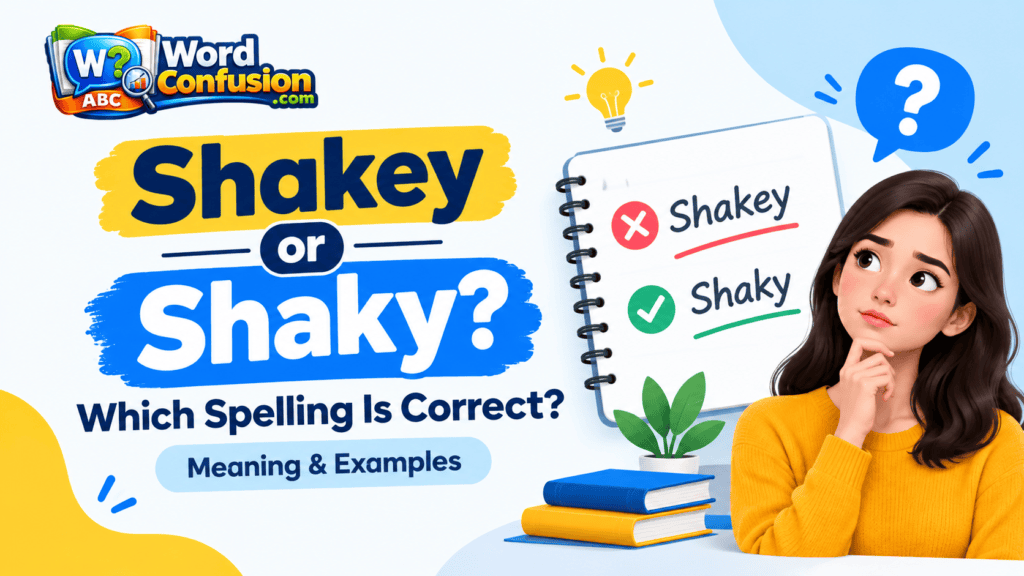
If you are wondering whether shakey or shaky is correct, the standard English spelling is shaky. It is an adjective that can mean trembling, physically unsteady, weak, uncertain, or unreliable. Shakey is generally not the standard spelling when you mean the ordinary adjective, although you may see it intentionally used in names, nicknames, brands, or stylized writing.
So, for normal English writing, remember:
Shaky = standard spelling
Shakey = generally a misspelling of the adjective
Shakey or Shaky: The Quick Answer
Shaky is the correct standard spelling.
Use shaky when you want to describe something that is trembling, unstable, weak, uncertain, or unreliable.
| Spelling | Standard English? | Typical use |
|---|---|---|
| shaky | ✅ Yes | The standard adjective |
| shakey | ❌ Generally no | Usually a misspelling; may appear intentionally as a name or stylized form |
For example:
- Her hands were shaky after the long workout.
- The old table felt shaky.
- The company is in a shaky financial position.
- His argument was based on shaky evidence.
If you are writing an email, essay, report, article, or other formal text, choose shaky.
For more examples of English spelling confusion, you can also explore WordConfusion’s guide to Grimey or Grimy.
What Does Shaky Mean?
Shaky is an adjective with several related meanings.
At its most literal, it describes something that is trembling or not physically steady. It can also describe something that is weak, uncertain, unreliable, or insecure.
The exact meaning depends on context.
1. Shaky Means Trembling
When a person’s body or voice is moving involuntarily, you can describe it as shaky.
Examples:
- My hands were shaky after the exercise.
- She spoke in a shaky voice.
- His legs felt shaky after running several miles.
- I was feeling shaky after the frightening experience.
Here, shaky is connected with trembling or physical nervousness.
2. Shaky Means Physically Unstable
Shaky can also describe something that does not feel firm or secure.
For example:
- The chair is shaky.
- Be careful on that shaky ladder.
- The old fence looked shaky after the storm.
- We were standing on a shaky platform.
In these sentences, shaky means unsteady or lacking physical stability.
3. Shaky Can Describe Nervous Feelings
You can also use shaky to describe how someone feels emotionally or physically after stress, fear, excitement, or exhaustion.
For example:
- I felt shaky before the interview.
- She was still shaky after the accident.
- He sounded shaky when he answered the question.
In this context, shaky can suggest nervousness, weakness, or physical trembling.
4. Shaky Can Mean Weak or Uncertain
Shaky is not limited to physical situations. It can describe something that is doubtful, unreliable, or poorly supported.
For example:
- The report was based on shaky evidence.
- They had a shaky agreement.
- His explanation was rather shaky.
- The business is on shaky financial ground.
Here, shaky means weak, uncertain, unreliable, or insecure.
These different uses are consistent with the dictionary senses of shaky, which include physical trembling, lack of stability, emotional upset, weakness, and uncertainty.
Why Do People Spell It “Shakey”?
The spelling shakey is understandable because English pronunciation does not always make spelling obvious.
The word comes from shake, and when people hear the ending pronounced like “ee”, they may naturally expect:
shake → shakey
But the established standard adjective is:
shake → shaky
This is similar to other spelling confusions where the pronunciation can make a nonstandard spelling look reasonable. English spelling is not always a perfect representation of pronunciation.
For example, WordConfusion’s article on Scarey or Scary deals with a very similar spelling issue: writers may expect an extra e, even though scary is the standard spelling.
The important point is not to assume that every spelling that looks logical is an accepted standard form.
Is Shakey a Word?
This question needs a little nuance.
If you are asking whether shakey is the standard spelling of the adjective meaning trembling or unstable, the answer is no.
Use:
shaky
However, Shakey may appear intentionally in other contexts, such as:
- a person’s nickname
- a character’s name
- a brand or business name
- a username
- a deliberately stylized spelling
So it is better to say:
Shaky is the standard English spelling of the adjective. Shakey may appear as an intentional proper or stylized name.
This is more accurate than claiming that every appearance of shakey is automatically a spelling error.
The same distinction is useful when learning other commonly confused spellings. For example, Shinning or Shining explains how two similar-looking forms can have very different roles and meanings.
How Do You Spell Shaky?
The correct spelling is:
S-H-A-K-Y
A simple way to remember it is:
shake → shaky
The final spelling is -ky, not -key.
Correct
- shaky
- shaky hands
- shaky voice
- shaky ground
- shaky argument
Usually incorrect in standard English
- shakey
- shakey hands
- shakey voice
- shakey ground
If you are unsure while writing, remember:
Shaky ends with -y.
Shaky Pronunciation
Shaky is pronounced approximately:
SHAY-kee
Its dictionary pronunciation is /ˈʃeɪ.ki/. The pronunciation is essentially the same in British and American English.
This pronunciation may contribute to the spelling confusion because the final sound is an “ee” sound. However, pronunciation alone does not determine the standard spelling.
Is Shaky an Adjective?
Yes. Shaky is an adjective.
It describes a noun or gives information about a person’s, object’s, argument’s, or situation’s condition.
For example:
- shaky hands
- a shaky voice
- a shaky chair
- shaky evidence
- a shaky relationship
- a shaky economy
It can also come after a linking verb:
- His hands were shaky.
- The table feels shaky.
- Her explanation seemed shaky.
Understanding that shaky is an adjective makes it easier to use correctly in sentences.
Shaky in Sentences
Here are some natural examples showing the different meanings of shaky.
Everyday English
My hands were shaky after carrying the heavy boxes.
Here, shaky means trembling or unsteady.
Conversation
I was so nervous that my voice sounded shaky.
Here, shaky describes a voice affected by nervousness.
Physical Stability
That chair looks shaky, so I’ll use another one.
Here, shaky means unstable.
School or Academic Writing
The student’s conclusion was based on shaky evidence.
Here, shaky means weak or not reliable.
Business
The company had a shaky financial position after several difficult months.
Here, shaky means uncertain or unstable.
Relationships
Their relationship was already on shaky ground.
The expression shaky ground means an uncertain or unstable situation.
Confidence
His shaky confidence disappeared when the audience started asking questions.
Here, shaky suggests weakness or insecurity.
Shaky vs Similar Words
Several English words overlap with shaky, but they are not always interchangeable.
| Word | Main idea | Example |
|---|---|---|
| shaky | Unsteady, weak, uncertain, or trembling | shaky hands |
| unsteady | Not physically steady | an unsteady chair |
| trembling | Shaking physically | trembling hands |
| unstable | Not firmly controlled or likely to change/fail | an unstable structure |
| wobbly | Moving or leaning from side to side | a wobbly table |
| uncertain | Not definite or sure | an uncertain outcome |
For example, trembling focuses more specifically on physical shaking, while shaky can have both literal and figurative meanings.
That is why you can have shaky evidence, but you would not normally call evidence trembling.
Shaky vs Unsteady
Shaky and unsteady are close in meaning when talking about physical stability.
- The table is shaky.
- The table is unsteady.
Both sentences suggest that the table is not firm.
However, shaky has a wider range of figurative uses:
- shaky evidence
- shaky argument
- shaky relationship
- shaky economy
Unsteady is often more strongly associated with physical movement or balance.
Shaky vs Unstable
These words can also overlap.
Shaky often sounds more conversational:
The company is on shaky financial ground.
Unstable can sound more technical or serious:
The structure is unstable.
Both can describe something that lacks stability, but the best choice depends on context.
British vs American English: Shaky or Shakey?
There is no normal British-versus-American spelling difference here.
Both British English and American English use:
shaky
Not:
shakey
So you do not need to change the spelling based on whether you are writing for a British or American audience.
If you’re interested in broader English spelling differences, WordConfusion’s Spelling Differences category contains guides covering other commonly confused forms.
Common Mistakes With Shaky
Mistake 1: Writing “shakey” in standard English
❌ She had shakey hands.
✅ She had shaky hands.
Mistake 2: Assuming pronunciation determines spelling
The ending sounds like “ee,” but that does not mean the word should end in -ey.
Mistake 3: Treating “shakey” as a British spelling
It is not a standard British alternative to shaky.
Both British and American English use shaky.
Mistake 4: Using “shaky” only for physical movement
Shaky can also describe:
- evidence
- arguments
- finances
- relationships
- confidence
- plans
- situations
Mistake 5: Assuming “shakey” can never appear anywhere
If Shakey is part of a person’s name, brand, character, or another intentional stylized form, changing it to shaky could actually make the name incorrect.
Always consider context.
For another example of why spelling questions sometimes require more than simply labeling one form “wrong,” see WordConfusion’s guide to Unkept or Unkempt.
How to Remember the Correct Spelling of Shaky
Use this simple memory trick:
Shake → Shaky
Then remember:
Shaky ends in -y, not -ey.
You can also connect the spelling with familiar phrases:
- shaky hands
- shaky voice
- shaky ground
- shaky evidence
Seeing the correct spelling in common phrases makes it easier to remember.
Frequently Asked Questions
Is it spelled shaky or shakey?
Shaky is the standard English spelling. Use it when you mean trembling, unsteady, unstable, weak, uncertain, or unreliable.
Is shakey a correct spelling?
Not for the ordinary adjective. Shaky is the standard spelling. Shakey may still appear intentionally as a name, nickname, brand, username, or stylized form.
Is shakey a word?
Shakey is not the standard spelling of the adjective shaky, but it can occur as an intentional proper name or stylized spelling.
How do you spell shaky correctly?
Spell it S-H-A-K-Y: shaky.
What does shaky mean?
Shaky can mean trembling, physically unsteady, nervous, weak, uncertain, or unreliable, depending on the context.
Is shaky an adjective?
Yes. Shaky is an adjective. It can describe nouns such as hands, voice, table, evidence, argument, and relationship.
What is the difference between shaky and unsteady?
Both can mean lacking physical stability. However, shaky also has broader figurative uses, such as shaky evidence or a shaky relationship, while unsteady is often used for physical balance or movement.
Is shaky the same spelling in British and American English?
Yes. Shaky is the standard spelling in both British and American English.
What are some synonyms for shaky?
Depending on the context, synonyms include unsteady, unstable, trembling, wobbly, weak, uncertain, insecure, and unreliable. The best synonym depends on whether you are describing physical movement, emotions, or something figurative.
What is the opposite of shaky?
Possible opposites include steady, stable, firm, secure, certain, reliable, and strong, depending on the context.
Final Answer: Shakey or Shaky?
If you are describing something that is trembling, unstable, weak, uncertain, or unreliable, use shaky.
Shaky = standard English spelling
Shakey = generally not the standard spelling of the adjective
For example:
- Her hands were shaky.
- He spoke in a shaky voice.
- The evidence was shaky.
- The company was on shaky ground.
The main exception is intentional usage such as a name, nickname, brand, or stylized spelling.
So if you’re writing normal English, the safe choice is simple:
Use “shaky,” not “shakey.”
For more practical English spelling, vocabulary, and usage guidance, explore WordConfusion.
If you are wondering whether shakey or shaky is correct, the standard English spelling is shaky. It is an adjective that can mean trembling, physically unsteady, weak, uncertain, or unreliable. Shakey is generally not the standard spelling when you mean the ordinary adjective, although you may see it intentionally used in names, nicknames, brands, or stylized writing.
So, for normal English writing, remember:
Shaky = standard spelling
Shakey = generally a misspelling of the adjective
Shakey or Shaky: The Quick Answer
Shaky is the correct standard spelling.
Use shaky when you want to describe something that is trembling, unstable, weak, uncertain, or unreliable.
| Spelling | Standard English? | Typical use |
|---|---|---|
| shaky | ✅ Yes | The standard adjective |
| shakey | ❌ Generally no | Usually a misspelling; may appear intentionally as a name or stylized form |
For example:
- Her hands were shaky after the long workout.
- The old table felt shaky.
- The company is in a shaky financial position.
- His argument was based on shaky evidence.
If you are writing an email, essay, report, article, or other formal text, choose shaky.
For more examples of English spelling confusion, you can also explore WordConfusion’s guide to Grimey or Grimy.
What Does Shaky Mean?
Shaky is an adjective with several related meanings.
At its most literal, it describes something that is trembling or not physically steady. It can also describe something that is weak, uncertain, unreliable, or insecure.
The exact meaning depends on context.
1. Shaky Means Trembling
When a person’s body or voice is moving involuntarily, you can describe it as shaky.
Examples:
- My hands were shaky after the exercise.
- She spoke in a shaky voice.
- His legs felt shaky after running several miles.
- I was feeling shaky after the frightening experience.
Here, shaky is connected with trembling or physical nervousness.
2. Shaky Means Physically Unstable
Shaky can also describe something that does not feel firm or secure.
For example:
- The chair is shaky.
- Be careful on that shaky ladder.
- The old fence looked shaky after the storm.
- We were standing on a shaky platform.
In these sentences, shaky means unsteady or lacking physical stability.
3. Shaky Can Describe Nervous Feelings
You can also use shaky to describe how someone feels emotionally or physically after stress, fear, excitement, or exhaustion.
For example:
- I felt shaky before the interview.
- She was still shaky after the accident.
- He sounded shaky when he answered the question.
In this context, shaky can suggest nervousness, weakness, or physical trembling.
4. Shaky Can Mean Weak or Uncertain
Shaky is not limited to physical situations. It can describe something that is doubtful, unreliable, or poorly supported.
For example:
- The report was based on shaky evidence.
- They had a shaky agreement.
- His explanation was rather shaky.
- The business is on shaky financial ground.
Here, shaky means weak, uncertain, unreliable, or insecure.
These different uses are consistent with the dictionary senses of shaky, which include physical trembling, lack of stability, emotional upset, weakness, and uncertainty.
Why Do People Spell It “Shakey”?
The spelling shakey is understandable because English pronunciation does not always make spelling obvious.
The word comes from shake, and when people hear the ending pronounced like “ee”, they may naturally expect:
shake → shakey
But the established standard adjective is:
shake → shaky
This is similar to other spelling confusions where the pronunciation can make a nonstandard spelling look reasonable. English spelling is not always a perfect representation of pronunciation.
For example, WordConfusion’s article on Scarey or Scary deals with a very similar spelling issue: writers may expect an extra e, even though scary is the standard spelling.
The important point is not to assume that every spelling that looks logical is an accepted standard form.
Is Shakey a Word?
This question needs a little nuance.
If you are asking whether shakey is the standard spelling of the adjective meaning trembling or unstable, the answer is no.
Use:
shaky
However, Shakey may appear intentionally in other contexts, such as:
- a person’s nickname
- a character’s name
- a brand or business name
- a username
- a deliberately stylized spelling
So it is better to say:
Shaky is the standard English spelling of the adjective. Shakey may appear as an intentional proper or stylized name.
This is more accurate than claiming that every appearance of shakey is automatically a spelling error.
The same distinction is useful when learning other commonly confused spellings. For example, Shinning or Shining explains how two similar-looking forms can have very different roles and meanings.
How Do You Spell Shaky?
The correct spelling is:
S-H-A-K-Y
A simple way to remember it is:
shake → shaky
The final spelling is -ky, not -key.
Correct
- shaky
- shaky hands
- shaky voice
- shaky ground
- shaky argument
Usually incorrect in standard English
- shakey
- shakey hands
- shakey voice
- shakey ground
If you are unsure while writing, remember:
Shaky ends with -y.
Shaky Pronunciation
Shaky is pronounced approximately:
SHAY-kee
Its dictionary pronunciation is /ˈʃeɪ.ki/. The pronunciation is essentially the same in British and American English.
This pronunciation may contribute to the spelling confusion because the final sound is an “ee” sound. However, pronunciation alone does not determine the standard spelling.
Is Shaky an Adjective?
Yes. Shaky is an adjective.
It describes a noun or gives information about a person’s, object’s, argument’s, or situation’s condition.
For example:
- shaky hands
- a shaky voice
- a shaky chair
- shaky evidence
- a shaky relationship
- a shaky economy
It can also come after a linking verb:
- His hands were shaky.
- The table feels shaky.
- Her explanation seemed shaky.
Understanding that shaky is an adjective makes it easier to use correctly in sentences.
Shaky in Sentences
Here are some natural examples showing the different meanings of shaky.
Everyday English
My hands were shaky after carrying the heavy boxes.
Here, shaky means trembling or unsteady.
Conversation
I was so nervous that my voice sounded shaky.
Here, shaky describes a voice affected by nervousness.
Physical Stability
That chair looks shaky, so I’ll use another one.
Here, shaky means unstable.
School or Academic Writing
The student’s conclusion was based on shaky evidence.
Here, shaky means weak or not reliable.
Business
The company had a shaky financial position after several difficult months.
Here, shaky means uncertain or unstable.
Relationships
Their relationship was already on shaky ground.
The expression shaky ground means an uncertain or unstable situation.
Confidence
His shaky confidence disappeared when the audience started asking questions.
Here, shaky suggests weakness or insecurity.
Shaky vs Similar Words
Several English words overlap with shaky, but they are not always interchangeable.
| Word | Main idea | Example |
|---|---|---|
| shaky | Unsteady, weak, uncertain, or trembling | shaky hands |
| unsteady | Not physically steady | an unsteady chair |
| trembling | Shaking physically | trembling hands |
| unstable | Not firmly controlled or likely to change/fail | an unstable structure |
| wobbly | Moving or leaning from side to side | a wobbly table |
| uncertain | Not definite or sure | an uncertain outcome |
For example, trembling focuses more specifically on physical shaking, while shaky can have both literal and figurative meanings.
That is why you can have shaky evidence, but you would not normally call evidence trembling.
Shaky vs Unsteady
Shaky and unsteady are close in meaning when talking about physical stability.
- The table is shaky.
- The table is unsteady.
Both sentences suggest that the table is not firm.
However, shaky has a wider range of figurative uses:
- shaky evidence
- shaky argument
- shaky relationship
- shaky economy
Unsteady is often more strongly associated with physical movement or balance.
Shaky vs Unstable
These words can also overlap.
Shaky often sounds more conversational:
The company is on shaky financial ground.
Unstable can sound more technical or serious:
The structure is unstable.
Both can describe something that lacks stability, but the best choice depends on context.
British vs American English: Shaky or Shakey?
There is no normal British-versus-American spelling difference here.
Both British English and American English use:
shaky
Not:
shakey
So you do not need to change the spelling based on whether you are writing for a British or American audience.
If you’re interested in broader English spelling differences, WordConfusion’s Spelling Differences category contains guides covering other commonly confused forms.
Common Mistakes With Shaky
Mistake 1: Writing “shakey” in standard English
❌ She had shakey hands.
✅ She had shaky hands.
Mistake 2: Assuming pronunciation determines spelling
The ending sounds like “ee,” but that does not mean the word should end in -ey.
Mistake 3: Treating “shakey” as a British spelling
It is not a standard British alternative to shaky.
Both British and American English use shaky.
Mistake 4: Using “shaky” only for physical movement
Shaky can also describe:
- evidence
- arguments
- finances
- relationships
- confidence
- plans
- situations
Mistake 5: Assuming “shakey” can never appear anywhere
If Shakey is part of a person’s name, brand, character, or another intentional stylized form, changing it to shaky could actually make the name incorrect.
Always consider context.
For another example of why spelling questions sometimes require more than simply labeling one form “wrong,” see WordConfusion’s guide to Unkept or Unkempt.
How to Remember the Correct Spelling of Shaky
Use this simple memory trick:
Shake → Shaky
Then remember:
Shaky ends in -y, not -ey.
You can also connect the spelling with familiar phrases:
- shaky hands
- shaky voice
- shaky ground
- shaky evidence
Seeing the correct spelling in common phrases makes it easier to remember.
Frequently Asked Questions
Is it spelled shaky or shakey?
Shaky is the standard English spelling. Use it when you mean trembling, unsteady, unstable, weak, uncertain, or unreliable.
Is shakey a correct spelling?
Not for the ordinary adjective. Shaky is the standard spelling. Shakey may still appear intentionally as a name, nickname, brand, username, or stylized form.
Is shakey a word?
Shakey is not the standard spelling of the adjective shaky, but it can occur as an intentional proper name or stylized spelling.
How do you spell shaky correctly?
Spell it S-H-A-K-Y: shaky.
What does shaky mean?
Shaky can mean trembling, physically unsteady, nervous, weak, uncertain, or unreliable, depending on the context.
Is shaky an adjective?
Yes. Shaky is an adjective. It can describe nouns such as hands, voice, table, evidence, argument, and relationship.
What is the difference between shaky and unsteady?
Both can mean lacking physical stability. However, shaky also has broader figurative uses, such as shaky evidence or a shaky relationship, while unsteady is often used for physical balance or movement.
Is shaky the same spelling in British and American English?
Yes. Shaky is the standard spelling in both British and American English.
What are some synonyms for shaky?
Depending on the context, synonyms include unsteady, unstable, trembling, wobbly, weak, uncertain, insecure, and unreliable. The best synonym depends on whether you are describing physical movement, emotions, or something figurative.
What is the opposite of shaky?
Possible opposites include steady, stable, firm, secure, certain, reliable, and strong, depending on the context.
Final Answer: Shakey or Shaky?
If you are describing something that is trembling, unstable, weak, uncertain, or unreliable, use shaky.
Shaky = standard English spelling
Shakey = generally not the standard spelling of the adjective
For example:
- Her hands were shaky.
- He spoke in a shaky voice.
- The evidence was shaky.
- The company was on shaky ground.
The main exception is intentional usage such as a name, nickname, brand, or stylized spelling.
So if you’re writing normal English, the safe choice is simple:
Use “shaky,” not “shakey.”
For more practical English spelling, vocabulary, and usage guidance, explore WordConfusion.