Puddy or Putty? Which Spelling Is Correct? Meaning & Usage
 Abdul Moeed
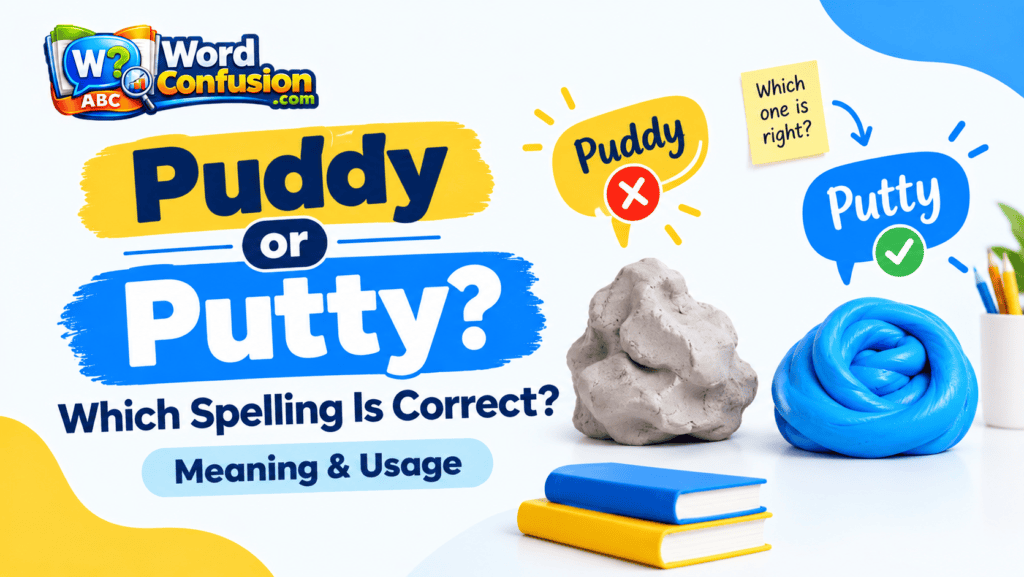
If you’re wondering whether it is puddy or putty, the correct spelling depends on what you mean. If you’re talking about the soft material used to fill holes, seal gaps, glaze windows, or repair surfaces, the correct word is putty. However, puddy is not simply a nonexistent word: it appears in rare British usage as an adjective meaning “short and podgy.”
So, for everyday English, DIY, construction, woodworking, and home repair, use putty.
Puddy or Putty: Quick Answer
Putty is the standard spelling when you mean a soft material used for filling, sealing, glazing, or repairing surfaces.
Puddy is not the standard spelling of that material. However, puddy does exist as a rare British adjective meaning “short and podgy.”
| Word | Meaning | Common use |
|---|---|---|
| Putty | A soft material used for filling, sealing, or glazing | Standard English |
| Puddy | A rare British adjective meaning short and podgy | Rare |
| PuTTY | The name of computer networking software | Technology |
For most situations, especially when discussing repairs, the answer is simple:
Putty = correct.
What Does Putty Mean?
Putty is a soft, moldable substance used to fill small holes, cracks, or gaps and to seal or secure certain surfaces.
Cambridge Dictionary describes putty as a soft substance similar to clay, particularly used for holding glass in window frames or filling small holes in wood.
You might encounter putty in:
- Window repair
- Woodworking
- Home improvement
- Plumbing
- Construction
- Arts and crafts
- Surface repair
For example:
The carpenter used putty to fill the small holes in the wooden frame.
The word can also describe the material more generally:
The putty was soft enough to shape by hand.
Putty in simple words
Think of putty as a soft repair or filling material.
It can be applied to an imperfect surface to fill a hole, close a gap, create a smooth finish, or provide a seal, depending on the type of putty being used.
Is “Puddy” a Real Word?
Yes—but this is where the distinction becomes important.
If you mean the material used to fill cracks or seal windows, puddy is not the standard spelling. Use putty.
However, puddy does appear as a rare British adjective. Collins Dictionary gives it the meaning “short and podgy.”
So saying “puddy is never a word” would be too broad.
A better way to remember the distinction is:
- Putty = the common word for the soft repair material.
- Puddy = a rare British adjective with a different meaning.
This kind of distinction is common in English. A word can be rare, regional, or specialized without being completely nonexistent. You can see a similar pattern in our guide to Shinning or Shining, where both spellings exist but have different meanings.
Putty as a Noun
The most common grammatical use of putty is as a noun.
A noun names the material itself.
Examples:
- The window needs new putty.
- The carpenter applied putty to the damaged wood.
- We bought some putty for the repair.
- The old putty around the glass had cracked.
- She used putty to fill the holes in the wall.
In these sentences, putty refers to the substance.
Putty as a Verb
Putty can also be used as a verb.
As a verb, it means to apply putty to something.
Examples:
- The worker puttied the damaged wood.
- We need to putty the holes before painting.
- He puttied the window frame before applying a new coat of paint.
So:
Putty = noun: the material
Putty = verb: to apply the material
This is useful to know because English often turns names of materials into verbs describing how they are used.
How Do You Pronounce Putty?
Putty is generally pronounced approximately like:
PUHT-ee
Cambridge gives the UK pronunciation as /ˈpʌt.i/ and the US pronunciation as /ˈpʌt̬.i/.
The pronunciation can make the spelling slightly confusing for English learners because the word sounds fairly close to what someone might spell phonetically as “puddy.”
But pronunciation alone does not determine spelling.
The standard written form for the material is:
putty
not:
puddy
If spelling by sound is something you struggle with, our guide to Grimey or Grimy covers another example where pronunciation can make an alternative spelling seem logical even though one form is preferred in standard English.
How to Use Putty in a Sentence
Here are some natural examples of putty in different contexts.
Home Repair
I used putty to fill the cracks around the window.
Woodworking
The carpenter applied putty to the holes in the wooden cabinet.
Window Repair
The old putty around the glass had become brittle.
Painting and Decorating
Fill the holes with putty before painting the wall.
Plumbing
The plumber used plumber’s putty to help seal the fitting.
Arts and Crafts
The children shaped the soft putty into small figures.
Figurative Usage
He was putty in her hands.
In this expression, putty in someone’s hands does not mean actual putty. It means that a person is very easily influenced or controlled by someone else.
For example:
Whenever she asked him for a favor, he was putty in her hands.
Common Types of Putty
The word putty can refer to different materials depending on the context.
Window Putty
Traditionally used around glass in window frames to help secure and seal the glass.
Wood Putty
Used to fill small holes, dents, and imperfections in wood.
Plumber’s Putty
A soft sealing compound commonly used around certain plumbing fixtures.
Glazing Putty
Used in glazing applications, particularly around glass and window frames.
Modeling Putty
A moldable material used for creative, craft, or modeling purposes.
The exact properties of putty vary depending on the product and its intended purpose, so different types should not automatically be treated as interchangeable.
Why Do People Write “Puddy” Instead of “Putty”?
The confusion is understandable.
One reason is pronunciation. When people hear putty, they may not immediately know whether the middle sound should be represented by t or d in writing, particularly because pronunciation varies between accents.
Another reason is that English spelling is not always a perfect representation of pronunciation.
A person who has only heard the word spoken may naturally guess:
puddy
instead of:
putty
There is also a broader pattern in English where people spell unfamiliar words according to how they sound. Our article on Platform vs Flatform covers another spelling confusion where a familiar-looking alternative can seem reasonable even though the two forms have different meanings.
The safest solution is to remember the standard written form:
putty
Puddy vs Putty: What Is the Difference?
| Feature | Putty | Puddy |
|---|---|---|
| Standard spelling for repair material | ✅ Yes | ❌ No |
| Common English word | ✅ Yes | ❌ Rare |
| Used for filling/sealing | ✅ Yes | ❌ No |
| Can be a noun | ✅ Yes | ❌ Not in this sense |
| Can be a verb | ✅ Yes | ❌ No |
| Rare British adjective | ❌ No | ✅ Yes |
| Meaning “short and podgy” | ❌ No | ✅ Yes |
The key point is that these words are not interchangeable.
If you’re writing about home repairs, windows, woodworking, or sealing materials, use putty.
If you encounter puddy in a British dictionary or specialized text, check the context because it may be referring to its rare adjective meaning.
Putty in British and American English
There is no ordinary British-versus-American spelling difference here.
The standard spelling is:
- British English: putty
- American English: putty
You do not need to change putty to puddy depending on your audience.
The rare word puddy is a separate vocabulary item rather than an American spelling of putty. Collins identifies it as a rare British adjective.
This is different from genuine spelling variations between varieties of English. For example, some words can have different British and American forms, while putty does not.
Putty vs Filler: Are They the Same?
Not exactly.
Putty is a type of material used for specific filling, sealing, glazing, or repair purposes.
Filler is a broader term for a substance used to fill holes, gaps, cracks, or surface imperfections.
Depending on the job, a filler might be made from different materials and have different properties from putty.
In simple terms:
Putty can be a type of filler, but not every filler is putty.
The right product depends on the surface and the type of repair.
Is PuTTY the Same as Putty?
No.
putty is an ordinary English word referring to the material.
PuTTY is the name of a software application associated with network connections and remote computing.
The capitalization helps distinguish the proper name from the common noun.
For example:
The carpenter used putty around the window.
versus:
I used PuTTY to connect to the remote server.
They are completely different uses of the word.
Common Mistakes With Puddy and Putty
Mistake 1: Using “puddy” for the repair material
❌ The carpenter used puddy to fill the holes.
✅ The carpenter used putty to fill the holes.
Mistake 2: Assuming “puddy” is always meaningless
That is also too broad.
Although it is not the standard spelling for the repair material, puddy does exist in rare British usage with a different meaning.
Mistake 3: Treating putty and filler as exact synonyms
They can overlap in some contexts, but they are not automatically the same material.
Mistake 4: Confusing putty with PuTTY
Lowercase putty usually refers to the material.
Capitalized PuTTY refers to software.
Mistake 5: Assuming the pronunciation tells you the spelling
English pronunciation can make puddy look like a reasonable spelling, but the standard spelling of the material is putty.
If you enjoy learning about words that look or sound confusing, you can explore more commonly confused English words.
Easy Memory Trick
Use this simple reminder:
Putty fills and seals.
If you’re talking about:
- repairing wood
- glazing windows
- filling holes
- sealing certain plumbing fittings
- repairing surfaces
think:
P-U-T-T-Y
Putty = repair material
Puddy should only be used when the context specifically calls for its rare, separate meaning.
Frequently Asked Questions
Is it puddy or putty?
Putty is the correct spelling when you mean the soft material used for filling, sealing, glazing, or repairing surfaces. Puddy is not the standard spelling for that material, although it exists as a rare British adjective with a different meaning.
Is puddy a real word?
Yes. Puddy is a rare British adjective meaning “short and podgy,” according to Collins Dictionary. It is not, however, the standard spelling of the repair material called putty.
Is puddy a correct spelling of putty?
No. If you mean the soft material used for filling, sealing, or glazing, the correct spelling is putty.
What does putty mean?
Putty is a soft, moldable substance used for filling holes, sealing gaps, glazing windows, and repairing certain surfaces. Cambridge Dictionary describes it as a soft substance similar to clay.
What is putty used for?
Putty can be used for filling small holes, repairing imperfections, sealing certain gaps, glazing windows, and other specialized repair tasks. Different types include window putty, wood putty, glazing putty, and plumber’s putty.
How do you pronounce putty?
Putty is pronounced approximately PUHT-ee. Cambridge lists UK /ˈpʌt.i/ and US /ˈpʌt̬.i/.
Is putty a noun or a verb?
It can be both.
As a noun, putty is the material:
The window needs new putty.
As a verb, putty means to apply putty:
We need to putty the holes before painting.
Is putty spelled differently in British and American English?
No. Putty is the standard spelling in both British and American English.
What does “putty in someone’s hands” mean?
The expression putty in someone’s hands means being very easy for another person to influence, persuade, or control.
For example:
He is completely putty in her hands.
Is PuTTY the same as putty?
No. Putty is the common English word for a soft repair or sealing material. PuTTY is the name of software used for network and remote-computing tasks.
Final Answer: Puddy or Putty?
If you’re talking about the soft material used to fill, seal, glaze, or repair, the correct spelling is putty.
Puddy is not the standard spelling of that material, but it is not accurate to say that the word never exists. It has a rare British dictionary meaning describing someone or something as short and podgy.
So the easiest rule is:
Putty = the repair material.
Puddy = a rare word with a different meaning.
When in doubt about the material, choose putty.