OTS Meaning in Text: What Does OTS Mean in Texting & Chat?

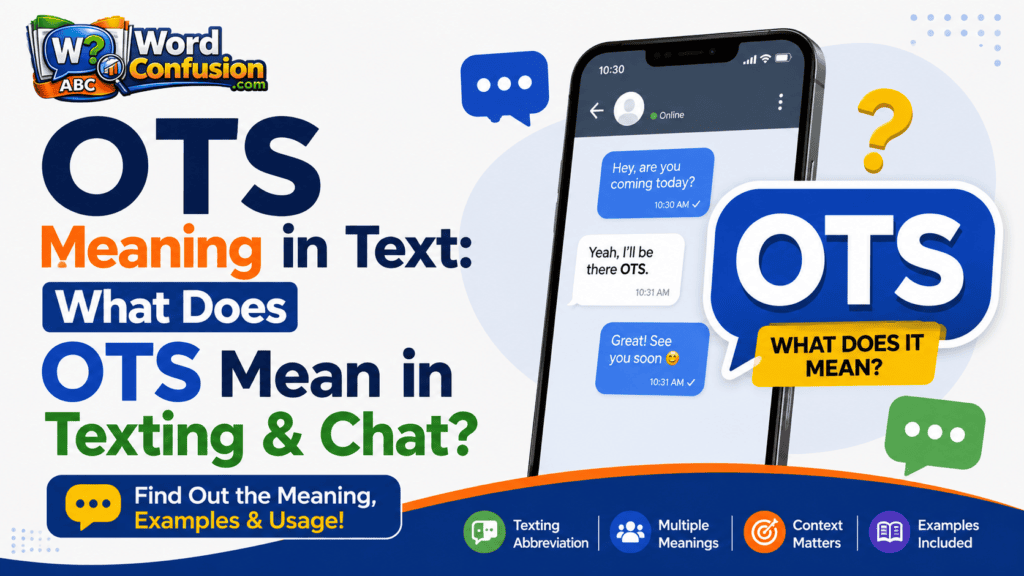
If you saw OTS in a text message, chat, or social media post, its meaning may depend on the conversation. OTS can mean “On The Scene” in informal texting, especially when someone is talking about arriving at or being present at a place or event. However, OTS has other meanings in different contexts, including “On The Side,” “On The Spot,” “Over The Shoulder,” and “Off The Subject.” The surrounding words usually tell you which meaning is intended.
📖 See also:Sapphire or Saphire? The Correct Spelling Explained
What Does OTS Mean in Text?
OTS is a context-dependent abbreviation. In texting, one established meaning is “On The Scene,” which can indicate that someone has arrived at a location or is already present at an event.
For example:
“OTS at the concert. Where are you?”
Here, OTS means “On The Scene”—the person is already at the concert.
However, it is important not to assume that OTS always means “On The Scene.” Slang and abbreviations can have different meanings across conversations and communities. Reference sites list several possible expansions for OTS, including “On The Scene,” “On The Side,” “On The Spot,” “Off The Subject,” and “Over The Shoulder.”
Quick Answer
OTS can mean “On The Scene” in texting and online chat, particularly when someone is saying they have arrived or are already present. But OTS has multiple meanings, so you should use the context of the conversation to determine what the sender means.
OTS Has Multiple Meanings
Unlike some texting abbreviations with one widely recognized expansion, OTS can represent different phrases.
| OTS meaning | What it means | Typical context |
| On The Scene | Already at a place or event | Texting, events, casual chat |
| On The Side | Something additional or separate | Casual conversation |
| On The Spot | Immediately or in a particular place | General conversation |
| Over The Shoulder | Viewed from behind or over someone’s shoulder | Photography, gaming, visual contexts |
| Off The Subject | Moving away from the current topic | Conversation |
| Off The Shelf | Readily available rather than custom-made | Business, products, technical contexts |
Not all of these meanings are equally likely in a casual text. The safest approach is to look at the surrounding message before choosing an expansion.
OTS = On The Scene
When OTS refers to “On The Scene,” it generally communicates presence or arrival.
For example:
“OTS at the stadium.”
“We’re OTS now.”
“OTS at the party. Come outside.”
In these examples, the conversation is about being physically present somewhere.
OTS = On The Side
In some slang references, OTS is also listed as “On The Side.”
This interpretation makes more sense when the conversation involves something additional, separate, or secondary.
For example:
“I do freelance work OTS.”
Because this meaning is less obvious to many readers, the surrounding sentence is especially important.
OTS = On The Spot
Some abbreviation references list OTS as “On The Spot.”
This can fit conversations about something happening immediately or at a particular location.
For example:
“They asked me OTS.”
If the meaning isn’t obvious from the message, asking the sender is better than guessing.
OTS = Over The Shoulder
“Over The Shoulder” is another documented expansion of OTS.
This meaning is more likely in a technical, gaming, photography, film, or visual context than in an ordinary text conversation.
For example:
“Use an OTS shot for the interview.”
Here, OTS refers to an over-the-shoulder shot, not “On The Scene.”
OTS = Off The Subject
Some slang references use OTS for “Off The Subject.”
This can appear when someone wants to move away from the current topic.
For example:
“OTS, did you finish the movie?”
In this context, the writer is signaling a change of subject.
How Do You Know Which OTS Meaning Someone Means?
The easiest way to understand OTS is to look at the topic of the conversation.
| Conversation is about… | OTS may mean… |
| Arriving at an event | On The Scene |
| Being present somewhere | On The Scene |
| Something additional or separate | On The Side |
| An immediate action or situation | On The Spot |
| Photography or camera angles | Over The Shoulder |
| Changing the conversation topic | Off The Subject |
| Products or ready-made solutions | Off The Shelf |
For example, compare these:
“OTS at the restaurant.”
This strongly suggests “On The Scene.”
But:
“We need an OTS solution.”
The context could point toward a business or technical expansion rather than texting slang.
A simple rule
Never interpret an abbreviation in isolation when multiple meanings are possible.
Read the sentence before and after OTS. Ask:
- What is the conversation about?
- Is the person talking about a place or event?
- Are they discussing a topic change?
- Is this a gaming, photography, or business conversation?
- Does one expansion make grammatical and logical sense?
Context usually resolves the ambiguity.
📖 See also:What Does WFH Mean in Text? Meaning, Examples & Usage
OTS Meaning in Texting and Online Chat
In casual texting, OTS is an informal abbreviation, not a standard formal English word.
When it is used as “On The Scene,” it can communicate that someone has reached a location or is already there.
Text message examples
“OTS at the café.”
“I’m OTS. Where are you?”
“We’re OTS at the venue.”
“OTS now—come meet us.”
These messages are short because texting often favors conversational shorthand.
However, abbreviations aren’t universally understood. If the recipient doesn’t recognize OTS, writing the full phrase can be clearer.
OTS Meaning on Snapchat, Instagram, TikTok, and Discord
OTS does not necessarily acquire a completely new meaning simply because it appears on a particular social platform. The conversation itself is usually more important than the app.
Snapchat
If someone sends:
“OTS at the mall”
the likely interpretation is “On The Scene” if the conversation is about meeting there.
In an Instagram DM, OTS may function like other casual abbreviations:
“OTS at the event!”
Again, the surrounding conversation determines the intended meaning.
TikTok
A TikTok comment or direct message can contain slang and abbreviations, but OTS should still be interpreted from context rather than automatically assigned one universal definition.
Discord and Gaming Chat
Discord and gaming communities introduce additional possibilities. For example, “Over The Shoulder” can make sense in a gaming, camera, or visual discussion.
That’s why the same three letters can mean something different in a gaming conversation than they do in a group chat about meeting friends.
OMW vs. OTS, OTW, OT, and OTP
OTS can be confused with other short internet abbreviations.
| Abbreviation | Common meaning | Main difference |
| OTS | On The Scene | Can indicate being present, depending on context |
| OMW | On My Way | The person is traveling toward a destination |
| OTW | On The Way | Also indicates something or someone is on the way |
| OT | Off Topic | Usually signals a change away from the current subject |
| OTP | One True Pairing | Common in fandom and social-media discussions |
OTS vs. OMW
This is the most useful distinction when OTS means “On The Scene.”
OMW = On My Way
“OMW to the concert.”
The person is traveling there.
OTS = On The Scene
“OTS at the concert.”
The person is indicating that they are already there.
So:
OMW → still going
OTS → already there, when used as “On The Scene”
Don’t assume the distinction applies whenever OTS appears, though. The actual conversation still determines the meaning.
📖 See also:Leary or Leery: Which Is Correct?
How to Use OTS in a Text Message
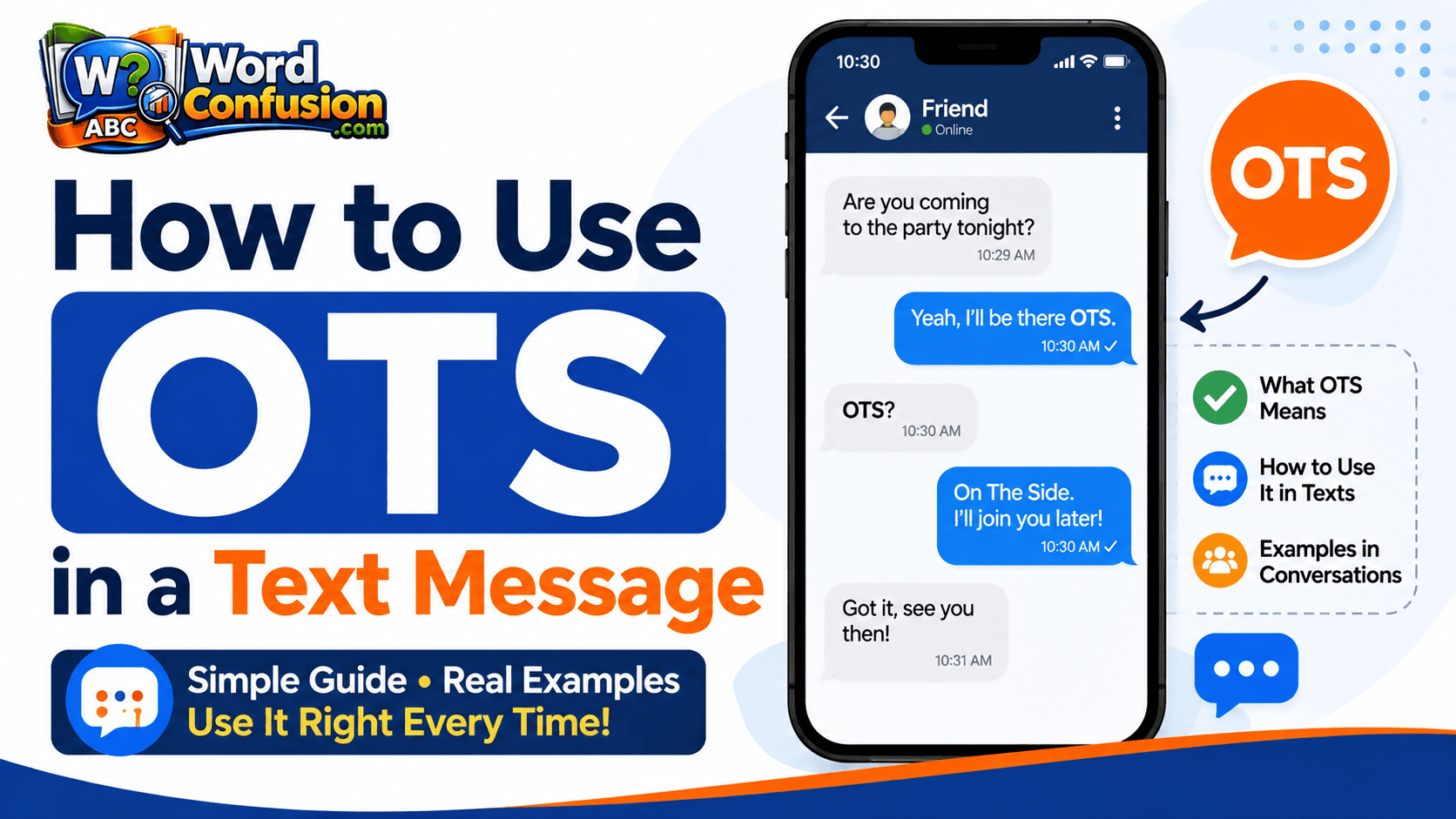
If you’re using OTS to mean “On The Scene,” make sure the context makes the meaning obvious.
Example 1: Meeting friends
Alex: Where are you?
Sam: OTS at the coffee shop.
Here, Sam is saying they are already at the coffee shop.
Example 2: Concert
“OTS at the concert! Section B.”
The sender is letting someone know they have arrived.
Example 3: Group event
“We’re OTS. Meet us near the entrance.”
The context makes “On The Scene” relatively easy to understand.
Example 4: When OTS means something else
“OTS, did you see yesterday’s game?”
If the sender is using OTS as “Off The Subject,” they’re changing the topic.
The same abbreviation can therefore produce different interpretations depending on what comes before and after it.
Is OTS Formal or Informal?
OTS is generally informal when used as texting or internet slang.
It’s appropriate when communicating casually with people who understand the abbreviation, such as:
- Friends
- Family
- Group chats
- Casual DMs
- Informal online communities
When to avoid OTS
Avoid unexplained slang in:
- Formal emails
- Academic assignments
- Business documents
- Job applications
- Official correspondence
- Professional communication where clarity matters
Instead of writing:
“I’m OTS.”
a professional message could simply say:
“I have arrived.”
Clear language is usually better than an unfamiliar abbreviation.
Common Mistakes When Interpreting OTS
1. Assuming OTS always means “On The Scene”
This is the biggest mistake.
“On The Scene” is an established interpretation, but reference sources document other meanings as well.
2. Ignoring the surrounding conversation
Three letters aren’t enough to identify an abbreviation’s meaning when several expansions exist.
Look at the topic and nearby words.
3. Confusing OTS with OMW
OMW normally means “On My Way.”
If someone says:
“OMW!”
they’re telling you they’re traveling.
If OTS means “On The Scene” in a particular conversation:
“OTS!”
can indicate that they’ve arrived.
4. Using OTS in formal communication
Even if you know what it means, your reader may not.
When clarity matters, spell out the intended phrase.
How to Respond When Someone Says OTS
Your response depends on what the sender means.
If OTS means “On The Scene”
You could reply:
“Where are you?”
“I’m on my way.”
“I’ll meet you at the entrance.”
If you’re already there
You might say:
“I’m near the front door.”
If you don’t understand the abbreviation
The simplest response is:
“What do you mean by OTS?”
There’s nothing wrong with asking for clarification. Because OTS has multiple possible meanings, guessing can easily lead to confusion.
📖 See also:Holistic or Wholistic: Which Is Correct? Meaning & Examples
Frequently Asked Questions About OTS
What does OTS mean in text?
OTS is a context-dependent abbreviation. In informal texting, one established meaning is “On The Scene,” particularly when someone is talking about being present at or arriving at a place or event. Other meanings are possible depending on the conversation.
What does OTS stand for?
OTS can stand for different phrases. In texting, “On The Scene” is one established meaning, but other references list alternatives such as “On The Side,” “On The Spot,” “Off The Subject,” and “Over The Shoulder.”
What does OTS mean in texting?
In texting, OTS can mean “On The Scene.” For example, “OTS at the restaurant” can mean the sender is already at the restaurant. However, context should always be considered because OTS has other possible meanings.
Does OTS have multiple meanings?
Yes. OTS can represent different phrases in different contexts. The intended meaning depends on the conversation, platform, and subject being discussed.
What does OTS mean on Snapchat?
OTS does not have one universal Snapchat-specific meaning. If someone uses it while discussing meeting somewhere, “On The Scene” may fit. Other meanings are possible, so check the surrounding conversation.
What does OTS mean on Instagram?
OTS can be used as an informal abbreviation in Instagram messages or comments, but its meaning depends on context. When the conversation concerns arriving somewhere, “On The Scene” may be intended.
What does OTS mean on TikTok?
OTS can appear in TikTok comments or messages, but there isn’t one guaranteed TikTok-specific definition. Look at the surrounding text and topic to determine the intended meaning.
Is OTS formal or informal?
When used as texting slang, OTS is informal. It is better suited to casual messages, DMs, and online conversations than formal writing.
Is OTS the same as OMW?
No. OMW commonly means “On My Way,” which indicates that someone is traveling toward a destination. When OTS means “On The Scene,” it indicates that someone is already present or has arrived.
How do you use OTS in a text message?
If you are using OTS to mean “On The Scene,” you could write:
“OTS at the café. Where are you?”
Use it only when the recipient is likely to understand the abbreviation.
Summary: What Does OTS Mean in Text?
OTS can have multiple meanings in text and online communication. “On The Scene” is an established informal texting meaning and can indicate that someone has arrived at or is present at a place or event. However, OTS can also represent other phrases, including “On The Side,” “On The Spot,” “Over The Shoulder,” and “Off The Subject.”
The best way to determine the intended meaning is to use context.
Key Takeaways
- OTS is an abbreviation with multiple possible meanings.
- “On The Scene” is an established texting interpretation.
- OTS can mean different things in different conversations.
- The surrounding words and topic help identify the intended meaning.
- OMW means “On My Way,” which is different from “On The Scene.”
- OTS is generally informal when used as texting slang.
- If you’re unsure what someone means, simply ask for clarification.
- what does OTS mean when someone texts you
Looking for more English word meanings, grammar tips, and commonly confused words? Visit the WordConfusion homepage to explore our latest language guides, spelling differences, vocabulary explanations, text abbreviations, and practical examples. Whether you’re learning English or improving your writing skills, you’ll find clear, easy-to-understand resources for everyday communication.
Written by
 Abdul Moeed
Abdul Moeed is a professional content writer and SEO link-building specialist with 5+ years of experience. He creates search-optimized content and develops effective SEO strategies that improve website visibility, authority, and organic growth.
View LinkedIn profileLatest posts
 What Does PG Mean in Text? Meaning, Examples & Usage
 What Does OFCC Mean in Text? Meaning, Uses & Examples
 What Does MSG Mean in Text? Meaning, Examples & Usage
 What Does STY Mean in Text? Meaning, Examples & Usage
 What Does “Twin” Mean in Slang? Meaning, Text & Examples
 What Does LMC Mean in Text? Meaning, Examples & Usage