Holistic or Wholistic: Which Is Correct? Meaning & Examples

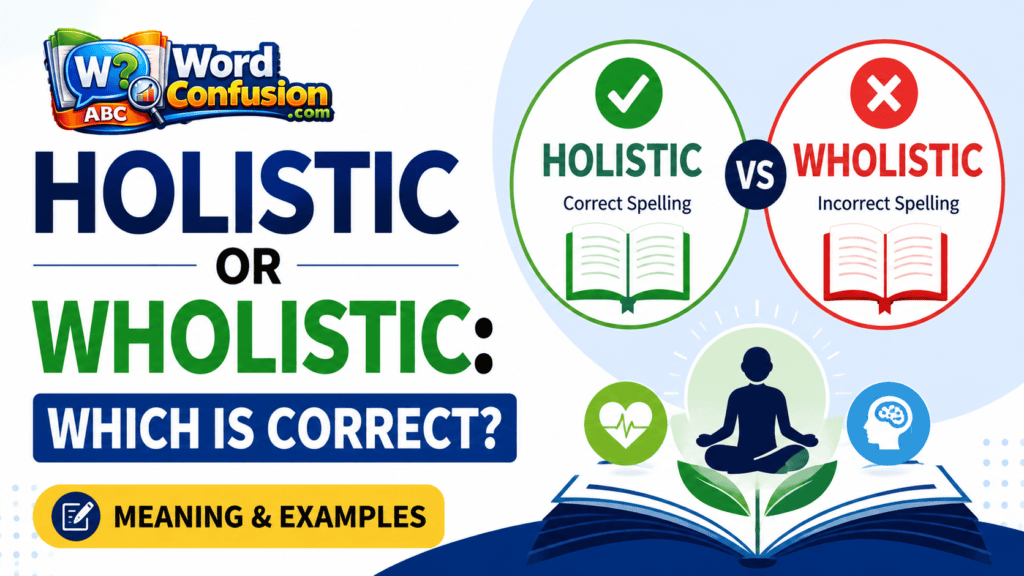
If you are wondering whether holistic or wholistic is the correct spelling, the short answer is: holistic is the standard and much more common choice. However, wholistic is not simply a nonexistent word. Major dictionaries recognize it as a variant of holistic, although it is far less common.
Both words relate to the idea of considering something as a whole rather than focusing only on individual parts. For academic, professional, and general formal writing, holistic is the spelling you should normally use.
📖 See also:What Does WDYM Mean in Text? Definition, Tone & Examples
Holistic or Wholistic: Quick Answer
Holistic is the preferred spelling in modern standard English.
Wholistic is a recognized variant, but it is much less common. It developed partly because people naturally associate the word with whole. Merriam-Webster lists wholistic as a variant of holistic, while holistic is the established form used far more widely.
| Word | Status | Best choice? |
| holistic | Standard, widely used | Yes |
| wholistic | Recognized but uncommon variant | Usually no |
The easiest rule to remember
When in doubt, use holistic.
For example:
- We need a holistic approach to the problem.
- The school takes a holistic view of student development.
- The company adopted a holistic strategy for improving customer experience.
What Does Holistic Mean?
Holistic is an adjective that describes an approach that considers a person, system, situation, or problem as a whole, rather than examining only one part.
Cambridge Dictionary defines holistic in terms of dealing with or treating the whole rather than individual parts, while Merriam-Webster connects the word with complete systems and the relationships among their parts.
In simple English:
Holistic means looking at the complete picture instead of concentrating on just one part.
For example, imagine a student who is struggling in school. A narrow approach might look only at test scores. A holistic approach could also consider the student’s study habits, attendance, learning environment, motivation, and overall development.
The idea is not simply to collect more information. It is to understand how different parts relate to the whole.
Simple breakdown
Holistic = whole + connected parts + overall perspective
That is why the word appears in areas such as:
- education
- healthcare
- business
- psychology
- environmental studies
- personal development
- problem-solving
What Does Wholistic Mean?
Wholistic has essentially the same meaning as holistic.
It refers to considering something as a whole rather than focusing exclusively on separate parts. Merriam-Webster lists wholistic as a variant of holistic, and Collins likewise recognizes it as a variant spelling.
So why don’t we normally use wholistic?
Because holistic is overwhelmingly more common and is the conventional spelling.
The spelling wholistic is easy to understand because it visually resembles the English word whole. That connection probably helps explain why people sometimes spell the word with a w.
However, if you are writing an essay, report, article, business document, or other formal text, holistic is the safer and more conventional choice.
Holistic vs Wholistic: What’s the Difference?
The main difference is usage and frequency, not the basic meaning.
| Feature | Holistic | Wholistic |
| Basic meaning | Considering something as a whole | Essentially the same |
| Standard spelling | Yes | Less conventional |
| Dictionary status | Established word | Recognized variant |
| Frequency | Much more common | Much less common |
| Formal writing | Recommended | Usually avoid as the default |
| Common phrase | holistic approach | wholistic approach |
| Best choice for most writers | Yes | No |
So it would be misleading to say that wholistic is simply “not a word.”
A more accurate statement is:
Holistic is the standard and preferred spelling, while wholistic is a recognized but much less common variant.
That distinction is important if you want your writing to be both accurate and natural.
📖 See also:Focusing or Focussing: Which Spelling Is Correct?
Which Spelling Should You Use?
In most situations, choose holistic.
In academic writing
Use holistic:
The study takes a holistic approach to language development.
In professional writing
Use holistic:
The organization developed a holistic strategy for improving employee performance.
In everyday writing
Use holistic:
We need to take a holistic view of the situation.
When might you see “wholistic”?
You may encounter wholistic in particular publications, organizations, or texts where that spelling has been intentionally adopted.
If you are quoting a source or referring to a name that specifically uses wholistic, preserve its original spelling.
Otherwise, holistic is the conventional choice.
Why Do People Spell Holistic as Wholistic?
The spelling confusion is understandable.
The meaning of holistic is strongly connected with the idea of a whole. As a result, many people instinctively expect the word to contain whole:
whole → wholistic
But the history of holistic is more complicated than simply taking whole and adding a suffix.
Holistic is connected to holism, a term associated with the idea that systems should be understood as wholes. Merriam-Webster traces holistic to holism + -istic and dates its first known use to 1926.
The underlying concept ultimately connects to the Greek word holos, meaning “whole” or “complete.”
So the association with whole makes sense semantically, but that does not make wholistic the standard spelling.
Where Did the Word Holistic Come From?
The history of holistic is closely connected to the word holism.
The term holism is associated with South African statesman and philosopher Jan Smuts, who used it in his 1926 work Holism and Evolution. The word ultimately relates to the Greek holos, meaning “whole” or “entire.”
From holism, English developed the adjective holistic.
This history explains an important point:
Holistic is not simply “whole” with a few letters added. It developed through the concept and terminology of holism.
That is also why the spelling without w is the established form.
How Do You Pronounce Holistic?
The pronunciation varies slightly between British and American English.
Cambridge Dictionary gives these pronunciations:
- British English: /həˈlɪs.tɪk/
- American English: /hoʊlˈɪs.tɪk/
A simple approximation is:
- British: huh-LIS-tik
- American: hoh-LIS-tik
The stress falls on the lis sound.
How Is Holistic Used?
Holistic is usually used before a noun or as part of a phrase describing an approach, perspective, or way of thinking.
Common combinations include:
- holistic approach
- holistic perspective
- holistic view
- holistic health
- holistic education
- holistic development
- holistic treatment
- holistic strategy
- holistic solution
- holistic thinking
- holistic lifestyle
- holistic learning
The exact meaning depends on the context, but the central idea remains the same: considering the whole rather than isolating one part.
What Does “Holistic Approach” Mean?
A holistic approach is a way of dealing with a subject by considering its different parts together and in relation to the whole.
For example:
A holistic approach to education considers academic performance, social development, emotional well-being, and practical skills.
The point is not that every factor receives equal attention. Instead, the approach recognizes that different factors can influence one another.
Another example:
The company took a holistic approach to improving employee performance.
That might involve looking at training, workload, management, workplace culture, communication, and employee well-being rather than blaming poor performance on a single factor.
Holistic in a Sentence: Examples
Here are several natural examples of holistic in different contexts.
Everyday example
We need a holistic view of the problem before deciding what to do.
Education
The school promotes a holistic approach to student development.
Business
The company adopted a holistic strategy for improving customer satisfaction.
Health
The program takes a holistic approach to wellness.
Environment
A holistic environmental policy considers both economic and ecological effects.
Problem-solving
Taking a holistic approach helped the team identify the underlying causes of the issue.
Academic writing
The researchers used a holistic framework to examine the relationship between the different variables.
Personal development
She takes a holistic approach to improving her physical and mental well-being.
Notice that holistic does not automatically mean “healthy.” Its meaning is broader than health.
📖 See also:What Does SN Mean in Text? Meanings, Uses & Examples
Holistic vs Related Words
Several words overlap with holistic, but they are not exact synonyms.
| Word | Meaning | How it differs from holistic |
| Holistic | Considering the whole and the relationships among its parts | Focuses on the complete system |
| Comprehensive | Covering a broad or complete range | Emphasizes coverage |
| Integrated | Combining separate elements into a unified whole | Emphasizes combination |
| Overall | Considering the general or total picture | More general and less specialized |
| Complete | Having all necessary parts | Focuses on completeness |
| Wholesome | Healthy, beneficial, or morally good | Does not mean “holistic” |
Holistic vs comprehensive
These words can be close in meaning, but they emphasize different things.
A comprehensive report attempts to cover all or most relevant information.
A holistic approach focuses on understanding the subject as a connected whole.
For example:
The report provides a comprehensive review of the evidence.
This emphasizes breadth and coverage.
The doctor took a holistic approach to the patient’s care.
This emphasizes the person or situation as a whole and the relationship among relevant factors.
Holistic vs Whole
Whole is a much broader and more basic English word.
It can mean complete or entire:
I ate the whole cake.
Holistic, on the other hand, is usually used to describe an approach, perspective, or method that considers an entire system or situation rather than isolated parts.
Compare:
We examined the whole document.
with:
We took a holistic approach to evaluating the document.
The two words are related in concept, but they are not interchangeable in every sentence.
Common Mistakes With Holistic
1. Assuming “wholistic” is always simply wrong
This is too absolute.
Holistic is the standard spelling, but wholistic is recognized as a less common variant by major dictionaries.
2. Assuming holistic only relates to health
You can have a holistic approach to:
- education
- business
- research
- environmental policy
- personal development
- problem-solving
3. Treating holistic and comprehensive as exact synonyms
They overlap, but their emphasis differs.
Comprehensive focuses on covering a broad range.
Holistic focuses on the whole and the relationship between its parts.
4. Assuming holistic means “perfect”
It does not.
A holistic approach can still identify problems, limitations, or weaknesses. The word describes how something is considered, not whether the result is perfect.
5. Assuming holistic comes directly from whole
The concepts are closely related, but holistic developed through holism, rather than simply being formed from the modern English word whole.
A Simple Memory Trick
Here’s an easy way to remember the preferred spelling:
Holistic comes from holism, so remember it without the W.
You can also remember:
HOLISTIC = HOLISM → WHOLE
The word refers to considering the whole, but its standard spelling does not begin with wh-.
📖 See also:What Does FYE Mean in Text? Meaning, Slang & Examples
Frequently Asked Questions
Is holistic or wholistic correct?
Holistic is the standard and much more common spelling. Wholistic is also recognized as a variant, but it is far less common. For most formal, academic, and professional writing, use holistic.
Is wholistic a real word?
Yes. Wholistic is a recognized variant of holistic. However, it is much less common than holistic, so it is generally not the best default choice.
Is wholistic a misspelling of holistic?
Not necessarily. Although many people use wholistic because they associate the word with whole, dictionaries recognize it as a variant of holistic. Nevertheless, holistic is the established and preferred spelling.
Do holistic and wholistic mean the same thing?
Yes, their basic meanings are essentially the same: both refer to considering something as a whole rather than focusing only on individual parts.
Which spelling is more common, holistic or wholistic?
Holistic is much more common and is the conventional spelling used in general, academic, and professional English.
What does holistic mean?
Holistic means considering a person, system, or situation as a whole rather than examining only individual parts.
What does wholistic mean?
Wholistic means essentially the same thing as holistic. It is a less common variant spelling.
What is a holistic approach?
A holistic approach considers different parts of a subject together and looks at how they contribute to the overall situation.
How do you pronounce holistic?
In British English, it is pronounced approximately huh-LIS-tik. In American English, it is approximately hoh-LIS-tik. Cambridge lists /həˈlɪs.tɪk/ for UK English and /hoʊlˈɪs.tɪk/ for US English.
Is holistic the same as comprehensive?
Not exactly. Holistic emphasizes understanding the whole and the connections among its parts, while comprehensive emphasizes covering a broad or complete range of information.
How do you use holistic in a sentence?
You can use holistic to describe an approach or perspective that considers the complete picture:
The school takes a holistic approach to student development.
Final Answer: Holistic or Wholistic?
Holistic is the spelling you should normally use.
It is the standard, established, and much more common form. Wholistic is a recognized variant with the same basic meaning, but it is considerably less common.
So if you’re writing an essay, report, article, email, or professional document, choose:
holistic
For example:
We need a holistic approach to solving this problem.
The key thing to remember is that wholistic is not simply a nonexistent word. It is a real but uncommon variant. That is why the most accurate answer is not “holistic is right and wholistic is wrong,” but rather:
Holistic is the preferred standard spelling; wholistic is a much less common variant.
Key Takeaways
- Holistic is the standard and preferred spelling.
- Wholistic is a recognized but uncommon variant.
- Both words have essentially the same core meaning.
- Holistic means considering something as a whole rather than focusing only on separate parts.
- A holistic approach looks at the overall picture and the relationships among its parts.
- Holistic is used in education, business, health, research, personal development, and many other contexts.
- The word is connected to holism, not simply formed by adding letters to whole.
- For formal and professional writing, holistic is the safest choice.
Looking for more English word meanings, grammar tips, and commonly confused words? Visit the WordConfusion homepage to explore our latest language guides, spelling differences, vocabulary explanations, text abbreviations, and practical examples. Whether you’re learning English or improving your writing skills, you’ll find clear, easy-to-understand resources for everyday communication.
Written by
 Abdul Moeed
Abdul Moeed is a professional content writer and SEO link-building specialist with 5+ years of experience. He creates search-optimized content and develops effective SEO strategies that improve website visibility, authority, and organic growth.
View LinkedIn profileLatest posts
 What Does PG Mean in Text? Meaning, Examples & Usage
 What Does OFCC Mean in Text? Meaning, Uses & Examples
 What Does MSG Mean in Text? Meaning, Examples & Usage
 What Does STY Mean in Text? Meaning, Examples & Usage
 What Does “Twin” Mean in Slang? Meaning, Text & Examples
 What Does LMC Mean in Text? Meaning, Examples & Usage