Leary or Leery: Which Is Correct?

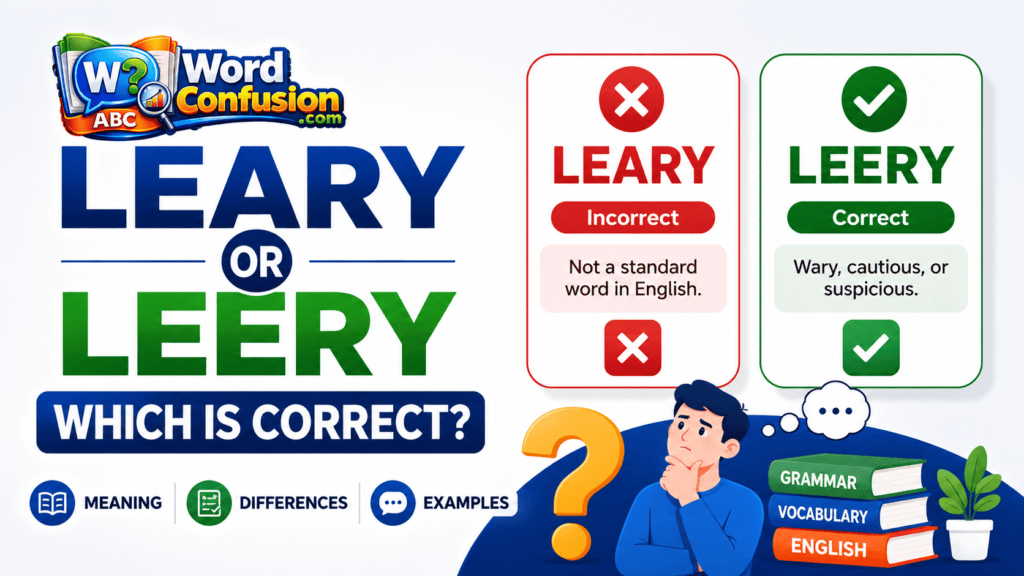
If you are wondering whether leary or leery is the correct spelling, leery is the standard form you should normally use. It means suspicious, wary, or cautious because you do not fully trust someone or something.
Leary is not simply a made-up spelling, though. Merriam-Webster records it as a less common spelling of leery. So the two forms can refer to the same meaning, but leery is the better choice for everyday, academic, and professional writing.
Quick answer: Use leery in most situations.
Example: I’m leery of buying a used car from someone I don’t know.
📖 See also:Holistic or Wholistic: Which Is Correct? Meaning & Examples
Leary or Leery: Quick Answer
| Spelling | Meaning | Recommended? |
| leery | Suspicious, wary, or cautious | Yes |
| leary | A less common spelling of leery | Usually use leery |
Merriam-Webster lists leery as the main form and identifies leary as a less common variant.
So if you are writing an email, essay, article, report, school assignment, or business document, leery is the safest spelling.
What Does Leery Mean?
Leery is an adjective that describes someone who does not completely trust a person, situation, idea, or thing and therefore feels cautious about it.
In simple English, leery means “not fully trusting and therefore careful.”
For example:
- I’m leery of that website because it looks suspicious.
- She was leery of accepting the offer.
- They are leery of making such a large investment.
Cambridge defines leery as not trusting someone or something and usually avoiding it if possible. Oxford similarly explains it as being careful because you suspect there may be danger or a problem.
What Does Leery Imply?
Being leery usually involves some reason for caution.
If you say:
I’m leery of that deal.
you are not necessarily saying that the deal is definitely bad. You are saying that something about it makes you doubtful, suspicious, or unwilling to trust it completely.
That is why leery often appears when someone notices a possible risk, warning sign, or reason for distrust.
Is Leary a Correct Spelling?
Yes, but with an important qualification.
Leary is recorded by Merriam-Webster as a less common spelling of leery. Its meaning is given as “suspicious” or “wary,” and it is often used with of.
So it would be inaccurate to say that leary is never a real word.
However, leery is the standard and much more conventional spelling for general modern English. Merriam-Webster’s main entry for leery lists leary as a less common variant.
The Practical Rule
If you are unsure which spelling to choose:
Choose “leery.”
This is especially appropriate in:
- Academic writing
- Professional writing
- Websites and articles
- Formal correspondence
- School assignments
- General everyday English
Leary vs Leery: What’s the Difference?
The main difference is frequency and standard usage, not meaning.
Leery is the established form you will generally see in dictionaries, edited writing, and everyday English.
Leary is a less common variant spelling of the same adjective.
Compare These Examples
Preferred:
I’m leery of buying anything from that seller.
Less common variant:
I’m leary of buying anything from that seller.
The meaning is essentially the same, but the first sentence uses the spelling most readers will expect.
Bottom Line
Leery = standard/preferred spelling
Leary = less common variant
If you are choosing a spelling for your own writing, use leery.
📖 See also:What Does WDYM Mean in Text? Definition, Tone & Examples
How to Use Leery in a Sentence
One of the most common patterns is:
be leery of + person, thing, or situation
You can also use:
be leery of + verb-ing
Oxford specifically gives both patterns: leery of something/somebody and leery of doing something.
1.Examples With a Person
- I’m leery of people who make promises they cannot keep.
- She is leery of strangers who ask too many personal questions.
- He became leery of his new business partner.
2.Examples With a Thing or Situation
- We are leery of the company’s latest proposal.
- Investors were leery of the sudden price increase.
- She is leery of that website because it looks unreliable.
3.Examples With an -ing Verb
- I’m leery of spending so much money.
- They were leery of signing the contract.
- He is leery of investing without more information.
These patterns reflect the way major learner dictionaries describe the word’s normal usage.
Leery vs Wary vs Suspicious vs Cautious
These words are closely related, but they are not perfect substitutes in every sentence.
| Word | Basic idea | Example |
| Leery | Not fully trusting something or someone | I’m leery of that offer. |
| Wary | Alert and cautious about possible danger or trouble | She is wary of strangers. |
| Suspicious | Believing something may be wrong, dishonest, or untrustworthy | He was suspicious of their motives. |
| Cautious | Taking care to avoid risk or mistakes | She was cautious about investing. |
Merriam-Webster groups leery with words such as wary, cautious, skeptical, careful, and suspicious, while Cambridge lists suspicious and wary as close synonyms.
Leery vs Wary
Leery and wary are very close.
- I’m leery of his proposal.
- I’m wary of his proposal.
Both suggest that you do not completely trust the proposal.
A useful distinction is that wary often emphasizes alertness to possible danger, while leery often emphasizes reluctance or distrust.
Leery vs Suspicious
Suspicious can be stronger.
If you are leery of someone, you are cautious because you do not fully trust them.
If you are suspicious of someone, you may actively believe that they have done something wrong or have dishonest motives.
Leery vs Cautious
Cautious is broader.
You can be cautious simply because something involves risk:
She was cautious when crossing the icy road.
You would not normally use leery here because there is no issue of distrust.
By contrast:
She was leery of the seller.
suggests that she did not fully trust the seller.
Leery Pronunciation
Leery is pronounced approximately like “LEER-ee.”
Cambridge gives these pronunciations:
- UK: /ˈlɪə.ri/
- US: /ˈlɪr.i/
The pronunciation is not the main source of the spelling confusion. The problem is that leary can look like a natural spelling when someone writes the word based on how it sounds.
Why Do People Spell Leery as Leary?

The confusion is understandable because English spelling is not always predictable from pronunciation.
The ending -y appears in many familiar adjectives, and the vowel sound in leery can lead some writers to choose a instead of ee.
There is also an additional reason for confusion: leary is actually recorded as a less common variant, so readers may encounter both spellings.
That makes this different from a simple case where one spelling is completely unattested.
📖 See also:Focusing or Focussing: Which Spelling Is Correct?
Leery Examples in Real Life
Everyday Conversation
I’m a little leery of eating at a restaurant I’ve never heard of.
The speaker is not necessarily saying the restaurant is bad. They simply do not completely trust it yet.
Online Shopping
I’d be leery of buying an expensive phone from a seller with no reviews.
The lack of reviews creates a reason for caution.
Workplace
The team was leery of adopting the new software without testing it first.
The employees are hesitant because they are not yet confident in the software.
Business
Investors were leery of putting more money into the project.
They have concerns that make them reluctant to invest.
Academic or Formal Context
Researchers should be leery of drawing broad conclusions from a small sample.
Here, leery means cautious about accepting a conclusion without sufficient evidence.
Common Mistakes With Leary and Leery
Mistake 1: Assuming Leary Is Completely Wrong
It is better not to describe leary as nonexistent.
Dictionaries record it as a less common spelling variant.
Better guidance: Use leery as your default spelling.
Mistake 2: Thinking Leary and Leery Have Different Meanings
In this spelling variation, they do not represent two different vocabulary words with different meanings.
Leary is a less common spelling of leery.
Mistake 3: Using Leery for Every Type of Caution
Leery normally suggests some degree of distrust, suspicion, or concern.
For general carefulness, cautious may be a better word.
Mistake 4: Confusing Leery With Weary
These words look and sound somewhat similar but have completely different meanings.
- Leery = suspicious or wary
- Weary = tired or exhausted
Example:
She was leery of the stranger.
She was weary after the long journey.
Mistake 5: Forgetting “Of”
A very common structure is leery of:
I’m leery of that idea.
You can also use leery of + -ing:
I’m leery of signing the agreement.
Easy Memory Trick for Leery
Try this:
Leery has “eer” — think “I see something suspicious, so I’m leery.”
Another simple association is:
Leery → wary → careful
When you see leery, think:
“I don’t quite trust this.”
That captures the central idea better than memorizing a complicated dictionary definition.
Leary or Leery: Final Answer
Leery is the spelling you should normally use.
Leary is a recognized but less common spelling variant, not simply a nonexistent word. Merriam-Webster explicitly identifies it as a less common spelling of leery.
So if you are writing something and wondering which form looks correct, choose:
leery
Quick Memory Guide
Leery = standard spelling
Leary = less common variant
Leery = suspicious, wary, or distrustful
Leery of = common usage pattern
Example:
I’m leery of buying a product from that website.
📖 See also:What Does SN Mean in Text? Meanings, Uses & Examples
Frequently Asked Questions
Is leary a real word?
Yes. Leary is recorded as a less common spelling of leery. It means suspicious or wary and is often used with of. However, leery is the preferred spelling for most general writing.
Is leary an incorrect spelling of leery?
Not exactly. Leary is a recognized variant, but it is less common. If you want the standard and more widely expected spelling, use leery.
What does leery mean?
Leery means suspicious, wary, or cautious because you do not fully trust someone or something or suspect there could be a problem.
How do you use leery in a sentence?
The most common pattern is leery of + person, thing, or activity.
For example:
I’m leery of accepting the offer without reading the contract.
You can also use leery of + -ing:
She was leery of investing so much money.
Oxford specifically recognizes both constructions.
Is leery the same as wary?
They are very close in meaning. Both can describe someone who is cautious because they see a possible danger or problem. Leery often emphasizes distrust or reluctance, while wary can emphasize being alert to danger. Cambridge and Oxford both identify wary as a synonym of leery.
Is leery the same as suspicious?
They overlap, but they are not always identical. Leery usually describes a cautious lack of trust, while suspicious can suggest a stronger belief that something is wrong, dishonest, or questionable.
How do you pronounce leery?
It is approximately pronounced “LEER-ee.” Cambridge lists UK /ˈlɪə.ri/ and US /ˈlɪr.i/.
What does “be leery of” mean?
Be leery of means to be cautious or distrustful of someone or something because you suspect there may be a problem or risk.
For example:
Be leery of websites that ask for sensitive information without explaining why.
Conclusion
When choosing between leary and leery, the safest answer is simple: use leery.
Leery means suspicious, wary, or cautious because you do not completely trust someone or something. It is commonly followed by of, as in leery of strangers, leery of the proposal, or leery of investing.
Although leary is recorded as a less common spelling variant, leery is the form readers will generally expect.
If you remember only one thing, remember this:
Leery is the standard spelling; leary is the less common variant.
Looking for more English word meanings, grammar tips, and commonly confused words? Visit the WordConfusion homepage to explore our latest language guides, spelling differences, vocabulary explanations, text abbreviations, and practical examples. Whether you’re learning English or improving your writing skills, you’ll find clear, easy-to-understand resources for everyday communication.
Written by
 Abdul Moeed
Abdul Moeed is a professional content writer and SEO link-building specialist with 5+ years of experience. He creates search-optimized content and develops effective SEO strategies that improve website visibility, authority, and organic growth.
View LinkedIn profileLatest posts
 What Does PG Mean in Text? Meaning, Examples & Usage
 What Does OFCC Mean in Text? Meaning, Uses & Examples
 What Does MSG Mean in Text? Meaning, Examples & Usage
 What Does STY Mean in Text? Meaning, Examples & Usage
 What Does “Twin” Mean in Slang? Meaning, Text & Examples
 What Does LMC Mean in Text? Meaning, Examples & Usage