Humanize AI Text for Blogs: How to Keep E-E-A-T Signals Intact

A good humanizer is a very thorough cleaner. Give it a stiff AI paragraph, and it scrubs out the repetition, the stock transitions, the sentences that all march to the same beat. The trouble is that cleaners don’t always know what’s dirt and what’s evidence. Run a food blogger’s line “I burned the first batch at 220°C, so I dropped it to 200 and added two minutes” through a careless rewrite, and you can get back “Baking at high temperatures may lead to burnt results.” Smoother, maybe. But the proof that a real person stood in a real kitchen is gone. That’s the risk when you humanize AI text online for a blog that depends on search. The words get better and the signals Google looks for- experience, expertise, authoritativeness, and trust- quietly get worse.
What E-E-A-T Is Actually Asking
E-E-A-T sounds like a technical checklist. It’s really four plain questions a reader asks about any post:
- Experience: Were you actually there? Did you use it, cook it, visit it, fix it?
- Expertise: Do you know this subject well enough to be worth listening to?
- Authoritativeness: Do other people and sources back you up?
- Trust: Can I rely on what this page tells me?
Google’s own guidance on creating helpful content says plainly that of these, “trust is most important,” and it asks site owners to make the “Who, How, and Why” behind content clear, including how automation or AI was used. It also asks whether content shows “first-hand expertise and a depth of knowledge,” such as from using a product or visiting a place.
Notice what those questions have in common. Every one of them is answered by specifics: a named author, a tested result, a cited source, an honest caveat. Those specifics are exactly what a heavy-handed rewrite tends to flatten when you humanize content in bulk. Tools like UnAIMyText can save hours on the rhythm and readability side. This guide shows how to use that kind of tool so it polishes your post without wiping off your fingerprints.
Polish the Connective Tissue, Protect the Evidence
Before you humanize content, sort your sentences. The simplest way to think about it: every blog post has two kinds of sentences. Some carry evidence. Others just move the reader from one piece of evidence to the next. When you humanize AI text online, the second kind is fair game. The first kind needs protection.
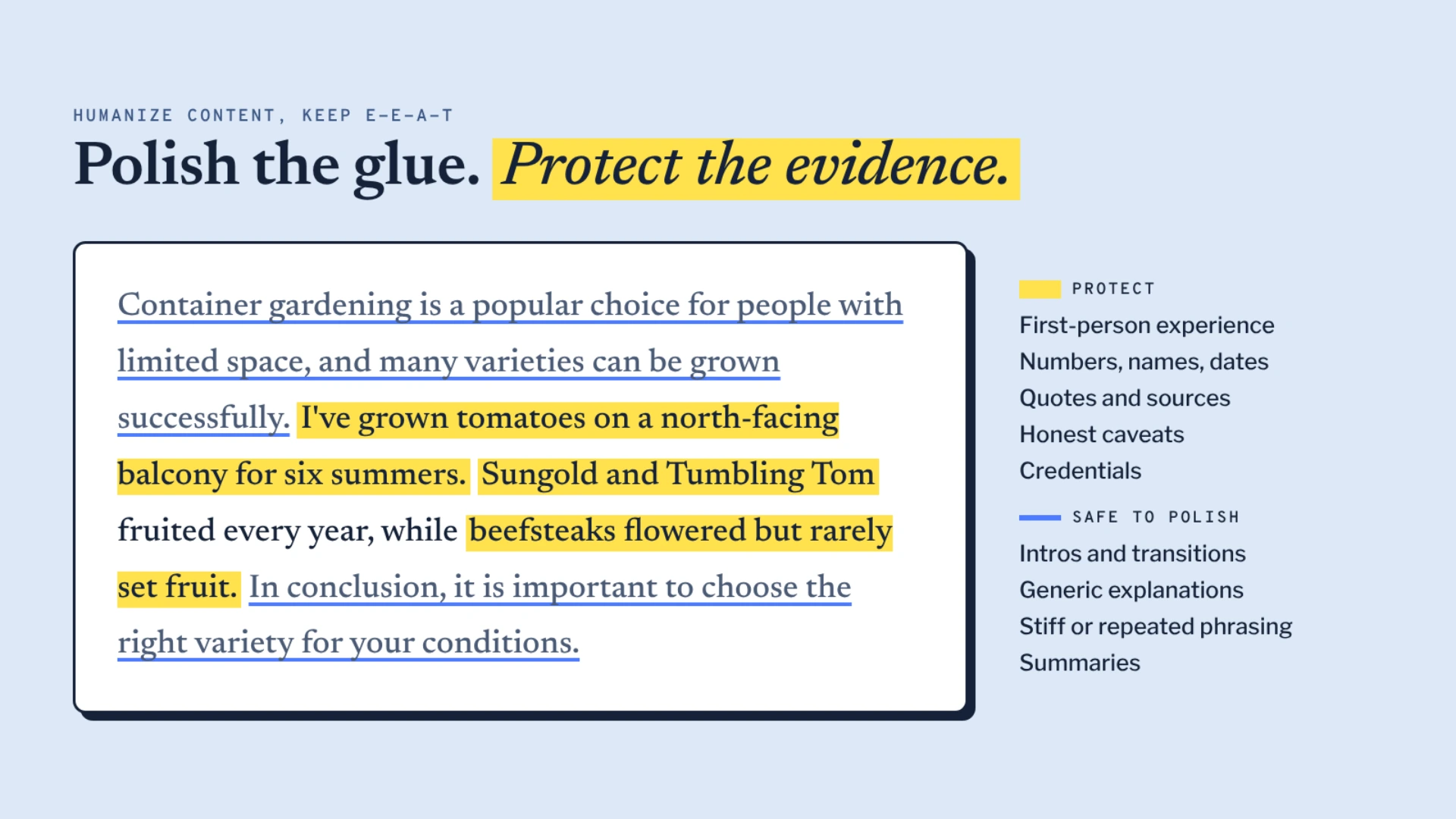
Safe to polish: introductions and transitions, generic explanations, summaries, repetitive sentence openings, stiff phrasing like “it is important to note that,” and anywhere the rhythm feels mechanical.
Protect at all costs:
- First-person experience (“I tested,” “we found,” “on my third try”)
- Numbers, measurements, prices, dates
- Names of people, products, places, and studies
- Direct quotes and their attribution
- Links to sources and the claims attached to them
- Qualifiers and honest caveats (“in our test,” “for most users,” “this may not apply if”)
- Credentials and context (“as a registered dietitian,” “after ten years fixing bikes”)
Those last two items matter more than they look. Qualifiers are trust signals. A rewrite that turns “this worked for most of our test group” into “this works” has made the sentence punchier and the page less honest. Readers and quality raters both notice overconfidence.
A Workflow to Humanize Content Without Losing E-E-A-T
The six steps below are how to humanize content in a way that keeps those signals in place.
1. Add the experience before anything else. If the AI draft has no first-hand material, no tool can supply it. Before humanizing, add your own results, photos, observations, and opinions. This is the “E” in E-E-A-T, and it’s the part AI can’t fake well.
2. Highlight your protect list. Go through the draft and highlight every sentence that carries a number, a name, a quote, a link, a credential, or a first-person claim. It takes five minutes and gives you a map of what must survive when you humanize content.
3. Humanize the unhighlighted parts. Paste the connective sections into your tool, one section at a time, rather than the whole post. When you humanize AI text online in smaller chunks, it’s much easier to see what changed.
4. Diff-check every protected sentence. Compare the output with your highlighted original. Did a number change? Did “I” become “you” or “one”? Did a source link lose the claim it supported? Did a caveat vanish? Restore anything that moved.
5. Show who wrote it and how. Add a byline that links to an author page with real credentials. Where readers would expect it, add a short note on how the post was produced. Google’s guidance specifically asks for this kind of “How” transparency.
6. Read it as a skeptic. Read the finished post as someone who doubts you. Would they believe you did what you say? Would they trust the numbers? If anything sounds like it came from nowhere, add the evidence or cut the claim.
What a Careless Rewrite Does to E-E-A-T
Here’s a paragraph from a hypothetical gardening blog, run through two different approaches.
Original draft with experience added:
I’ve grown tomatoes in containers on a north-facing balcony for six summers. The two varieties that consistently gave me fruit were Sungold and Tumbling Tom. Larger beefsteak types flowered but rarely set fruit, which matches what the seed packets say about needing six to eight hours of direct sun.
After a careless humanizing pass:
Growing tomatoes in containers can be rewarding, even in less sunny spots. Some varieties tend to perform better than others, while larger types may struggle with limited light. Experts generally recommend plenty of direct sunlight for the best results.
Read them side by side. This is what happens when people humanize AI text online by pasting a whole post and accepting whatever comes back. The second version is perfectly fluent and has lost almost every E-E-A-T signal: the six summers, the balcony, the named varieties, the honest observation about beefsteaks, and where the sun advice came from. It now sounds like a thousand other gardening posts, which is precisely the problem.
After a careful pass on connective text only:
Six summers on a north-facing balcony have taught me which tomatoes put up with shade. Sungold and Tumbling Tom fruited every year. Beefsteaks flowered but rarely set fruit, which fits the seed-packet advice of six to eight hours of direct sun.
Tighter rhythm, every fact intact. That’s the target whenever you humanize content for a blog that wants to rank.
What Quality Raters Are Trained to Spot
Google’s quality raters don’t rank pages directly, but their guidelines show what Google’s systems are designed to reward. In January 2025, Google updated those guidelines with specific language on AI content. As PPC Land’s breakdown of the update explains, pages where “almost all Main Content is copied or paraphrased with no effort or added value” can receive the Lowest rating, and raters are told to watch for paraphrased content that only repeats common knowledge.
That’s a warning for anyone who uses humanizers as a substitute for substance. If you humanize AI text online without adding anything new, the result is still paraphrase. A rewrite of thin content is still thin content. The data on rankings points the same way. In a study of 42,000 top-ranking blog pages, Semrush found human-written content held the number-one spot 80% of the time, compared with 9% for purely AI-generated pages. AI-assisted content ranks well. Content with nobody’s experience in it struggles at the top.
Trust Signals That Live Outside the Text
Not every E-E-A-T signal sits in your sentences. These live around them, and no humanizer touches them, so check them every time you humanize AI text online and publish:
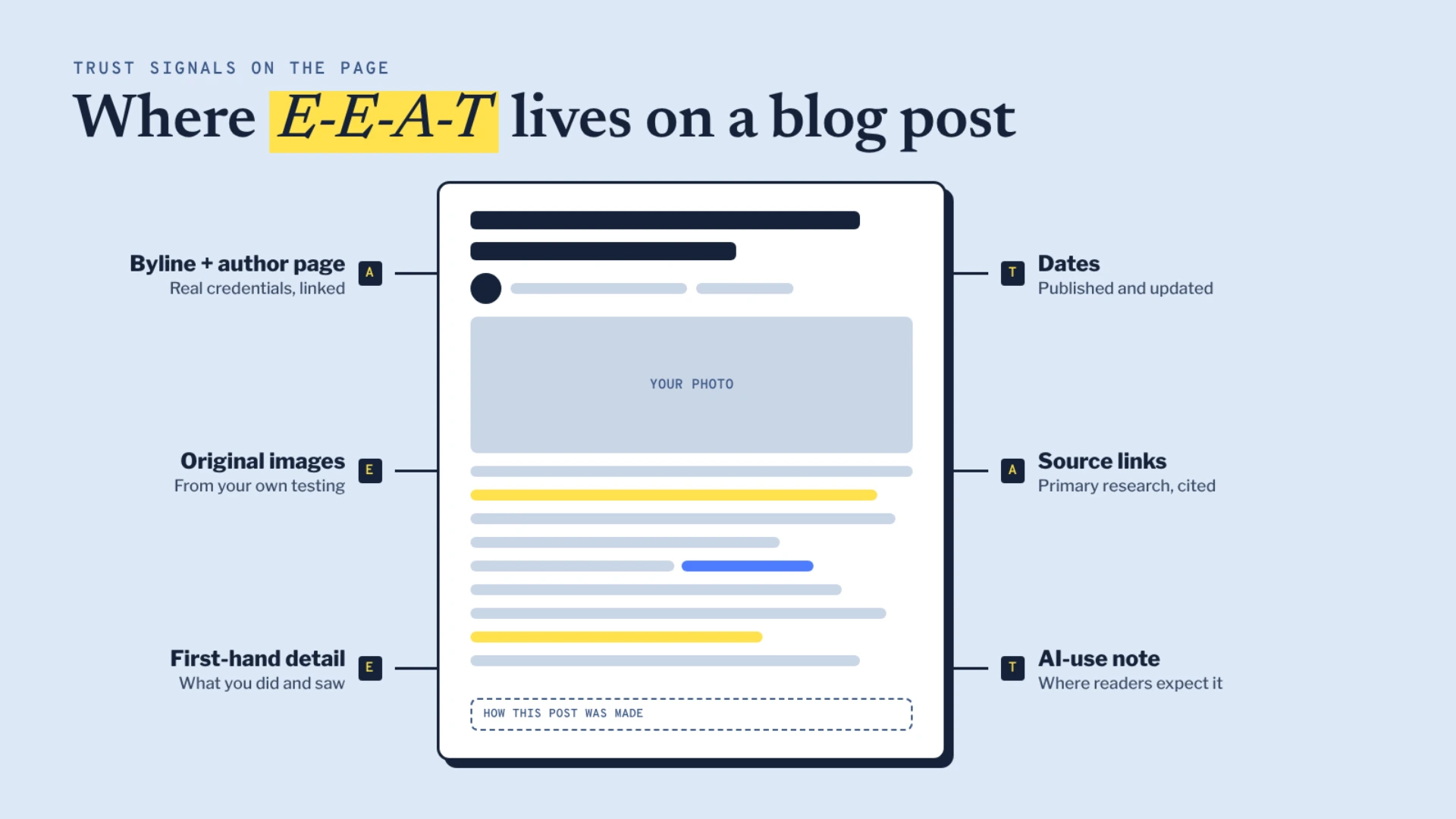
- Byline and author page with real credentials and links to the author’s other work.
- Published and updated dates, especially on topics that change.
- Original images from your own testing, rather than stock photos.
- Source links to primary research, not to other blogs repeating it.
- A short disclosure of how AI was used, where readers would reasonably expect one.
- Contact and about pages that make it clear who stands behind the site.
Where Humanizers Earn Their Keep
None of this means you should avoid humanizers. Used well, they’re a real help with the parts of a post that drag: the stiff intros, the “furthermore” transitions, the paragraphs where every sentence is the same length. Readers notice those patterns even when they can’t name them. Raptive’s research found people rate content they suspect is AI-written nearly 50% less trustworthy, whether or not it actually is. Smoother writing protects trust too, and bloggers who humanize content this way usually find the edit goes faster, because they only touch the parts that need it.
The goal is to humanize content where it reads like a machine and leave alone the places where it already reads like you. Polish the connective tissue. Protect the evidence. That balance is what lets you humanize AI text online quickly and still publish posts that show real experience and earn trust.
If you’d like to understand why some passages still get flagged even after a careful edit, this explainer on how AI detectors work walks through the patterns they measure. It’s useful context for deciding which sections to humanize and which to rewrite by hand.
Written by
 Abdul Moeed
 is a professional content writer and SEO link-building specialist with 5+ years of experience. He creates search-optimized content and develops effective SEO strategies that improve website visibility, authority, and organic growth.
View LinkedIn profileLatest posts
 What Are Peptides: Meaning, Types, Uses & Safety Facts
 Furlough Meaning: Definition, Examples, Pay & Layoff Rules
 Discernment Meaning: Definition, Origin, Examples & Uses
 E.g. Meaning in Text: Full Form, Usage, Examples & i.e. Difference
 TMI Meaning in Text: Definition, Examples, Uses & Replies
 Simple Ways to Make Learning Spanish Easier