Bearable vs Bareable: Which Spelling Is Correct?

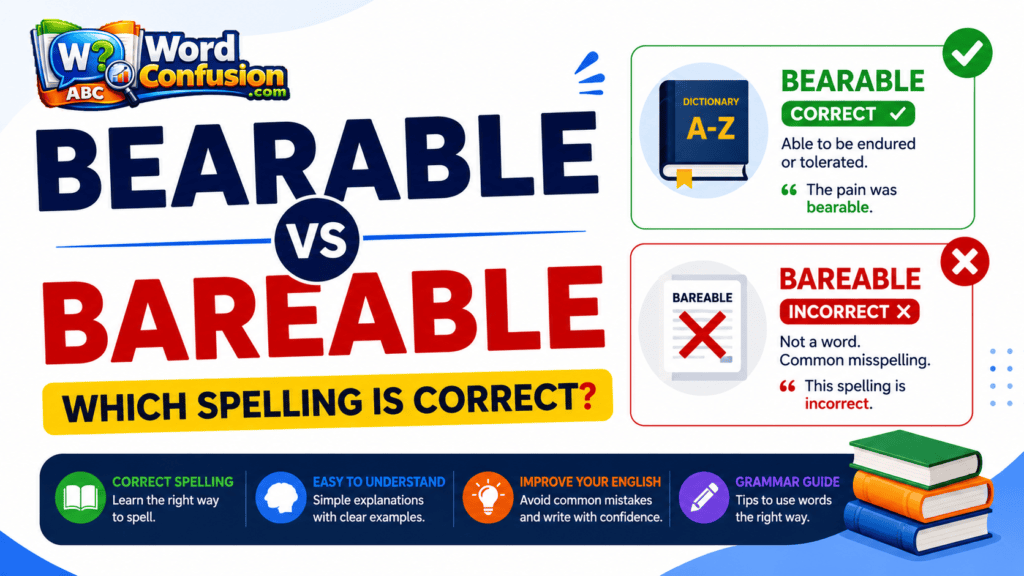
If you are wondering whether bearable or bareable is the correct spelling, the answer is bearable. Bearable means “able to be endured, tolerated, or dealt with.” Bareable is generally considered a misspelling or nonstandard form when used with this meaning.
The easiest way to remember it is simple: If you can bear something, it is bearable.
📖 See also:What Does BFFR Mean in Text? Meaning, Slang & Examples
Bearable vs Bareable: Quick Answer
| Word | Correct for this meaning? | Meaning |
| Bearable | ✅ Yes | Able to be endured or tolerated |
| Bareable | ❌ Generally no | A common misspelling/nonstandard form of bearable |
| Bear | ✅ Yes | To endure, tolerate, carry, or withstand |
| Bare | ✅ Yes | Uncovered, exposed, or lacking something |
| Unbearable | ✅ Yes | Too difficult or painful to endure |
So, when you want to say that something can be tolerated, use bearable.
Correct: The heat was bearable after sunset.
Incorrect: The heat was bareable after sunset.
What Does Bearable Mean?
Bearable is an adjective that describes something that can be endured, tolerated, accepted, or dealt with.
For example, if a situation is difficult but you can still cope with it, you can call it bearable.
- The pain was bearable.
- The workload is bearable now.
- The noise became bearable after the machine was turned off.
- The weather is hot, but still bearable.
Dictionaries such as Cambridge and Oxford define bearable around the idea of something being capable of being endured or dealt with.
Bearable Definition
Bearable means:
Able to be endured, tolerated, accepted, or dealt with.
It is an adjective, so it normally describes a person, thing, situation, experience, or condition.
For example:
The pain is bearable.
Here, bearable describes the noun pain.
Is Bareable a Word?
If you search for “is bareable a word?”, the safest answer is that bareable is not the standard spelling you should use when you mean “able to be endured.”
The standard English form is:
bearable
The form bareable does appear in real-world writing and is recorded by Wiktionary as an eggcorn or misspelling of bearable.
That distinction matters because saying that a spelling “never appears” would be inaccurate. People do use bareable, usually because bear and bare sound alike.
For standard English writing, especially in school, business, academic, or professional contexts, use bearable.
Why Is It Bearable, Not Bareable?
The spelling becomes much easier to understand when you look at the root word.
Bear Means “Endure”
One meaning of the verb bear is to endure, tolerate, or withstand.
For example:
I cannot bear the pain.
From this meaning of bear, we get:
The pain is bearable.
The connection is:
bear → endure → bearable
That is why the word is spelled with bear, not bare.
Bare Has a Different Meaning
Bare is also a real English word, but it has a completely different meaning.
It can mean uncovered, exposed, empty, or minimal.
Examples:
- bare feet — feet without shoes or socks
- bare walls — walls without decoration
- bare skin — uncovered skin
- a bare room — a room with very little furniture
So:
bear = endure
but:
bare = uncovered/exposed
Because these words sound alike, it is easy to confuse them in writing.
Bearable vs Bareable: What’s the Difference?
The main difference is that bearable is the standard spelling for something that can be endured or tolerated.
Bareable is commonly produced by confusing bear with bare.
Compare:
The pain was bearable.
The sentence means that the pain could be endured.
But bare has nothing to do with enduring pain. Its meaning relates to being uncovered or lacking something.
This is a classic example of a spelling confusion caused by homophones—words that sound the same but have different meanings and spellings.
How Do You Spell Bearable Correctly?
The correct spelling is:
B-E-A-R-A-B-L-E
The easiest memory trick
Remember:
If you can bear it, it’s bearable.
For example:
I can bear the cold.
The cold is bearable.
This memory trick connects the spelling directly to the meaning.
You can also remember the opposite:
bearable ↔ unbearable
If something is unbearable, you cannot tolerate or endure it. Remove the un-, and you get bearable.
📖 See also:Pastime or Passtime? Which Spelling Is Correct?
How Is Bearable Pronounced?
Bearable is pronounced approximately like:
BAIR-uh-buhl
The exact pronunciation varies slightly between British and American English. Cambridge lists UK and US pronunciations for the word.
The pronunciation contributes to the spelling confusion because bear and bare are homophones in standard English.
So someone may hear the word and instinctively write bareable, even though the correct spelling is bearable.
Bearable in a Sentence
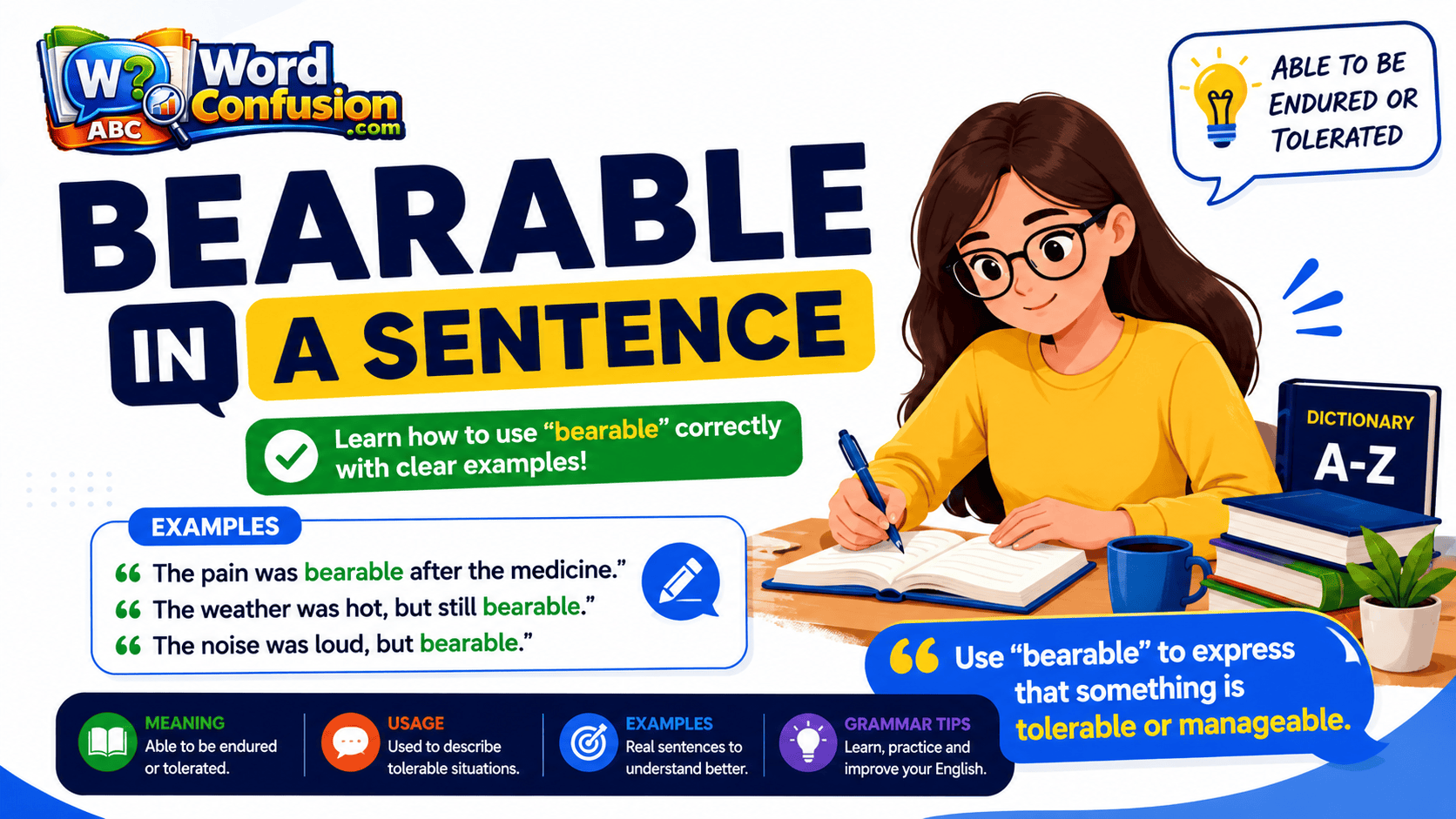
Here are some natural examples showing how bearable is used.
Everyday Examples
The heat became bearable once the sun went down.
The noise is bearable with the windows closed.
The long journey was surprisingly bearable.
Work Examples
The workload became more bearable after another employee joined the team.
Working from home made the commute-related stress more bearable.
School Examples
The difficult assignment was bearable because we had plenty of time to finish it.
The lecture was long, but it was still bearable.
Conversation Examples
“Is the pain bearable now?”
“The wait is bearable because we have somewhere comfortable to sit.”
Professional Example
The revised schedule makes the additional workload more bearable for the team.
Notice that bearable normally describes something that is difficult, unpleasant, painful, or inconvenient but still possible to tolerate.
Bearable vs Tolerable vs Unbearable
These words are closely related, but they are not always interchangeable in exactly the same way.
| Word | Basic meaning | Example |
| Bearable | Able to be endured | The pain is bearable. |
| Tolerable | Acceptable or able to be tolerated | The working conditions are tolerable. |
| Unbearable | Impossible or extremely difficult to endure | The noise was unbearable. |
Bearable and tolerable can often describe similar situations. Unbearable is the direct opposite of bearable.
For example:
The heat is bearable.
means you can endure it.
But:
The heat is unbearable.
means it has become too difficult to endure.
📖 See also:What Does LMS Mean in Text? Meaning, Examples & Uses
Common Bearable Spelling Mistakes
The most common mistake is replacing bear with bare.
| Incorrect or nonstandard form | Correct form |
| ❌ bareable | ✅ bearable |
| ❌ bearible | ✅ bearable |
| ❌ bareible | ✅ bearable |
The most important one to remember is:
❌ bareable → ✅ bearable
Don’t let the word bare trick you simply because it sounds the same as bear.
Why Do People Spell Bearable as Bareable?
There are several reasons for the confusion.
1. Bear and bare sound alike
Because bear and bare are homophones, hearing the word does not tell you which spelling to choose.
2. Bare is a familiar word
People already know words such as:
- bare feet
- bare skin
- bare walls
- bare hands
That familiarity can make bareable look plausible.
3. The connection to “bear = endure” is easy to miss
Once you understand that bear can mean “endure,” the spelling becomes much more logical:
bear → bearable
rather than:
bare → bareable
Frequently Asked Questions
Is it bearable or bareable?
Bearable is the correct standard spelling when you mean “able to be endured or tolerated.” Bareable is generally a misspelling or nonstandard form used in its place.
Is bareable a correct spelling?
For standard English, use bearable. Bareable does occur in real-world usage and is recorded as a nonstandard form or eggcorn of bearable, but it is not the spelling you should normally use in formal writing.
Is bearable a word?
Yes. Bearable is a standard English adjective meaning capable of being endured, tolerated, or dealt with.
How do you spell bearable?
Spell it:
B-E-A-R-A-B-L-E
A useful memory trick is: If you can bear it, it’s bearable.
What does bearable mean?
Bearable means something can be endured, tolerated, accepted, or dealt with.
For example:
The pain was difficult but bearable.
Why do people spell bearable as bareable?
The mistake usually happens because bear and bare sound alike. Since bare is also a familiar English word, bareable can look like a logical spelling even though bearable is the standard form for this meaning.
Is bearable an adjective?
Yes. Bearable is an adjective.
For example:
The temperature is bearable.
Here, bearable describes the noun temperature.
What is the difference between bear and bare?
Bear can mean to endure, tolerate, carry, or withstand.
Bare means uncovered, exposed, empty, or minimal.
For example:
I cannot bear the pain.
but:
He walked with bare feet.
What is the opposite of bearable?
The opposite is unbearable.
Bearable means something can be endured, while unbearable means it is too difficult, painful, or unpleasant to endure.
📖 See also:Ingage vs Engage: Which Is Correct? Meaning & Examples
Final Answer: Bearable or Bareable?
The correct standard spelling is bearable.
Use bearable when you mean something that can be endured, tolerated, or dealt with. Bareable is generally a misspelling or nonstandard form caused by confusion between bear and bare.
The easiest rule to remember is:
If you can bear it, it’s bearable.
So if you’re writing about pain, pressure, heat, noise, stress, workload, or any other difficult experience that can still be tolerated, choose bearable.
Looking for more English word meanings, grammar tips, and commonly confused words? Visit the WordConfusion homepage to explore our latest language guides, spelling differences, vocabulary explanations, text abbreviations, and practical examples. Whether you’re learning English or improving your writing skills, you’ll find clear, easy-to-understand resources for everyday communication.
Written by
 Abdul Moeed
Abdul Moeed is a professional content writer and SEO link-building specialist with 5+ years of experience. He creates search-optimized content and develops effective SEO strategies that improve website visibility, authority, and organic growth.
View LinkedIn profileLatest posts
 What Does PG Mean in Text? Meaning, Examples & Usage
 What Does OFCC Mean in Text? Meaning, Uses & Examples
 What Does MSG Mean in Text? Meaning, Examples & Usage
 What Does STY Mean in Text? Meaning, Examples & Usage
 What Does “Twin” Mean in Slang? Meaning, Text & Examples
 What Does LMC Mean in Text? Meaning, Examples & Usage