Pastime or Passtime? Which Spelling Is Correct?

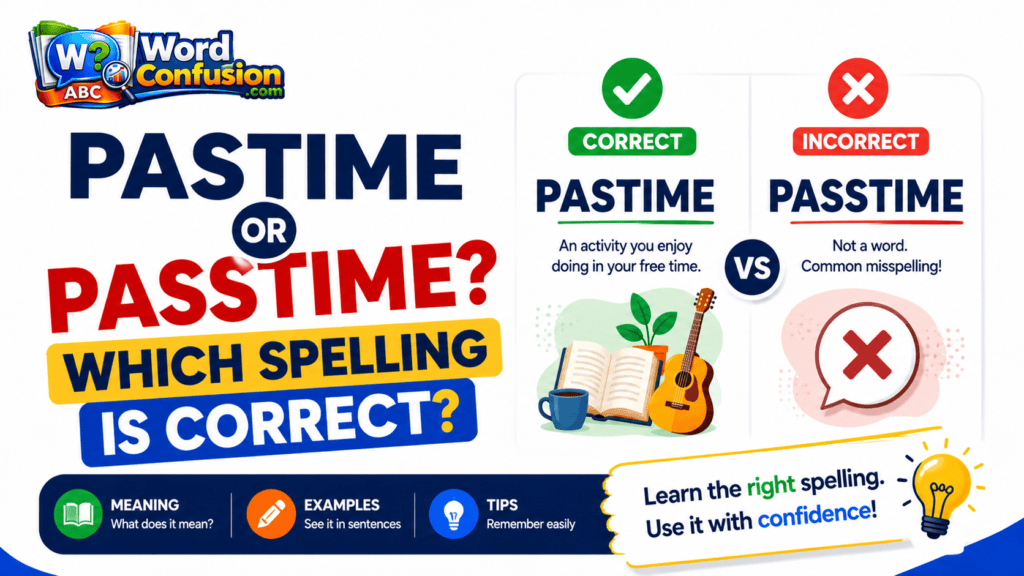
If you are wondering whether pastime or passtime is correct, the answer is pastime.
Pastime is the standard modern English spelling for a noun meaning an enjoyable activity you do during your free time. Reading, gardening, painting, playing chess, and photography can all be pastimes. Passtime is not the standard modern spelling.
The confusion is understandable because pastime is connected historically with the idea of passing time. That is also why it is easy to confuse pastime with the two-word phrase pass time.
📖 See also:What Does LMS Mean in Text? Meaning, Examples & Uses
Pastime or Passtime: The Quick Answer
Pastime is the correct spelling.
- ✅ pastime — correct modern spelling
- ❌ passtime — not the standard modern spelling
- ✅ pass time — correct when used as a verb phrase
For example:
Reading is my favorite pastime.
But:
I read to pass time while waiting.
The two expressions are related in meaning, but they have different grammatical functions.
What Does Pastime Mean?
Pastime is a noun that means an activity you enjoy doing when you are not working or otherwise occupied. Cambridge Dictionary defines it as an activity done for enjoyment.
In simple English, a pastime is something enjoyable you do in your spare time.
Common Pastime Examples
Some common pastimes include:
- Reading
- Gardening
- Painting
- Photography
- Playing chess
- Cooking
- Hiking
- Collecting things
- Playing music
- Doing crafts
For example:
Reading is a relaxing pastime.
Gardening has become her favorite pastime.
Chess is a popular pastime for people who enjoy strategy games.
A pastime does not have to be a formal hobby. It can be any enjoyable activity that occupies your free time.
Why Do People Write “Passtime”?
The spelling passtime looks logical because English speakers may connect the word with the phrase pass time.
For example:
I read books to pass time.
It is therefore easy to imagine that an activity used to pass time should be called a passtime.
However, the standard modern noun is spelled pastime, with one s in the middle:
pastime
The spelling is not simply a modern mistake with no historical explanation. The word has a long history connected with the idea of passing time, which helps explain why forms such as pass-time and passtime can appear in older contexts.
For modern standard English, however, use pastime.
Is “Passtime” a Word?
If you encounter passtime, it is usually intended to mean pastime, but it is not the standard modern spelling you should use in ordinary English writing.
This distinction matters because English contains many older spellings and historical forms that are no longer standard today.
So, for schoolwork, professional writing, websites, emails, and other modern English contexts, write:
pastime
rather than:
passtime
Is “Pastime” One Word or Two?
Pastime is written as one word.
Correct:
Reading is my favorite pastime.
Not:
Reading is my favorite past time.
However, past time can appear as a separate phrase when past and time have their ordinary grammatical meanings.
Pastime vs Passtime vs Pass Time vs Past Time
These forms look similar, but they do not all mean the same thing.
| Form | Correct? | Grammar | Meaning | Example |
| pastime | ✅ | Noun | An enjoyable activity | Reading is my pastime. |
| passtime | ❌ in modern standard usage | — | Usually intended to mean pastime | Use pastime instead. |
| pass time | ✅ | Verb phrase | To spend or occupy time | I read to pass time. |
| past time | ✅ in appropriate contexts | Phrase | Time that has passed, or something overdue depending on context | It is past time to leave. |
The most important distinction is between pastime and pass time.
Pastime as a Noun
Pastime names an activity.
Gardening is a peaceful pastime.
Football is a popular pastime in many countries.
Her favorite pastime is painting.
Because pastime is a noun, it can appear after words such as my, your, a, favorite, and popular.
Pass Time as a Verb Phrase
Pass time describes an action: spending or occupying time.
I listen to music to pass time.
She played a game to pass the time.
We talked to pass the time while waiting for the bus.
A common expression is:
pass the time
So remember:
pastime = the activity
pass time = the action of occupying time
Past Time as a Separate Phrase
Past time is different again.
For example:
It is past time to start the meeting.
Here, past means that something is overdue or should already have happened.
Another example is:
Those events belong to a past time.
So don’t automatically treat past time as another spelling of pastime.
📖 See also:Ingage vs Engage: Which Is Correct? Meaning & Examples
How to Spell Pastime Correctly
The easiest spelling to remember is:
PAS + TIME = PASTIME
There is only one s between pa and time:
pastime
A useful memory trick is:
You pass time with a pastime.
Think of the relationship this way:
pass time → pastime
You pass time by doing a pastime.
This connection can help you remember both the spelling and the difference in grammar.
How to Use “Pastime” in a Sentence
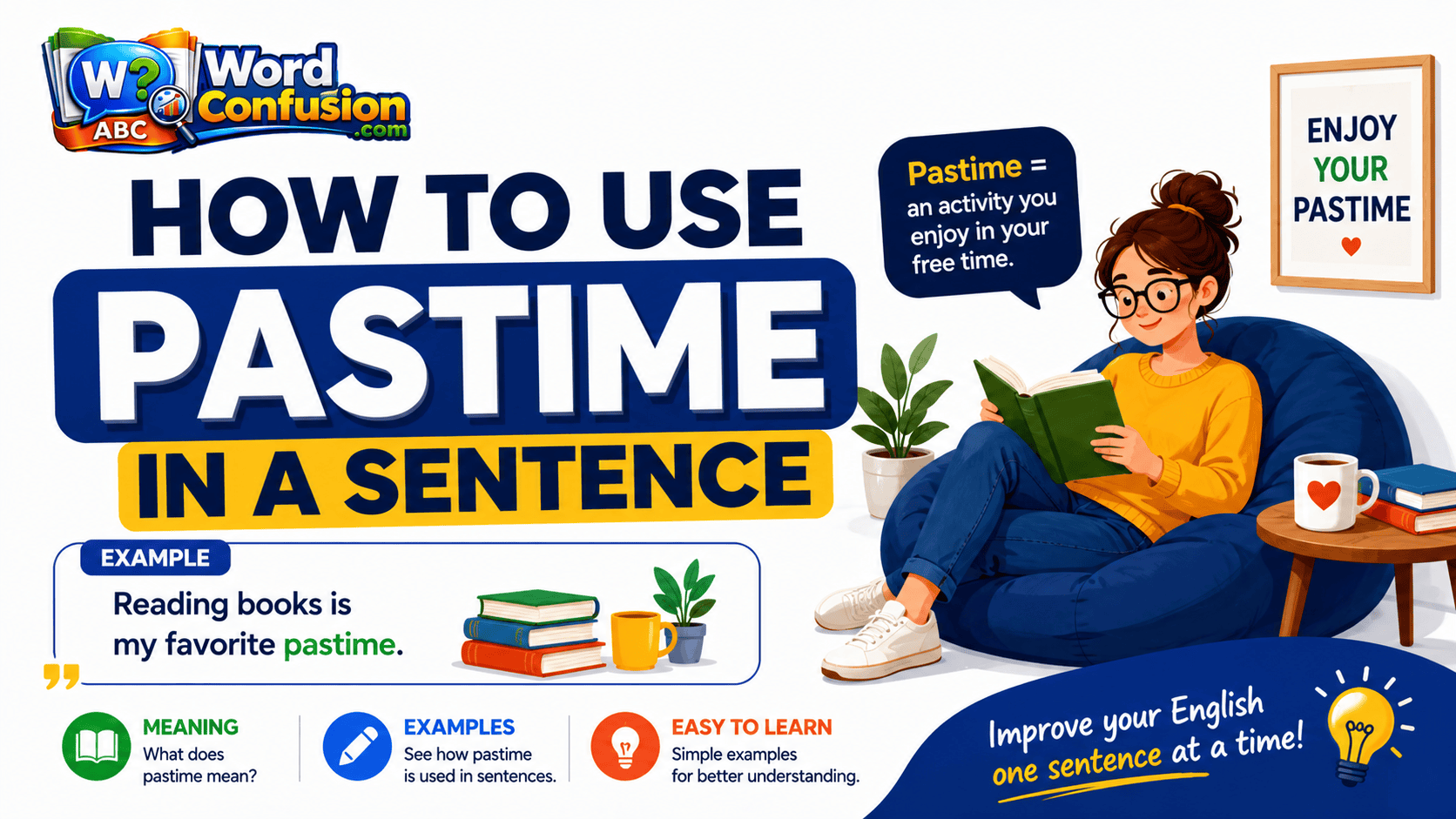
Here are some natural examples.
Everyday Examples
Reading is my favorite pastime.
Gardening is a relaxing pastime.
Playing cards is a popular pastime for my grandparents.
Photography became his favorite pastime after he bought a camera.
She enjoys painting as a weekend pastime.
Academic Examples
The study examined how students spend their free time and which pastimes they prefer.
Reading can be an educational pastime as well as an enjoyable one.
Workplace Examples
Hiking is one of my favorite pastimes outside work.
His main pastime is learning about new technology.
Notice that pastime works naturally in both casual and formal sentences.
Pastime Pronunciation
Pastime is generally pronounced like:
PASS-time
Cambridge gives different British and American pronunciations, but the spelling remains pastime in both varieties of English.
The pronunciation can make the spelling feel slightly less obvious, especially for learners who expect the word to be written as passtime.
Even so, remember that pronunciation does not determine the standard spelling.
Is Pastime the Same as a Hobby?
Pastime and hobby are closely related, but they are not always exact synonyms.
A hobby is an activity someone regularly does for pleasure, often as a personal interest. Cambridge defines a hobby as an activity someone does for pleasure when they are not working.
A pastime is broader. It can refer to an enjoyable activity that occupies someone’s free time.
For example:
Gardening is my hobby.
and:
Gardening is my favorite pastime.
Both sentences are natural.
A hobby often suggests an ongoing personal interest, while pastime emphasizes the activity as a way of enjoying or occupying free time.
📖 See also:What Does JFC Mean in Text? Meaning, Slang & Examples
Common Mistakes With Pastime
Here are some frequent spelling and usage mistakes.
Mistake 1: Writing “passtime”
❌ Reading is my favorite passtime.
✅ Reading is my favorite pastime.
Mistake 2: Writing “past time” when you mean a hobby
❌ Photography is my favorite past time.
✅ Photography is my favorite pastime.
When you mean an enjoyable activity, use pastime as one word.
Mistake 3: Confusing “pastime” with “pass time”
❌ My favorite pass time is reading.
✅ My favorite pastime is reading.
But:
I read to pass the time.
Here, pass the time is a verb phrase, so the two-word form is correct.
Mistake 4: Assuming “passtime” must be correct because of “pass time”
English spelling does not always follow the most obvious combination of words. Some compounds have developed into established spellings over time.
That is why the safest rule is simple:
Use “pastime” for the noun.
Pastime Synonyms
Depending on the context, possible synonyms include:
- Hobby
- Recreation
- Leisure activity
- Activity
- Pursuit
- Amusement
- Diversion
- Interest
These words are related, but they are not interchangeable in every sentence.
For example:
Reading is my favorite pastime.
sounds natural.
Reading is my favorite diversion.
is also possible, but it gives the sentence a slightly different tone.
Why Is “Pastime” Spelled That Way?
The spelling makes more sense when you consider the history of the word.
Pastime is associated with the older idea of passing time through an enjoyable activity. That historical connection helps explain why modern speakers may instinctively write passtime.
However, modern standard English has settled on the single-word spelling:
pastime
This is a useful reminder that English spelling is shaped by historical usage, not always by the way a word might logically be constructed today.
British vs American English: Is the Spelling Different?
No.
Pastime is the standard spelling in both British and American English.
The pronunciation can vary somewhat between the two varieties, but you should not change the spelling to passtime in American English or British English. Cambridge lists pastime in both its UK and US pronunciation information.
So:
- 🇬🇧 British English: pastime
- 🇺🇸 American English: pastime
There is no standard regional spelling difference here.
Quick Reference: Pastime vs Passtime
| Question | Answer |
| Which spelling is correct? | Pastime |
| Is “passtime” standard modern English? | No |
| Is “pastime” one word? | Yes |
| What part of speech is pastime? | Noun |
| What does pastime mean? | An enjoyable activity done during free time |
| Is “pass time” correct? | Yes, as a verb phrase |
| Is “past time” the same as “pastime”? | No |
| Is the spelling different in British and American English? | No |
| What is an easy memory trick? | You pass time with a pastime. |
Frequently Asked Questions
Is it pastime or passtime?
Pastime is the correct modern English spelling. It is a noun meaning an enjoyable activity that you do during your free time. Passtime is not the standard modern spelling.
Is “passtime” a correct word?
Not as the standard modern spelling of the noun. If you mean an enjoyable leisure activity, use pastime.
How do you spell pastime correctly?
Spell it pastime: P-A-S-T-I-M-E.
What does pastime mean?
A pastime is an activity that you do for enjoyment, especially during your free time. Reading, gardening, painting, and playing chess can all be pastimes.
Is pastime one word or two?
Pastime is one word when it means an enjoyable leisure activity.
Reading is my favorite pastime.
What is the difference between pastime and pass time?
Pastime is a noun for an enjoyable activity.
Reading is a relaxing pastime.
Pass time is a verb phrase meaning to spend or occupy time.
I read to pass time while waiting.
Is it “past time” or “pastime”?
Both forms can be correct, but they have different meanings.
Pastime means an enjoyable activity:
Gardening is my pastime.
Past time consists of two separate words and has a different grammatical meaning:
It is past time to leave.
How do you use pastime in a sentence?
You can use pastime as a noun:
Photography is his favorite pastime.
Reading is a popular pastime.
Gardening has become a relaxing pastime for her.
Why do people spell pastime as “passtime”?
The error is understandable because pastime is historically connected with the idea of passing time. People may therefore connect it directly with pass time and write passtime. Modern standard English, however, uses pastime.
📖 See also:Implicit vs Complicit: Meaning, Differences & Examples
Conclusion
If you are choosing between pastime and passtime, use pastime.
Pastime is the standard modern spelling of the noun meaning an enjoyable activity done during free time. Passtime is not the standard spelling you should use in modern English writing.
Also remember the important difference between pastime and pass time:
A pastime is an activity; you pass time by doing it.
So if reading, gardening, gaming, sports, photography, or another enjoyable activity fills your free time, it can be your pastime—not your passtime.
Looking for more English word meanings, grammar tips, and commonly confused words? Visit the WordConfusion homepage to explore our latest language guides, spelling differences, vocabulary explanations, text abbreviations, and practical examples. Whether you’re learning English or improving your writing skills, you’ll find clear, easy-to-understand resources for everyday communication.
Written by
 Abdul Moeed
Abdul Moeed is a professional content writer and SEO link-building specialist with 5+ years of experience. He creates search-optimized content and develops effective SEO strategies that improve website visibility, authority, and organic growth.
View LinkedIn profileLatest posts
 What Does PG Mean in Text? Meaning, Examples & Usage
 What Does OFCC Mean in Text? Meaning, Uses & Examples
 What Does MSG Mean in Text? Meaning, Examples & Usage
 What Does STY Mean in Text? Meaning, Examples & Usage
 What Does “Twin” Mean in Slang? Meaning, Text & Examples
 What Does LMC Mean in Text? Meaning, Examples & Usage