Ingage vs Engage: Which Is Correct? Meaning & Examples

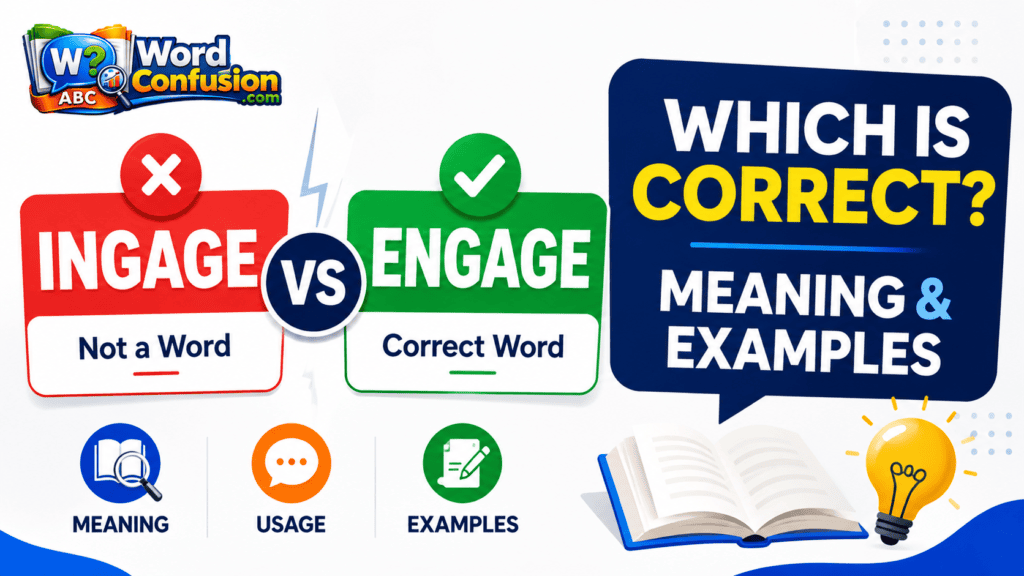
If you are wondering whether “ingage” or “engage” is the correct spelling, the answer is simple: engage is the correct spelling in modern standard English.
Ingage is not the standard modern spelling. However, you may occasionally find ingage in older texts because it was historically used as a spelling of engage. In contemporary English, especially in school, business, academic, and professional writing, you should use engage.
For example:
- ✅ The teacher tried to engage the students.
- ❌ The teacher tried to ingage the students.
Let’s look at the difference, meaning, pronunciation, and correct usage of these two forms.
📖 See also:What Does JFC Mean in Text? Meaning, Slang & Examples
Quick Answer: Is It Ingage or Engage?
Engage is the correct spelling in modern English.
Ingage is not the standard modern form, although it can appear as an obsolete historical spelling of engage. If you are writing an email, essay, report, article, or social media post today, use engage.
| Word | Modern spelling? | Meaning | Recommended use |
| engage | ✅ Yes | To involve, interact, participate, attract, hire, or operate something, depending on context | Use in modern English |
| ingage | ❌ No | Historical/obsolete form of engage | Avoid in modern writing |
The easiest rule to remember
ENgage is the correct modern spelling.
Ingage vs Engage: What’s the Difference?
The main difference is spelling and modern usage.
Engage is the standard English verb. It has several meanings, including involving someone, interacting with someone, participating in an activity, attracting attention, or operating a mechanism.
Ingage, on the other hand, is not the spelling you should use in contemporary English. It is most likely to be a spelling mistake when someone means engage. Historically, however, ingage was used as an older spelling of the word.
This distinction is important because saying that ingage has never existed at all would be inaccurate.
So, if you are choosing between the two for modern writing:
Engage is correct. Ingage is not the standard modern spelling.
Is “Ingage” a Word?
Ingage is not a standard modern English word, but it has existed as an obsolete spelling of “engage.”
You may encounter ingage in historical dictionaries or older written material. It is therefore better described as an obsolete spelling rather than simply claiming that it has never been used.
For modern English, the correct form is:
engage
For example:
- ✅ We need to engage our customers.
- ❌ We need to ingage our customers.
If you are writing something today, there is normally no reason to use ingage.
Why Do People Confuse “Ingage” and “Engage”?
One reason for this spelling confusion is pronunciation.
Engage is pronounced approximately:
/ɪnˈɡeɪdʒ/
The first sound is similar to the word “in.” Because the word sounds as though it begins with an in- sound, some people naturally spell it ingage.
But pronunciation does not always tell you exactly how a word should be spelled.
Compare:
engage → sounds like “in-GAGE”
The spelling still begins with en-, not in-.
This is a common type of English spelling confusion: a word can sound different from what its spelling might initially suggest.
What Does “Engage” Mean?
Engage is a verb with several meanings. Its exact meaning depends on the context.
1. To involve someone
To engage someone can mean to get their attention or involve them in something.
The teacher used a game to engage the students.
Here, engage means to involve the students and keep them interested.
2. To attract attention or interest
Something can engage an audience when it holds their attention.
The opening paragraph immediately engaged the reader.
This meaning is common in writing, education, entertainment, and communication.
3. To participate in something
Engage in means to take part in an activity.
She regularly engages in volunteer work.
They engaged in a long discussion.
Notice the structure:
engage in + activity
4. To interact with someone or something
Engage with means to interact, communicate, or respond.
The company wants to engage with its customers.
Students should engage with the material rather than simply memorize it.
The structure is:
engage with + person, group, idea, or subject
5. To hire someone
In some contexts, engage means to hire or employ someone.
The company engaged a lawyer to handle the case.
This usage is more formal.
6. To cause a mechanism to operate
In technical contexts, engage can mean to connect or activate a mechanism.
Press the lever to engage the brake.
This meaning is common in mechanical and technical language.
How to Use “Engage” Correctly
Understanding the common grammatical patterns can help you avoid mistakes.
Engage + object
Use engage + someone/something when you mean to involve, attract, or occupy someone.
The teacher engaged the students with an interesting activity.
The speaker engaged the audience from the beginning.
Not:
❌ The teacher engaged in the students.
Engage in + activity
Use engage in when someone participates in an activity.
We engage in regular exercise.
They engaged in a serious discussion.
He enjoys engaging in creative activities.
Engage with + person, group, or subject
Use engage with when the meaning involves interaction.
The manager engaged with the employees.
Readers can engage with the content through comments.
Students need to engage with difficult ideas.
These patterns are worth remembering because engage, engage in, and engage with do not always mean exactly the same thing.
Engage in a Sentence: Examples
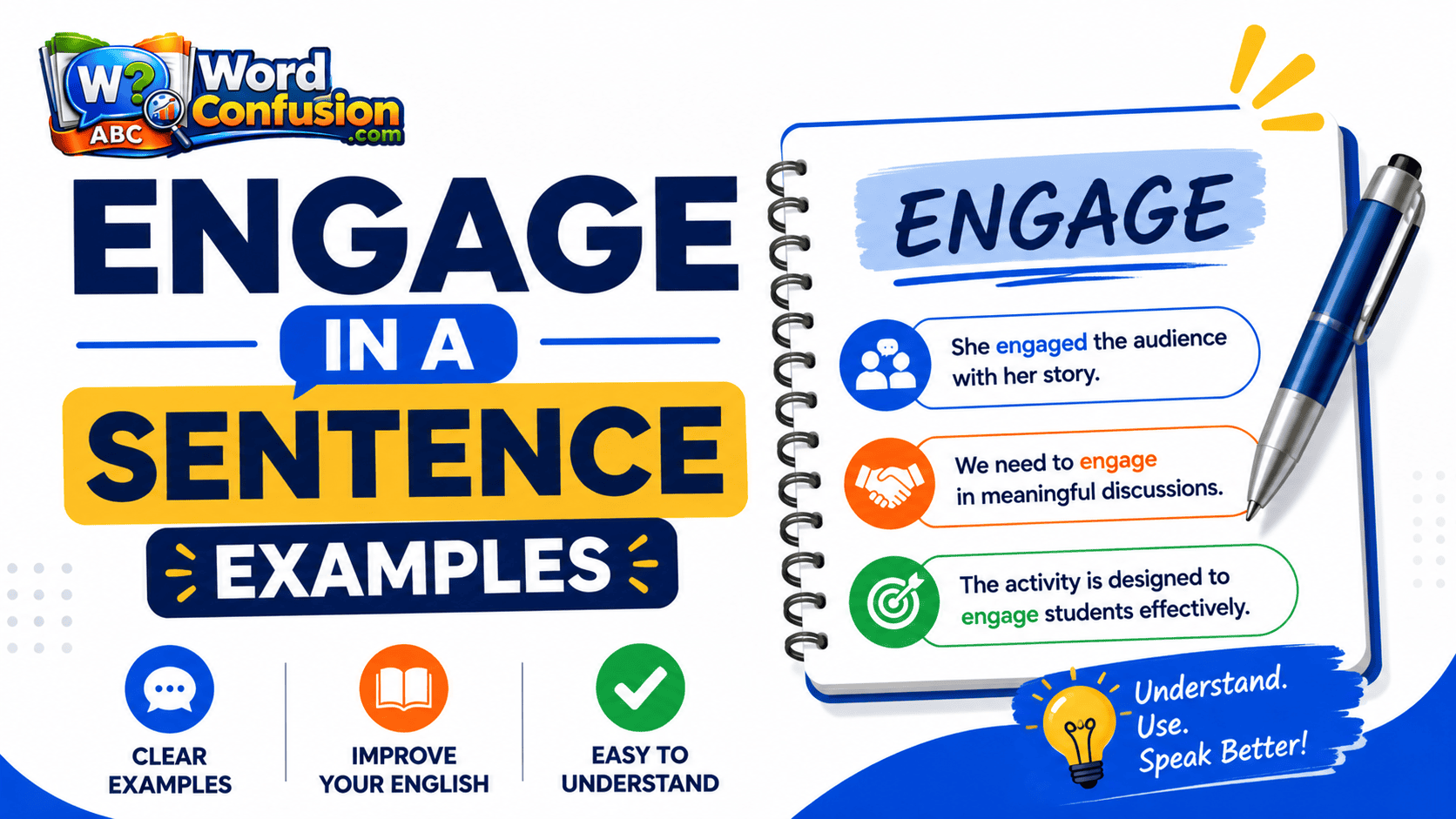
Here are some examples showing how engage is used in everyday and professional English.
Everyday English
I enjoy engaging in meaningful conversations.
Try to engage with people instead of avoiding them.
Education
The teacher created an activity to engage the students.
Students learn more when they engage with the material.
Business
The company wants to engage with new customers.
The campaign successfully engaged its target audience.
Writing
A strong introduction can engage readers.
Good writers know how to engage their audience.
Professional English
The company engaged a consultant to review the project.
Technical usage
The driver pressed the pedal to engage the brake.
These examples demonstrate why the meaning of engage can change slightly depending on the words around it.
📖 See also:Implicit vs Complicit: Meaning, Differences & Examples
Common Mistakes With “Engage”
Mistake 1: Writing “ingage”
❌ Ingage
✅ Engage
The standard modern spelling is engage.
Mistake 2: Using “engage in” incorrectly
❌ She engaged in the students.
✅ She engaged the students.
Here, the students are the people being involved, so engage + object is appropriate.
Mistake 3: Confusing “engage” with “engage in”
❌ He engaged football every weekend.
✅ He engaged in football activities every weekend.
When engage means participate in an activity, engage in is normally the appropriate structure.
Mistake 4: Confusing “engage with” and “engage in”
Compare:
She engaged in a discussion.
This means she participated in the discussion.
She engaged with the other participants.
This emphasizes her interaction with the people involved.
Engage vs Ingage: Correct Spelling Examples
| Incorrect or obsolete form | Correct modern form |
| ingage | engage |
| ingaged | engaged |
| ingaging | engaging |
For contemporary English writing, use the forms beginning with eng-.
Examples
❌ The presentation was designed to ingage the audience.
✅ The presentation was designed to engage the audience.
❌ She was ingaged in a conversation.
✅ She was engaged in a conversation.
❌ The speaker was very ingaging.
✅ The speaker was very engaging.
How to Remember the Correct Spelling
A simple memory trick is:
EN + GAGE = ENGAGE
Remember that modern engage starts with EN, not IN.
You can also connect the spelling to related words:
- engage
- engaged
- engaging
- engagement
All of these standard modern forms use eng-.
So if you are unsure whether to write ingage or engage, choose:
ENGAGE
Is “Engage” a Correct Word?
Yes. Engage is a standard English verb and is widely used in everyday, academic, professional, business, and technical contexts.
It can mean:
- to involve someone
- to attract someone’s attention
- to participate in something
- to interact with someone
- to hire someone
- to activate or connect a mechanism
For example:
The story engaged my attention.
We engage in regular discussions.
The company engages with its customers.
Ingage or Engage: Which One Should You Use?
For modern English, the answer is straightforward:
Use “engage.”
Although ingage can be found as an obsolete historical spelling, it is not the standard spelling used in contemporary English.
If you’re writing for school, work, business, a website, an email, or everyday communication, engage is the appropriate choice.
Quick comparison
Engage → ✅ Correct modern spelling
Ingage → ❌ Not the standard modern spelling
Ingage in an old text → Possible historical usage
Frequently Asked Questions
Is ingage a word?
Ingage is not a standard modern English spelling, but it has been used historically as an obsolete spelling of engage. In contemporary writing, use engage.
Is ingage correct?
No. Engage is the correct spelling in modern standard English. Ingage should generally be treated as a misspelling unless you are discussing or quoting historical language.
Is it ingage or engage?
It is engage in modern English.
✅ Please engage with the audience.
❌ Please ingage with the audience.
Which is correct: ingage or engage?
Engage is correct. Ingage is not the standard modern spelling.
How do you spell engage correctly?
Spell it:
E-N-G-A-G-E
The correct word is engage.
Why do people spell engage as ingage?
The confusion may come partly from pronunciation. Engage begins with an /ɪn/ sound, which can make ingage seem like a logical spelling.
What does engage mean?
Engage can mean to involve, attract attention, participate, interact, hire, or activate something, depending on the context.
How do you use engage in a sentence?
You can use it in several ways:
The teacher engaged the students.
They engaged in a discussion.
The company engaged with its customers.
Is ingage an English word?
Ingage has historical usage as an obsolete spelling of engage, but it is not the standard modern form. Modern writers should use engage.
What is the difference between engage and ingage?
Engage is the standard modern spelling and a common English verb. Ingage is an obsolete historical spelling and is generally considered incorrect in modern writing.
📖 See also:Notable vs Noteable: Which Spelling Is Correct?
Final Takeaway
If you’re deciding between ingage vs engage, choose engage.
Engage is the correct modern English spelling. It can mean to involve someone, attract attention, participate in an activity, interact with someone, hire someone, or activate a mechanism.
While ingage appears in some historical texts as an obsolete spelling of engage, it should not normally be used in contemporary English.
Easy rule:
ENgage is correct. INgage is not the standard modern spelling.
Looking for more English word meanings, grammar tips, and commonly confused words? Visit the WordConfusion homepage to explore our latest language guides, spelling differences, vocabulary explanations, text abbreviations, and practical examples. Whether you’re learning English or improving your writing skills, you’ll find clear, easy-to-understand resources for everyday communication.
Written by
 Abdul Moeed
Abdul Moeed is a professional content writer and SEO link-building specialist with 5+ years of experience. He creates search-optimized content and develops effective SEO strategies that improve website visibility, authority, and organic growth.
View LinkedIn profileLatest posts
 What Does PG Mean in Text? Meaning, Examples & Usage
 What Does OFCC Mean in Text? Meaning, Uses & Examples
 What Does MSG Mean in Text? Meaning, Examples & Usage
 What Does STY Mean in Text? Meaning, Examples & Usage
 What Does “Twin” Mean in Slang? Meaning, Text & Examples
 What Does LMC Mean in Text? Meaning, Examples & Usage