AI Detection vs Plagiarism Checking: Why Students Need Both?

Meera ran her history essay through an AI detector the night before it was due. It came back at 6%. She relaxed, submitted, and went to bed.
A week later, her tutor asked her to come in. The AI score was never the issue. Two paragraphs on the causes of the 1857 uprising matched a public study-notes website almost word for word. She had copied them into her notes months earlier, forgotten where they came from, and folded them into the essay as her own.
Meera is invented, but her mistake is common. She ran one check and assumed it covered everything. It didn’t, because AI detection and plagiarism checking are not two versions of the same test. They ask completely different questions, and a plagiarism checker for students covers ground that an AI detector never touches.
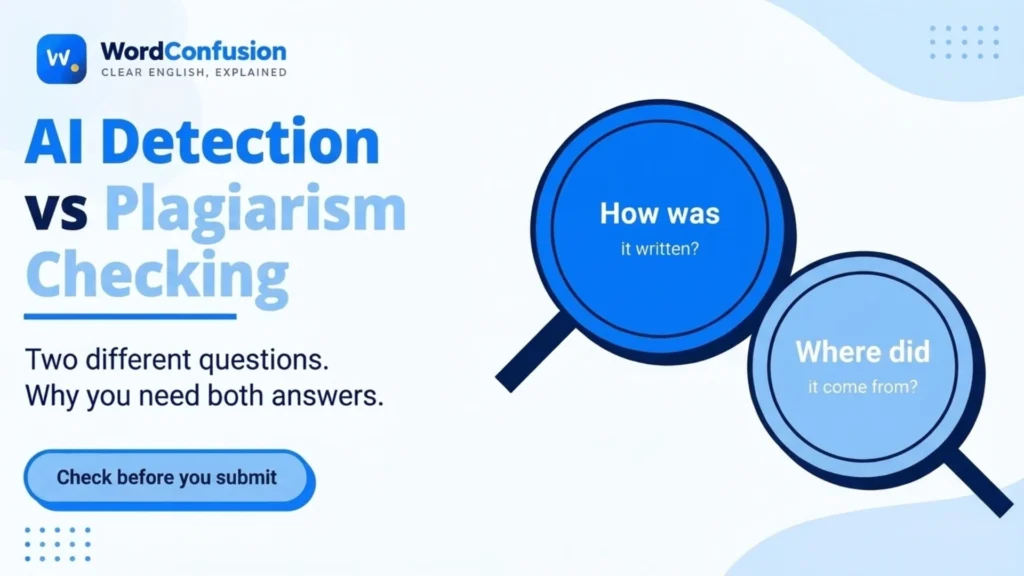
One asks “how”; the other asks “where from”
An AI detector reads your writing style. It looks at rhythm, word choice, and sentence patterns, and estimates how much of the text reads as if a language model produced it. It never compares your essay with anything else.
A plagiarism checker does the opposite. It ignores style and compares your phrases against text that already exists, then reports how much overlaps. That overlap figure is your similarity score.
So when people search for “AI detector vs plagiarism checker”, the honest answer is that neither replaces the other. Here is how they line up:
| AI detector | Plagiarism checker | |
| Question it answers | Does this read as AI wrote it? | Does this match text that already exists? |
| What it compares against | Nothing. It scores the style of your text alone. | Published pages, and in campus tools, stored papers and journals |
| What you get | An AI percentage, often with highlighted lines | A similarity score plus the matching sources |
| What it misses | Human-written text copied from somewhere else | Fresh AI text that matches nothing online |
Four ways a paper can go wrong
The easiest way to see why students need both checks is to sort papers by two things: who wrote the words, and where the ideas came from.
Your own words, your own thinking. Both scores should be low. A few percent of similarity is normal, because common phrases and properly quoted material always show up.
Copied from a website. This was Meera’s problem. A human wrote the original, so an AI detector has nothing to flag. Only a plagiarism check finds it.
Generated fresh by AI. Brand-new AI text usually matches nothing online, so the similarity score can sit near zero. Only an AI detector raises the question.
A source rewritten by AI. This is the tricky one. Paste an article into a chatbot, ask it to reword the text, and you may get something that partly dodges both checks. Running both gives you the best chance of noticing.
Even then, neither tool is perfect. A 2023 study in the International Journal for Educational Integrity tested 14 AI detection tools, including Turnitin. It concluded that none of them were accurate or reliable enough to trust on their own. The tools tended to label text as human-written, and their results got worse when the AI text had been disguised or edited. That is a good reason to treat every score as a prompt to look closer, not a final answer.
What is a similarity score, really?
A similarity score is the share of your text that matches other sources. That is all. It is not a plagiarism verdict, and a higher number does not automatically mean you cheated.
Plenty of honest overlap shows up in every paper:
- Direct quotations, even when they are correctly cited
- Your reference list or bibliography
- Technical terms and standard definitions
- Short stock phrases, such as “the results suggest that”
What matters is what each match is. Whichever similarity score checker you use, open every source the report lists and ask one question: did I mean to use this, and did I give credit? If the answer is yes, you are fine. If it is a sentence you forgot you borrowed, add quotation marks and a citation, or rewrite the idea in your own words and still cite where it came from.
How to check plagiarism online for free
Most universities give instructors access to a campus similarity tool, but students often cannot run their own drafts through it. That is the gap a free plagiarism checker for students fills. Look for a web overlap checker that shows the source behind every match, not just a number.
DetectGPT’s free plagiarism checker is one option built for exactly this. You paste up to 3,000 words, and it looks for matching phrases on public web pages, then shows the source next to each match so you can see what overlapped. There is no account to create. It does not search a private archive of student papers, so it will not reproduce a campus report, but it catches the most common problem: text lifted from websites.
The useful part is that the same site also runs an AI writing check. You can paste the same draft into its AI checker and get a percentage plus highlighted lines, which covers the other half of the picture in one sitting.
Don’t forget the check no tool does
There is a third problem that neither checker catches: references that don’t exist.
If you used a chatbot for research, check every citation by hand. Researchers writing in Scientific Reports asked ChatGPT to produce short literature reviews and then checked each reference. With GPT-3.5, 55% of the citations were fabricated. With GPT-4, the figure dropped to 18%, but nearly a quarter of the real citations still contained substantive errors.
A made-up source will not match anything in a plagiarism database, and it will not change your AI score. It just sits in your bibliography until a marker tries to look it up. Search for each title, check the author and year, and confirm the source says what you claim it says.
A 10-minute routine for the night before
- Finish the paper, including the reference list.
- Run the draft through a plagiarism checker for students. Open every source in the report and fix any uncited borrowing.
- Run an AI check on the same version. Rewrite highlighted lines that don’t sound like you.
- Look up every citation you did not personally read.
- Save this final version along with your earlier drafts and notes.
Step five sounds minor. It isn’t. If your work is ever questioned, a trail of drafts shows how the paper came together far better than any score can.
Three myths worth dropping
“A low AI score means my paper is safe.” It only means the style did not read as machine-written. Copied human text can score 0% AI and still be plagiarism.
“A 0% similarity score is the goal.” Real research quotes and cites sources, so some overlap is expected. A completely blank report on a paper full of quotations would be unusual.
“A free plagiarism checker will match my university’s report.” Campus tools compare against their own collections of submitted papers and journals, so their numbers will differ. A free check is a pre-check, not a preview of your exact score.
One last thing
Meera’s essay would have been fine if she had kept better notes. That is the real lesson. Tools help you catch problems, but the habits that prevent them are simple: write down where every idea comes from, put quotation marks around anything you copy the moment you copy it, and check both how your paper reads and where its words came from before you hit submit.
Written by
 Abdul Moeed
 is a professional content writer and SEO link-building specialist with 5+ years of experience. He creates search-optimized content and develops effective SEO strategies that improve website visibility, authority, and organic growth.
View LinkedIn profileLatest posts
 What Are Peptides: Meaning, Types, Uses & Safety Facts
 Furlough Meaning: Definition, Examples, Pay & Layoff Rules
 Discernment Meaning: Definition, Origin, Examples & Uses
 E.g. Meaning in Text: Full Form, Usage, Examples & i.e. Difference
 TMI Meaning in Text: Definition, Examples, Uses & Replies
 Humanize AI Text for Blogs: How to Keep E-E-A-T Signals Intact