Seal vs Seel: Which Is Correct? Meaning, Difference & Examples

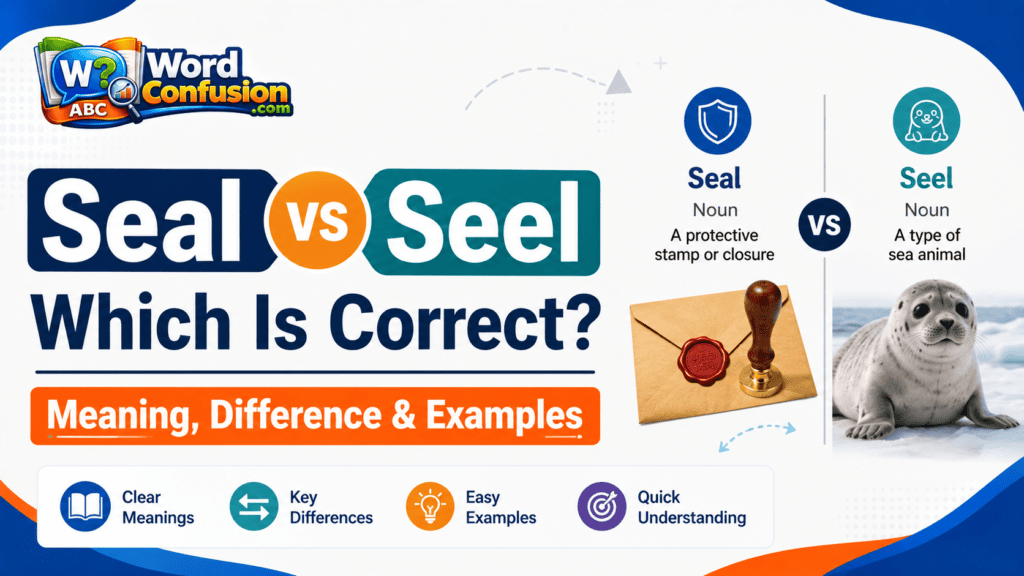
If you’re wondering whether the correct spelling is seal or seel, the answer is simple: seal is the word you normally want in modern English. It can mean to close or secure something, refer to a marine animal, or describe an official mark or closure. Seel is also a real English word, but it is an archaic verb historically associated with closing or sewing a bird’s eyelids, particularly in falconry.
The two words are pronounced alike in standard English, which makes them easy to confuse. However, they have different meanings and are not interchangeable.
📖 See also:IMO Meaning in Text: Definition, Examples & How to Use It
Seal vs Seel: The Quick Answer
| Word | Meaning | Modern Usage | Part of Speech |
| seal | To close, secure, approve, or refer to a marine mammal or official mark | Very common | Noun and verb |
| seel | Historically, to close or sew a bird’s eyelids | Rare and archaic | Verb |
Simple rule: If you’re writing ordinary modern English, use seal. Use seel only when you specifically mean the rare historical word.
Examples
- Please seal the envelope before mailing it.
- The workers sealed the crack in the wall.
- We saw a seal swimming near the shore.
- The two companies sealed the agreement.
- The historical text describes falconers who seeled birds’ eyes.
So, for almost every everyday situation, seal is the correct choice.
What Does “Seal” Mean?
Seal is a common modern English word with several meanings. It can function as both a noun and a verb. Dictionaries list meanings involving closing or protecting something, official marks, agreements, and the marine animal.
Seal as a Verb
As a verb, seal usually means to close something securely so that air, liquid, or other substances cannot enter or escape.
For example:
- Seal the bag tightly.
- Seal the envelope before sending it.
- The plumber sealed the pipe to stop the leak.
- Please seal the container after opening it.
It can also mean to make an agreement official or certain:
The two sides sealed the deal with a handshake.
This figurative use is very common in business and everyday English.
Other common expressions include:
- seal a deal
- seal an agreement
- seal an envelope
- seal a container
- seal a crack
- seal a package
- seal something off
- seal something in
Seal as a Noun
As a noun, seal has several common meanings.
1. A marine animal
A seal is a marine mammal that spends part of its life in or around the sea.
We watched a seal resting on the rocks.
2. An official mark
A seal can be an official mark placed on a document to show authenticity, approval, or authority.
The certificate carried the official seal of the organization.
3. A closure that prevents leakage
A seal can also be something that prevents air, gas, or liquid from passing through an opening.
The rubber seal around the pipe needs replacing.
This meaning is common in mechanical, industrial, packaging, and household contexts.
What Does “Seel” Mean?
Seel is a real English word, but it is archaic and extremely uncommon in modern everyday English.
Merriam-Webster defines seel as a verb meaning to close the eyes of a bird, particularly a hawk, by drawing threads through the eyelids. It also records an archaic meaning related to closing one’s eyes.
Collins similarly identifies seel with historical falconry, where it referred to sewing the eyelids of a hawk or falcon shut during training.
Seel as an Archaic Verb
For example:
The old account describes how the falconer seeled the young hawk.
This is a historical usage, not normal modern vocabulary.
You are unlikely to need seel in ordinary conversation, school writing, business communication, emails, or general online writing.
Why Don’t You See “Seel” Very Often?
The word belongs mainly to historical or specialized vocabulary. Modern English speakers normally use completely different wording rather than seel.
Therefore, if you encounter seel in an old book or historical text, don’t automatically assume that the writer made a spelling mistake. It can be a legitimate archaic word.
Seal vs Seel: What’s the Difference?
The biggest difference is meaning and modern usage.
| Feature | Seal | Seel |
| Modern English? | Yes | Rare/archaic |
| Commonly used today? | Yes | No |
| Can be a noun? | Yes | No in the relevant historical sense |
| Can be a verb? | Yes | Yes |
| Meaning “close securely”? | Yes | No in normal modern usage |
| Meaning “marine animal”? | Yes | No |
| Meaning “official mark”? | Yes | No |
| Historical falconry meaning? | No | Yes |
| Pronunciation | /siːl/ | /siːl/ |
The distinction can be summarized in one sentence:
Seal is a normal modern English word; seel is a rare historical verb.
Is It “Seal” or “Seel” in Modern English?
For modern English, choose seal.
If you mean:
- close something
- make something airtight
- stop a leak
- close an envelope
- close a container
- make an agreement official
- refer to the marine animal
- refer to an official mark
then seal is the correct spelling.
Correct
Please seal the box.
Incorrect for modern everyday usage
Please seel the box.
The second sentence uses seel as though it were an alternative spelling of seal. That is not how the modern word is used.
The important exception is historical writing where seel is deliberately being used in its archaic sense.
📖 See also:WTF Meaning in Text: What It Means, Uses & Examples
Seal vs Seel Pronunciation
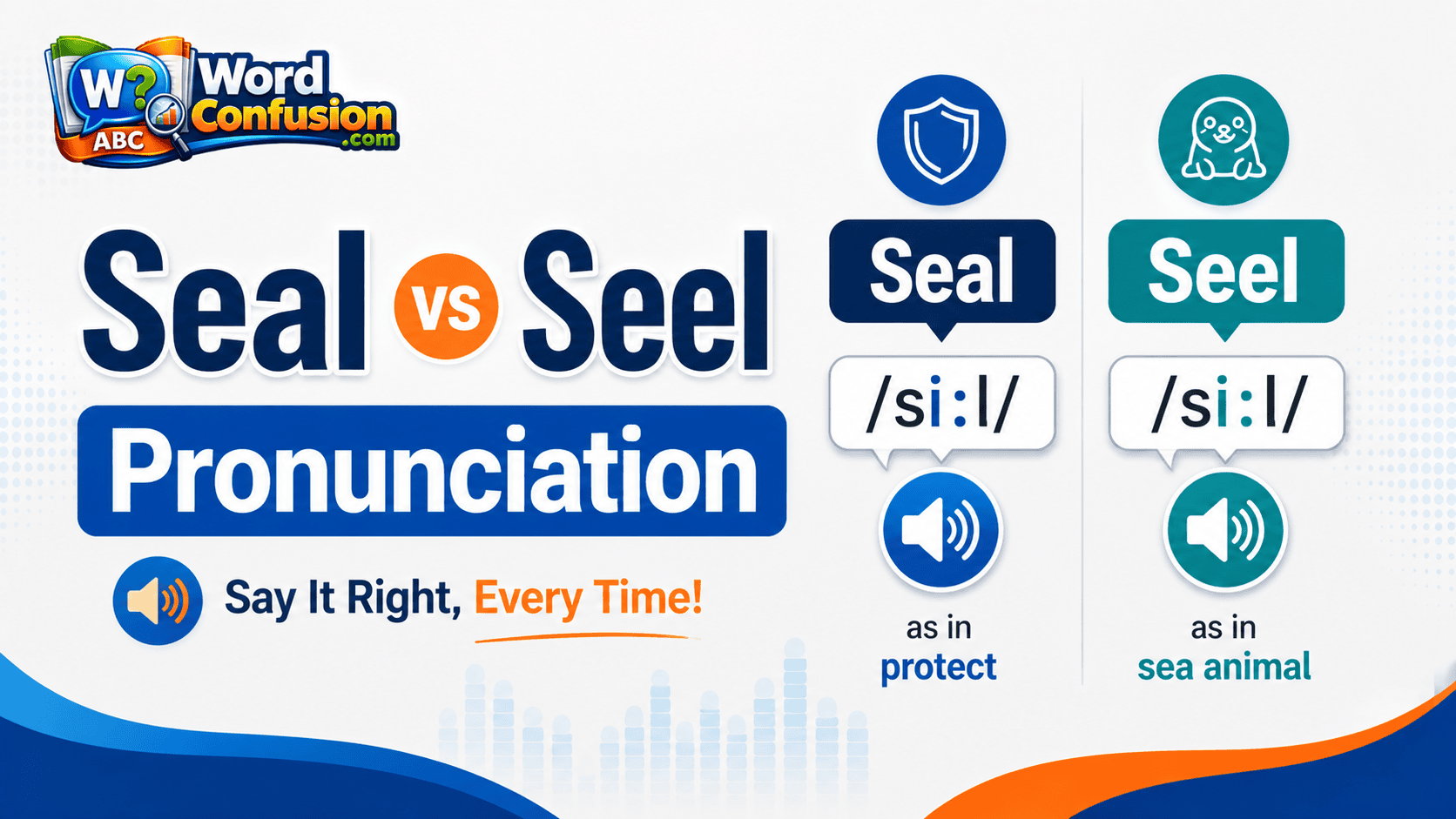
Seal and seel are pronounced the same in the standard pronunciation represented by dictionaries: /siːl/. Cambridge gives seal as /siːl/, while Merriam-Webster gives seel as /ˈsēl/.
This makes them a type of spelling confusion based on sound.
The problem is that pronunciation cannot tell you which spelling to choose.
You have to look at the meaning.
For example:
Please seal the envelope.
Here, seal means “close securely.”
But:
The historical text says the falcon was seeled.
Here, seeled comes from the rare historical verb seel.
Seal vs Seel Examples in Sentences
Here are some practical examples showing how the words differ:
| Situation | Example |
| Closing an envelope | Please seal the envelope before mailing it. |
| Closing a package | Make sure you seal the package properly. |
| Preventing a leak | The technician sealed the crack in the pipe. |
| Closing a container | Seal the jar tightly after opening it. |
| Finalizing an agreement | Both companies sealed the deal yesterday. |
| Official mark | The document carries the organization’s official seal. |
| Marine animal | We saw a seal near the beach. |
| Historical falconry | The old account describes how the falconer seeled the bird. |
Notice that seal appears naturally in everyday English, while seel appears only in a specialized historical context.
Common Mistakes With Seal and Seel
Mistake 1: Using “seel” for “close”
❌ Please seel the envelope.
✅ Please seal the envelope.
When you mean “close or secure,” use seal.
Mistake 2: Thinking “seel” is simply a misspelling
❌ Seel is not a real English word.
This is too broad.
✅ Seel is a real but archaic English word.
The distinction matters because readers may encounter it in historical literature or dictionaries.
Mistake 3: Assuming similar pronunciation means identical meaning
The fact that two words sound alike does not mean they can be substituted for each other.
Compare:
Seal the bottle.
with:
The falcon was seeled.
The pronunciation may be similar, but the meanings are completely different.
📖 See also:Busyness vs Business: Which Is Correct? Meaning & Examples
How to Remember Seal vs Seel
For everyday English, remember:
Seal = the normal modern word.
Think of all the familiar expressions:
- seal an envelope
- seal a container
- seal a crack
- seal a deal
- a seal at the beach
- an official seal
If you see seel, think:
“Rare historical word.”
That simple distinction will prevent most spelling mistakes.
When Should You Use “Seal”?
Use seal when writing modern English about:
- packages
- envelopes
- containers
- pipes
- cracks
- doors and openings
- agreements
- official documents
- marine animals
- security closures
- protection against air or liquid
Examples:
The workers sealed the window.
She sealed the letter.
The company sealed the agreement.
We saw three seals in the water.
The bottle’s seal was broken.
These are all normal modern uses.
When Should You Use “Seel”?
Use seel only when the historical meaning is specifically relevant.
It may appear in:
- historical writing
- older literature
- discussions of falconry
- historical dictionaries
- texts describing older practices
For ordinary modern writing, choosing seel when you mean “seal” will make your spelling look incorrect.
Frequently Asked Questions
Is it seal or seel?
Seal is correct for almost all modern English uses. Seel is a real but archaic word with a historical meaning connected to closing a bird’s eyes, especially in falconry.
Is seel a real word?
Yes. Seel is a real English word, but it is rare and archaic. Merriam-Webster records it as a verb meaning to close the eyes of a bird such as a hawk, while Collins gives its historical falconry meaning.
What does seel mean in English?
Seel is an archaic verb historically meaning to sew or close the eyelids of a bird, particularly a hawk or falcon. It can also have the broader archaic sense of closing the eyes.
What is the difference between seal and seel?
Seal is a common modern noun and verb. Seel is a rare archaic verb associated historically with falconry. They are pronounced alike but have different meanings.
Are seal and seel pronounced the same?
Yes. Both are represented with the long ee sound, /siːl/ or /ˈsēl/.
Can I use seel instead of seal?
No, not in ordinary modern English. If you mean “close,” “secure,” or “make airtight,” use seal. Seel should be reserved for its historical meaning.
How do you spell seal as in “close”?
The correct spelling is seal:
Please seal the package.
Not seel.
What does seal mean as a verb?
As a verb, seal can mean to close or secure something, prevent air or liquid from passing through, or formally finalize an agreement.
Is seel an archaic English word?
Yes. Major dictionaries identify seel as an archaic or historical word, particularly associated with falconry.
📖 See also:MBN Meaning in Text: What “Must Be Nice” Really Meanst Does CM Mean?
Final Takeaway
When you’re choosing between seal vs seel, use seal in virtually all modern English situations.
Seal can mean to close or secure something, finalize an agreement, refer to an official mark, describe a closure, or name the marine animal. Seel is a genuine English word, but it is archaic and primarily belongs to historical falconry vocabulary.
So the easiest rule is:
Seal = modern English.
Seel = rare, historical English.
If you’re writing an email, article, school assignment, business document, text message, or everyday sentence, seal is almost certainly the word you need.
Looking for more English word meanings, grammar tips, and commonly confused words? Visit the WordConfusion homepage to explore our latest language guides, spelling differences, vocabulary explanations, text abbreviations, and practical examples. Whether you’re learning English or improving your writing skills, you’ll find clear, easy-to-understand resources for everyday communication.
Written by
 Abdul Moeed
Abdul Moeed is a professional content writer and SEO link-building specialist with 5+ years of experience. He creates search-optimized content and develops effective SEO strategies that improve website visibility, authority, and organic growth.
View LinkedIn profileLatest posts
 What Does PG Mean in Text? Meaning, Examples & Usage
 What Does OFCC Mean in Text? Meaning, Uses & Examples
 What Does MSG Mean in Text? Meaning, Examples & Usage
 What Does STY Mean in Text? Meaning, Examples & Usage
 What Does “Twin” Mean in Slang? Meaning, Text & Examples
 What Does LMC Mean in Text? Meaning, Examples & Usage