Reevaluation or Re-evaluation: Which Spelling Is Correct?

Have you ever paused while writing and wondered whether reevaluation or re-evaluation is the correct spelling? You’re not alone. Many writers, students, and professionals are unsure whether this word should include a hyphen.
The good news is that both spellings are correct. However, reevaluation (without a hyphen) is generally the preferred form in modern American English, while re-evaluation still appears in some publications, style guides, and contexts where extra clarity is desired.
In this guide, you’ll learn the difference between reevaluation vs re-evaluation, when a hyphen is appropriate, what major dictionaries and style guides recommend, and how to use each form correctly in real sentences.
Quick Answer: Reevaluation or Re-evaluation?
Both reevaluation and re-evaluation are correct spellings. In modern American English, reevaluation is the preferred spelling because many formerly hyphenated words have evolved into closed compounds. The hyphenated form re-evaluation remains acceptable, especially when writers want to emphasize the prefix re- or improve readability.
| Spelling | Correct? | Usage |
| Reevaluation | ✅ Yes | Preferred in modern American English |
| Re-evaluation | ✅ Yes | Acceptable but less common |
Featured Snippet Answer
Both reevaluation and re-evaluation are correct spellings. In modern American English, reevaluation without a hyphen is more common and preferred by most dictionaries and style guides. The hyphenated form re-evaluation is still acceptable when clarity is needed or when a publication follows specific hyphenation rules.
What Does Reevaluation Mean?
Reevaluation means examining, reviewing, or assessing something again after an initial judgment, decision, or analysis has already been made.
In simple terms, it means evaluating something a second time.
Definition
Reevaluation (noun): The process of reviewing or assessing something again to determine whether previous conclusions remain valid.
Examples
- The company conducted a reevaluation of its hiring policies.
- After receiving new evidence, the committee ordered a reevaluation of the case.
- A yearly reevaluation of financial goals can improve planning.
Reevaluation vs Re-evaluation: What’s the Difference?
The meaning of both forms is exactly the same.
The only difference is the presence or absence of a hyphen.
| Feature | Reevaluation | Re-evaluation |
| Meaning | Review again | Review again |
| Correct Spelling | Yes | Yes |
| American English | Preferred | Acceptable |
| Modern Usage | More common | Less common |
| Formal Writing | Widely accepted | Sometimes used |
Why Do Both Forms Exist?
Historically, many English words beginning with the prefix re- were written with hyphens.
Examples include:
- re-enter
- re-elect
- re-evaluate
- re-examine
Over time, many of these words became closed compounds:
- reenter
- reelect
- reevaluate
- reexamine
As English evolved, reevaluation followed the same pattern.
Which Spelling Is Preferred in American English?
In modern American English, reevaluation is usually preferred.
Most contemporary dictionaries and publications favor dropping unnecessary hyphens whenever clarity remains intact.
Why American English Prefers Reevaluation
Modern spelling conventions encourage:
- Simpler word forms
- Fewer unnecessary punctuation marks
- Consistency with other closed compounds
For this reason, you’ll often see:
- reevaluation
- reevaluate
- reexamine
- reopen
- reuse
instead of their hyphenated alternatives.
Examples
✅ The board requested a reevaluation of the proposal.
✅ The project underwent a complete reevaluation last year.
What About British English?
British English is somewhat more flexible regarding hyphenation.
While reevaluation is increasingly common in British publications, some British writers still prefer re-evaluation, particularly in formal or traditional writing.
British English Trends
Modern British English has also been moving toward closed compounds, although this transition is sometimes slower than in American English.
As a result, both spellings frequently appear.
Example
- The organization announced a re-evaluation of its environmental strategy.
- The organization announced a reevaluation of its environmental strategy.
Both versions are generally acceptable.
When Should You Use a Hyphen After Re-?
The prefix re- means “again” or “back.”
In many words, a hyphen is no longer necessary. However, there are situations where using one can improve readability.
General Rule
If the word is widely recognized without a hyphen, use the closed form.
Examples:
- reevaluate
- reelection
- reelect
- reenter
- reopen
When a Hyphen Improves Clarity
Sometimes a hyphen helps avoid confusion.
Consider these examples:
Recover vs Re-cover
- Recover = regain
- Re-cover = cover again
Resign vs Re-sign
- Resign = quit
- Re-sign = sign again
In such cases, a hyphen changes the meaning and improves clarity.
Does Reevaluation Need a Hyphen for Clarity?
Usually, no.
Most readers immediately understand reevaluation without difficulty.
Therefore, the hyphen is generally unnecessary.
What Major Style Guides Say
Style guides often influence spelling decisions in professional writing.
AP Style
The Associated Press (AP) Stylebook generally avoids unnecessary hyphens and favors simpler word forms when clarity is maintained.
As a result, reevaluation is typically preferred.
Chicago Manual of Style
The Chicago Manual of Style also supports the trend toward closed compounds once words become widely accepted without hyphens.
Therefore, reevaluation fits modern style recommendations.
Academic Writing Standards
Academic institutions usually prioritize:
- Consistency
- Dictionary-preferred spellings
- Clarity
Most academic papers today use reevaluation, although either form may be accepted if used consistently.
Dictionary Preferences
Major dictionaries increasingly recognize reevaluation as the standard spelling.
| Dictionary Trend | Preferred Form |
| Modern American Dictionaries | Reevaluation |
| Academic Dictionaries | Reevaluation |
| Business Writing References | Reevaluation |
| Traditional Usage References | Both Accepted |
The key takeaway is that reevaluation has become the dominant modern spelling.
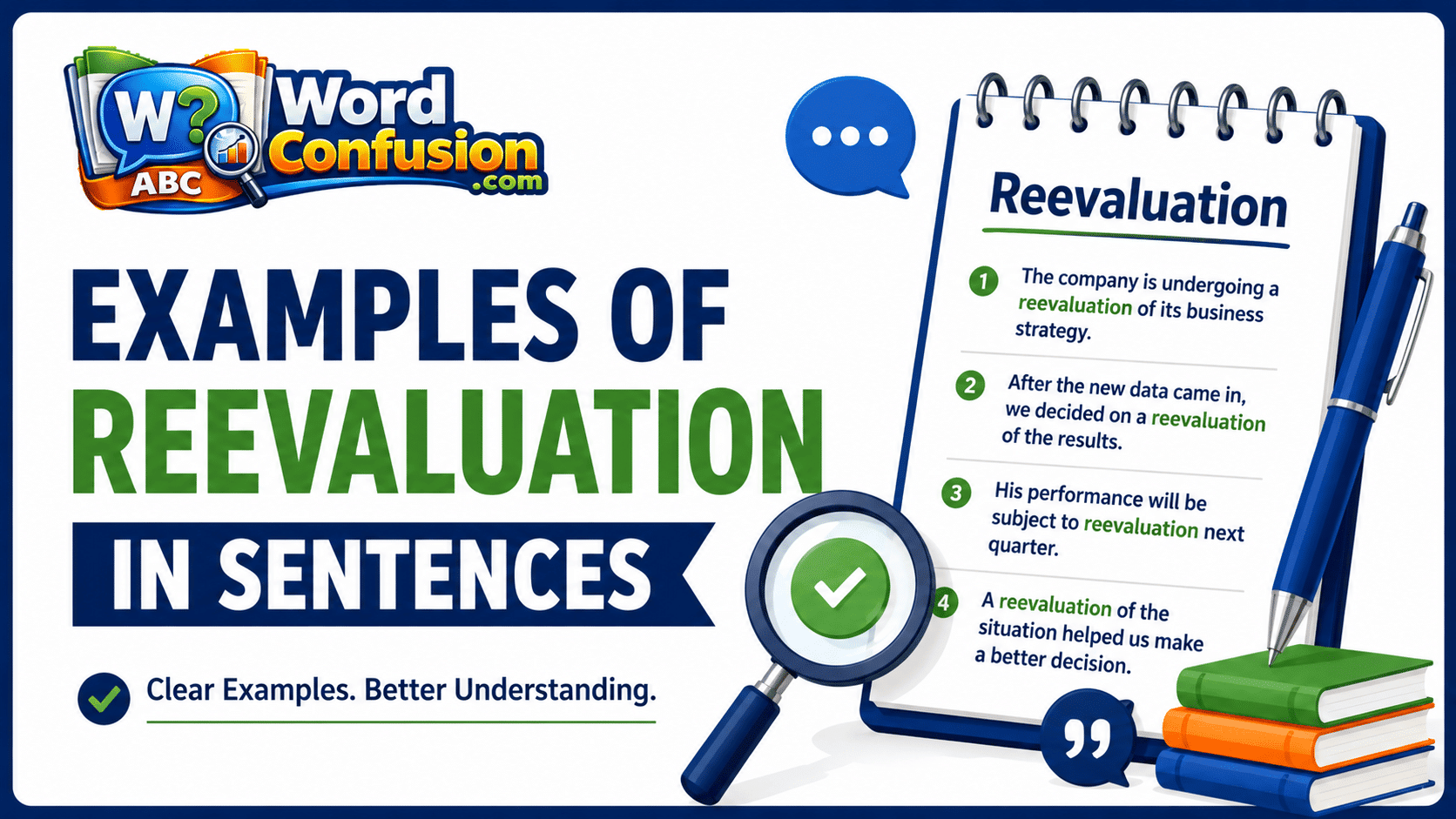
Examples of Reevaluation in Sentences
Business Writing Examples
- Management ordered a reevaluation of the company’s budget strategy.
- The merger required a complete reevaluation of operational costs.
- Investors requested a reevaluation of projected earnings.
Academic Writing Examples
- The researchers performed a reevaluation of the collected data.
- New findings led to a reevaluation of the original hypothesis.
- The study recommends periodic reevaluation of educational policies.
Everyday English Examples
- After hearing both sides, she began a reevaluation of her opinion.
- A recent experience caused a reevaluation of his priorities.
- The coach suggested a reevaluation of the team’s strategy.
Similar Re- Words and Their Hyphenation
Many writers ask about other words that follow the same pattern.
| Preferred Form | Alternate Form |
| reevaluate | re-evaluate |
| reelect | re-elect |
| reenter | re-enter |
| reopen | re-open |
| reuse | re-use |
| reexamine | re-examine |
| reelection | re-election |
| reorganization | re-organization |
In most modern American writing, the closed forms are increasingly preferred.
Common Mistakes Writers Make
1. Assuming Re-evaluation Is Wrong
Many people believe the hyphenated version is incorrect.
It isn’t.
Both forms are acceptable.
2. Using Both Spellings in the Same Document
Choose one version and remain consistent throughout your writing.
Incorrect
❌ The report required a reevaluation. Later, the re-evaluation was completed.
Better
✅ The report required a reevaluation. Later, the reevaluation was completed.
3. Adding Hyphens to Every Re- Word
Not every word beginning with re- requires a hyphen.
Modern English increasingly favors closed compounds.
4. Ignoring Style Guides
If you’re writing for:
- A newspaper
- A university
- A corporation
- A publisher
Always check their preferred style guide.
Pro Tips for Professional Writing
Use Reevaluation as Your Default Choice
For most situations, reevaluation is the safest and most modern option.
Follow Your Organization’s Style Guide
Some organizations have specific hyphenation preferences.
Consistency matters more than personal preference.
Use Hyphens Only When They Improve Clarity
If a reader could misunderstand the word without a hyphen, add one.
For reevaluation, this rarely happens.
Check Dictionary Recommendations
When uncertain, consult a respected dictionary and follow its preferred spelling.
Reevaluation or Re-evaluation: Which One Is More Common Today?
Modern English has steadily moved toward eliminating unnecessary hyphens.
This trend affects many words that once required punctuation.
Examples include:
- email instead of e-mail
- online instead of on-line
- reevaluate instead of re-evaluate
- reevaluation instead of re-evaluation
Because of this shift, reevaluation now appears more frequently in modern publications, business documents, academic writing, and online content.
FAQs
Is reevaluation one word or two?
Reevaluation is one word. The alternative spelling re-evaluation uses a hyphen but still represents a single concept.
Should reevaluation have a hyphen?
Usually not. Modern American English generally prefers reevaluation without a hyphen.
Is re-evaluation wrong?
No. Re-evaluation is a correct and accepted spelling, although it is less common today.
Which spelling is preferred in American English?
Reevaluation is the preferred spelling in modern American English.
Which spelling is preferred in British English?
British English accepts both forms, though some writers still use re-evaluation more often than American writers do.
What does reevaluation mean?
It means reviewing, assessing, or evaluating something again.
Can I use reevaluation in academic writing?
Yes. Reevaluation is widely accepted in academic writing and professional publications.
What is the difference between reevaluation and re-evaluation?
There is no difference in meaning. The distinction is purely stylistic.
When should re- words use a hyphen?
A hyphen is often used when it prevents confusion or follows a specific style-guide requirement.
How do you spell reevaluation correctly?
Both reevaluation and re-evaluation are correct, but reevaluation is generally preferred in modern usage.
Final Verdict: Reevaluation or Re-evaluation?
Both reevaluation and re-evaluation are correct spellings, but reevaluation is the preferred form in modern American English. Most dictionaries, style guides, and professional writers favor the closed compound because it aligns with current spelling conventions and reduces unnecessary punctuation.
If you’re unsure which version to use, choose reevaluation for most situations. Use re-evaluation only when a style guide requires it or when you feel the hyphen improves readability.
In short:
✅ Reevaluation — preferred modern spelling
✅ Re-evaluation — acceptable alternative spelling
For most business, academic, and everyday writing, reevaluation is the best choice.
If you’re learning English vocabulary and commonly confused words, you may also enjoy our guides on Goodmorning or Good Morning, Cancellation vs Cancelation, and Coachs or Coaches. Understanding these distinctions will make your writing clearer, more accurate, and more professional.
Written by
 Abdul Moeed
Abdul Moeed is a professional content writer and SEO link-building specialist with 5+ years of experience. He creates search-optimized content and develops effective SEO strategies that improve website visibility, authority, and organic growth.
View LinkedIn profileLatest posts
 What Does PG Mean in Text? Meaning, Examples & Usage
 What Does OFCC Mean in Text? Meaning, Uses & Examples
 What Does MSG Mean in Text? Meaning, Examples & Usage
 What Does STY Mean in Text? Meaning, Examples & Usage
 What Does “Twin” Mean in Slang? Meaning, Text & Examples
 What Does LMC Mean in Text? Meaning, Examples & Usage