Propose vs Purpose: Meaning, Difference & Examples
 Abdul Moeed
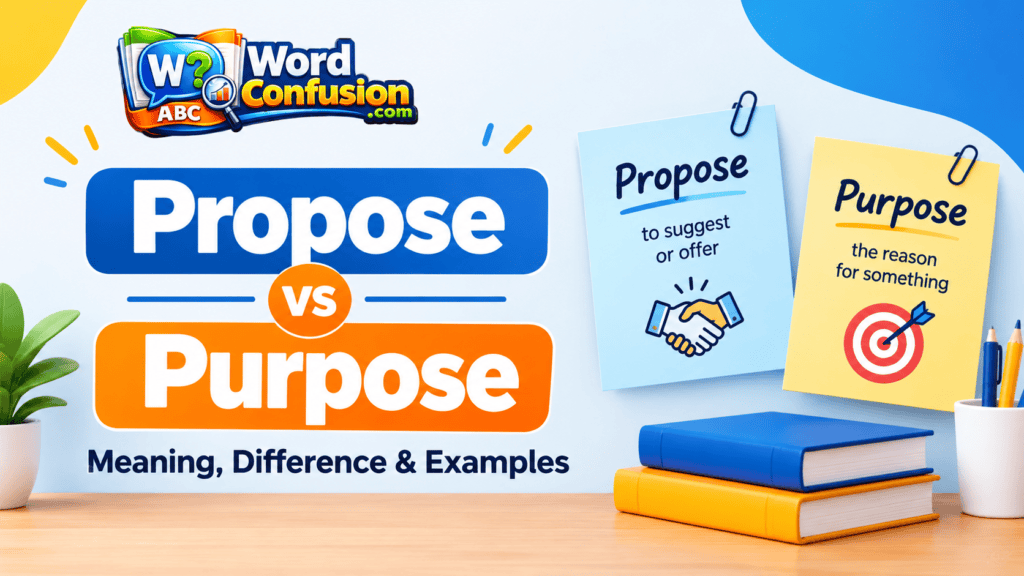
If you are confused about propose vs purpose, you are not alone. The words look and sound similar, but they have different meanings and grammatical roles. Propose is primarily a verb meaning to suggest, recommend, or put forward an idea or plan. Purpose is mainly a noun meaning the reason, aim, or goal behind something. In simple terms, you propose an idea, but you explain its purpose.
Propose vs Purpose: Quick Answer
Propose means to suggest or put something forward for consideration, while purpose means the reason, aim, or intended function of something.
| Feature | Propose | Purpose |
|---|---|---|
| Part of speech | Verb | Mainly noun |
| Basic meaning | Suggest or put forward | Reason, aim, or goal |
| Main question | What are you suggesting? | Why is it done? |
| Common pattern | propose a plan | purpose of a plan |
| Example | I propose a new solution. | The purpose is to improve safety. |
| Related word | proposal | purposeful |
Easy rule to remember
Propose = suggest.
Purpose = reason or aim.
For example:
I proposed a new training program.
The purpose of the program is to improve employee skills.
The first sentence tells us what was suggested. The second explains why the program exists.
What Does “Propose” Mean?
Propose is a verb. It means to suggest an idea, plan, solution, or action for other people to consider.
Propose meaning
In simple English:
Propose = to suggest or put forward an idea, plan, or action.
For example:
- I propose a new approach to the problem.
- She proposed a different solution.
- They proposed changing the meeting time.
- The committee proposed a new policy.
The word can also have another common meaning: to ask someone to marry you.
For example:
He proposed to his partner during their vacation.
So, the meaning of propose depends on context.
Common things you can propose
You can propose:
- an idea
- a plan
- a solution
- a change
- a policy
- a method
- a project
- a meeting
- a course of action
- marriage
How to Use “Propose” Correctly
One reason learners confuse propose with purpose is that propose can appear in several grammatical patterns.
1. Propose + noun
Use propose + noun when suggesting something.
I propose a new plan.
The manager proposed a solution.
They proposed several changes.
2. Propose + -ing
You can use propose + gerund (-ing form) when suggesting an action.
She proposed changing the schedule.
We proposed moving the meeting to Friday.
They proposed reducing the project budget.
3. Propose + that-clause
You can also use propose with a clause beginning with that.
I propose that we start early.
The committee proposed that the rule be changed.
She proposed that everyone work together.
4. Propose to + verb
Propose to + verb can be used when someone formally states an intention or plan.
We propose to expand the business next year.
The company proposes to introduce a new service.
However, don’t assume that every sentence with propose needs to. The structure depends on what you want to say.
5. Propose marriage
When propose refers to marriage, it means to ask someone to marry you.
He proposed to her after five years of dating.
She said yes when he proposed.
What Does “Purpose” Mean?
Purpose is primarily a noun. It refers to the reason something is done, created, used, or intended to happen.
Purpose meaning
In simple English:
Purpose = the reason, aim, or goal of something.
For example:
The purpose of this meeting is to discuss the new project.
The sentence explains why the meeting is being held.
More examples:
- What is the purpose of this tool?
- The purpose of education is broader than memorizing facts.
- The main purpose of the report is to explain the results.
- The purpose of this exercise is to improve your writing.
Depending on context, purpose can refer to a reason, aim, intention, goal, or function.
How to Use “Purpose” Correctly
Purpose commonly appears in several useful structures.
1. Purpose of + noun
Use purpose of + noun to explain why something exists or is done.
What is the purpose of this meeting?
The purpose of the program is to help students.
The purpose of the machine is to reduce production time.
2. Purpose of + -ing
You can also use purpose of before an -ing form.
The purpose of exercising is to improve your health.
The purpose of studying vocabulary is to communicate more clearly.
3. On purpose
On purpose means intentionally or deliberately.
She broke the glass on purpose.
He didn’t forget your name on purpose.
Compare:
I forgot the appointment by accident.
I ignored the message on purpose.
4. Serve a purpose
Serve a purpose means to have a useful function or reason for existing.
Every part of the system serves a purpose.
This feature serves a useful purpose.
What Is the Difference Between Propose and Purpose?
The easiest way to understand propose vs purpose is to focus on the difference between suggesting something and explaining why something exists or happens.
Propose
Propose describes the act of putting an idea, plan, or suggestion forward.
The manager proposed a new training program.
Purpose
Purpose describes the reason or aim behind something.
The purpose of the training program is to improve employee skills.
So:
Someone proposes a plan.
The plan has a purpose.
That’s the central difference.
Compare these examples
The scientist proposed a new theory.
The scientist suggested or put forward the theory.
The purpose of the theory was to explain the observed results.
The purpose explains the reason or intended function.
Another example:
The school proposed a new reading program.
The school suggested the program.
The purpose of the program is to improve students’ reading skills.
The purpose explains why the program was created.
Propose vs Purpose Pronunciation
The words are also pronounced differently.
| Word | UK Pronunciation | US Pronunciation | Stress |
|---|---|---|---|
| propose | /prəˈpəʊz/ | /prəˈpoʊz/ | Second syllable |
| purpose | /ˈpɜː.pəs/ | /ˈpɝː.pəs/ | First syllable |
A useful listening clue is the stress:
pro-POSE
but:
PUR-pose
The final sound is also different. Propose ends with a voiced z sound, while purpose ends with the unstressed -pəs sound.
Propose vs Purpose in Sentences
Seeing the words together can make the difference much easier to remember.
Everyday English
Propose:
I propose that we eat at home tonight.
Purpose:
The purpose of eating at home is to save money.
Academic English
Propose:
The researchers proposed a new explanation for the results.
Purpose:
The purpose of the study was to examine the effects of sleep on memory.
Business English
Propose:
The manager proposed a change to the company’s schedule.
Purpose:
The purpose of the change is to improve productivity.
Workplace communication
Propose:
I would like to propose a solution to this problem.
Purpose:
The purpose of this meeting is to find a solution.
Daily conversation
Propose:
Why don’t I propose a different idea?
Purpose:
What’s the purpose of doing it that way?
These examples show that the words may appear in similar discussions, but they perform different jobs.
Common Mistakes With Propose and Purpose
Mistake 1: Writing “the propose of”
❌ The propose of this meeting is to discuss the project.
✅ The purpose of this meeting is to discuss the project.
Why?
Because you are explaining the reason for the meeting, so you need the noun purpose.
Mistake 2: Writing “I purpose a new idea”
❌ I purpose a new idea.
✅ I propose a new idea.
Why?
You are suggesting an idea, so you need the verb propose.
Mistake 3: Confusing “purpose” with “propose”
❌ The company purposed a new strategy.
✅ The company proposed a new strategy.
Here, the company is putting a strategy forward for consideration.
Mistake 4: Using “propose” when you mean “reason”
❌ The propose of the project is to reduce costs.
✅ The purpose of the project is to reduce costs.
Ask yourself:
Am I talking about a suggestion?
If yes, use propose.
Am I explaining why something exists or is done?
If yes, use purpose.
Propose vs Proposal vs Purpose
These three words are related, but they are not interchangeable.
| Word | Part of Speech | Meaning | Example |
|---|---|---|---|
| propose | Verb | Suggest or put forward | We propose a new plan. |
| proposal | Noun | A suggested plan or idea | We submitted a proposal. |
| purpose | Noun | Reason, aim, or intended function | The purpose is to reduce costs. |
Think of the relationship this way:
propose → proposal
You propose something, and that suggestion can be called a proposal.
But the purpose of that proposal is its reason or intended aim.
For example:
The company proposed a new recycling program.
The company submitted a proposal for the program.
The purpose of the program is to reduce waste.
This three-way comparison is one of the easiest ways to keep the words separate.
Propose vs Purpose: A Simple Memory Trick
Use two questions.
Question 1: “Am I suggesting something?”
If yes, think:
PROPOSE = SUGGEST
I propose a new solution.
Question 2: “Am I explaining why?”
If yes, think:
PURPOSE = REASON
The purpose of the solution is to save time.
The fastest memory rule
PROPOSE = put an idea forward.
PURPOSE = why something is done.
If you remember those two lines, you can usually choose the correct word without thinking about complicated grammar terminology.
Propose or Purpose: Which Is Correct?
Both are correct words, but they are correct in different situations.
Use propose when you mean:
- suggest
- recommend
- put forward
- formally present an idea
- ask someone to marry you
Use purpose when you mean:
- reason
- aim
- goal
- intention
- function
Compare:
I propose a new approach.
The purpose of the approach is to save time.
Both sentences are correct because the words perform different grammatical and semantic roles.
Mini Quiz: Propose or Purpose?
Choose propose or purpose in each sentence.
- The main ___ of this meeting is to discuss the budget.
- I would like to ___ a different solution.
- What is the ___ of this machine?
- The committee ___ changing the policy.
- The ___ of the study was to examine language development.
- She ___ that we leave earlier.
- He ___ to her during their vacation.
Answers
- purpose
- propose
- purpose
- proposed
- purpose
- proposed
- proposed
A useful way to check your answers is to ask:
Suggestion? → propose
Reason/aim? → purpose
Frequently Asked Questions About Propose vs Purpose
What is the difference between propose and purpose?
Propose is primarily a verb meaning to suggest or put forward an idea, plan, or action. Purpose is mainly a noun meaning the reason, aim, goal, or intended function of something. You propose a plan, while a plan has a purpose.
What does propose mean?
Propose means to suggest, recommend, or put forward something for consideration. For example, “I propose a new solution” means “I suggest a new solution.” It can also mean to ask someone to marry you.
What does purpose mean?
Purpose means the reason, aim, goal, intention, or function of something. For example, “The purpose of this meeting is to discuss the project” explains why the meeting is taking place.
Is propose a verb?
Yes. Propose is primarily a verb. It can mean to suggest or put forward an idea, plan, or action. It can also refer to asking someone to marry you.
Is purpose a noun?
Yes. Purpose is mainly used as a noun in everyday English. It refers to the reason, aim, goal, or intended function of something.
Is it propose or purpose?
It depends on what you mean. Use propose when you mean “suggest” or “put forward.” Use purpose when you mean “reason,” “aim,” or “goal.”
For example:
I propose a new plan.
The purpose of the plan is to save money.
How do you use propose in a sentence?
You can use propose when suggesting something:
She proposed a new solution.
You can also use it with an -ing form:
They proposed changing the schedule.
Or with a that-clause:
He proposed that we start early.
How do you use purpose in a sentence?
Use purpose when explaining the reason or aim of something:
The purpose of this lesson is to improve your grammar.
You can also use it in expressions such as:
She did it on purpose.
What is the difference between proposal and purpose?
A proposal is a suggestion, plan, or idea that someone puts forward. A purpose is the reason or aim behind something.
We submitted a proposal for a new project.
The purpose of the project is to improve efficiency.
What is the difference between propose and proposal?
Propose is a verb:
They proposed a new plan.
Proposal is a noun:
They submitted a new proposal.
The two words are closely related, but they cannot normally be used interchangeably.
Key Takeaways
- Propose is primarily a verb.
- Purpose is mainly a noun.
- Propose means to suggest or put something forward.
- Purpose means the reason, aim, goal, or function of something.
- You propose a plan.
- A plan has a purpose.
- Proposal is the noun related to propose.
- On purpose means intentionally.
- Propose can also mean asking someone to marry you.
- When unsure, use the suggestion test:
- Can you replace it with “suggest”? → propose
- Can you replace it with “reason” or “aim”? → purpose
If you’re building your English vocabulary through word comparisons, WordConfusion also covers other distinctions such as platform vs flatform and oversight vs oversite.
Conclusion
The difference between propose vs purpose becomes simple once you focus on what each word does.
Propose means to suggest, recommend, or put an idea or plan forward. Purpose means the reason, aim, or intended function behind something.
Remember:
Propose = suggest.
Purpose = reason or aim.
For example:
We proposed a new training program because the purpose was to improve employee skills.
That distinction will help you avoid common mistakes such as writing “the propose of the meeting” when you mean “the purpose of the meeting.”
For more practical English grammar, vocabulary, and commonly confused-word guides, explore WordConfusion.