Pre vs Post: Meaning, Usage, Examples, and Key Differences
 Abdul Moeed
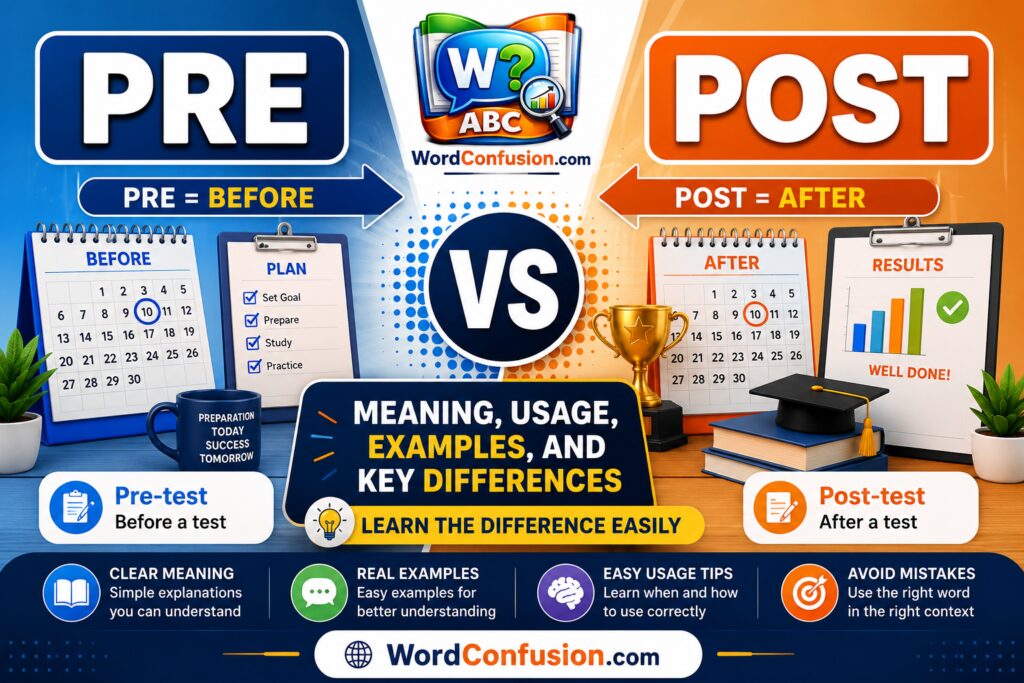
Understanding the difference between pre and post is important because these two common English prefixes completely change the meaning of a word. While pre means before something happens, post means after it happens.
Whether you are talking about a pre-test, post-test, pre-workout, post-workout, or pre-production and post-production, knowing when to use each prefix helps you communicate clearly and accurately.
Quick Answer: Pre vs Post
The difference between pre and post is simple:
- Pre means before an event, action, or time period.
- Post means after an event, action, or time period.
For example:
- A pre-test is given before instruction begins.
- A post-test is given after instruction is completed.
Featured Snippet Answer
Pre and post are English prefixes that indicate timing. Pre means before something happens, while post means after it happens. For example, a pre-workout supplement is taken before exercise, whereas a post-workout meal is consumed after exercise. These prefixes help show the relationship between actions and events.
What Is the Difference Between Pre and Post?
The main difference between pre and post is the timing they represent.
| Prefix | Meaning | Indicates |
| Pre | Before | Something happens earlier |
| Post | After | Something happens later |
| Post | After | Something happens later |
Think of them as opposite directions on a timeline.
Before Event → Pre
Event Happens
After Event → Post
Pre Meaning
The prefix pre- comes from Latin and means before.
It is added to words to show that something occurs earlier than a particular event, action, or period.
Examples:
- Preheat
- Preschool
- Preview
- Prehistoric
- Prepay
Post Meaning
The prefix post- also comes from Latin and means after.
It shows that something occurs following an event, action, or period.
Examples:
- Postgraduate
- Postwar
- Postpartum
- Postmortem
- Postseason
Pre vs Post Comparison Table
| Feature | Pre | Post |
| Meaning | Before | After |
| Position in Time | Earlier | Later |
| Common Use | Preparation | Follow-up |
| Example | Pre-test | Post-test |
| Example | Pre-workout | Post-workout |
| Example | Pre-production | Post-production |
How to Pronounce Pre and Post
Correct pronunciation can help English learners use these prefixes confidently.
Pre Pronunciation
Pre is pronounced:
/priː/
Sounds like:
“pree”
Examples:
- Pre-test
- Preview
- Preheat
Post Pronunciation
Post is pronounced:
/poʊst/
Sounds like:
“pohst”
Examples:
- Postwar
- Postgraduate
- Postseason
Why Pre and Post Are Important in English
English uses prefixes to create new words and add meaning.
The prefixes pre and post are among the most common because they help indicate when something happens.
Without them, readers may not know whether an action occurs before or after an event.
Consider these examples:
- Pre-launch meeting = meeting before launch
- Post-launch review = review after launch
A single prefix changes the entire meaning.
How These Prefixes Change Word Meaning
Before an Event
When pre is added to a word, it shows preparation, anticipation, or an earlier stage.
Examples:
| Word | Meaning |
| Preheat | Heat beforehand |
| Preview | View before release |
| Preschool | Education before primary school |
| Preorder | Order before official release |
| Prepay | Pay in advance |
After an Event
When post is added to a word, it shows results, consequences, or a later stage.
Examples:
| Word | Meaning |
| Postwar | After a war |
| Postgraduate | After graduation |
| Postpartum | After childbirth |
| Postmortem | Examination after death |
| Postseason | After the regular season |
Common Words Using Pre
Many everyday English words begin with pre.
Preheat
To heat something before cooking.
Example: Preheat the oven to 180°C before baking.
Preview
To see something before it becomes available.
Example: We watched a preview of the movie.
Preschool
Education before primary school.
Example: Her son attends preschool.
Prehistoric
Existing before recorded history.
Example: Scientists discovered prehistoric fossils.
Prepay
To pay in advance.
Example: Customers can prepay for annual services.
Common Words Using Post
The prefix post appears in many academic, medical, and everyday terms.
Postgraduate
Education after completing a bachelor’s degree.
Example: She is pursuing postgraduate studies.
Postwar
Occurring after a war.
Example: The city expanded rapidly during the postwar years.
Postpartum
The period after childbirth.
Example: Postpartum care is important for new mothers.
Postmortem
An examination conducted after death.
Example: The doctor requested a postmortem examination.
Postseason
Games played after the regular sports season.
Example: The team qualified for the postseason.
Pre vs Post Examples in Sentences
Everyday Examples
- We held a pre-event meeting before the conference.
- The company conducted a post-event survey afterward.
- Please prepay your membership fee.
- A post-trip report was prepared for management.
Academic Examples
- Students completed a pre-test before the course started.
- A post-test measured learning outcomes.
- Researchers compared pre-study and post-study results.
Workplace Examples
- The team scheduled a pre-launch discussion.
- Management organized a post-launch review.
- Employees attended pre-training orientation sessions.
Pre-Test vs Post-Test Explained
One of the most common uses of these prefixes appears in education.
| Term | Meaning |
| Pre-test | Assessment before learning |
| Post-test | Assessment after learning |
Example
A teacher gives students a pre-test to measure existing knowledge.
After the lessons are completed, students take a post-test to measure improvement.
This comparison helps determine how much learning occurred.
Pre-Workout vs Post-Workout Explained
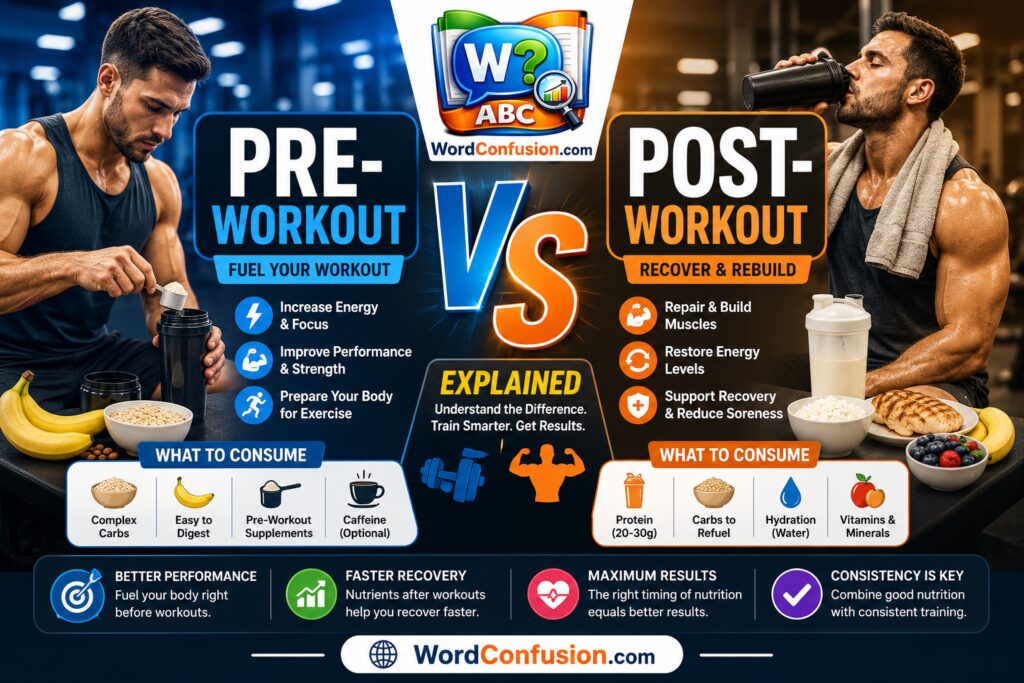
Fitness enthusiasts frequently use these terms.
Pre-Workout
Something taken before exercise to improve energy and focus.
Example: He drank a pre-workout supplement before training.
Post-Workout
Something consumed after exercise to support recovery.
Example: She ate a protein-rich post-workout meal.
Pre-Production vs Post-Production Explained
These terms are common in film, media, and content creation.
Pre-Production
Everything done before filming begins.
Examples include:
- Planning
- Scheduling
- Script development
- Budgeting
Post-Production
Everything done after filming is complete.
Examples include:
- Editing
- Sound design
- Visual effects
- Final review
Pre-Order vs Post-Order Explained
Pre-Order
Purchasing an item before its official release.
Example: Thousands of customers placed a pre-order for the new smartphone.
Post-Order
In technical fields such as computing and mathematics, post-order refers to processing after a specific step or structure. It is less common in everyday English than pre-order.
Common Mistakes When Using Pre and Post
Using the Wrong Timeline
Many learners accidentally reverse the meanings.
❌ The post-meeting agenda was sent before the meeting.
✅ The pre-meeting agenda was sent before the meeting.
Misunderstanding the Event
Always identify the main event first.
Ask yourself:
Before what?
or
After what?
Once you know the anchor event, choosing the correct prefix becomes easier.
Unnecessary Prefix Usage
Sometimes plain English is clearer.
Instead of:
❌ Pre-arrival preparations before arrival
Use:
✅ Preparations before arrival
Hyphenation Errors
Some words require a hyphen, while others are commonly written as a single word.
Examples:
- Pre-test
- Post-test
- Pre-workout
- Post-workout
Always check modern dictionary usage when unsure.
Easy Memory Tricks for Pre vs Post
Pre = Prepare
Many words involving preparation start with pre.
Examples:
- Prepare
- Preplan
- Preview
Remember:
Preparation happens before something begins.
Post = After the Event
Think of receiving updates after something has happened.
The event comes first, then the post-event discussion.
Alphabet Trick
In the alphabet:
P-R-E comes before P-O-S-T conceptually in a timeline.
Remember:
Pre → Event → Post
Timeline Trick
Visualize:
Before → During → After
Pre belongs on the left.
Post belongs on the right.
Pro Tips for Using Pre and Post Correctly
Identify the Anchor Event
Every pre or post word revolves around a specific event.
Ask:
“What event am I talking about?”
Use the Before-or-After Rule
If it happens earlier, use pre.
If it happens later, use post.
Learn Common Prefix Words
Building vocabulary helps you recognize these prefixes instantly.
Practice with Real Examples
Examples from school, work, fitness, and daily life make the meanings easier to remember.
Common Words With Pre and Post
| Pre Words | Post Words |
| Preheat | Postwar |
| Preview | Postgraduate |
| Preschool | Postpartum |
| Prehistoric | Postmortem |
| Prepay | Postseason |
| Pretest | Posttest |
| Preorder | Postorder |
| Preworkout | Postworkout |
Frequently Asked Questions
What does pre mean?
Pre means before. It is a prefix used to show that something happens earlier than an event, action, or period.
What does post mean?
Post means after. It indicates that something happens following an event, action, or period.
Is pre before or after?
Pre means before.
Example:
A pre-flight checklist is completed before takeoff.
Is post before or after?
Post means after.
Example:
A post-flight report is written after landing.
How do you use pre and post in English?
Use pre for actions that happen before an event and post for actions that happen after an event.
Examples:
- Pre-test
- Post-test
- Pre-workout
- Post-workout
What are some common pre and post words?
Common pre words include:
- Preheat
- Preview
- Preschool
- Prehistoric
Common post words include:
- Postwar
- Postgraduate
- Postpartum
- Postmortem
What is the difference between pre and post?
The difference is timing.
Pre means before an event, while post means after an event.
When should you use pre and post?
Use these prefixes whenever you need to indicate whether something occurs before or after a specific event, action, or time period.
Final Thoughts on Pre vs Post
The distinction between pre and post is straightforward once you understand their meanings. Pre refers to something that happens before an event, while post refers to something that happens after it.
From pre-tests and post-tests to pre-workout and post-workout, these prefixes help explain timing clearly and efficiently. By identifying the main event and applying the simple before-or-after rule, you can use both prefixes accurately in writing and everyday communication.
If you’re learning English vocabulary and commonly confused words, you may also enjoy our guides on Rug vs Rag,Planing or Planning, and Hopeing or Hoping. Understanding these distinctions will make your writing clearer, more accurate, and more professional.