40+ Other Ways to Say “I Understand”: Professional & Polite

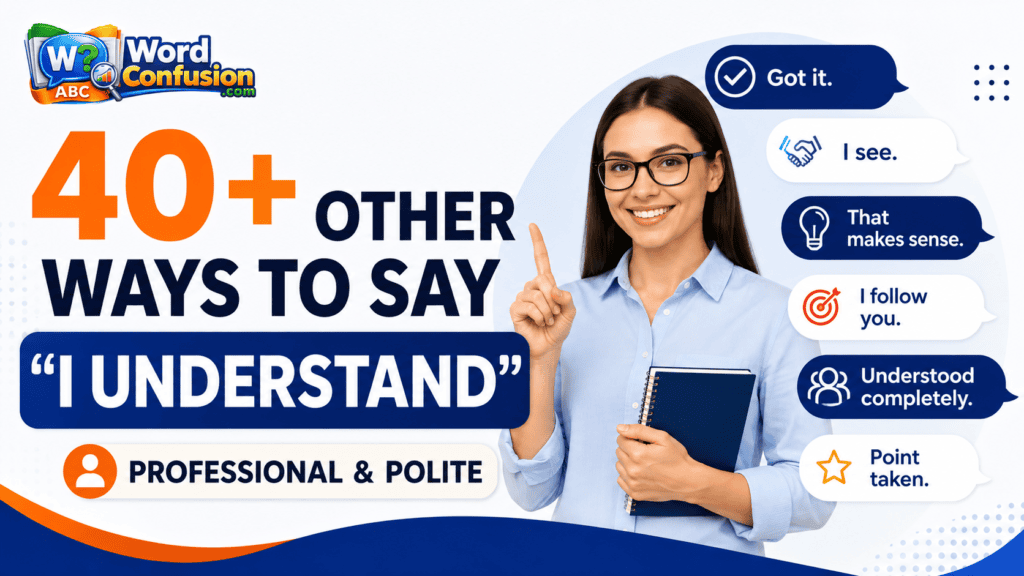
“I understand” is a useful English phrase, but you do not always need to repeat it. Depending on the situation, you might want to sound more professional, polite, empathetic, casual, or specific.
Some alternatives include “I see what you mean,” “That makes sense,” “Understood,” “I hear you,” “I get it,” and “I appreciate the clarification.” However, these expressions are not exact synonyms in every situation. The best choice depends on what you actually want to communicate.
📖 See also:RLS Meaning in Text: What Does RLS Stand For?
If you enjoy practical English vocabulary and usage guides, you can also explore more resources from WordConfusion.
Quick Answer: What Can I Say Instead of “I Understand”?
Here are some of the best alternatives to “I understand”:
- I see what you mean. — for understanding someone’s point
- That makes sense. — for saying an explanation is logical
- Understood. — for acknowledging instructions or information
- I follow you. — for showing that you are following an explanation
- I hear you. — for acknowledging someone’s feelings or concerns
- I get it. — for casual conversations
- I appreciate the clarification. — for professional communication
- I see your point. — for acknowledging someone’s argument
- I understand your concern. — for professional or empathetic situations
- We’re on the same page. — for showing shared understanding
- I know what you mean. — for everyday conversations
- I appreciate your perspective. — for respectfully acknowledging someone’s viewpoint
The important point is that understanding does not necessarily mean agreeing. For example, you can say, “I understand your point, but I have a different view.”
What Does “I Understand” Mean?
“I understand” generally means that you have grasped what someone has said, explained, instructed, or expressed.
It can communicate several slightly different ideas.
Understanding Information
You can use “I understand” when you have understood facts, instructions, or an explanation.
“I understand the new procedure now.”
Here, the speaker means that the information is clear.
Understanding Someone’s Point
“I understand” can also acknowledge someone’s reasoning or perspective.
“I understand your point, even though I don’t completely agree.”
In this case, understanding and agreement are clearly different.
Showing Empathy
The phrase can also be used when someone is describing a difficult experience.
“I understand how frustrating that must be.”
Here, the speaker is expressing empathy rather than simply confirming that they understood information.
This distinction matters because “I understand,” “I agree,” and “I hear you” do not always communicate the same thing.
The Best Alternatives to “I Understand” at a Glance
| Alternative | Tone | Best Used For | Agreement Implied? |
| I understand | Neutral | General situations | No |
| Understood | Professional | Instructions and information | No |
| I see what you mean | Neutral | Understanding someone’s reasoning | No |
| That makes sense | Conversational | Logical explanations | Sometimes |
| I follow you | Neutral | Following an explanation | No |
| I hear you | Empathetic | Feelings and concerns | No |
| I get it | Casual | Friends and informal conversations | No |
| Got it | Casual | Quick acknowledgment | No |
| I appreciate the clarification | Professional | Emails and explanations | No |
| I see your point | Neutral/Professional | Arguments and viewpoints | No |
| I understand your concern | Professional/Empathetic | Complaints and concerns | No |
| I’m on the same page | Professional/Casual | Shared understanding | Often |
| I agree | Direct | Agreement | Yes |
| I can relate | Personal | Similar experiences | No |
The table shows why choosing an alternative based only on the dictionary meaning of “understand” can be misleading.
📖 See also:MFW Meaning in Text: What Does MFW Stand For?
40+ Other Ways to Say “I Understand”
Professional Ways to Say “I Understand”
When you’re communicating with a manager, client, customer, colleague, or professional contact, choose language that is clear and appropriate for the relationship.
1. Understood
“Understood” is concise and professional. It works particularly well when someone has given you instructions.
“Understood. I’ll send the revised document this afternoon.”
It acknowledges the information without unnecessarily repeating the entire explanation.
2. I Appreciate the Clarification
Use this when someone has explained something that was previously unclear.
“I appreciate the clarification. I’ll update the report accordingly.”
This is especially natural in professional emails.
3. I See Your Point
This phrase acknowledges someone’s argument or reasoning.
“I see your point regarding the proposed deadline.”
It does not necessarily mean that you agree.
4. I Understand Your Perspective
This is useful when discussing different opinions.
“I understand your perspective, and I appreciate you explaining it.”
It sounds respectful without automatically expressing agreement.
5. Your Point Is Clear
This is a direct way to confirm that you understood someone’s main idea.
“Thank you for explaining the issue. Your point is clear.”
6. I’m Clear on the Next Steps
Use this when you understand what you are expected to do.
“Thanks for the update. I’m clear on the next steps.”
This is often more useful in workplace communication than simply saying “I understand.”
7. I Appreciate Your Explanation
This combines acknowledgment with appreciation.
“I appreciate your explanation. The process is much clearer now.”
8. I Recognize Your Concerns
This is useful when responding to a customer, client, colleague, or stakeholder who has raised an issue.
“I recognize your concerns and will make sure they are addressed.”
It acknowledges the concern without promising that you agree with every point.
9. I’ll Proceed Accordingly
This is best when the person has given you instructions and you want to confirm that you will act on them.
“Understood. I’ll proceed accordingly.”
It communicates both understanding and intended action.
10. I Acknowledge Your Point
This is formal and somewhat more reserved.
“I acknowledge your point and will take it into consideration.”
Use it when you want to recognize someone’s argument without necessarily agreeing.
Polite Ways to Say “I Understand”
If you want to sound respectful and natural without being overly formal, these expressions work well.
11. I See What You Mean
This is one of the most versatile alternatives.
“Oh, I see what you mean now.”
It works especially well when someone has just explained their reasoning.
12. That Makes Sense
Use this when the explanation seems logical.
“That makes sense. I hadn’t considered it from that angle.”
It is friendly and natural in both everyday and workplace conversations.
13. I Follow You
“I follow you” means that you are able to follow someone’s explanation or reasoning.
“Yes, I follow you. So the main issue is the deadline?”
It is particularly useful during discussions.
14. I Know What You Mean
This is common in everyday English.
“I know what you mean. I’ve had the same problem.”
It can sometimes suggest that you have experienced something similar.
15. I Appreciate Your Perspective
This expression is respectful and diplomatic.
“I appreciate your perspective, and I can see why you reached that conclusion.”
It acknowledges someone’s viewpoint without necessarily agreeing with it.
16. I See Your Point
This is a polite way to recognize someone’s reasoning.
“I see your point about keeping the original schedule.”
17. I Understand Where You’re Coming From
This phrase is useful when someone has explained their motivation or viewpoint.
“I understand where you’re coming from, but I think we need another option.”
It is particularly natural when people have different opinions.
18. That’s Clear
Use this when someone has provided information or instructions.
“Thanks for explaining that. That’s clear now.”
It is short, natural, and useful in professional conversations.
📖 See also:SMTH Meaning in Text: What Does SMTH Stand For?
Formal Alternatives to “I Understand”
Formal English sometimes requires a more deliberate tone, particularly in business correspondence, reports, official communication, or academic settings.
19. I Fully Understand
“I fully understand the importance of meeting this deadline.”
This emphasizes complete understanding.
20. I Have a Clear Understanding
“I now have a clear understanding of the requirements.”
This sounds formal and works well in professional writing.
21. I Recognize the Situation
“I recognize the challenges associated with the proposed changes.”
This focuses on acknowledging a situation rather than simply saying you understand it.
22. I Acknowledge That
“I acknowledge that the circumstances have changed.”
This is formal and often more appropriate for written communication than casual conversation.
23. I Grasp the Situation
“I believe I now grasp the situation fully.”
“Grasp” means to understand something, but it is less common as a direct conversational response than “I understand.”
24. I Comprehend
“Comprehend” is a genuine synonym for “understand,” but it deserves a warning.
Although this sentence is grammatically correct:
“I comprehend the instructions.”
it can sound stiff or unnatural in ordinary conversation.
Most speakers would simply say:
“I understand the instructions.”
So comprehend is useful as a vocabulary synonym, but it is not always the best conversational replacement.
25. Your Instructions Are Clear
This is particularly useful when responding to instructions.
“Thank you. Your instructions are clear, and I’ll begin the task today.”
Casual Ways to Say “I Understand”
With friends, family, or people you know well, a shorter and more relaxed expression usually sounds more natural.
26. Got It
“Got it. I’ll bring the documents tomorrow.”
“Got it” is very common in casual conversation and informal workplace communication.
27. I Get It
“Okay, I get it now.”
This is natural and conversational.
28. Gotcha
“Gotcha. So we’re meeting at six?”
“Gotcha” is informal. It is fine in casual conversation but usually isn’t the best choice for formal business emails.
29. I See
Sometimes the simplest expression works best.
“Oh, I see.”
It can communicate that you have just understood something.
30. I’m With You
“I’m with you. Let’s look at the second option.”
This means that you are following the speaker’s reasoning or position.
31. That Makes Sense
This works in both casual and professional settings.
“That makes sense. Thanks for explaining it.”
32. I Know What You Mean
“I know what you mean. It can be difficult to explain.”
This is particularly natural when someone is describing an experience or feeling.
📖 See also:Other Ways to Say “Near Me”: 50+ Natural Alternatives
Empathetic Ways to Say “I Understand”
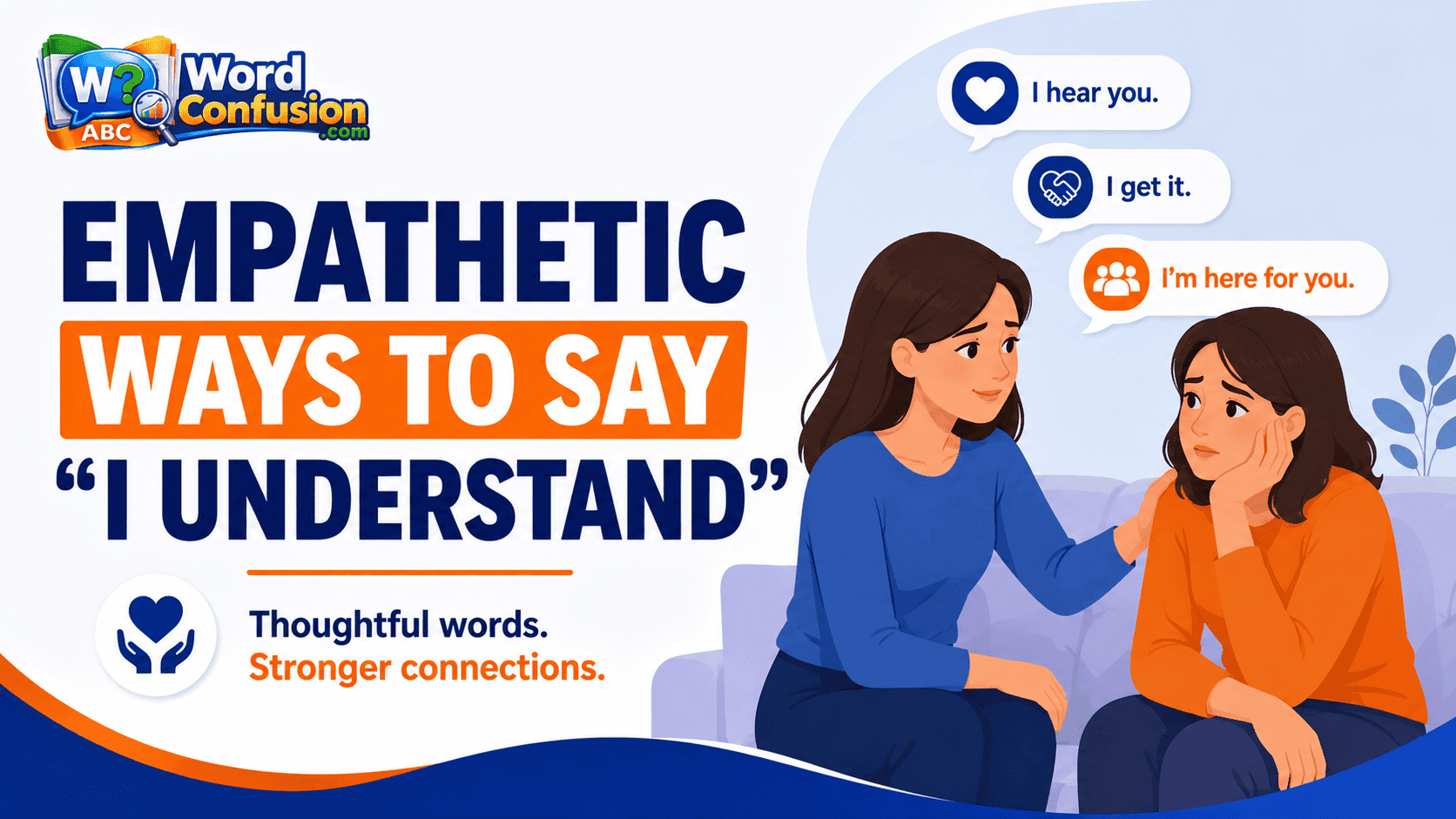
Sometimes the goal isn’t simply to show that you understood someone’s words. You want to acknowledge their feelings.
In these situations, choose an expression that shows attention and empathy.
33. I Hear You
👉“I hear you” is commonly used to acknowledge someone’s feelings, concerns, or frustration.
“I hear you. It has been a difficult situation.”
It does not necessarily mean that you agree.
34. I Understand Your Concern
This is especially useful in customer service and professional communication.
“I understand your concern, and I’ll look into the issue.”
35. I Can See Why You Feel That Way
This directly acknowledges someone’s emotional reaction.
“I can see why you feel that way after what happened.”
36. I Can See Where You’re Coming From
This is a natural way to acknowledge someone’s perspective or motivation.
“I can see where you’re coming from.”
37. I Appreciate What You’re Saying
This communicates that you have listened and considered the person’s words.
“I appreciate what you’re saying, and I’ll think carefully about it.”
38. I Can Relate
Use this when you genuinely have a similar experience.
“I can relate. I had a similar experience last year.”
Don’t use “I can relate” simply as a replacement for “I understand.” It suggests a personal connection that may not exist.
39. I Understand How Difficult This Is
This is useful when someone is dealing with a challenging situation.
“I understand how difficult this is, and I’m here to help.”
40. I Appreciate Your Perspective
This is a diplomatic way to show that you have listened to someone’s viewpoint.
“I appreciate your perspective, even though I see the issue differently.”
How to Say “I Understand” in a Professional Email
The best professional alternative depends on what you’re responding to.
Responding to Instructions
Use “Understood” when someone has given you clear instructions.
“Understood. I’ll complete the report and send it to you by Friday.”
You can also say:
“Thank you for the clarification. I’ll proceed accordingly.”
Responding to a Clarification
When someone has explained something that was unclear, try:
“Thank you for the clarification. I now have a clear understanding of the requirements.”
Or, more naturally:
“Thank you for clarifying. That makes sense now.”
Responding to a Client Concern
When a client raises a concern, a simple “I understand” can sometimes sound too generic.
Instead:
“I understand your concern, and I appreciate you bringing this to our attention.”
This acknowledges the person’s concern before moving toward a solution.
Confirming Next Steps
If you want to show that you understand what needs to happen:
“I’m clear on the next steps and will proceed accordingly.”
This is stronger than simply saying:
“I understand.”
because it confirms both understanding and action.
Responding to a Manager
For instructions from a manager, professional and concise wording is usually best:
“Understood. I’ll make the requested changes and send the updated version this afternoon.”
Avoid overly casual responses such as:
“Gotcha!”
unless your workplace relationship and communication style clearly make that appropriate.
How to Say “I Understand” at Work
Different workplace situations call for different expressions.
| Situation | Natural Response |
| Your manager gives you instructions | Understood. |
| A coworker explains a process | I follow you. |
| A client raises a concern | I understand your concern. |
| Someone clarifies a requirement | I appreciate the clarification. |
| You agree with someone’s reasoning | That makes sense. |
| You understand someone’s argument | I see your point. |
| You share the same understanding | We’re on the same page. |
| You need to acknowledge an update | Thanks for letting me know. |
| You want to confirm action | I’ll proceed accordingly. |
| You’re having an informal team conversation | Got it. |
The goal isn’t to sound more complicated. It’s to choose the expression that communicates your exact intention.
“I Understand” vs. Similar Expressions
“I Understand” vs. “I Agree”
These phrases are not interchangeable.
👉I understand means:
I grasp your point or information.
👉I agree means:
I share your opinion or conclusion.
You can understand someone without agreeing with them:
“I understand your argument, but I don’t agree with the proposed solution.”
This distinction is important in professional and sensitive conversations.
“I Understand” vs. “I Hear You”
👉I understand is broader.
I hear you often focuses more on acknowledging someone’s feelings, concerns, or frustration.
Compare:
“I understand the new procedure.”
with:
“I hear you. You’re frustrated with how the situation was handled.”
The second sentence is more empathetic.
“I Understand” vs. “I See What You Mean”
👉“I see what you mean” is especially useful when someone is explaining an idea, argument, or perspective.
“I see what you mean now.”
It often sounds more conversational than:
“I understand what you mean.”
“I Understand” vs. “That Makes Sense”
“That makes sense” evaluates an explanation as logical or reasonable.
“That makes sense. Now I understand why the deadline changed.”
Notice the difference:
- I understand → I grasp it.
- That makes sense → The explanation seems logical.
“I Understand” vs. “Understood”
“Understood” is shorter and often more direct.
“Understood. I’ll make the changes.”
It is especially common when acknowledging instructions.
“I understand” can sound slightly warmer or more conversational:
“I understand what you’re asking.”
Both are correct; the context determines which sounds better.
“I Understand” vs. “Got It”
“Got it” is more casual.
“Got it. I’ll send it tonight.”
It works well in conversations, texts, chats, and informal workplace communication.
For a formal email, “Understood” or “Thank you for the clarification” is usually safer.
📖 See also:LOL Meaning in Text: What Does LOL Stand For?
Common Mistakes When Replacing “I Understand”
1. Assuming Every Alternative Means Exactly the Same Thing
This is the biggest mistake.
“Understood,” “I hear you,” “That makes sense,” and “I agree” all relate to understanding, but they perform different communicative functions.
Choose based on meaning, not just vocabulary similarity.
2. Using Casual Expressions in Formal Emails
“Got it” and “Gotcha” are perfectly normal in casual conversations.
But in a formal client email, something like:
“Thank you for the clarification. I understand the requirements.”
usually sounds more appropriate.
3. Confusing Understanding With Agreement
Avoid saying:
“I understand, so I agree.”
Understanding and agreement are separate ideas.
Instead:
“I understand your position, although I have a different opinion.”
4. Using “I Hear You” When You Mean “I Agree”
“I hear you” acknowledges someone.
It doesn’t necessarily mean you support their position.
If you agree, say:
“I agree.”
If you understand their reasoning but don’t agree, say:
“I see your point, but I have a different view.”
5. Using “I Can Relate” Without a Similar Experience
“I can relate” implies some degree of personal connection.
If you’ve never experienced the situation yourself, a better choice may be:
“I can see why that would be difficult.”
6. Using “I Comprehend” Just to Sound More Formal
More formal vocabulary isn’t automatically better.
“I comprehend” is grammatically correct, but “I understand” is generally more natural.
Good English is about appropriate wording, not unnecessarily complicated wording.
7. Using “Duly Noted” When You Want to Sound Warm
“Duly noted” acknowledges information, but depending on context it can sound formal, distant, or even slightly cold.
If you want a warmer tone, try:
“Thanks for letting me know. I’ll keep that in mind.”
Which Alternative Should You Choose?
Use this simple guide:
Someone gives you instructions:
→ Understood.
Someone explains an idea:
→ I see what you mean.
An explanation seems logical:
→ That makes sense.
You are following an argument:
→ I follow you.
Someone shares frustration or concern:
→ I hear you.
A client raises a concern:
→ I understand your concern.
Someone clarifies something:
→ I appreciate the clarification.
You’re talking casually:
→ Got it.
👉You understand someone’s viewpoint:
→ I see your point.
You respect their viewpoint:
→ I appreciate your perspective.
👉You share the same understanding:
→ We’re on the same page.
You genuinely agree:
→ I agree.
This approach is much more useful than memorizing a long list of synonyms.
Examples in Real Conversations
Example 1: Understanding Instructions
Manager: “Please send the revised proposal before 3 p.m.”
You: “Understood. I’ll send it before 3 p.m.”
Example 2: Understanding an Explanation
Friend: “I didn’t call because I thought you were busy.”
You: “Oh, I see what you mean.”
Example 3: Understanding a Concern
Customer: “I’ve already contacted support twice.”
You: “I understand your frustration, and I’ll check what happened.”
Example 4: Casual Conversation
Friend: “So basically, the first option costs more but gives us better quality.”
You: “Got it.”
Example 5: Different Opinion
Colleague: “I think we should launch next week.”
You: “I see your point, but I think we need more testing first.”
Example 6: Empathy
Friend: “I’m exhausted from dealing with all these deadlines.”
You: “I hear you. That’s a lot to deal with.”
Example 7: Shared Understanding
Coworker: “Let’s finish the urgent tasks first and handle the rest tomorrow.”
You: “We’re on the same page.”
Example 8: Professional Email
“Thank you for clarifying the requirements. I now have a clear understanding of what needs to be completed and will proceed accordingly.”
Is “I Understand” Still a Good Phrase?
Absolutely.
You do not need to replace “I understand” every time you use it.
It is:
- grammatically correct
- natural
- widely understood
- appropriate in professional communication
- useful in everyday conversation
The purpose of alternatives is not to make your English sound unnecessarily complicated.
They help you communicate more precisely.
For example:
“I understand.”
is perfectly fine.
But:
“I understand your concern, and I’ll look into it.”
is more informative.
Likewise:
“I see what you mean.”
may be better when someone has just explained their reasoning.
The best alternative is therefore the one that adds the meaning you actually want.
Frequently Asked Questions
What is another professional way to say “I understand”?
Some strong professional alternatives are “Understood,” “I appreciate the clarification,” “I see your point,” “I understand your concern,” and “I’m clear on the next steps.” Choose based on whether you’re acknowledging instructions, understanding a viewpoint, or responding to a concern.
What is a polite way to say “I understand”?
Try “I see what you mean,” “I understand where you’re coming from,” “That makes sense,” “I appreciate your perspective,” or “I see your point.” These expressions are polite without sounding unnecessarily formal.
How do you say “I understand” professionally?
In professional communication, you can say “Understood,” “I appreciate the clarification,” “Your instructions are clear,” “I have a clear understanding,” or “I’ll proceed accordingly.”
What can I say instead of “I understand” in an email?
For a professional email, useful alternatives include:
- “Thank you for the clarification.”
- “I understand the requirements.”
- “Understood.”
- “I appreciate the explanation.”
- “I’m clear on the next steps.”
- “I’ll proceed accordingly.”
The best choice depends on what you’re acknowledging.
Is “Understood” polite?
Yes. “Understood” is generally polite and professional, especially when acknowledging instructions or information.
However, because it is concise, it can sound somewhat direct in certain situations. If you want a warmer response, try:
“Thank you for clarifying. I understand.”
Is “Got it” professional?
“Got it” is acceptable in many informal workplace conversations, especially chats and quick exchanges with colleagues.
For formal emails, client communication, or more traditional professional settings, “Understood,” “Thank you for the clarification,” or “I appreciate the explanation” may be better choices.
Is “Gotcha” formal or informal?
“Gotcha” is informal.
It is natural in casual conversations but generally unsuitable for formal emails, academic writing, or highly professional communication.
Does “I understand” mean “I agree”?
No.
“I understand” means that you grasp someone’s point, information, reasoning, or feelings.
“I agree” means that you share their opinion or conclusion.
For example:
“I understand your position, but I don’t agree with the decision.”
Both ideas can appear in the same conversation, but they are not the same.
How do I show empathy instead of saying “I understand”?
Try expressions such as:
- “I hear you.”
- “I can see why you feel that way.”
- “I understand your concern.”
- “I can see where you’re coming from.”
- “I understand how difficult this is.”
- “I appreciate what you’re going through.”
Choose an expression that genuinely reflects the situation.
What is the best alternative to “I understand” at work?
There isn’t one universal best alternative.
- For instructions, “Understood” is excellent.
- For an explanation, try “I see what you mean.”
- For a client concern, “I understand your concern” is appropriate.
- For shared understanding, “We’re on the same page” can work well.
Is “I hear you” the same as “I understand”?
Not exactly.
“I hear you” often focuses on acknowledging someone’s feelings, concerns, or perspective, while “I understand” can refer to information, instructions, reasoning, or emotions.
What is a formal synonym for “I understand”?
Depending on context, formal alternatives include “I comprehend,” “I fully understand,” “I acknowledge that,” “I recognize the situation,” and “I have a clear understanding.”
However, formal does not always mean better. In most professional communication, natural phrases such as “I understand,” “Understood,” or “I appreciate the clarification” are preferable to unnecessarily complicated wording.
Can I say “I understand your point, but…”?
Yes. This is a useful structure when you want to acknowledge someone’s reasoning while expressing a different opinion.
For example:
“I understand your point, but I think we should consider another option.”
This makes it clear that you have listened without pretending to agree.
What is the difference between “I understand” and “That makes sense”?
“I understand” says that you have grasped something.
“That makes sense” says that the explanation seems logical or reasonable.
You can use both:
“That makes sense. Now I understand why the schedule changed.”
📖 See also:HMJ Meaning in Text: Slang, Examples & HMU Difference
Key Takeaways
- “I understand” is already correct and natural.
- Use “Understood” for instructions and clear information.
- Use “I see what you mean” when you understand someone’s reasoning.
- Use “That makes sense” when an explanation is logical.
- Use “I hear you” when acknowledging feelings or concerns.
- Use “Got it” in casual communication.
- Use “I appreciate the clarification” in professional emails.
- Use “I understand your concern” for customer or client communication.
- Use “We’re on the same page” when you share an understanding.
- Use “I agree” only when you actually agree.
- Remember that understanding and agreement are not the same thing.
- Choose an alternative because it communicates your intended meaning more precisely—not simply because it sounds more sophisticated.
Conclusion
There are plenty of ways to say “I understand,” but the best expression depends on what kind of understanding you want to communicate.
If someone gives you instructions, “Understood” is concise and professional. If someone explains their reasoning, “I see what you mean” sounds natural. .If you’re acknowledging a concern, “I hear you” or “I understand your concern” may be more appropriate. For casual conversations, “Got it” and “I get it” are perfectly natural.
Most importantly, don’t feel that you have to replace “I understand” every time. It remains a clear, useful English phrase. The real goal is not variety for its own sake; it is precision, tone, and natural communication.
When you choose the expression that matches your exact meaning, your English becomes clearer, more natural, and more effective.
Written by
 Abdul Moeed
Abdul Moeed is a professional content writer and SEO link-building specialist with 5+ years of experience. He creates search-optimized content and develops effective SEO strategies that improve website visibility, authority, and organic growth.
View LinkedIn profileLatest posts
 Exempt vs Non Exempt: Meaning, Overtime Rules & Examples
 What Does PG Mean in Text? Meaning, Examples & Usage
 What Does OFCC Mean in Text? Meaning, Uses & Examples
 What Does MSG Mean in Text? Meaning, Examples & Usage
 What Does STY Mean in Text? Meaning, Examples & Usage
 What Does “Twin” Mean in Slang? Meaning, Text & Examples