What Does Ima Mean in Text? Slang Meaning & Examples

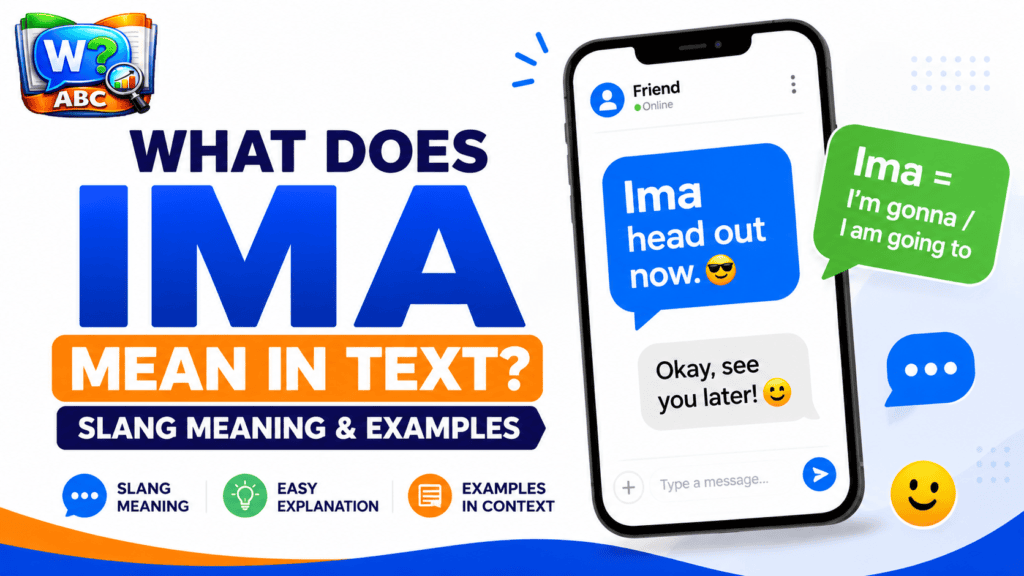
Have you ever received a message like “Ima call you later” or “Ima head out now” and wondered what “Ima” means?
You’re not alone. “Ima” is a common piece of internet slang that appears in text messages, social media posts, and online chats every day. While it may look unusual at first, its meaning is simple once you understand the context.
In this guide, you’ll learn what Ima means in text, where it comes from, how people use it on platforms like WhatsApp, Snapchat, TikTok, Instagram, and Discord, and how it compares with similar expressions such as Imma and I’m gonna. You’ll also find plenty of real-life examples, common mistakes to avoid, and tips for using it naturally.
Quick Answer
“Ima” means “I’m going to.” It is an informal slang expression commonly used in text messages, online chats, and social media. People use it to quickly tell someone about an action they are about to do.
Example:
- Ima text you after work.
- Ima grab some food first.
- Ima be there in five minutes.
Because it is informal, Ima is best suited for casual conversations with friends and family rather than professional emails or academic writing.
Featured Snippet Answer
In text messages, “Ima” means “I’m going to.” It is an informal slang expression used in texting, social media, and online conversations to describe an action someone plans to do soon. For example, “Ima call you later” simply means “I’m going to call you later.”
What Does “Ima” Mean in Text?
In texting, Ima is a shortened, phonetic way of writing “I’m going to.”
Instead of typing the full phrase, many people write Ima because it is quicker and sounds similar to the way the phrase is pronounced in casual speech.
Simple Definition
Ima = I’m going to
It expresses an intention or future action.
Examples
- Ima watch that movie tonight.
- Ima finish my homework first.
- Ima send you the pictures later.
- Ima join the game in a minute.
- Ima talk to you tomorrow.
In every example, Ima can be replaced with I’m going to without changing the meaning.
Is “Ima” a Real Word?
Not exactly.
Ima is not considered standard English and is rarely found in formal dictionaries as a regular word. Instead, it is recognized as an informal spelling or slang form of the spoken phrase “I’m going to.”
Because it reflects everyday speech rather than formal grammar, you’ll mostly see it in:
- Text messages
- Social media comments
- Online gaming chats
- Group conversations
- Casual online communities
You generally won’t find it in business reports, school essays, legal documents, or professional emails.
Is “Ima” an Abbreviation, Acronym, or Slang?
Many people ask whether Ima is an abbreviation or an acronym.
The most accurate answer is that Ima is internet slang.
Here’s the difference:
| Term | Does “Ima” Fit? | Explanation |
| Abbreviation | Partly | It shortens the phrase “I’m going to.” |
| Acronym | No | It is not formed from the first letters of multiple words. |
| Slang | Yes | It is an informal expression commonly used in digital communication. |
So, while some people casually call it an abbreviation, “slang” is the most accurate description in the context of texting and social media.
Where Did “Ima” Come From?
The expression developed naturally from spoken American English.
When people say “I’m going to” quickly in everyday conversation, the words often blend together and sound like:
- I’ma
- Ima
- Imma
As texting became more popular, users began writing the phrase the way it sounded in speech. Over time, Ima became a familiar part of online communication, especially among younger users and on social media platforms.
Today, it is widely recognized across messaging apps and online communities.
How Do You Pronounce “Ima”?
Most people pronounce Ima like:
Eye-muh
It closely matches the natural spoken pronunciation of “I’m gonna” or “I’m going to” when said quickly in casual conversation.
The spelling simply reflects everyday speech rather than formal written English.
Why Do People Say “Ima” Instead of “I’m Going To”?
There are several reasons why people prefer using Ima in casual conversations.
1. It’s Faster to Type
Shorter messages are easier to send, especially on mobile devices.
Instead of typing:
I’m going to call you later.
Many people simply write:
Ima call you later.
2. It Sounds More Natural
Many speakers already pronounce “I’m going to” in a way that sounds like “I’ma.” Writing it this way mirrors natural conversation.
3. It Fits Casual Online Communication
Texting, social media, and chat apps encourage relaxed, conversational language. Slang terms like Ima, IDK, TBH, and NGL make conversations feel quicker and more informal.
4. It Creates a Friendly Tone
Using Ima can make messages sound more personal and conversational, especially when chatting with friends, family, or online communities.
When Should You Use “Ima”?
Use Ima when talking casually with people you know.
Suitable situations include:
- Texting friends
- Family conversations
- Group chats
- WhatsApp messages
- Snapchat conversations
- Instagram DMs
- TikTok comments
- Discord chats
- Online gaming
Avoid using Ima in:
- Job applications
- Business emails
- Academic essays
- School assignments
- Professional reports
- Formal presentations
In those situations, always write “I’m going to” instead.
Key Takeaways
- Ima means “I’m going to.”
- It is informal internet slang used in texting and online conversations.
- It expresses something the speaker plans to do.
- It is common on WhatsApp, Snapchat, Instagram, TikTok, Discord, and Messenger.
- It should be avoided in formal or professional writing.
How Is “Ima” Used in Text Messages?
People use Ima to tell someone what they’re about to do or what they plan to do soon. It usually appears at the beginning of a sentence and is followed by a verb.
Examples in Everyday Texting
Friend: Are you coming over?
You: Ima leave in 10 minutes.
Friend: Want to play tonight?
You: Ima finish dinner first.
Sibling: Can you help me later?
You: Ima clean my room, then I’ll help.
Coworker (casual chat): Are you joining the meeting?
You: Ima log in now.
Friend: Did you watch the new episode?
You: Not yet. Ima watch it tonight.
In each example, Ima means “I’m going to.”
Ima Meaning on Different Social Media Platforms
Although the meaning stays the same, the way people use Ima can vary slightly depending on the platform.
Ima Meaning on WhatsApp
On WhatsApp, Ima usually appears in quick conversations between friends and family.
Examples
- Ima call you after dinner.
- Ima send the photos now.
- Ima be home soon.
Ima Meaning on Snapchat
Snapchat messages are fast and informal, making Ima very common.
Examples
- Ima post a streak.
- Ima open your snap later.
- Ima send one back.
Ima Meaning on Instagram
You’ll often see Ima in comments, captions, Stories, and direct messages.
Examples
- Ima try this trend.
- Ima upload more pictures tomorrow.
- Ima follow you back.
Ima Meaning on TikTok
TikTok users frequently use Ima before describing something they’re about to do.
Examples
- Ima try this recipe.
- Ima recreate this dance.
- Ima save this video.
Ima Meaning on Discord
Gamers and online communities often use Ima while chatting during games.
Examples
- Ima join the voice chat.
- Ima switch characters.
- Ima restart the game.
Ima Meaning on Messenger
Facebook Messenger conversations are usually informal, so Ima fits naturally.
Examples
- Ima message you later.
- Ima head out now.
- Ima be there soon.
Examples of “Ima” in Text Conversations
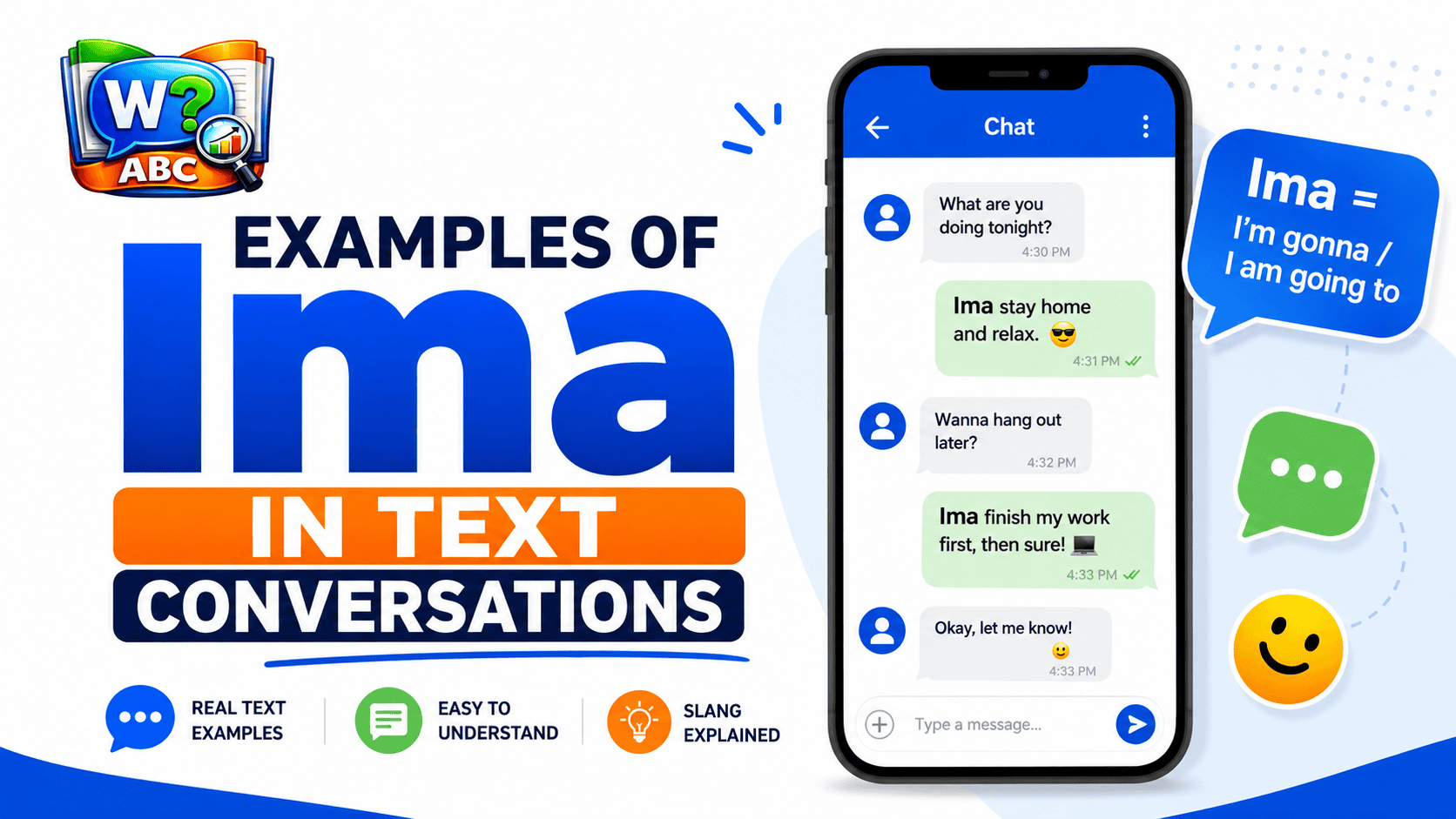
Here are more real-life examples to show how the expression is used naturally.
Example 1
Alex: Are you hungry?
Sam: Yeah. Ima order pizza.
Example 2
Emma: Did you finish your homework?
Liam: Not yet. Ima do it after dinner.
Example 3
Chris: Can we talk tonight?
Jordan: Sure. Ima call you around 8.
Example 4
Taylor: Where are you?
Morgan: Traffic is bad. Ima be there in five minutes.
Example 5
Jamie: Did you see my message?
Casey: Sorry! Ima reply properly when I get home.
Example 6
Friend: Movie tonight?
You: Absolutely. Ima buy the tickets.
Example 7
Friend: Who’s driving?
You: Ima drive if that’s okay.
Example 8
Friend: Can you send me the link?
You: Yep. Ima send it now.
Example 9
Friend: Want coffee?
You: Ima grab one on my way.
Example 10
Friend: Are you ready?
You: Almost. Ima put my shoes on.
These examples show that Ima almost always introduces an action that will happen soon.
How Do You Reply to “Ima”?
There’s no special response required. Simply reply based on what the person says they plan to do.
Here are some natural replies.
| Someone Says | Possible Reply |
| Ima call you later. | Sounds good! |
| Ima head home now. | Drive safely! |
| Ima finish this first. | No problem, take your time. |
| Ima send it tonight. | Thanks, I appreciate it. |
| Ima be there soon. | Great, see you soon! |
| Ima watch that movie. | Let me know what you think! |
| Ima order food. | Good idea—I’m hungry too! |
| Ima study this evening. | Good luck with your studying! |
The best reply depends on the conversation, but a friendly acknowledgment is usually enough.
Ima vs Imma
Many people think these two words are different, but they’re very similar.
| Ima | Imma |
| Means “I’m going to.” | Means “I’m going to.” |
| Common spelling | Also very common |
| Informal | Informal |
| Used in texting | Used in texting |
| Casual English | Casual English |
Which One Is More Correct?
Neither spelling is considered standard English.
Some people prefer Imma because it more closely matches the way they pronounce the phrase, while others simply type Ima because it’s shorter.
Both mean exactly the same thing.
Example
- Ima leave now.
- Imma leave now.
Both sentences have the same meaning.
Ima vs “I’m Gonna”
Although these expressions are similar, they are written differently.
| Ima | I’m Gonna |
| Very informal slang | Informal spoken English |
| Mostly seen in texting | Common in speech and writing |
| Shorter | Slightly longer |
| Casual conversations | Casual conversations |
Example
- Ima watch a movie.
- I’m gonna watch a movie.
Both express a future intention.
Ima vs “I’m Going To”
| Ima | I’m Going To |
| Informal | Standard English |
| Texting slang | Correct formal grammar |
| Best for chats | Best for professional writing |
| Common online | Accepted everywhere |
Example
Casual
Ima email you later.
Formal
I’m going to email you later.
Both sentences mean the same thing, but the second is appropriate for work, school, and professional communication.
Can You Use “Ima” in Formal Writing?
No. “Ima” should not be used in formal writing.
Although it’s widely understood in casual conversations, it isn’t considered standard written English. In professional or academic settings, always use the complete phrase “I’m going to.”
Use “Ima” In:
- Text messages
- WhatsApp chats
- Snapchat conversations
- Instagram DMs
- TikTok comments
- Discord chats
- Casual conversations with friends and family
Avoid “Ima” In:
- Business emails
- Job applications
- School essays
- Research papers
- Cover letters
- Professional reports
- Official documents
Example
❌ Ima submit the report tomorrow.
✅ I’m going to submit the report tomorrow.
Using standard English in formal situations helps you sound more professional and avoids confusion.
Common Mistakes When Using “Ima”
Even though Ima is simple, people sometimes misuse it. Here are the most common mistakes.
1. Using It in Professional Writing
Incorrect
Ima send the contract today.
Correct
I’m going to send the contract today.
2. Assuming It’s an Acronym
Some people think Ima stands for several words like an acronym. It doesn’t.
It is simply an informal written form of “I’m going to.”
3. Confusing “Ima” with “I’m”
“Ima” expresses a future action.
I’m describes your current state or identity.
Examples
- I’m tired.
- Ima go to bed.
These sentences have different meanings.
4. Using It Without a Following Action
“Ima” should normally be followed by a verb.
✔ Ima leave now.
✔ Ima call you later.
✘ Ima tomorrow.
Pro Tips for Using “Ima” Naturally
- Use it only in casual conversations.
- Follow it with an action verb.
- Don’t use it in formal documents.
- If you’re unsure whether the situation is formal, choose “I’m going to.”
- Remember that both Ima and Imma have the same meaning.
Frequently Asked Questions
What does Ima mean in text?
Ima means “I’m going to.” It’s an informal slang expression used in text messages, social media, and online chats to describe a future action.
What does Ima stand for?
Although many people ask what it “stands for,” Ima is not a true acronym. It is simply a casual written form of “I’m going to.”
Is Ima slang?
Yes. Ima is internet slang commonly used in digital conversations and casual messaging.
Is Ima a real English word?
Not in standard English. It is an informal spelling based on everyday speech and is mainly used online.
Is Ima the same as Imma?
Yes. Both Ima and Imma mean “I’m going to.” The difference is only in spelling and personal preference.
Why do people say Ima?
People use Ima because it’s shorter, quicker to type, and reflects natural spoken English.
Can Ima be used in formal writing?
No. In professional or academic writing, use “I’m going to” instead.
What does Ima mean on TikTok?
On TikTok, Ima has the same meaning: “I’m going to.” Users often write it before describing something they plan to do, such as trying a trend or posting a new video.
What does Ima mean on Snapchat?
On Snapchat, Ima simply means “I’m going to.” It’s commonly used in quick, casual conversations between friends.
How do you use Ima in a sentence?
Here are a few examples:
- Ima call you after work.
- Ima finish this later.
- Ima head home now.
- Ima watch that movie tonight.
Final Thoughts
Ima is a simple but popular piece of internet slang that means “I’m going to.” It’s widely used in text messages, social media posts, and online chats because it’s quick, conversational, and easy to understand.
Whether you’re chatting on WhatsApp, posting on TikTok, messaging on Snapchat, or talking with friends on Discord, you’ll often see Ima used to describe an upcoming action.
Just remember the key rule: use “Ima” in casual conversations, but choose “I’m going to” whenever you’re writing something formal or professional.
If you’re learning English vocabulary and commonly confused words, you may also enjoy our guides on PM Meaning, What Does HWY Mean in Text?, and What Does FAFO Mean in Text?. Understanding these distinctions will make your writing clearer, more accurate, and more professional.
Written by
 Abdul Moeed
Abdul Moeed is a professional content writer and SEO link-building specialist with 5+ years of experience. He creates search-optimized content and develops effective SEO strategies that improve website visibility, authority, and organic growth.
View LinkedIn profileLatest posts
 Exempt vs Non Exempt: Meaning, Overtime Rules & Examples
 What Does PG Mean in Text? Meaning, Examples & Usage
 What Does OFCC Mean in Text? Meaning, Uses & Examples
 What Does MSG Mean in Text? Meaning, Examples & Usage
 What Does STY Mean in Text? Meaning, Examples & Usage
 What Does “Twin” Mean in Slang? Meaning, Text & Examples