Encode vs Incode: Which Is Correct? Meaning, Usage & Examples
 Abdul Moeed
Introduction
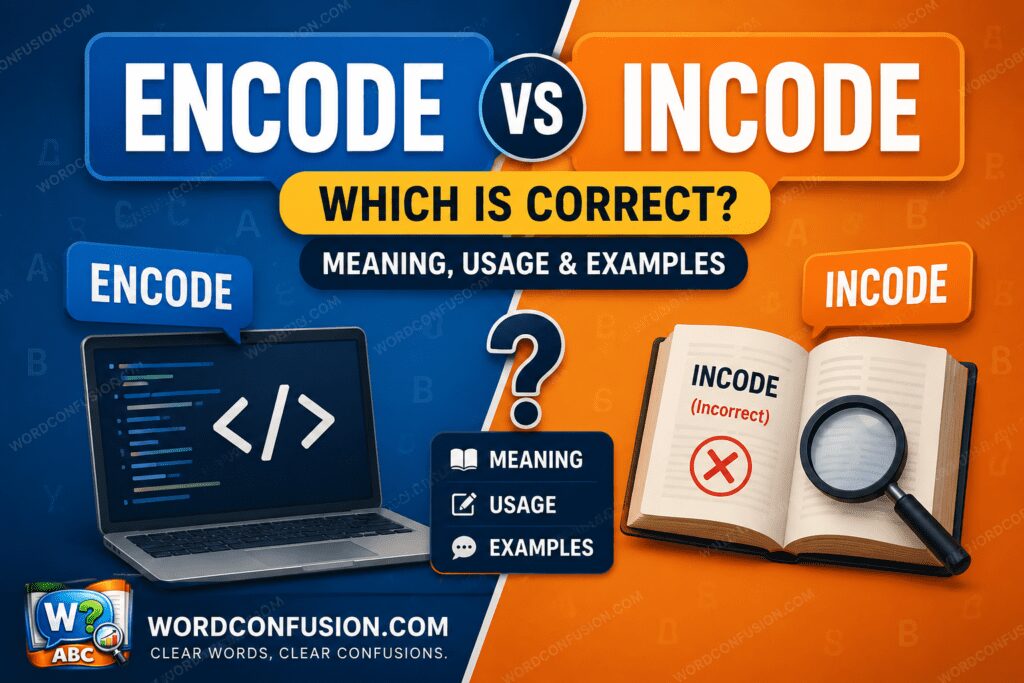
Have you seen “incode” written somewhere and wondered whether it is correct? The short answer is simple: encode is the correct English word, while incode is usually a spelling mistake.
The confusion happens because both words sound somewhat similar when spoken quickly. However, dictionaries, computer science terminology, and standard English usage recognize encode as the correct form.
In this guide, you’ll learn the difference between Encode vs Incode, the meaning of encode, how it is used in technology and everyday language, common mistakes to avoid, and plenty of examples.
Quick Answer
| Word | Correct? | Meaning |
| Encode | ✅ Yes | To convert information into a specific form or code |
| Incode | ❌ Usually No | Common misspelling of encode |
Correct: We need to encode the data before transmission.
Incorrect: We need to incode the data before transmission.
Featured Snippet Answer
Encode vs Incode: Encode is the correct English word that means converting information, text, signals, or data into a coded format. Incode is generally considered a misspelling of encode and is not recognized as a standard English word in dictionaries. When writing about computing, communication, or information processing, always use encode.
Encode vs Incode: What’s the Difference?
The difference is straightforward.
| Feature | Encode | Incode |
| Valid English word | ✅ Yes | ❌ No |
| Found in dictionaries | ✅ Yes | ❌ No |
| Used in computing | ✅ Yes | ❌ No |
| Correct for professional writing | ✅ Yes | ❌ No |
| Common spelling mistake | ❌ No | ✅ Yes |
Whenever you’re discussing data, text, information, media, or programming, encode is the correct choice.
What Does Encode Mean?
Encode means converting information into another format so it can be stored, processed, transmitted, or understood by a system.
Encode Definition
Encode (verb): To convert information, text, symbols, sounds, or data into a coded form.
Simple Examples
- Computers encode text into binary.
- Smartphones encode photos before storing them.
- Streaming platforms encode videos for online playback.
- Humans encode memories in the brain.
Encode Meaning in Computer Science
In computer science, encoding is extremely important.
Computers cannot understand information the same way humans do. Therefore, data must be converted into formats machines can process.
Common Encoding Examples
- Text encoding (UTF-8)
- Audio encoding (MP3)
- Video encoding (MP4)
- Character encoding
- Image encoding
Example
A computer may encode the letter A into a binary representation before storing it.
Without encoding, modern computing systems would not function efficiently.
Is Incode a Real Word?
In standard English, incode is not recognized as a dictionary word.
Most people use it accidentally when they actually mean encode.
Why Does “Incode” Appear Online?
You may see “incode” because of:
- Typing mistakes
- Autocorrect errors
- Pronunciation confusion
- Lack of familiarity with technical vocabulary
In professional writing, academic work, and technology-related content, encode should always be used.
Encode Definition and Word Origin
The word encode comes from:
- En- (put into)
- Code (system of symbols or instructions)
Together, the word literally means:
“To put something into code.”
This origin makes it easier to remember the correct spelling.
Encode vs Decode
People often confuse encoding with decoding.
| Term | Meaning |
| Encode | Convert information into a coded form |
| Decode | Convert coded information back into readable form |
Example
- A message is encoded before transmission.
- The receiver decodes the message.
- The original information becomes readable again.
Think of encoding and decoding as opposite processes.
Encode vs Encrypt: Are They the Same?
No.
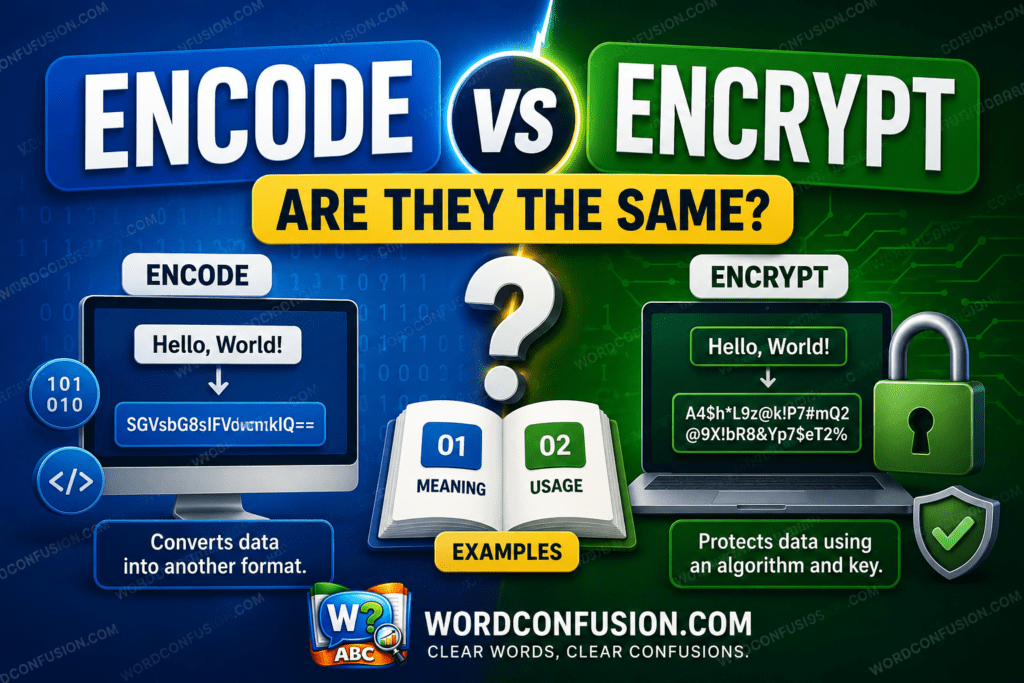
Many beginners use these terms interchangeably, but they are different.
| Encode | Encrypt |
| Changes format | Secures information |
| Intended for compatibility | Intended for protection |
| Can often be reversed easily | Requires a key to decrypt |
| Used for processing | Used for security |
Example
A website may:
- Encode data for storage.
- Encrypt passwords for security.
Both processes are useful, but they serve different purposes.
Real-Life Examples of Encode
Encoding isn’t limited to computers.
Human Communication
People encode ideas into words when speaking.
Example:
A teacher encodes information into a lesson.
Memory Formation
Psychologists use the term encode when discussing memory.
Example:
Students encode information more effectively through repetition.
Digital Media
Videos and music are encoded into formats devices can understand.
Example:
The software encoded the video into MP4 format.
Encode in Sentences
Here are some examples of correct usage.
Correct Examples
✅ The application can encode large files quickly.
✅ We need to encode the document before sending it.
✅ The video editor encoded the footage into a smaller format.
✅ Scientists study how the brain encodes memories.
✅ The system encodes information automatically.
Common Mistakes People Make
Mistake #1: Writing Incode Instead of Encode
❌ Please incode the data.
✅ Please encode the data.
Mistake #2: Confusing Encode With Encrypt
❌ Encoding protects sensitive passwords.
✅ Encryption protects sensitive passwords.
Mistake #3: Using Encode Incorrectly
❌ He encoded his lunch.
✅ He encoded the information.
Use encode when information is being converted into another format.
Why Encoding Matters
Encoding helps technology work correctly.
Benefits include:
- Faster data processing
- Better communication between systems
- Improved compatibility
- Efficient storage
- Reliable data transmission
Without encoding, software, websites, apps, and digital communication would struggle to function properly.
Character Encoding Explained
Character encoding allows computers to represent letters and symbols numerically.
Example
The character:
A
can be represented using a numerical value in a character encoding system.
Popular standards include:
- UTF-8
- ASCII
- Unicode
These systems ensure text displays correctly across devices.
Text Encoding Examples
Text encoding is everywhere.
Examples include:
- Websites
- Emails
- Mobile apps
- Databases
- Digital documents
When text appears correctly on different devices, encoding is usually working behind the scenes.
How to Remember the Correct Spelling
Use these simple memory tricks.
Remember the Prefix
The word is:
EN + CODE = ENCODE
Not:
IN + CODE
Think of Coding
Since encoding is related to coding information, the word naturally begins with en-.
Writing Habit
Whenever discussing data or information, pause and check whether you’ve written encode, not incode.
Commonly Asked Questions About Encode vs Incode
Which Is Correct: Encode or Incode?
Encode is correct. Incode is generally a misspelling.
Is Incode a Word in English?
No. Standard English dictionaries do not recognize incode as a common English word.
What Does Encode Mean?
Encode means converting information into a coded or specific format for storage, processing, or transmission.
What Is the Opposite of Encode?
The opposite is decode.
Is Encode Used Only in Computing?
No. It is also used in psychology, communication, linguistics, and media studies.
What Is an Example of Encode?
Example:
The software encoded the audio file before uploading it.
Common Mistakes to Avoid
- Writing incode instead of encode
- Confusing encoding with encryption
- Using encode outside information-related contexts
- Assuming encode and decode mean the same thing
- Misspelling encoded, encoding, or encoder
Pro Tips for Writers
✅ Use encode whenever information is converted into another format.
✅ Remember that incode is usually incorrect.
✅ Distinguish between encoding and encryption.
✅ Use examples when explaining technical concepts.
✅ Double-check spelling in technology-related writing.
Conclusion
When comparing Encode vs Incode, the correct word is encode. It means converting information, data, text, audio, or signals into a specific format that computers or systems can process. Incode is generally a spelling mistake and should be avoided in professional, academic, and technical writing.
If you’re unsure which word to use, remember this simple rule:
Encode is correct. Incode is incorrect.
If you’re learning English vocabulary and commonly confused words, you may also enjoy our guides on platform-vs-flatform, Tweek vs Tweak, Moment vs Momment, and Kick Rocks Meaning. Understanding these distinctions will make your writing clearer, more accurate, and more professional.