What Does DNI Mean in Text? Meaning, Examples & Uses (2026)
 Abdul Moeed
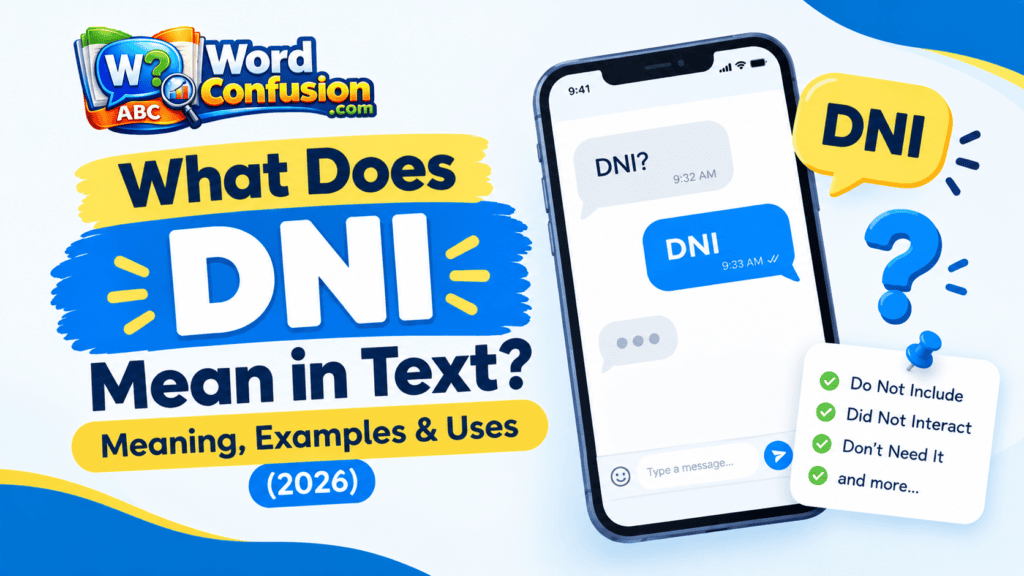
If you’ve seen “DNI” in a social-media bio, text message, comment, or online profile, you may wonder what it means. In most online conversations, DNI means “Do Not Interact.” It is an informal abbreviation people use to set a boundary and tell a particular person or group not to engage with them or their content.
For more explanations of modern texting language and online abbreviations, explore the practical English guides at WordConfusion.
Quick Answer: What Does DNI Mean in Text?
DNI usually means “Do Not Interact” in texting and social media. People use it to tell certain users not to message, follow, comment on, or otherwise engage with them or their content. You’ll commonly see DNI in social-media bios, posts, comments, profiles, and online communities.
For example:
“Minors DNI.”
This means that people under the stated age are being asked not to interact with the account or its content.
What Does DNI Stand For?
DNI stands for “Do Not Interact.”
The phrase is used as a direct boundary statement. A person may put DNI in a profile or post and then specify who they do not want interacting with them.
For example:
- “Minors DNI.” → People under 18 should not interact.
- “DNI if you support hate speech.” → People who fit that description are asked not to engage.
- “DNI with NSFW accounts.” → The person does not want interaction from accounts associated with that type of content.
- “DNI, please.” → A general request not to interact.
One important point: DNI is a request or boundary, not a technical blocking feature. Someone can write “DNI” without actually preventing another person from viewing or contacting their account.
What Does DNI Mean in Texting and Chat?
In texting and chat, DNI has essentially the same meaning: “Do Not Interact.”
It may appear in:
- Text messages
- Group chats
- Direct messages
- Social-media bios
- Comments
- Posts
- Online community profiles
- Gaming communities
The surrounding words usually explain exactly who the person is referring to.
For example:
“DNI if you’re here just to argue.”
The person is not saying that nobody can interact with them. They are specifically asking people who intend to argue not to engage.
This context-based approach is useful when interpreting other texting abbreviations too. For example, WordConfusion’s guide to SH meaning in text explains how a short form can take its practical meaning from the surrounding conversation.
DNI Examples in Text Messages
Here are some realistic examples of how DNI can appear online.
Example 1: Age boundary
“Minors DNI.”
Meaning: People under the specified age should not interact with the person or account.
Example 2: Behavior boundary
“DNI if you’re going to start drama.”
Meaning: People looking for an argument or conflict are being asked not to interact.
Example 3: Content boundary
“DNI with NSFW accounts.”
Meaning: The person does not want accounts associated with NSFW content interacting with them.
Example 4: General boundary
“DNI please.”
Meaning: The person is directly asking others not to interact.
Example 5: Social-media bio
“Book lover 📚 | 20 | DNI: hateful accounts”
Here, DNI introduces a group of people the account owner does not want interacting with them.
Example 6: A conversation
Alex: “Why didn’t you follow that account?”
Sam: “Their bio says DNI if you’re under 18, and I’m 17.”
Sam is explaining that the account has specifically requested that people in that category not interact.
Where Is DNI Commonly Used?
DNI is especially common in informal online spaces where people use profiles, bios, posts, or community rules to communicate boundaries.
| Platform or space | Typical use of DNI |
| Bios, posts, comments, DMs | |
| TikTok | Bios, comments, captions |
| Discord | Profiles, servers, community spaces |
| Snapchat | Informal profiles and conversations |
| X | Bios, posts, replies |
| Profiles and community discussions | |
| Group chats | Personal boundaries and audience rules |
The meaning does not normally change from one platform to another. DNI still means “Do Not Interact.” What changes is the context in which the person uses it.
That is similar to other online abbreviations covered in WordConfusion’s guides, such as TF meaning in text, where the same shorthand can be understood by looking at how it functions in a conversation.
Why Do People Use DNI?
People use DNI mainly to communicate boundaries quickly.
1. Setting boundaries
A person may not want interaction from certain groups of people or accounts.
For example:
“DNI if you support bullying.”
This establishes a clear boundary without requiring a long explanation.
2. Filtering unwanted interaction
DNI can help people communicate who they do not want commenting, messaging, following, or engaging with their content.
3. Managing online communities
In online communities, people may use DNI alongside community expectations or profile information to discourage certain types of interaction.
4. Making boundaries visible
Putting DNI in a bio or profile makes the boundary visible before someone starts a conversation.
This is one reason short internet abbreviations can be useful: they communicate a longer idea in just a few characters.
Is DNI Rude?
DNI is not automatically rude. Its tone depends heavily on the wording and context.
Compare these examples:
Polite or softer
“Minors DNI, please.”
The addition of “please” makes the request sound more courteous.
Neutral
“Minors DNI.”
This is direct and matter-of-fact.
More blunt
“DNI.”
Standing alone, DNI can sound abrupt because there is no softening language.
Potentially harsh
“DNI if you’re here to cause problems.”
The boundary itself is reasonable, but the wording may sound confrontational.
So when someone asks, “Is DNI rude?”, the best answer is:
Not necessarily. DNI is a direct boundary statement, and its tone depends on what accompanies it and how the reader interprets the wording.
Is DNI Slang or an Acronym?
DNI is best described as an informal online abbreviation or initialism.
It is often grouped with internet slang because people commonly use it in casual digital communication. However, there is a small linguistic distinction worth knowing.
An acronym is generally formed from the first letters of words and pronounced as a word, such as “NASA.”
An initialism is also formed from initial letters, but the letters are pronounced individually.
Because DNI is normally read as “D-N-I,” calling it an initialism is more precise than simply calling it an acronym.
For everyday communication, though, “internet abbreviation” is perfectly understandable.
WordConfusion uses the same distinction when discussing other online initialisms and abbreviations, such as OOTD meaning in text.
DNI vs. BYI vs. DND vs. Block
These terms can appear in similar online contexts, but they are not interchangeable.
| Term | Meaning | Main purpose |
| DNI | Do Not Interact | Tells certain people not to engage |
| BYI | Before You Interact | Provides information or conditions before someone interacts |
| DND | Do Not Disturb | Requests that someone not be interrupted |
| Block | Restrict another account | Technically limits or prevents interaction |
| No DM | No direct messages | Requests that people do not privately message |
The most important distinction is between DNI and blocking.
DNI is a boundary.
Blocking is a platform action.
Someone can write:
“DNI”
while their account remains completely accessible.
If they block someone, the platform itself may prevent or restrict certain interactions.
What Does DNI Actually Do?
DNI communicates a preference or boundary.
It can mean:
- Please don’t message me.
- Please don’t comment.
- Please don’t follow me.
- Please don’t engage with my content.
- Please don’t interact if you belong to the stated category.
But DNI does not automatically:
- Block an account
- Hide a profile
- Prevent someone from viewing content
- Disable comments
- Technically stop someone from contacting the account
That distinction is important because a profile saying “DNI” is not necessarily using a platform feature. It is usually communicating a social boundary.
Can You Use DNI in a Text Message?
Yes, but DNI is highly informal.
It can work naturally in:
- Text messages with friends
- Group chats
- Social-media bios
- Online communities
- Casual DMs
- Informal posts
It is generally not appropriate for:
- Professional emails
- Academic writing
- Business correspondence
- Formal notices
- Customer-service communication
In a professional situation, write the full idea instead.
For example, instead of:
“DNI.”
you could say:
“Please refrain from contacting me.”
Or:
“Please do not engage with this account.”
Complete wording is usually clearer when you are communicating with clients, colleagues, customers, teachers, or unfamiliar audiences.
Common Mistakes When Interpreting DNI
1. Assuming DNI means “blocked”
It doesn’t.
DNI is usually a request or boundary. Blocking is a technical action performed through a platform.
2. Assuming DNI always means “don’t talk to me”
Not necessarily.
The person may specify a particular group or behavior.
For example:
“DNI if you support X.”
This doesn’t mean they never want anyone to talk to them.
3. Ignoring the words after DNI
The text surrounding DNI often tells you exactly who the boundary applies to.
Compare:
“DNI minors”
with:
“DNI if you’re here to argue.”
The intended audience is completely different.
4. Treating DNI as a formal English expression
DNI belongs primarily to informal internet communication. It would sound unusual in a formal letter or business document.
5. Assuming every abbreviation has one fixed meaning
Context matters with many online abbreviations. WordConfusion’s guide to FMB meaning in text is another example of why the surrounding conversation can matter when interpreting digital shorthand.
What Does DNI Mean on Instagram?
On Instagram, DNI usually means “Do Not Interact.”
You may see it in:
- Instagram bios
- Posts
- Captions
- Comments
- Story-related profiles
- DMs
For example:
“DNI: hateful accounts”
means the account owner does not want interaction from accounts they consider hateful.
There is no separate Instagram-specific definition. The context simply tells you how the boundary is being applied.
What Does DNI Mean on TikTok?
On TikTok, DNI also generally means “Do Not Interact.”
It may appear in:
- Bios
- Video captions
- Comments
- Creator profiles
- Community-related posts
For example:
“DNI if you support bullying.”
The person is asking users who fit that description not to engage.
What Does DNI Mean on Discord?
On Discord, DNI usually retains the meaning “Do Not Interact.”
You might see it in:
- User profiles
- Server-related profiles
- Community spaces
- Social posts connected to Discord
The important point is that Discord does not give DNI a special alternative meaning. The abbreviation still communicates an interaction boundary.
Other Meanings of DNI
In an online texting or social-media context, “Do Not Interact” is the meaning this article focuses on.
However, DNI can mean other things in completely different contexts.
For example, in government or intelligence contexts, DNI can refer to Director of National Intelligence.
In medical contexts, abbreviations can also have specialized meanings that are unrelated to social-media language.
Therefore, always consider the subject of the conversation before assuming an abbreviation refers to internet slang.
This is a general rule for interpreting abbreviations. For example, WordConfusion’s guide to SMD meaning in text shows how the same letters can have completely different meanings in everyday online conversations and technical contexts.
How Do You Respond to DNI?
If someone uses DNI and you are included in the group they have asked not to interact, the simplest response is usually not to engage.
If you’re unsure whether their DNI statement applies to you, you can clarify politely when appropriate.
For example:
“Just checking—does your DNI include people who are 18?”
However, if the boundary is clearly stated and applies to you, respecting it is the better choice.
How to Remember the Meaning of DNI
A simple memory trick is:
D = Do
N = Not
I = Interact
So:
DNI = Do Not Interact
Think of it as a short online sign saying:
“Please don’t engage here.”
That makes it easier to remember what the abbreviation is communicating.
Frequently Asked Questions About DNI
What does DNI mean in text?
DNI usually means “Do Not Interact” in text messages and online communication. It is an informal abbreviation used to tell certain people or groups not to engage with someone or their content.
What does DNI stand for?
DNI stands for “Do Not Interact.”
What does DNI mean in texting?
In texting, DNI means “Do Not Interact.” It is generally used as a boundary statement, especially when the sender wants to discourage interaction from a particular group.
What does DNI mean on social media?
On social media, DNI usually means “Do Not Interact.” It may appear in a bio, post, caption, comment, or profile to communicate who should not engage with the account.
What does DNI mean on Instagram?
DNI on Instagram generally means “Do Not Interact.” Users may put it in their bios, posts, or comments to establish boundaries around who they want interacting with their account.
What does DNI mean on TikTok?
DNI on TikTok usually means “Do Not Interact.” It is commonly used in bios, captions, comments, or profiles to communicate an interaction boundary.
What does DNI mean on Discord?
DNI on Discord generally means “Do Not Interact.” It can appear in profiles or community-related spaces when someone wants to discourage certain users from engaging with them.
Is DNI slang?
DNI is an informal online abbreviation or initialism. It is often grouped with internet slang because of its widespread use in casual digital communication.
Is DNI rude?
DNI is not automatically rude. It is a direct boundary statement, and its tone depends on the wording and context. Adding words such as “please” can make the request sound softer.
Does DNI mean you are blocked?
No. DNI usually communicates a request not to interact; it does not automatically block or technically restrict another user.
How do you use DNI in a sentence?
DNI is commonly used before or alongside the group or behavior being excluded. For example:
“Minors DNI.”
or:
“DNI if you’re here to argue.”
What is the difference between DNI and BYI?
DNI means “Do Not Interact” and establishes a boundary against interaction. BYI means “Before You Interact” and is generally used to provide information, warnings, or conditions that someone should know before interacting.
Key Takeaways
- DNI usually means “Do Not Interact.”
- It is an informal online abbreviation or initialism.
- It is common in social-media bios, posts, comments, profiles, and chats.
- People use DNI to communicate boundaries or discourage specific types of interaction.
- The exact meaning is usually clarified by the words surrounding DNI.
- DNI is not the same as blocking someone.
- It is generally appropriate for casual online communication, not formal or professional writing.
- Its tone can be polite, neutral, or blunt depending on the wording.
- The easiest way to remember it is D = Do, N = Not, I = Interact.
Final Thoughts
The DNI meaning in text is usually “Do Not Interact.” You’ll most often encounter it in social-media bios, online profiles, comments, posts, and informal conversations where someone wants to establish a boundary.
The key is to look at what follows DNI. A phrase such as “minors DNI” communicates a different boundary from “DNI if you’re here to argue,” even though the basic abbreviation stays the same.
And remember: DNI is a request, not a technical block. Understanding that distinction makes it much easier to interpret the term correctly and respond appropriately in online conversations.
For more explanations of texting abbreviations, vocabulary, grammar, and everyday English usage, explore WordConfusion.