Village vs Subdivision: Meaning, Differences & Examples
 Abdul Moeed
Author
Abdul Moeed
Author
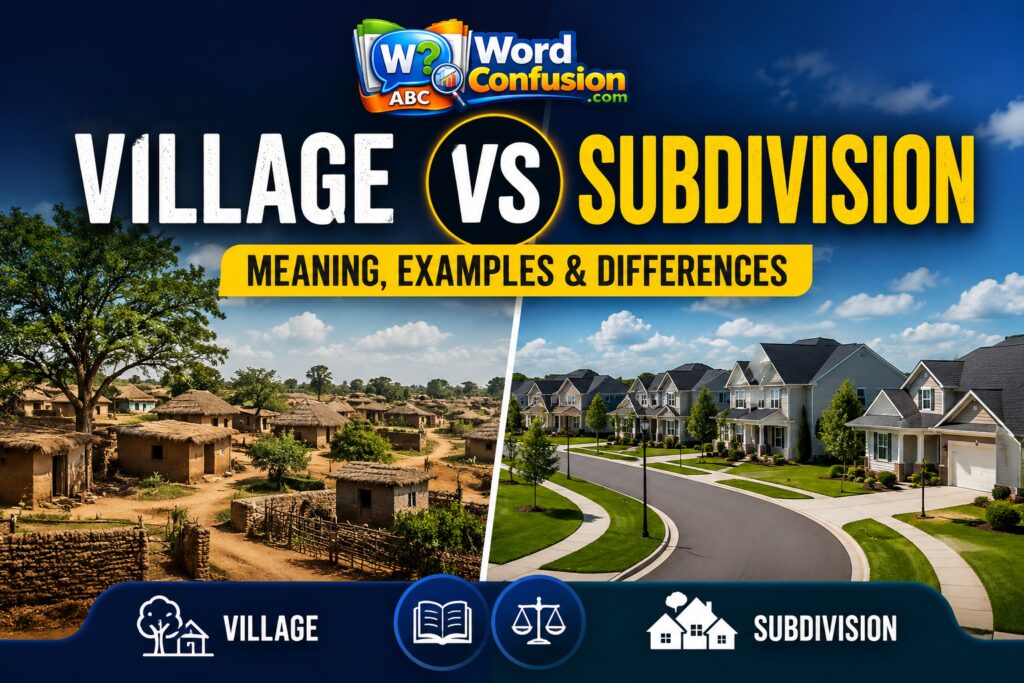
When comparing Village vs Subdivision, many people assume the two terms mean the same thing. However, they refer to very different concepts. A village is a community or settlement that often develops naturally over time, while a subdivision is a planned residential development created by dividing land into smaller lots for housing.
Understanding the difference is important for real estate, geography, community planning, and everyday communication. If you’re exploring more English vocabulary, word meanings, and commonly confused terms, you can also find simple explanations and examples throughout WordConfusion.
Quick Answer: Village vs Subdivision
A village is a small community or settlement that may have its own history, identity, and sometimes local governance. A subdivision is a residential development where a larger piece of land is divided into smaller lots for homes.
In simple terms:
- Village = Community
- Subdivision = Housing Development
Village vs Subdivision Comparison Table
| Feature | Village | Subdivision |
|---|---|---|
| Basic meaning | A community or settlement | Land divided into smaller lots for development |
| How it develops | May develop over time | Usually created through a planned land-development process |
| Main focus | Community and settlement | Land use and property development |
| Governance | May have local government or other structures | May be subject to local authorities, zoning rules, and sometimes an HOA |
| Typical identity | Community-based | Development/property-based |
What Is a Village?
Village Meaning
A village is a small settlement that is larger than a hamlet but smaller than a town. Villages have existed for centuries and are often built around shared social, cultural, economic, or geographic connections.
Many villages developed naturally as groups of people settled in an area for farming, trade, fishing, or other activities.
Characteristics of a Village
Villages often share several features:
- Strong community identity
- Historical significance
- Local traditions and culture
- Residential and commercial areas
- Public gathering spaces
- Schools, shops, and community facilities
Not every village looks the same. Some villages are rural and agricultural, while others have grown into suburban communities.
Real-World Examples of Villages
Examples include:
- A farming village surrounded by agricultural land
- A coastal fishing village
- A historic village near a larger city
- An incorporated village with local government
In each case, the village functions as a community rather than a housing project.
What Is a Subdivision?
Subdivision Meaning
A subdivision is a parcel of land that has been divided into smaller lots for residential, commercial, or mixed-use development.
Most people use the term to describe residential neighborhoods developed by builders or real estate companies.
How Subdivisions Are Created
The process generally includes:
- Purchasing a large tract of land
- Dividing it into individual lots
- Designing roads and infrastructure
- Installing utilities
- Constructing homes and community amenities
Unlike villages, subdivisions are intentionally planned from the beginning.
Examples of Residential Subdivisions
Examples include:
- A gated housing community
- A master-planned residential development
- A suburban housing project
- A new neighborhood built by a developer
Many subdivisions include parks, walking trails, playgrounds, and community centers.
Village vs Subdivision: Key Differences
Origin and Development
One of the biggest differences involves how they come into existence.
Village
Villages often emerge naturally over many years or even centuries as people settle in a specific area.
Subdivision
Subdivisions are designed and constructed according to a development plan created by builders and land developers.
Governance and Administration
Village
Some villages have:
- Local councils
- Municipal governments
- Community leadership structures
Subdivision
Subdivisions are typically governed by:
- Municipal authorities
- County governments
- Homeowners’ associations (HOAs)
The governance structure depends on local laws and regulations.
Population and Community Structure
Village
Residents often share:
- Historical connections
- Cultural traditions
- Long-standing community ties
Subdivision
Residents are connected primarily through:
- Shared housing development
- Property ownership
- Community rules and amenities
Infrastructure and Services
Village
Infrastructure may evolve gradually over time.
Examples include:
- Roads
- Schools
- Local businesses
- Public services
Subdivision
Infrastructure is usually planned before residents move in.
Examples include:
- Streets
- Sidewalks
- Utility systems
- Recreational facilities
Land Use and Planning
Village
Land use can be diverse, including:
- Residential areas
- Farms
- Shops
- Public buildings
Subdivision
Land use is generally focused on residential development, although some larger communities may include commercial areas.
Village vs Neighborhood vs Subdivision
People often confuse these three terms because they all describe places where people live.
| Term | Meaning |
| Village | A community or settlement |
| Neighborhood | A section of a city, town, or community |
| Subdivision | A planned housing development |
A subdivision may form part of a neighborhood, and a village may contain multiple neighborhoods or housing developments. The exact relationship depends on local geography and legal definitions.
Understanding these relationships helps avoid confusion.
Rural Village vs Modern Subdivision
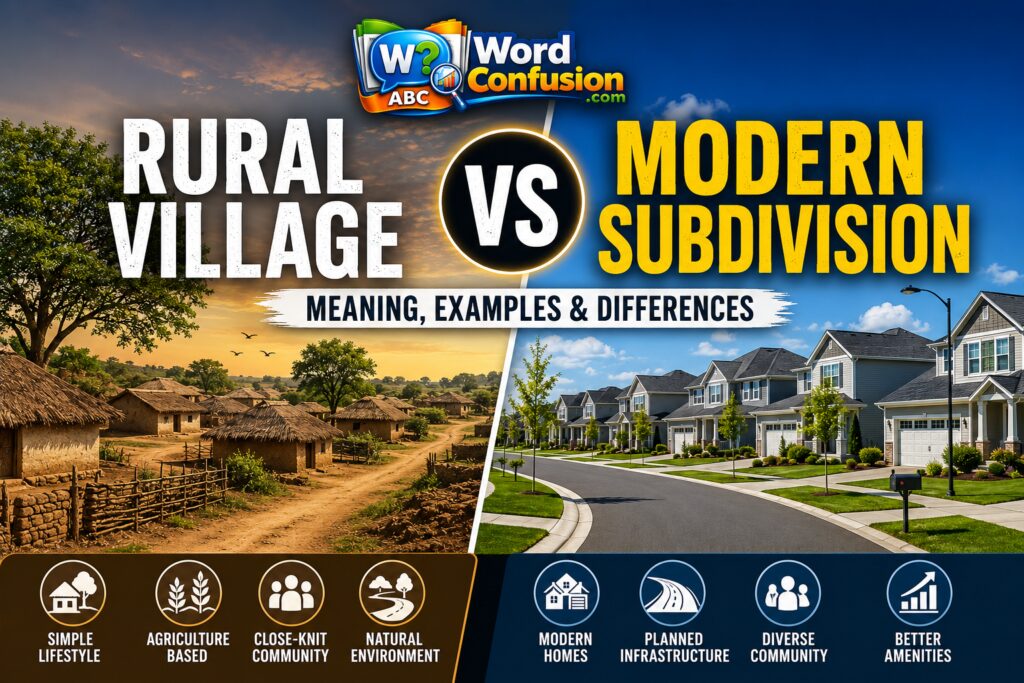
Community Experience
Villages frequently develop a strong sense of local identity over generations.
Subdivisions may build community through:
- Homeowners’ associations
- Social events
- Shared amenities
However, their identity is usually tied to the development itself rather than historical roots.
Accessibility and Amenities
Subdivisions often provide easier access to:
- Shopping centers
- Schools
- Transportation
- Recreational facilities
Villages may provide a quieter environment but sometimes have fewer nearby services.
Village vs Subdivision in Real Estate
How Realtors Use These Terms
Real estate professionals use these terms carefully because they describe different types of communities.
When a listing mentions a village, it may refer to:
- A historic settlement
- A municipality
- A recognized community area
When a listing mentions a subdivision, it usually refers to:
- A specific housing development
- A planned residential community
- A legally recorded development project
Property Listings Explained
Consider these examples:
Correct:
- “The home is located in the Oak Meadows subdivision.”
- “The property is situated within the village of Greenfield.”
These examples show how the terms serve different purposes.
Can a Subdivision Be Called a Village?
Marketing vs Reality
Sometimes developers use the word village in project names because it sounds welcoming and community-oriented.
Examples:
- Maple Village
- Cedar Village
- Riverstone Village
However, the development may still legally be a subdivision.
The name alone does not determine its classification.
Naming Conventions in Housing Developments
Many housing projects use words such as:
- Village
- Estates
- Meadows
- Gardens
- Heights
These are often branding choices rather than official community designations.
Common Mistakes When Using Village and Subdivision
Confusing Community With Development
A village is generally a community.
A subdivision is generally a development.
Mixing the two can create confusion.
Incorrect
“The village was built by a developer last year.”
Better
“The subdivision was built by a developer last year.”
Ignoring Geographic Context
Some people assume every small residential area is a village.
In reality, many are subdivisions or neighborhoods.
Context matters.
Misunderstanding Real Estate Terminology
In real estate documents, subdivision often has a legal meaning related to land division.
Village usually refers to a community, municipality, or settlement.
Frequently Asked Questions
What is a village in simple terms?
A village is a small community or settlement where people live, work, and interact. It is typically larger than a hamlet but smaller than a town.
What is a subdivision?
A subdivision is a piece of land divided into smaller lots for residential or commercial development.
What is the difference between a village and a subdivision?
A village is a community or settlement, while a subdivision is a planned development created by dividing land into lots.
Is a subdivision the same as a neighborhood?
Not necessarily. A subdivision is a specific development, while a neighborhood is a broader residential area that may include multiple subdivisions.
Can a village contain subdivisions?
Yes. A village can include several subdivisions, neighborhoods, and housing developments within its boundaries.
Are villages always rural?
No. While many villages are rural, some villages are located in suburban or urban regions.
What is a master-planned community?
A master-planned community is a large-scale subdivision designed with housing, parks, schools, shops, and recreational facilities as part of a unified development plan.
Which term should I use?
Use village when referring to a community or settlement. Use subdivision when referring to a planned housing development.
Final Verdict: Village or Subdivision?
Village and subdivision describe different things. A village is a community or settlement, while a subdivision is a planned development created by dividing land into smaller lots. Use “village” when referring to a community or settlement, and “subdivision” when referring to a planned housing or land development.
If you’re learning English vocabulary and commonly confused words, you may also enjoy our guides on Party’s or Parties, Oversight or Oversite, and Touch Base or Touchbase. Understanding these distinctions will make your writing clearer, more accurate, and more professional.
Written by
 Abdul Moeed
Abdul Moeed is a professional content writer and SEO link-building specialist with 5+ years of experience. He creates search-optimized content and develops effective SEO strategies that improve website visibility, authority, and organic growth.
View LinkedIn profileLatest posts
 What Does PG Mean in Text? Meaning, Examples & Usage
 What Does OFCC Mean in Text? Meaning, Uses & Examples
 What Does MSG Mean in Text? Meaning, Examples & Usage
 What Does STY Mean in Text? Meaning, Examples & Usage
 What Does “Twin” Mean in Slang? Meaning, Text & Examples
 What Does LMC Mean in Text? Meaning, Examples & Usage