Planing or Planning: Which One Is Correct?
 Abdul Moeed
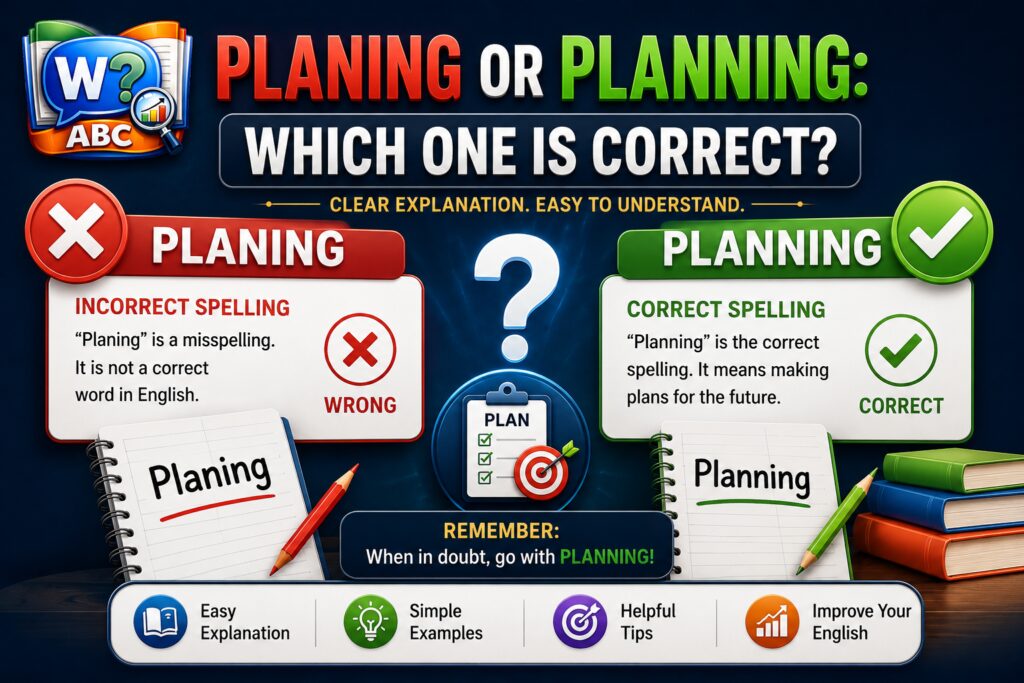
If you’ve ever wondered whether to write planing or planning, you’re not alone. These two words look very similar, but they have completely different meanings. In most everyday situations, planning is the correct spelling because it refers to making plans or preparing for something. However, planing is also a real word used mainly in woodworking and construction.
This guide explains the difference between planing and planning, their meanings, pronunciation, spelling rules, examples, and common mistakes so you can use each word correctly with confidence.
Quick Answer: Planing or Planning?
Planning is the correct spelling when you mean organizing, preparing, or making plans for the future.
Planing is a specialized term that means smoothing or shaping a surface, usually wood, with a plane tool.
Example
✅ We are planning a family vacation for next summer.
✅ The carpenter is planing the wooden board to make it smooth.
For most writing situations, you will need planning, not planing.
Featured Snippet Answer
The difference between planing and planning is their meaning. Planning refers to preparing, organizing, or making arrangements for something. Planing refers to smoothing or shaping a surface with a plane, especially in woodworking. If you are talking about making plans, the correct spelling is planning.
Planing vs Planning at a Glance
| Word | Meaning | Part of Speech | Common Usage |
| Planning | The process of making plans or preparing for something | Noun / Verb Form | Everyday English |
| Planing | Smoothing or shaping a surface with a plane | Verb Form | Woodworking, construction, manufacturing |
What Does Planning Mean?
Planning is the process of deciding what you want to do and how you will do it. It involves organizing resources, setting goals, and preparing for future actions.
Planning Pronunciation
Planning is pronounced:
PLAN-ing /ˈplænɪŋ/
Planning in a Sentence
- We are planning a surprise birthday party.
- Good planning helps businesses avoid problems.
- She spent weeks planning her wedding.
- Proper planning can save both time and money.
- The team is planning its next marketing campaign.
Common Uses of Planning
Planning is commonly used in:
- Business planning
- Financial planning
- Travel planning
- Event planning
- Project planning
- Academic planning
Because these situations are common in daily life, planning is the spelling most people need.
What Does Planing Mean?
Planing comes from the verb plane, which means to smooth, flatten, or shape a surface using a plane tool.
Planing Pronunciation
The word is pronounced:
PLAYN-ing /ˈpleɪnɪŋ/
Planing in a Sentence
- The carpenter is planing the edge of the board.
- Workers spent hours planing the wooden panels.
- He is planing the surface before applying paint.
- The craftsman carefully checked the wood after planing it.
Where Planing Is Used
You may see the word planing in:
- Woodworking
- Carpentry
- Furniture making
- Construction
- Manufacturing
Outside these fields, the word appears far less frequently than planning.
Why Is Planning Spelled With Double N?
One of the biggest reasons people write planing when they mean planning is that they are unsure why the word contains two N’s.
The Consonant Doubling Rule
In English, when a short one-syllable verb ends in:
vowel + consonant
the final consonant is often doubled before adding -ing.
Example
- Run → Running
- Sit → Sitting
- Swim → Swimming
- Plan → Planning
The word plan ends with:
- vowel: a
- consonant: n
Therefore, the final n doubles before adding -ing, creating planning.
Plan → Planning Explained
Incorrect:
❌ Plan + ing = Planing
Correct:
✅ Plan + ing = Planning
This follows a standard English spelling rule that learners frequently encounter.
Other Similar Examples
| Base Word | Correct Form |
| Run | Running |
| Sit | Sitting |
| Stop | Stopping |
| Begin | Beginning |
| Plan | Planning |
Learning this pattern makes it easier to avoid many common spelling mistakes.
Why People Confuse Planing and Planning
Several factors contribute to this spelling confusion.
Similar Spelling
The two words differ by only one letter, making them easy to mix up when typing quickly.
Similar Pronunciation
Although their pronunciations are not identical, many learners hear them as very similar in fast speech.
Typing Errors
Many writers accidentally omit one of the two N’s in planning.
Autocorrect Issues
Because planing is a real English word, spell-checkers may not always flag it as an error. This can allow mistakes to slip into emails, essays, and reports.
When Should You Use Planning?
Use planning whenever you are talking about preparation, organization, or future arrangements.
Academic Writing
- Students are planning their study schedules.
- Careful planning improves research projects.
Business Writing
- Strategic planning is essential for growth.
- The company is planning a product launch.
Everyday English
- We are planning dinner for Saturday.
- She is planning her future career.
If your sentence involves organizing or preparing, planning is almost certainly the correct choice.
When Should You Use Planing?
Use planing only when referring to smoothing or shaping a surface with a plane.
Woodworking
- The carpenter is planing the wood.
Construction
- Workers are planing rough boards before installation.
Manufacturing
- The machine is planing metal surfaces to improve accuracy.
Unless your topic involves materials or surfaces, you probably do not need the word planing.
Common Mistakes With Planning
Here are some mistakes writers frequently make.
Incorrect Sentences
We are planing our vacation.
She is planing her career goals.
The company is planing a new strategy.
Correct Sentences
We are planning our vacation.
She is planning her career goals.
The company is planning a new strategy.
Why These Are Wrong
In each example, the meaning involves preparation and organization rather than woodworking. Therefore, planning is the correct spelling.
How to Remember the Difference
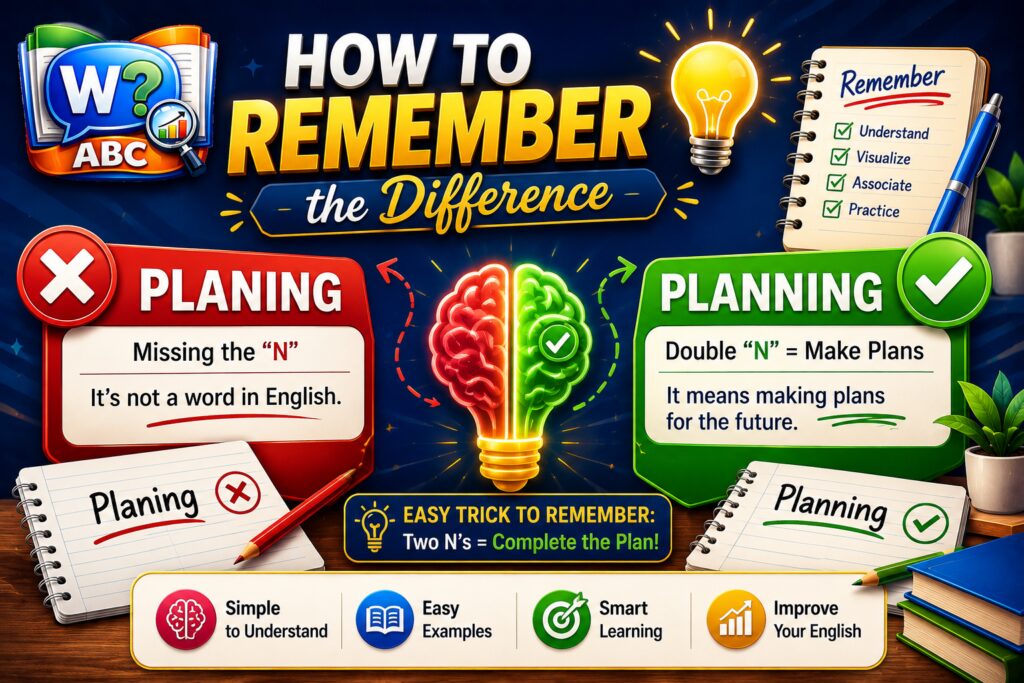
Simple Memory Trick
Think about the word plan.
When you add -ing, the final n doubles:
plan → planning
If you’re talking about organizing the future, always remember the extra n.
Another easy trick:
- Planning = Making plans.
- Planing = Using a plane.
This simple association helps many learners remember the difference instantly.
Mini Practice Quiz
Choose the correct word.
1. We are ______ our next family trip.
A. Planing
B. Planning
✅ Answer: Planning
2. The carpenter is ______ the wooden surface.
A. Planing
B. Planning
✅ Answer: Planing
3. Effective ______ improves productivity.
A. Planning
B. Planing
✅ Answer: Planning
4. He spent the afternoon ______ a rough board.
A. Planing
B. Planning
✅ Answer: Planing
Common Writing Tips
Tip 1: Check the Context
Ask yourself:
“Am I talking about making plans or shaping a surface?”
The answer usually reveals the correct spelling immediately.
Tip 2: Remember the Double N Rule
Many spelling mistakes disappear once you understand why planning has two N’s.
Tip 3: Read the Sentence Aloud
Reading your sentence aloud often makes the intended meaning clearer.
Tip 4: Watch for Autocorrect
Do not assume your spelling checker will catch every mistake. Since planing is a valid word, it may pass unnoticed.
Frequently Asked Questions
Is planing a real word?
Yes. Planing is a real English word that refers to smoothing or shaping a surface with a plane.
Is planning spelled correctly?
Yes. Planning is the correct spelling when referring to making plans, organizing activities, or preparing for future actions.
Why does planning have two n’s?
The final n doubles because of the English consonant-doubling rule used when adding -ing to certain short verbs.
How do you spell planning correctly?
The correct spelling is:
P-L-A-N-N-I-N-G
What does planing mean?
Planing means smoothing, shaping, or flattening a surface using a plane tool.
What is the difference between planing and planning?
Planning means organizing or preparing. Planing means smoothing a surface with a plane.
Is planing incorrect in English?
No. It is a correct word, but it is usually used in woodworking and construction rather than everyday writing.
When should I use planning?
Use planning whenever you are discussing preparation, organization, goal setting, scheduling, or making arrangements.
Final Verdict: Planing or Planning?
The correct word in most situations is planning. It refers to making plans, organizing tasks, and preparing for future events. Although planing is also a valid English word, it has a specialized meaning related to smoothing or shaping surfaces with a plane.
If you are writing about schedules, goals, projects, travel, business, education, or everyday activities, choose planning. Reserve planing for woodworking, carpentry, and similar technical contexts.
Remember this simple rule:
Making plans = Planning
Using a plane = Planing
Once you know the difference, you’ll never confuse these two words again.
If you’re learning English vocabulary and commonly confused words, you may also enjoy our guides on Hopeing or Hoping,Channel vs Chanel, and Finaly or Finally. Understanding these distinctions will make your writing clearer, more accurate, and more professional.