Dought vs Doubt: Which One Is Correct and How to Use It
 Abdul Moeed
Introduction
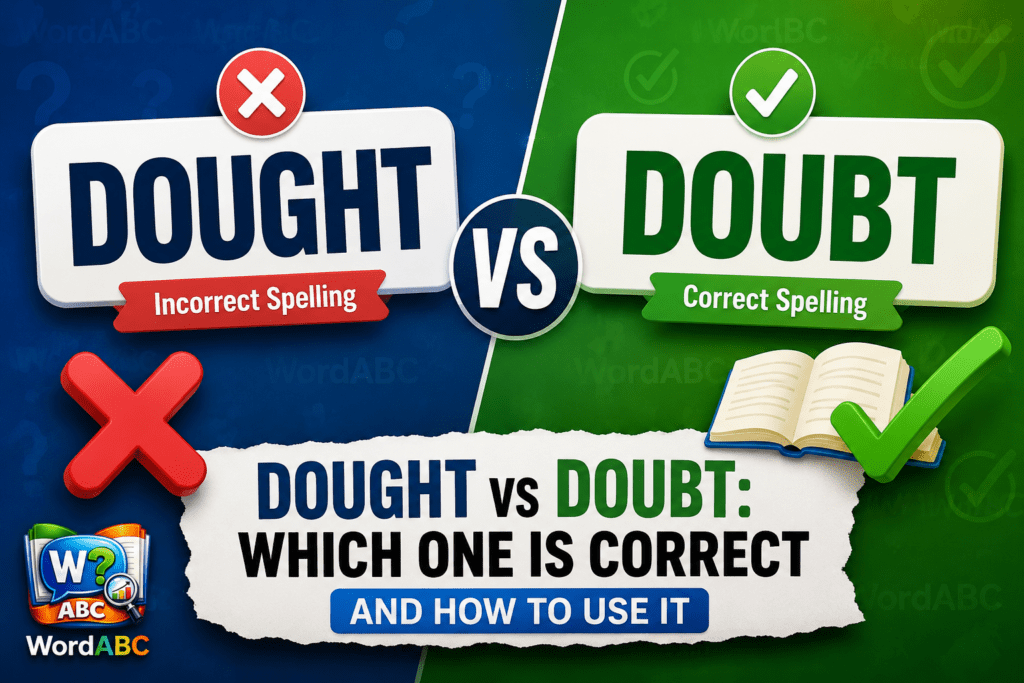
The correct spelling is “doubt,” not “dought.” Doubt means uncertainty or a lack of confidence in something, while “dought” is generally a misspelling in modern English. In this guide, you’ll learn the difference between dought vs doubt, why people confuse them, and how to use “doubt” correctly.
Quick Answer: Dought vs Doubt
👉 “Doubt” is correct.
👉 “Dought” is incorrect in modern English.
- Doubt = uncertainty, lack of belief
- Dought = not a standard English word (commonly a spelling mistake)
What Does “Doubt” Mean?
The word doubt refers to a feeling of uncertainty or lack of trust in something.
Meaning:
- Uncertainty about something
- Lack of confidence or belief
- Questioning whether something is true
Examples:
- I doubt he will come to the meeting.
- She has no doubt about her decision.
- There is some doubt about the results.
Is “Dought” a Real Word?
In modern English, “dought” is NOT a standard word.
However:
- It may appear as a common spelling mistake for “doubt.”
- In very old or dialectal usage, similar forms existed historically, but they are not used in modern writing or education.
👉 In simple terms:
If you are writing today, never use “dought.” Always use “doubt.”
Key Differences Between Dought and Doubt
| Feature | Dought | Doubt |
| Correct spelling | ❌ No | ✔ Yes |
| Meaning | Not standard | Uncertainty |
| Usage | Rare/mistake | Common English word |
| Modern English | Not used | Widely used |
| Acceptability | Incorrect | Correct |
Why People Confuse Dought and Doubt
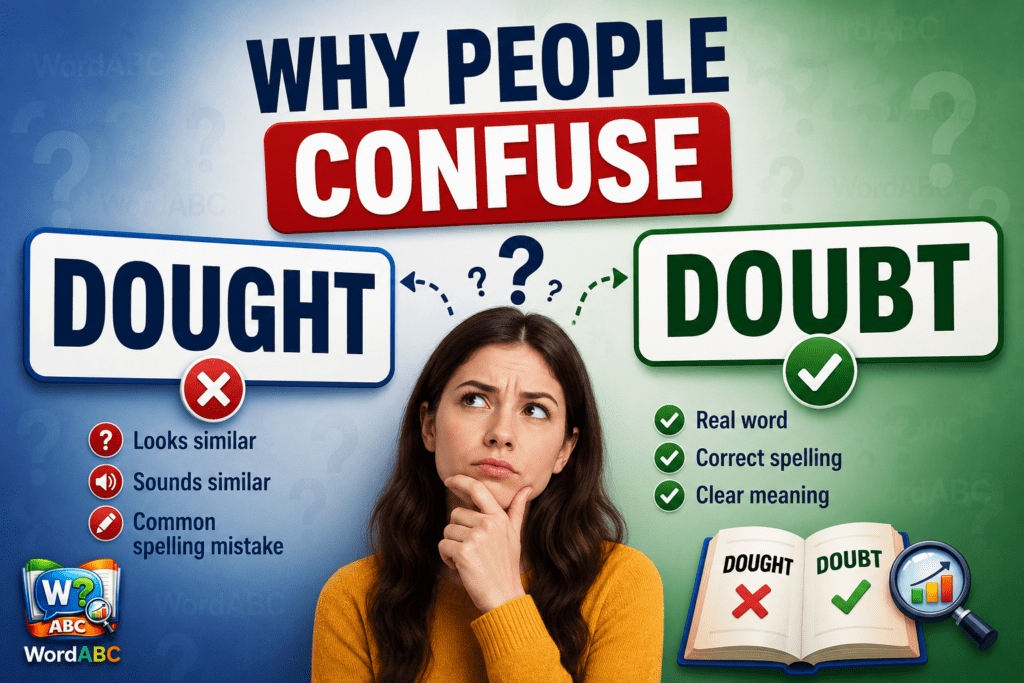
There are several reasons this confusion happens:
Similar spelling and pronunciation problems can also cause confusion between words such as Tweek vs Tweak.
1. Similar pronunciation
“Doubt” is pronounced /daʊt/, so the silent “b” is not heard. This can lead people to spell it the way it sounds.
2. Silent letter “b”
The silent “b” in doubt confuses learners and leads to misspelling.
3. Typing errors
Fast typing often leads to “dought” instead of “doubt.”
4. English spelling inconsistency
English words often don’t match pronunciation, causing confusion.
Correct Usage of “Doubt” (With Examples)
Everyday usage:
- I doubt the weather will improve today.
- Don’t doubt your abilities.
Formal usage:
- There is little doubt about the outcome.
- The scientist expressed doubt about the theory.
Idiomatic expressions:
- Beyond doubt (completely certain)
- No doubt (definitely)
- In doubt (uncertain situation)
Common Dought vs Doubt Mistakes
Writing “dought” instead of “doubt”
❌ I have no dought about it.
✅ I have no doubt about it.
Spelling “doubt” the way it sounds
❌ dout
❌ dought
✅ doubt
Forgetting the silent “b”
Explain that the b is silent but still part of the spelling.
Platform vs Flatform aur Encode vs Incode ko sirf isliye force mat karo kyunki woh spelling-confusion articles hain.
Practice Exercises
1. Fill in the blank
- I have no ___ about his honesty.
👉 Answer: doubt
2. Choose the correct word
- She (dought/doubt) the truth of the story.
👉 Answer: doubt
3. Correct the sentence
- He has no dought in his ability.
👉 Correct: He has no doubt in his ability.
FAQs
1. Is dought a word in English?
No, “dought” is not a standard English word and is usually a spelling mistake.
2. What is the correct spelling of doubt?
The correct spelling is d-o-u-b-t.
3. Why do people confuse dought and doubt?
Because of pronunciation, silent letters, and typing errors.
4. What does doubt mean?
It means uncertainty or lack of confidence in something.
5. Is it dout or doubt?
The correct form is doubt, not “dout.”
6. How do you use doubt in a sentence?
Example: I doubt he will arrive on time.
7. What is another word for doubt?
Uncertainty, hesitation, suspicion, or disbelief.
Is “dought” ever correct?
For modern standard English, “dought” is not the correct spelling of “doubt.” If you mean uncertainty or lack of belief, use “doubt.”
If you want to explore more commonly confused English words, visit WordConfusion.
Conclusion
The correct spelling is “doubt,” not “dought.” Doubt means uncertainty, hesitation, or a lack of belief, while dought is generally a misspelling in modern English. The confusion often happens because the b in doubt is silent. When writing about uncertainty or lack of confidence, always use doubt.