Treck or Trek: Which Spelling Is Correct? Meaning & Examples

If you are wondering whether the correct spelling is treck or trek, the answer is simple: trek is correct. Treck is generally a misspelling when you mean a long or difficult journey, especially one made on foot. Trek can be used as both a noun and a verb, and its common forms include treks, trekked, trekking, and trekker.
📖 See also:BB Meaning in Text: What Does BB Mean in Texting?
Treck or Trek: The Quick Answer
Trek is the correct English spelling.
| Spelling | Correct? | Meaning |
| trek | ✅ Yes | A long or difficult journey; to travel a long distance |
| treck | ❌ Generally no | Common misspelling of trek |
| trekking | ✅ Yes | The activity of making long journeys on foot |
| trecking | ❌ No | Misspelling of trekking |
| trekked | ✅ Yes | Past tense and past participle of trek |
| trecked | ❌ No | Misspelling of trekked |
So if you are writing an email, essay, travel guide, social media post, or any other standard English text, use trek, not treck.
Example:
We went on a challenging trek through the mountains.
What Does “Trek” Mean?
Trek has two main grammatical uses: it can be a noun or a verb.
As a noun, trek means a long walk or journey, often across hills, mountains, forests, or other challenging terrain. It can also describe any journey that feels long, difficult, or tiring.
As a verb, trek means to walk a long distance, usually over land and sometimes with considerable difficulty.
Trek as a noun
Examples:
- The mountain trek took three days.
- We went on a long trek through the forest.
- It was quite a trek from the station to the hotel.
Trek as a verb
Examples:
- We trekked through the valley all morning.
- They trekked across the mountains.
- She plans to trek through the northern region next summer.
The word can therefore describe both the journey itself and the action of making the journey.
Why Is “Trek” Correct and “Treck” Wrong?
The spelling treck looks believable because English contains many familiar words ending in -ck, such as check, deck, and neck. Since trek is pronounced /trek/, some writers naturally add a c before the k.
However, pronunciation does not determine spelling in a completely predictable way in English.
The standard spelling of the word meaning a long or difficult journey is simply:
T-R-E-K → trek
Therefore:
- ❌ treck
- ✅ trek
A useful point to remember is that trek does not need a “c” before its final k.
Correct Forms of “Trek”
One common source of confusion is what happens when you add endings to trek.
| Grammatical form | Correct spelling | Example |
| Base form | trek | We will trek tomorrow. |
| Third-person singular | treks | He treks every summer. |
| Past tense | trekked | They trekked for six hours. |
| Present participle | trekking | She is trekking in Nepal. |
| Person who treks | trekker | The trekker carried a small backpack. |
Notice what happens with -ed and -ing:
trek → trekked
trek → trekking
The final k is doubled before these endings.
Cambridge lists trekked as the past tense and past participle and trekking as the present participle.
Is “trecking” correct?
No. The standard spelling is:
trekking
Not:
trecking
Is “treked” correct?
No. The standard past-tense spelling is:
trekked
Not:
treked
Trek vs. Hike vs. Journey vs. Track
These words are related, but they are not interchangeable in every situation.
| Word | Main meaning | Example |
| Trek | A long or difficult journey, often on foot | We went on a mountain trek. |
| Hike | A walk, especially for exercise or recreation | We went for a two-hour hike. |
| Journey | Travel from one place to another | The journey took five hours. |
| Track | A path, route, or trail; also to follow something | We followed the mountain track. |
Trek vs. hike
A hike is generally a walk taken for recreation, exercise, or enjoyment.
A trek often emphasizes distance, difficulty, duration, or challenging terrain.
There is considerable overlap, though. A long mountain hike can also reasonably be called a trek.
Trek vs. journey
Journey is the broader word. It can describe travel by car, train, plane, boat, or on foot.
Trek usually suggests a more demanding journey, particularly one involving walking.
Trek vs. track
These words can sound similar, but their meanings are different.
A track can be a path or route:
We followed a narrow mountain track.
A trek is the journey or activity itself:
We completed a difficult mountain trek.
📖 See also:Seal vs Seel: Which Is Correct? Meaning, Difference & Examples
How Do You Spell “Trek”?
The correct spelling is:
T-R-E-K
There is no c between the e and k.
If you are writing the word in a sentence, use trek:
We planned a long trek through the hills.
Not:
We planned a long treck through the hills.
How Do You Pronounce “Trek”?
Trek is pronounced /trek/ in both British and American English.
It has one syllable and rhymes closely with words such as:
- check
- deck
- neck
- wreck
The pronunciation may help explain why treck feels natural to some writers, but the correct spelling remains trek.
Where Did the Word “Trek” Come From?
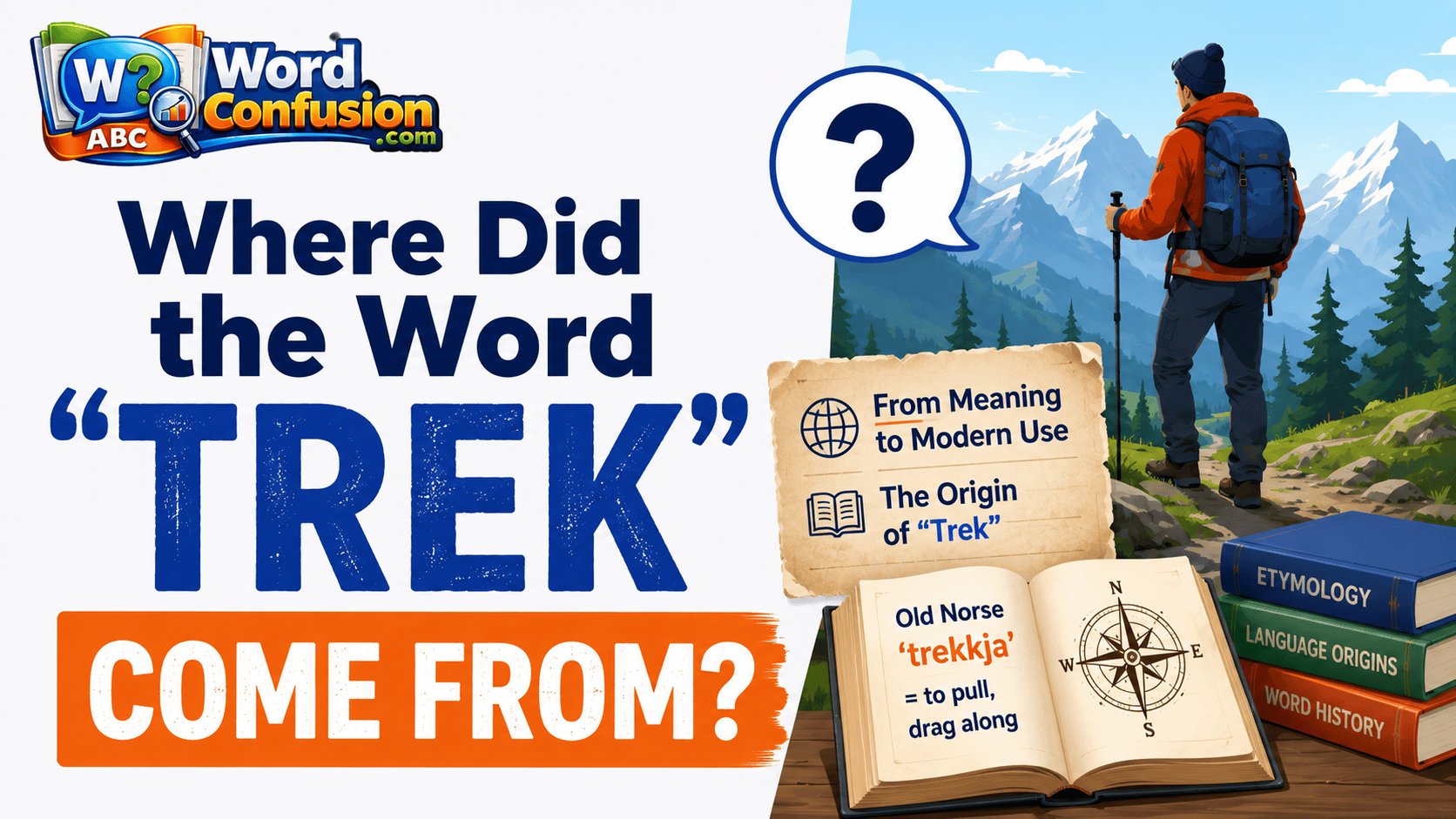
The history of trek is interesting because the word did not originally develop as an ordinary modern English hiking term.
English trek entered the language through South African usage in the 19th century. Etymonline traces it to Afrikaans trek, meaning a journey or migration, and further to Dutch trekken, meaning to march or journey and originally associated with drawing or pulling.
The word was initially associated with journeys by ox wagon in a South African context. Later, its meaning broadened in English to refer to a long journey or difficult expedition.
That history also explains why trek has such a strong association with long-distance travel.
Is “Trek” British or American English?
Trek is used in both British and American English.
The spelling does not change between the two varieties:
- British English: trek
- American English: trek
The pronunciation is also given as /trek/ in both versions of the Cambridge dictionary.
So there is no British spelling treck and American spelling trek distinction.
How Do You Use “Trek” in a Sentence?
Here are examples showing different types of usage.
Everyday conversation
It is quite a trek from my house to the station.
Travel
We went on a three-day trek through the mountains.
Outdoor adventure
They spent the weekend trekking through the forest.
Academic context
The researchers completed a difficult trek to reach the remote study site.
Professional or figurative use
Building a successful business can feel like a long trek.
Verb
We trekked for several hours before reaching the campsite.
These examples show that trek does not have to refer exclusively to mountains. It can also describe any journey that feels particularly long or difficult.
Common Mistakes to Avoid
Here are some of the most common spelling errors:
- ❌ treck
- ❌ trecking
- ❌ treked
- ❌ trecked
- ❌ treking
Use these instead:
- ✅ trek
- ✅ trekking
- ✅ treked → trekked
- ✅ trecked → trekked
- ✅ treking → trekking
- ✅ trekker
The important pattern is:
trek → trekking → trekked
The k doubles when the suffix begins with a vowel, as in -ing and -ed.
📖 See also:IMO Meaning in Text: Definition, Examples & How to Use It
How to Remember the Correct Spelling
A simple memory trick is:
Think “Star Trek” — TREK has no C.
You can also remember the basic word family:
TREK → TREKKING → TREKKED
Start with the short base word trek, then double the k when adding -ing or -ed.
This prevents two common mistakes at once: treck and treking.
Frequently Asked Questions
Is it treck or trek?
Trek is correct when you mean a long or difficult journey. Treck is generally a misspelling of trek.
Is treck a word?
Treck is not the standard spelling of the English word meaning a long journey or difficult walk. If that is the meaning you intend, use trek. A particular name, brand, or other proper noun could of course use a different spelling.
What does trek mean?
As a noun, trek means a long or difficult journey, especially one made on foot. As a verb, to trek means to walk a long distance or make a difficult journey.
How do you spell trek?
The correct spelling is T-R-E-K: trek.
What is the correct spelling of trekking?
The correct spelling is trekking, with two k’s.
trek + ing → trekking
What is the past tense of trek?
The past tense and past participle are trekked.
We trekked through the mountains.
Cambridge lists trekked as the past tense and past participle of trek.
Is trek the same as hike?
Not exactly. Both can refer to walking outdoors, but hike often emphasizes recreational walking, while trek commonly suggests a longer, more difficult, or more demanding journey.
Is trek spelled the same in British and American English?
Yes. Trek is spelled the same in both British and American English.
📖 See also:WTF Meaning in Text: What It Means, Uses & Examples
Key Takeaway
If you are choosing between treck or trek, use trek.
Trek is the standard spelling for a long or difficult journey and can also be used as a verb meaning to travel a long distance, usually on foot. The related forms are treks, trekked, trekking, and trekker.
The easiest rule to remember is:
Trek has one k in the base form. Trekking and trekked have two k’s.
So write:
✅ trek
✅ trekking
✅ trekked
❌ treck
❌ trecking
❌ trecked
Looking for more English word meanings, grammar tips, and commonly confused words? Visit the WordConfusion homepage to explore our latest language guides, spelling differences, vocabulary explanations, text abbreviations, and practical examples. Whether you’re learning English or improving your writing skills, you’ll find clear, easy-to-understand resources for everyday communication.
Written by
 Abdul Moeed
Abdul Moeed is a professional content writer and SEO link-building specialist with 5+ years of experience. He creates search-optimized content and develops effective SEO strategies that improve website visibility, authority, and organic growth.
View LinkedIn profileLatest posts
 What Does PG Mean in Text? Meaning, Examples & Usage
 What Does OFCC Mean in Text? Meaning, Uses & Examples
 What Does MSG Mean in Text? Meaning, Examples & Usage
 What Does STY Mean in Text? Meaning, Examples & Usage
 What Does “Twin” Mean in Slang? Meaning, Text & Examples
 What Does LMC Mean in Text? Meaning, Examples & Usage