IMO Meaning in Text: Definition, Examples & How to Use It

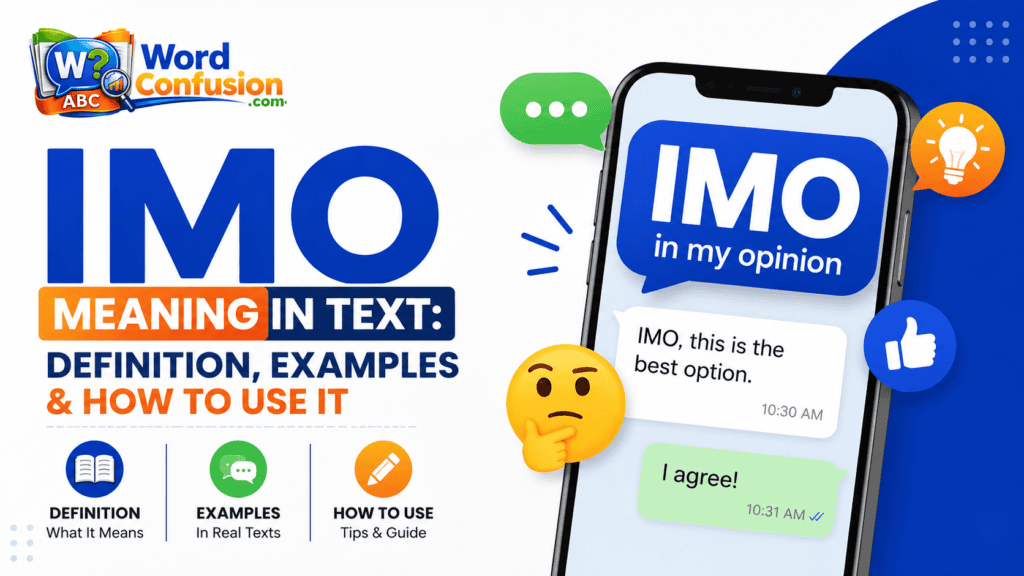
If you see IMO in a text, chat, comment, or social media post, it usually means “In My Opinion.” People use it to introduce a personal view, preference, judgment, or perspective.
For example:
“IMO, this is the best restaurant in town.”
This means:
“In my opinion, this is the best restaurant in town.”
IMO is informal and common in digital communication. It does not automatically make a statement polite or rude—the tone depends on the words around it.
📖 See also:WTF Meaning in Text: What It Means, Uses & Examples
What Does IMO Mean in Text?
IMO means “In My Opinion.” It is a common texting and internet abbreviation used when someone wants to make it clear that they are expressing their own viewpoint rather than stating an objective fact.
You may see IMO at the beginning or end of a message:
- “IMO, the first movie was better.”
- “The first movie was better, IMO.”
Both sentences mean essentially the same thing.
What Does IMO Stand For?
IMO stands for:
I — In
M — My
O — Opinion
It is an abbreviation used in informal digital communication, including texts, chats, comments, and social media.
How Is IMO Used in Chat and Social Media?
IMO can appear almost anywhere people have casual conversations online.
In text messages
“IMO, you should wait until tomorrow.”
In WhatsApp chats
“IMO, the blue one looks better.”
In Instagram comments or DMs
“IMO this is your best photo.”
On Snapchat
“IMO, that was the funniest part 😂”
On TikTok
“IMO, this version is way better.”
In group chats
“IMO, we should leave earlier.”
The platform does not change the meaning. Whether someone uses IMO on WhatsApp, Instagram, Snapchat, TikTok, Facebook, Reddit, or another messaging service, it generally means “In My Opinion.”
How Do You Use IMO in a Text?
The easiest way to use IMO is to put it before the opinion you want to express.
At the beginning
“IMO, this is the better choice.”
At the end
“This is the better choice, IMO.”
In a recommendation
“IMO, you should try the chocolate cake.”
In a disagreement
“IMO, I think you’re looking at it differently.”
In a casual discussion
“IMO, the second season was more interesting.”
IMO works particularly well when the speaker wants to distinguish a personal judgment from a fact.
For example:
“The movie is two hours long.”
That is presented as factual information.
But:
“IMO, the movie is too long.”
signals a personal judgment.
IMO Examples in Texting
Here are some natural examples of IMO in everyday conversations:
| Context | Example | Meaning |
| Preference | “IMO, pizza is better than burgers.” | This is my personal preference. |
| Advice | “IMO, you should talk to her.” | This is my suggestion or opinion. |
| Entertainment | “IMO, that was the best episode.” | That is my personal judgment. |
| Disagreement | “IMO, you’re being a little harsh.” | I personally think your reaction is too strong. |
| Recommendation | “IMO, this laptop is worth the money.” | This is my personal assessment. |
| Casual conversation | “The blue one is nicer, IMO.” | I personally prefer the blue one. |
Funny IMO Examples
Sometimes IMO appears in playful or exaggerated opinions:
- “IMO, fries should be considered a food group.”
- “IMO, Monday should be deleted.”
- “IMO, sleeping is a legitimate hobby.”
These are usually humorous rather than serious statements.
Is IMO Rude?
No. IMO is not inherently rude.
The abbreviation simply tells the reader that the following statement is someone’s opinion. The rest of the message determines whether it sounds friendly, respectful, blunt, sarcastic, or offensive.
Compare:
“IMO, you could try a different approach.”
This sounds relatively polite.
With:
“IMO, that’s a terrible idea.”
This can sound blunt.
So, IMO itself is neutral; context creates the tone.
This is an important distinction because adding IMO does not automatically make criticism polite.
📖 See also:Busyness vs Business: Which Is Correct? Meaning & Examples
What Does IMO Mean From a Girl or Guy?
If a girl or guy sends you IMO, it normally means exactly the same thing:
“In My Opinion.”
IMO does not have a special female, male, romantic, or flirtatious meaning.
For example:
“IMO, you look great in that outfit.”
The person is expressing a positive opinion. Whether they are flirting, being friendly, or simply giving a compliment depends on the broader conversation.
Likewise:
“IMO, you should take the job.”
is simply an opinion or piece of advice.
If you’re trying to understand someone’s intentions, look at the whole message and conversation, not the abbreviation alone.
Is IMO Formal or Informal?
IMO is informal.
It is perfectly natural in texting, social media, online discussions, and casual conversations. It can also appear in informal workplace chats when abbreviations are common.
However, writing “in my opinion” is usually better in formal communication.
| Situation | IMO? |
| Texting friends | ✅ Natural |
| Family group chat | ✅ Natural |
| Social media | ✅ Natural |
| Casual online discussion | ✅ Natural |
| Informal workplace chat | ⚠️ Usually acceptable |
| Professional email | ⚠️ Write “in my opinion” instead |
| Academic essay | ❌ Avoid |
| Official/legal writing | ❌ Avoid |
This does not mean the abbreviation is grammatically wrong. It simply belongs mainly to informal written communication.
IMO vs. IMHO, IME, and IMAO
Several internet abbreviations look similar to IMO but have different meanings.
| Abbreviation | Meaning | Main use |
| IMO | In My Opinion | Giving a personal opinion |
| IMHO | In My Humble Opinion / In My Honest Opinion | Giving an opinion, often with a modest or personal tone |
| IME | In My Experience | Sharing personal experience |
| IMAO | In My Arrogant Opinion | Humorous or sarcastic variation |
| TBH | To Be Honest | Introducing an honest or candid statement |
| FYI | For Your Information | Providing information rather than an opinion |
IMO vs. IMHO
These are the two most commonly confused.
IMO:
“IMO, this is the best option.”
IMHO:
“IMHO, this is the best option.”
Both introduce a personal opinion. IMHO can add a modest or humorous tone depending on the context, while IMO is more straightforward.
Does IMO Have Other Meanings?
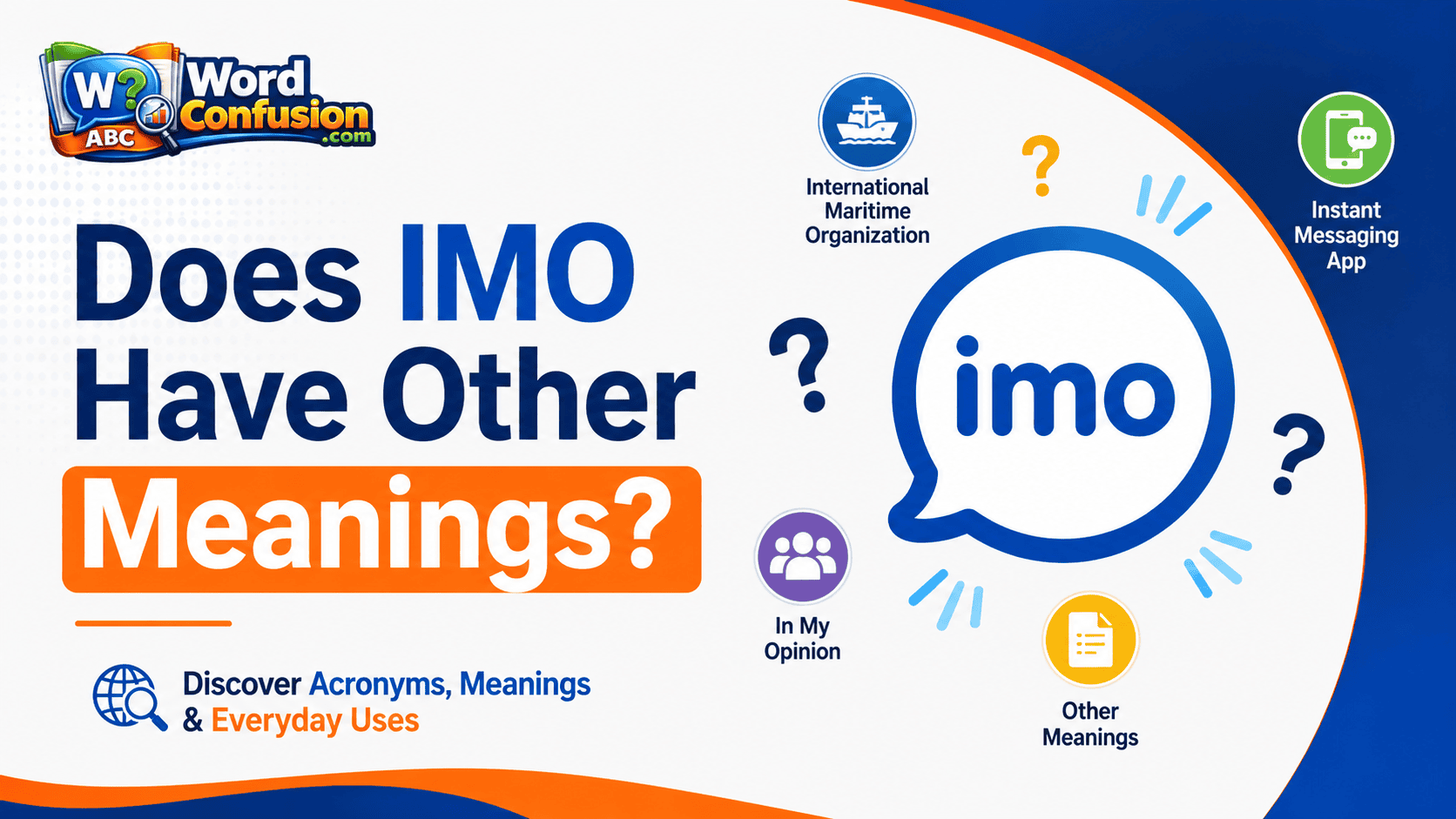
Yes. Context matters.
In texting and social media, IMO usually means “In My Opinion.” However, the abbreviation can represent other terms in specialized contexts.
One important example is the International Maritime Organization, a United Nations specialized agency concerned with international shipping.
So:
“IMO, that restaurant is excellent.”
almost certainly means “In My Opinion.”
But:
“The IMO adopted new maritime regulations.”
is likely referring to the International Maritime Organization, not internet slang.
There is also an imo messaging app, so the surrounding context can help determine which meaning is intended.
📖 See also:MBN Meaning in Text: What “Must Be Nice” Really Meanst Does CM Mean?
Common Mistakes With IMO
1. Thinking IMO means “fact”
IMO signals an opinion, not an objective fact.
“IMO, this is the best phone.”
The speaker is not claiming that everyone agrees. They are giving their personal judgment.
2. Assuming IMO is always polite
It isn’t.
“IMO, you’re completely wrong.”
The abbreviation does not remove the bluntness of the statement.
3. Using IMO in every opinion
You do not need to write IMO every time you express a view.
Instead of:
“IMO, I think this is good.”
you can simply write:
“I think this is good.”
Using both can sound repetitive.
4. Confusing IMO with IMHO
IMO means “In My Opinion.”
IMHO is a related expression with a slightly different tone.
5. Assuming IMO has a hidden romantic meaning
IMO itself does not indicate flirting or attraction.
The surrounding conversation is what matters.
When Should You Use IMO?
Use IMO when you’re having an informal conversation and want to clearly mark something as your personal opinion.
It is especially useful when:
- sharing a preference
- giving casual advice
- discussing movies, music, food, or games
- disagreeing with someone
- making a recommendation
- commenting on social media
- participating in online discussions
For formal writing, simply spell it out:
“In my opinion, this approach is more effective.”
That sounds more appropriate in professional and academic contexts.
How Should You Respond When Someone Says IMO?
There is no special response required. Respond to the opinion itself.
Casual response
“Yeah, I can see that.”
Agreeing
“IMO, you’re right. I had the same thought.”
Disagreeing politely
“I see your point, but I look at it differently.”
Asking for an explanation
“What makes you think that?”
Funny response
“Your opinion has been officially recorded. 😂”
The best response depends on the topic, not on the abbreviation.
Is IMO Still Used?
Yes. IMO remains a recognizable internet and texting abbreviation.
However, how frequently people use abbreviations varies by age, platform, community, and personal writing style. Some people prefer writing “in my opinion” or simply “I think”, while others use IMO naturally in casual digital conversations.
The important point is that IMO remains understandable in contemporary online communication.
Frequently Asked Questions
What does IMO mean in text?
IMO means “In My Opinion.” It is used in texts and online conversations to introduce a personal viewpoint, preference, judgment, or perspective.
What does IMO stand for?
IMO stands for “In My Opinion.”
What does IMO mean in texting?
In texting, IMO usually means “In My Opinion.” It tells the reader that the statement represents the sender’s personal view.
Is IMO slang?
IMO is commonly described as an internet abbreviation or texting abbreviation. It is informal and widely associated with online communication.
Is IMO rude?
No. IMO itself is neutral. The rest of the sentence determines whether the message sounds polite, blunt, sarcastic, or rude.
What does IMO mean from a girl?
It normally means “In My Opinion.” It does not have a special meaning when a girl uses it. Any romantic or flirtatious meaning must be inferred from the surrounding conversation.
What does IMO mean from a guy?
It normally means “In My Opinion.” The abbreviation itself does not indicate romantic interest or any special male-specific meaning.
What does IMO mean on social media?
On social media, IMO usually means “In My Opinion.” It is commonly used when someone wants to identify a statement as their personal viewpoint.
Can I use IMO in professional messages?
You can use it in some informal workplace chats, especially when the communication style is casual. For formal emails, reports, applications, or official documents, spelling out “in my opinion” is the safer choice.
What is the difference between IMO and IMHO?
Both express opinions. IMO means “In My Opinion,” while IMHO commonly means “In My Humble Opinion” and is sometimes interpreted as “In My Honest Opinion.” The exact tone depends on context.
Is IMO the same as “I think”?
They can perform a similar function, but they are not identical expressions.
“IMO, this is better.”
and
“I think this is better.”
both communicate a personal view. IMO is simply a compact internet abbreviation.
📖 See also:CM Meaning in Text: What Does CM Mean?
Final Takeaway
IMO means “In My Opinion.” It is an informal abbreviation used in texts, chats, comments, and social media when someone wants to share a personal viewpoint.
It can introduce an opinion, preference, recommendation, judgment, or disagreement. IMO itself is neither rude nor romantic, and it does not have a different meaning when used by a girl, guy, friend, or stranger. The surrounding words determine the tone.
For casual digital communication, IMO is perfectly natural. For formal writing, spelling out “in my opinion” is usually the better choice.
Looking for more English word meanings, grammar tips, and commonly confused words? Visit the WordConfusion homepage to explore our latest language guides, spelling differences, vocabulary explanations, text abbreviations, and practical examples. Whether you’re learning English or improving your writing skills, you’ll find clear, easy-to-understand resources for everyday communication.
Written by
 Abdul Moeed
Abdul Moeed is a professional content writer and SEO link-building specialist with 5+ years of experience. He creates search-optimized content and develops effective SEO strategies that improve website visibility, authority, and organic growth.
View LinkedIn profileLatest posts
 What Does PG Mean in Text? Meaning, Examples & Usage
 What Does OFCC Mean in Text? Meaning, Uses & Examples
 What Does MSG Mean in Text? Meaning, Examples & Usage
 What Does STY Mean in Text? Meaning, Examples & Usage
 What Does “Twin” Mean in Slang? Meaning, Text & Examples
 What Does LMC Mean in Text? Meaning, Examples & Usage