Different or Diffrent? Correct Spelling, Meaning & Usage

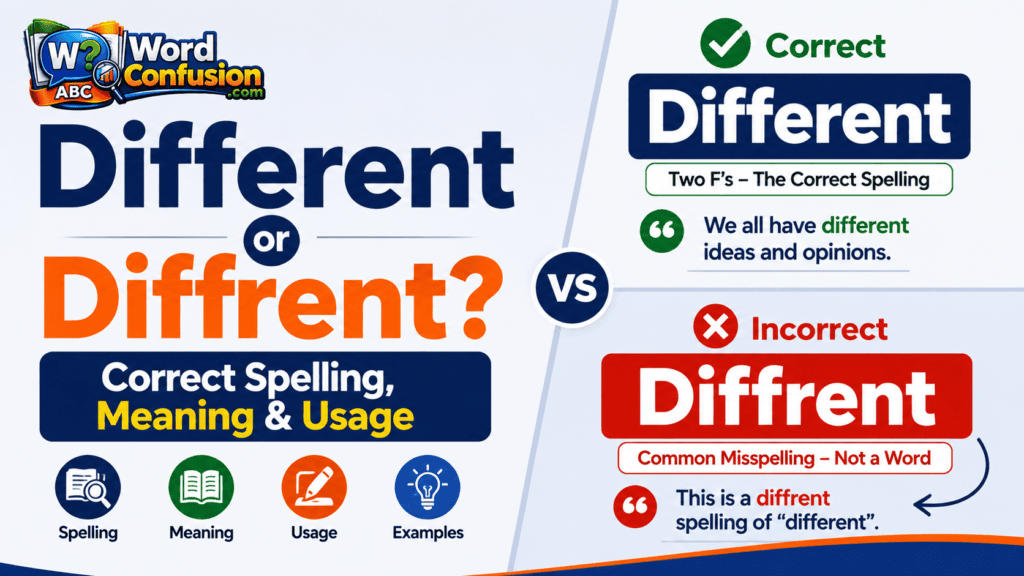
If you are wondering whether different or diffrent is correct, the answer is simple: different is the correct spelling. Diffrent is a common misspelling caused by leaving out the first e.
The correct spelling is d-i-f-f-e-r-e-n-t. The word different means “not the same,” “unlike,” or “distinct.”
📖 See also:OTS Meaning in Text: What Does OTS Mean in Texting & Chat?
Different or Diffrent: Quick Answer
| Spelling | Correct? | Meaning |
| different | ✅ Correct | Not the same; unlike |
| diffrent | ❌ Incorrect | Common misspelling of “different” |
Example
- Correct: My new phone is different from my old one.
- Incorrect: My new phone is diffrent from my old one.
So, whenever you mean “not the same,” use different.
How Do You Spell Different?
The correct spelling is:
D-I-F-F-E-R-E-N-T
A useful way to break it down is:
dif + fer + ent
The spelling contains two f’s and three e’s:
d i f f e r e n t
The most easily forgotten letter is often the e immediately after the two f’s. If you write diffrent, that e disappears.
A simple spelling check
Think of the word as:
differ + ent = different
This connects it to the verb differ, which means to be unlike or not the same.
What Does Different Mean?
Different is an adjective that describes something that is not the same as another thing. It can also mean unlike, distinct, or unusual depending on the context.
Examples of the meaning of different
- Sarah has a different opinion from mine.
- These two shirts look different.
- He chose a different route to work.
- Everyone has a different way of learning.
- This restaurant offers something different from the usual menu.
In each example, different shows that one person or thing is not the same as another.
Why Do People Spell Different as “Diffrent”?
Diffrent is not an alternative English spelling. It is a spelling mistake.
There are several practical reasons people may make this error.
Fast typing
When people type quickly, they may leave out a letter, especially in a familiar word. Since different is often used in everyday writing, the missing e can easily go unnoticed.
Pronunciation
In normal speech, the vowels in different may not sound as clearly as they appear in the written form. This can make the spelling less obvious, particularly for English learners.
Cambridge gives the UK pronunciation as /ˈdɪf.ər.ənt/ and the US pronunciation as /ˈdɪf.ɚ.ənt/.
Habit
Once someone repeatedly writes diffrent, the incorrect form can become a familiar spelling pattern. Regular proofreading and using a dictionary can help break that habit.
Relying too heavily on autocorrect
Spell-checking tools are useful, but they should not replace knowing the correct spelling. A person who notices the spelling pattern themselves is less likely to repeat the mistake.
Different vs Diffrent: What’s the Difference?
The difference is straightforward:
Different is the standard English spelling.
Diffrent is a misspelling.
There is no separate definition or special usage for diffrent. If you are writing an email, school assignment, article, report, or professional document, use different.
Remember:
Different has an “e” after the two f’s.
Correct: different
Incorrect: diffrent
How to Pronounce Different
The pronunciation of different varies slightly between British and American English, although the word is easily recognizable in both varieties.
- British English: /ˈdɪf.ər.ənt/
- American English: /ˈdɪf.ɚ.ənt/
A simple learner-friendly approximation is:
DIF-er-uhnt
The exact pronunciation can vary naturally depending on accent and speaking speed.
How many syllables does different have?
In careful pronunciation, different is commonly represented with three syllables:
dif-er-ent
In everyday speech, however, the middle sounds may be reduced, making the word sound shorter.
Different in a Sentence
The word different is extremely common in everyday English.
Everyday examples
- I want to try something different today.
- Your answer is different from mine.
- We have different tastes in music.
- This color looks different in natural light.
- She decided to take a different approach.
Academic examples
- Students learn in different ways.
- The study produced different results.
- These theories offer different explanations for the problem.
Workplace examples
- We need a different strategy for the new project.
- The two teams have different priorities.
- Please send me a different version of the report.
Conversation examples
A: Is this your usual coffee?
B: No, I ordered something different today.
📖 See also:Sapphire or Saphire? The Correct Spelling Explained
Different From, Different Than, or Different To?
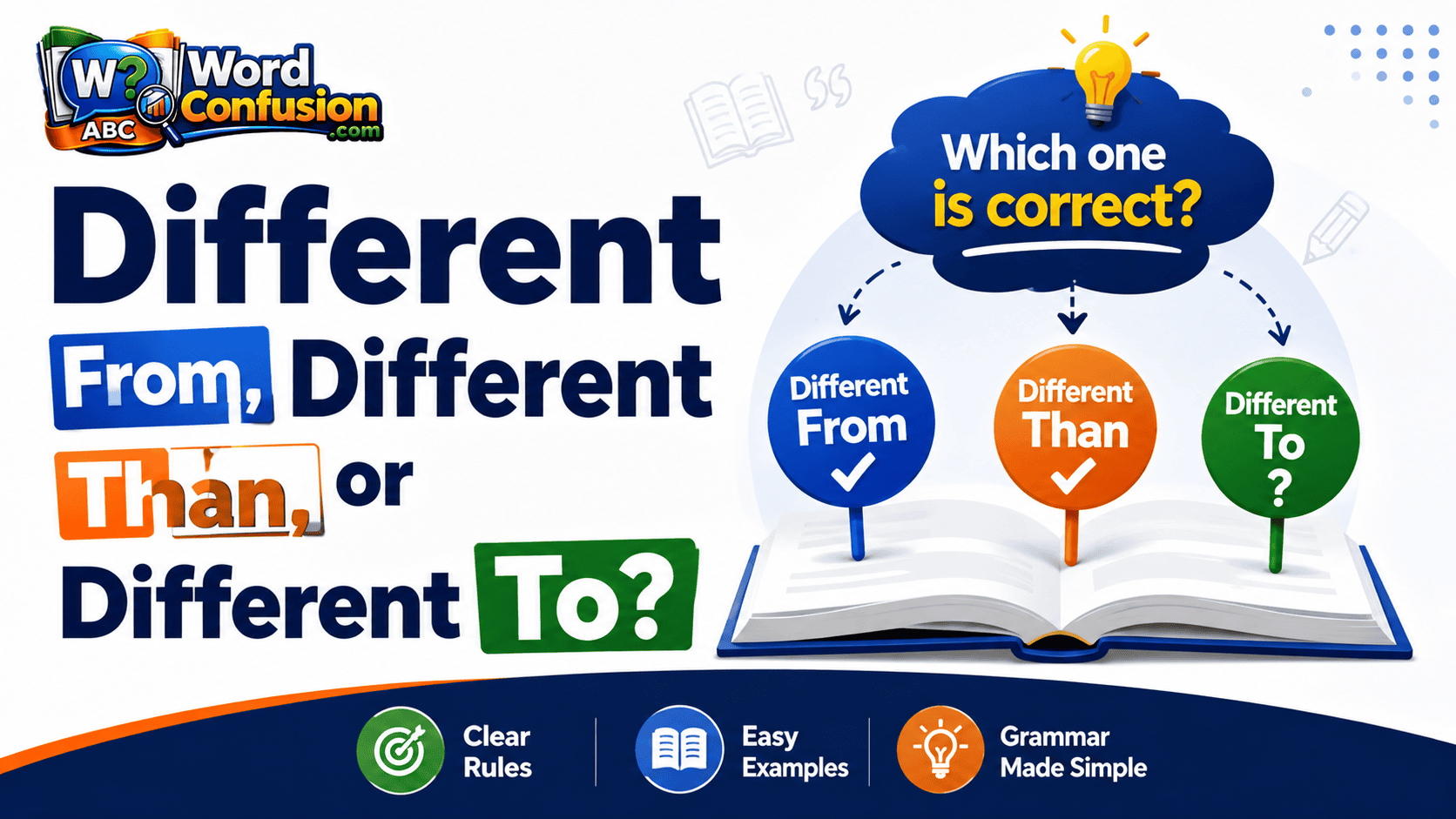
You may also wonder which expression is correct:
- different from
- different than
- different to
The answer depends partly on regional usage.
Different from
Different from is the safest general choice, particularly in careful or formal writing.
Her approach is different from mine.
Different than
Different than is widely used in American English.
This result is different than we expected.
It is also encountered in other varieties of English, although some speakers have traditionally preferred different from.
Different to
Different to is commonly used in British English, particularly in speech.
This version is different to the one I saw yesterday.
Cambridge notes the regional patterns of different from, different to, and different than, while Merriam-Webster also documents the established usage of these constructions.
Which one should you use?
If you want the least controversial option in general writing, different from is an excellent choice.
For example:
The new design is different from the original.
If you are writing specifically in American English, different than is also a normal construction. In British English, different to is common as well.
Common Misspellings of Different
Diffrent is not the only spelling mistake people can make with this word.
Other incorrect forms may include:
- diffrent
- differnt
- difrent
- diferent
- diffirent
- differant
- defferent
These forms should not be used as replacements for different in standard English.
The key point is simple:
There is only one standard spelling for the adjective: different.
📖 See also:What Does WFH Mean in Text? Meaning, Examples & Usage
Different Word Family
Understanding related words can make the spelling and meaning easier to remember.
| Word | Part of Speech | Meaning |
| differ | Verb | To be unlike or not agree |
| different | Adjective | Not the same; unlike |
| difference | Noun | A way in which things are unlike |
| differently | Adverb | In a different way |
Examples
- The two plans differ in several ways.
- We have different opinions.
- There is a clear difference between the two plans.
- The two teams approached the problem differently.
Seeing these words together can make the spelling of different easier to remember.
Easy Ways to Remember the Spelling
Here are two simple memory tricks.
Trick 1: Remember “differ + ent”
Think:
differ + ent = different
The beginning of different is closely connected to differ.
Trick 2: Watch the “ffe”
Look carefully at this part:
diFFE…
The word starts with diff, not diff followed immediately by r.
Write it a few times:
different
different
different
Then compare it:
diffrent ❌
The incorrect spelling is missing the e.
Common Mistakes With Different
Mistake 1: Writing “diffrent”
❌ The two products are diffrent.
✅ The two products are different.
Mistake 2: Forgetting the second “f”
❌ diferent
✅ different
Mistake 3: Adding an unnecessary letter
❌ differant
✅ different
Mistake 4: Confusing different with difference
These words are related but do different grammatical jobs.
- different = adjective
- difference = noun
Compare:
The two cars are different.
There is a difference between the two cars.
📖 See also:Leary or Leery: Which Is Correct?
Frequently Asked Questions
Is it different or diffrent?
Different is correct. Diffrent is an incorrect spelling.
Is diffrent a word?
No. Diffrent is not the standard spelling of the English adjective meaning “not the same.” The correct spelling is different.
What is the correct spelling of different?
The correct spelling is different:
d-i-f-f-e-r-e-n-t
How do I spell different?
Spell it different. A useful memory aid is differ + ent.
Why do people spell different as diffrent?
The mistake can happen because people type quickly, reduce vowel sounds when speaking, rely on familiar spelling patterns, or simply develop a habit of leaving out the e.
What does different mean?
Different means not the same, unlike, or distinct.
For example:
My answer is different from yours.
How do you pronounce different?
Cambridge lists /ˈdɪf.ər.ənt/ for British English and /ˈdɪf.ɚ.ənt/ for American English.
Is different spelled with two f’s?
Yes. Different contains two consecutive f’s:
di + ff + erent
It also contains an e immediately after those two f’s.
What is the difference between different and diffrent?
Different is the correct English spelling. Diffrent is a misspelling caused by leaving out the e.
Is “different from” or “different than” correct?
Both are established in English usage, but their frequency varies by region and style. Different from is the safest general choice, while different than is especially common in American English. Different to is also common in British English.
Conclusion
If you are choosing between different and diffrent, choose different every time.
Different is the correct spelling and means “not the same,” “unlike,” or “distinct.” Diffrent is a common misspelling because the e after the two f’s is easy to leave out.
The easiest way to remember it is:
differ + ent = different
So remember the extra e, and you will avoid one of the most common spelling mistakes with this word.
Looking for more English word meanings, grammar tips, and commonly confused words? Visit the WordConfusion homepage to explore our latest language guides, spelling differences, vocabulary explanations, text abbreviations, and practical examples. Whether you’re learning English or improving your writing skills, you’ll find clear, easy-to-understand resources for everyday communication.
Written by
 Abdul Moeed
Abdul Moeed is a professional content writer and SEO link-building specialist with 5+ years of experience. He creates search-optimized content and develops effective SEO strategies that improve website visibility, authority, and organic growth.
View LinkedIn profileLatest posts
 What Does PG Mean in Text? Meaning, Examples & Usage
 What Does OFCC Mean in Text? Meaning, Uses & Examples
 What Does MSG Mean in Text? Meaning, Examples & Usage
 What Does STY Mean in Text? Meaning, Examples & Usage
 What Does “Twin” Mean in Slang? Meaning, Text & Examples
 What Does LMC Mean in Text? Meaning, Examples & Usage