What Does WFH Mean in Text? Meaning, Examples & Usage

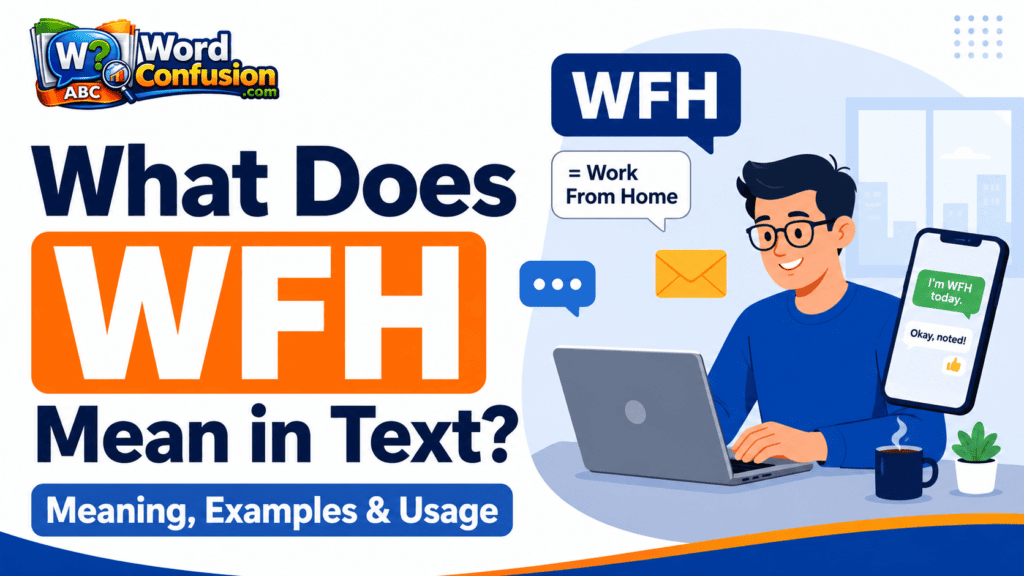
If you see WFH in a text message, chat, or workplace conversation, it usually means “work from home” or “working from home.” It tells you that someone is doing their job from home rather than going to their usual workplace. For example, “I’m WFH today” means “I’m working from home today.” Cambridge and Oxford both recognize WFH as an established abbreviation related to working from home.
📖 See also:Leary or Leery: Which Is Correct?
What Does WFH Mean in Text?
WFH means “work from home” or “working from home.”
In texting, people use WFH as a convenient abbreviation when talking about their work location or schedule.
For example:
“I’m WFH today.”
This means:
“I’m working from home today.”
WFH does not mean that someone has the day off. It normally means they are still working but are doing their job from home.
Cambridge lists WFH as both a noun and a verb abbreviation, while Oxford lists it as an abbreviation for “work from home.”
Quick meaning
WFH = Work From Home
Depending on the sentence, it can also represent working from home.
What Does WFH Stand For?
WFH stands for:
- W = Work
- F = From
- H = Home
So:
WFH → Work From Home
You may also see the phrase working from home used when WFH refers to the activity or arrangement.
For example:
- “I WFH on Fridays.” → I work from home on Fridays.
- “WFH is convenient.” → Working from home is convenient.
- “She is WFH today.” → She is working from home today.
A useful language note is that WFH is often casually called an acronym, but abbreviation is the safest general term. More precisely, it is an initialism because the letters are normally pronounced separately: W-F-H.
What Does WFH Mean in Chat and Texting?
In chat, WFH is usually shorthand for telling someone that you are working from home.
You might see it in:
- Text messages
- WhatsApp chats
- Workplace messaging apps
- Group chats
- Social media posts
- Status updates
- Online calendars
- Internal workplace emails
Examples of WFH in texting
Person 1: Are you coming into the office today?
Person 2: No, I’m WFH today.
“WFH tomorrow, so I’ll join the meeting online.”
Meaning: The person will work from home tomorrow and plans to attend the meeting remotely.
“I’m WFH this afternoon.”
Meaning: The person will be working from home during the afternoon.
“Are you WFH on Friday?”
Meaning: Are you working from home on Friday?
The abbreviation is especially useful when the context is already clear.
How Is WFH Used in Professional Communication?
WFH is not limited to casual texting. It is also common in workplace communication.
For example, a colleague might write:
“I’ll be WFH tomorrow.”
Or:
“I’m WFH today, but I’m available on Teams.”
This is perfectly understandable in an internal workplace setting.
However, there is an important distinction between professional and highly formal communication.
Internal workplace message
“WFH today. Please message me if you need anything.”
Natural and concise.
Internal email
“I’ll be WFH on Friday and will be available by email.”
Also natural.
More formal communication
“I’ll be working from home on Friday.”
The full phrase is usually the better choice when communicating with people who may not know the abbreviation or when the writing needs to sound particularly formal.
Rule of thumb: WFH is suitable when your audience already understands workplace shorthand. Use “working from home” when clarity or formality matters more than brevity.
📖 See also:Holistic or Wholistic: Which Is Correct? Meaning & Examples
Is WFH Formal or Informal?
WFH is widely used workplace shorthand, so it is more than simple internet slang. It can appear in professional communication, particularly in internal messages, emails, schedules, and workplace conversations.
Still, it is an abbreviation rather than the full expression.
Compare:
| Situation | Better wording |
| Text to a coworker | I’m WFH today. |
| Workplace chat | WFH today. |
| Internal email | I’ll be WFH tomorrow. |
| Formal email | I’ll be working from home tomorrow. |
| Formal report | working from home |
So, is WFH informal?
It can be informal in tone, but it is not necessarily unprofessional. Its suitability depends mainly on the audience and context.
How Do You Use WFH in a Sentence?
WFH can be used naturally in several ways.
1. To describe your current work location
“I’m WFH today.”
2. To describe a regular schedule
“I usually WFH on Fridays.”
Oxford provides a similar usage example showing WFH as a verb for working from home.
3. To talk about tomorrow
“I’ll be WFH tomorrow.”
4. To ask someone about their work location
“Are you WFH today?”
5. To explain why you’re joining remotely
“I’m WFH today, so I’ll join the meeting online.”
6. To discuss a work arrangement
“Our team has two WFH days each week.”
7. In a casual social post
“WFH, coffee, and a quiet morning.”
The exact grammar can vary because WFH is used as shorthand in several ways. Cambridge specifically records both noun and verb uses.
WFH vs Remote Work: What’s the Difference?
remote work and WFH are closely related, but they are not always identical.
WFH specifically indicates working from home. Remote work is broader and can include working from home, a coworking space, a library, or another location outside the employer’s usual workplace.
Cambridge defines remote working as working at home or another place that is not the organization’s usual place of business.
| Term | Meaning | Possible Location |
| WFH | Work from home | Home |
| Remote work | Work away from the usual workplace | Home or another location |
| Hybrid work | Mix of office and remote work | Office + home/other locations |
| WFA | Work from anywhere | Potentially many locations |
Example
Someone working from a home office:
WFH
Someone working from a coffee shop:
Remote work, but not necessarily WFH.
Someone working Monday and Tuesday at home and Wednesday through Friday in the office:
Hybrid work
Cambridge similarly describes hybrid working as an arrangement in which employees work partly in an office and partly from home or another location.
Common Misunderstandings About WFH
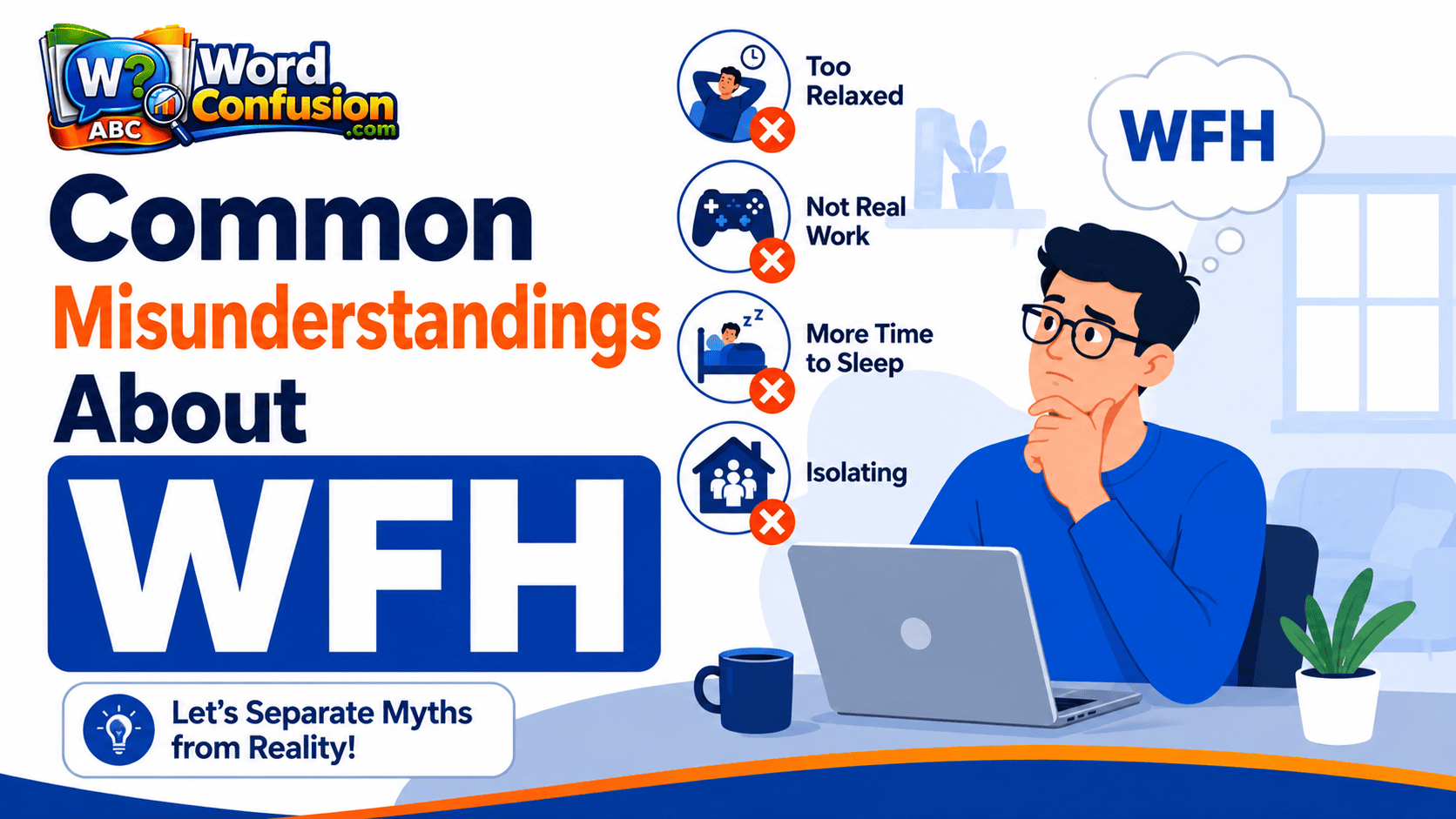
WFH does not mean “not working”
This is the most important distinction.
If someone says:
“I’m WFH today.”
They are saying they are working from home, not that they are taking a vacation or day off.
WFH does not automatically mean flexible hours
Someone can work from home while keeping exactly the same working hours as they would in an office.
WFH does not necessarily mean permanently remote
A person may WFH once a week, several days a week, or only occasionally.
For example:
“I WFH on Fridays.”
That does not necessarily mean the person works remotely every day.
WFH is not exactly the same as remote work
WFH identifies home as the work location.
Remote work is a broader category that can include other locations.
📖 See also:What Does WDYM Mean in Text? Definition, Tone & Examples
Can You Use WFH in an Email?
Yes, especially in internal workplace emails where the recipient understands the abbreviation.
For example:
Subject: Working location
I’ll be WFH tomorrow and will be available by email and Teams.
That sounds natural in an ordinary workplace environment.
For a more formal audience, write:
I’ll be working from home tomorrow and will remain available by email.
Which version should you choose?
Use WFH when:
- You are communicating with coworkers.
- The workplace commonly uses the abbreviation.
- You want to keep a message short.
- The context is already clear.
Use working from home when:
- The audience may not know WFH.
- You are writing for external readers.
- The message is highly formal.
- You want maximum clarity.
WFH Examples in Different Contexts
| Context | Example |
| Text message | I’m WFH today. |
| Workplace chat | WFH today, but I’m online. |
| Question | Are you WFH tomorrow? |
| Internal email | I’ll be WFH on Friday. |
| Schedule | WFH — Tuesday and Thursday |
| Social media | WFH and enjoying the quiet morning. |
| Formal writing | I’ll be working from home tomorrow. |
These examples show why context matters more than simply asking whether WFH is “formal” or “informal.”
Is WFH Slang?
Not exactly.
WFH is better described as a workplace abbreviation or initialism than as slang.
Slang often carries a strongly informal or group-specific meaning. WFH, on the other hand, has an established workplace meaning and is recognized by major English dictionaries.
That said, it is still shorthand. In highly formal writing, spelling out “working from home” is usually clearer.
A Simple Way to Remember WFH
Think of the three letters as a literal description:
W → Work
F → From
H → Home
WFH = Work From Home
If someone says “I’m WFH,” simply think:
“I’m working from home.”
That memory trick works because the abbreviation uses the first letters of the three words.
Frequently Asked Questions About WFH
What does WFH mean in text?
WFH means “work from home” or “working from home.” In a text message, it usually tells you that someone is doing their job from home instead of going to their usual workplace.
What does WFH stand for?
WFH stands for Work From Home. It can also refer to working from home, depending on how it is used in a sentence.
Does WFH mean work from home?
Yes. WFH commonly means “work from home.” It can also be used to refer to the activity of working from home.
What does WFH mean in texting?
In texting, WFH means work from home or working from home. For example, “I’m WFH today” means “I’m working from home today.”
What does WFH mean in chat?
WFH has the same basic meaning in chat: work from home. It is commonly used when discussing someone’s work location or schedule.
What does WFH mean on WhatsApp?
On WhatsApp, WFH generally means work from home. For example, “Are you WFH today?” means “Are you working from home today?”
Is WFH an abbreviation or acronym?
WFH is an abbreviation, and more specifically an initialism, because its letters are normally pronounced individually: W-F-H.
It is often casually called an acronym, but “initialism” is the more precise linguistic description.
Is WFH formal or informal?
WFH is established workplace shorthand. It can be appropriate in internal professional communication, but “working from home” is preferable when writing for a formal or unfamiliar audience.
Can WFH be used in a professional email?
Yes. For example:
“I’ll be WFH tomorrow.”
For a more formal email, use:
“I’ll be working from home tomorrow.”
What is the difference between WFH and remote work?
WFH specifically means working from home. Remote work is broader and can include working from home or another location outside the usual workplace.
Does WFH mean someone is off work?
No. WFH normally means the person is working from home, not that they are taking the day off.
📖 See also:Focusing or Focussing: Which Spelling Is Correct?
Final Takeaway
WFH means “work from home” or “working from home.” You will commonly see it in text messages, workplace chats, emails, schedules, and social media.
The easiest way to understand it is:
WFH = Work From Home
If a coworker says “I’m WFH today,” they are telling you that they are working from home today.
WFH is widely understood workplace shorthand, but “working from home” is the better choice when you need a more formal or universally clear expression. Cambridge and Oxford both recognize the abbreviation and its connection with working from home.
Looking for more English word meanings, grammar tips, and commonly confused words? Visit the WordConfusion homepage to explore our latest language guides, spelling differences, vocabulary explanations, text abbreviations, and practical examples. Whether you’re learning English or improving your writing skills, you’ll find clear, easy-to-understand resources for everyday communication.
Written by
 Abdul Moeed
Abdul Moeed is a professional content writer and SEO link-building specialist with 5+ years of experience. He creates search-optimized content and develops effective SEO strategies that improve website visibility, authority, and organic growth.
View LinkedIn profileLatest posts
 What Does PG Mean in Text? Meaning, Examples & Usage
 What Does OFCC Mean in Text? Meaning, Uses & Examples
 What Does MSG Mean in Text? Meaning, Examples & Usage
 What Does STY Mean in Text? Meaning, Examples & Usage
 What Does “Twin” Mean in Slang? Meaning, Text & Examples
 What Does LMC Mean in Text? Meaning, Examples & Usage