IDC Meaning in Text: How to Use It, and Real Examples

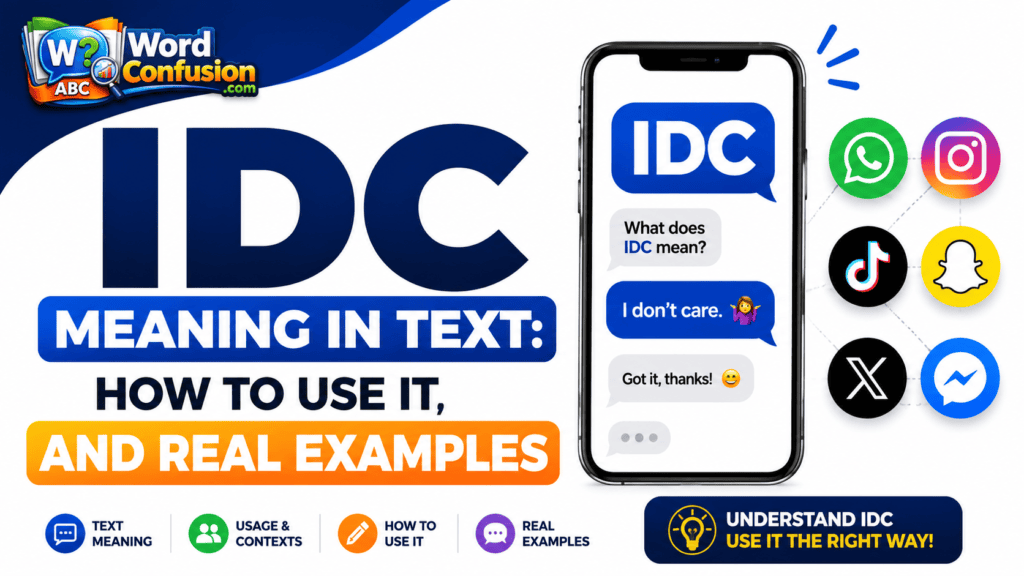
Have you ever received a message saying “IDC” and wondered what it means? You’re not alone. This popular texting abbreviation appears every day in text messages, social media posts, and online chats. While it’s short, its meaning can change slightly depending on the conversation and tone.
In this guide, you’ll learn the IDC meaning in text, what it stands for, how to use it correctly, when it may sound rude, and how people use it on platforms like Snapchat, Instagram, TikTok, WhatsApp, and Discord. You’ll also find real conversation examples, comparisons with similar abbreviations, and tips for using IDC naturally.
Quick Answer
IDC stands for “I Don’t Care.” In texting and online conversations, it’s used to express that someone has no preference, isn’t interested in the topic, or doesn’t mind the outcome. Depending on the context, it can sound casual, indifferent, or sometimes blunt.
Featured Snippet Answer
IDC means “I Don’t Care.” It is a common texting abbreviation used in messages, social media, and online chats to show indifference or a lack of preference. People often use IDC when they aren’t concerned about a decision or don’t have a strong opinion. Because tone is difficult to judge in text, it may sometimes come across as rude if used carelessly.
What Does IDC Stand For?
| Abbreviation | Full Form | Meaning | Common Usage |
| IDC | I Don’t Care | Showing indifference or no preference | Text messages, chats, social media, gaming, and online conversations |
The most common and widely accepted meaning of IDC is “I Don’t Care.” It has been part of internet slang for many years and remains one of the most frequently used abbreviations in digital communication.
People often type IDC instead of writing the full phrase because it’s faster and more convenient, especially during casual conversations.
What Does IDC Mean in Text?
The IDC meaning in text is “I Don’t Care.” It tells the other person that you don’t have a preference, aren’t emotionally invested in the decision, or aren’t bothered by the outcome.
Unlike some abbreviations that have several common meanings, IDC is remarkably consistent across texting platforms. Whether you’re chatting through SMS, WhatsApp, Instagram, Snapchat, or Discord, it almost always means “I Don’t Care.”
However, the tone depends entirely on the situation. Sometimes it simply means:
- “Either option is fine.”
- “I’m okay with whatever you choose.”
- “It doesn’t matter to me.”
In other situations, it may express frustration or complete disinterest.
Example
Friend: Where should we eat tonight?
You: IDC, you can choose.
Here, IDC means you genuinely have no preference.
How Is IDC Used in Texting?
People use IDC in many different situations. Understanding the context helps you know whether it’s being used casually or emotionally.
1. Expressing No Preference
This is the most common use.
Example
Alex: Pizza or burgers?
Sam: IDC. You decide.
Sam simply doesn’t mind either choice.
2. Showing Indifference
Sometimes someone uses IDC because the topic doesn’t matter to them.
Example
Emma: They’re changing the meeting room.
Jake: IDC.
Jake isn’t concerned about the change.
3. Ending a Conversation
Occasionally, IDC is used to stop discussing something.
Example
Person A: We keep arguing about this.
Person B: IDC anymore.
This version sounds stronger and may suggest the speaker is tired of the conversation.
4. Reacting to Drama
People often use IDC online when they don’t want to get involved.
Example
Friend: Did you hear what happened?
You: IDC. It’s not my business.
5. Giving Someone Freedom to Choose
Many people use IDC politely when they’re happy with any option.
Example
Mom: Which movie do you want to watch?
Son: IDC. Pick your favorite.
Although short, this version isn’t rude because the context is friendly.
Why Do People Use IDC Instead of “I Don’t Care”?
There are several reasons why IDC has become popular in texting language.
It’s Faster
Typing three letters is much quicker than writing the full sentence.
It’s Common Internet Slang
Most internet users immediately recognize IDC, making communication quicker.
It Fits Casual Conversations
Friends often use abbreviations to keep conversations short and relaxed.
It Saves Time
When chatting rapidly, abbreviations help people reply almost instantly.
Is IDC Always Negative?
No.
Many people assume IDC always sounds rude, but that’s not true.
Its meaning depends on:
- Your relationship with the other person
- The topic being discussed
- The overall tone of the conversation
- Whether the conversation is serious or casual
For example:
Neutral
Friend: Tea or coffee?
You: IDC.
This simply means either option is acceptable.
Slightly Rude
Friend: I worked hard on this project.
You: IDC.
Here, the response dismisses the other person’s effort and may hurt their feelings.
Emotional
Person A: Why are you upset?
Person B: IDC anymore.
This suggests frustration or emotional exhaustion rather than simple indifference.
Common Situations Where People Use IDC
You’ll frequently see IDC in conversations about:
- Choosing restaurants
- Picking movies
- Weekend plans
- Group decisions
- Online gaming
- Social media comments
- Friendly debates
- Casual chats
- Group messages
- Discord servers
Because it’s so versatile, IDC has become one of the most recognizable text message acronyms used today.
Real-Life Chat Examples
Here are some natural examples of IDC in everyday conversations.
Example 1
Liam: Which color should I buy?
Noah: IDC. Both look good.
Example 2
Sophia: Should we leave at 7 or 8?
Olivia: IDC. Either works for me.
Example 3
Chris: Want pizza tonight?
Ryan: IDC. Surprise me.
Example 4
Taylor: They’re changing the game schedule.
Jordan: IDC. I’ll still play.
Example 5
Emma: Everyone is talking about that celebrity.
Mia: IDC honestly.
Example 6
Friend: Who won the match?
You: IDC—I didn’t watch it.
When Should You Avoid Using IDC?
Although IDC is common, there are situations where it’s better to avoid it.
Don’t use IDC when:
- Someone is sharing personal feelings.
- A friend is asking for emotional support.
- You’re speaking to a teacher or manager.
- You’re writing a professional email.
- The conversation is serious or sensitive.
In these situations, IDC can seem dismissive, even if you didn’t mean it that way.
Instead, consider saying:
- “I’m okay with either option.”
- “Whatever works best for you.”
- “I don’t have a preference.”
- “You can decide.”
- “I’m fine with either choice.”
These alternatives sound warmer while communicating the same idea.
Quick Comparison
| Abbreviation | Meaning | Typical Tone | Best Used For |
| IDC | I Don’t Care | Neutral to blunt | Showing no preference or indifference |
| IDK | I Don’t Know | Neutral | Admitting you don’t know something |
| IKR | I Know, Right? | Friendly | Agreeing enthusiastically |
| TBH | To Be Honest | Honest | Sharing opinions |
| NVM | Never Mind | Casual | Dropping a topic |
IDC Meaning on Snapchat
On Snapchat, IDC still means “I Don’t Care.” People use it in private chats, group conversations, and replies to Stories when they want to show they have no preference or aren’t interested in a topic.
Snapchat conversations are usually quick and informal, so abbreviations like IDC, IDK, LOL, and TBH are common.
Snapchat Examples
Friend: Which filter should I use?
You: IDC. Both look great.
Friend: Are you joining the streak today?
You: IDC. Do whatever you want.
IDC Meaning on Instagram
On Instagram, IDC has the same meaning: “I Don’t Care.” You’ll often see it in:
- Direct Messages (DMs)
- Story replies
- Post comments
- Group chats
People use it to express indifference or to let someone else make the decision.
Instagram Examples
Friend: Should I post the first photo or the second one?
You: IDC. They both look amazing.
Comment:
IDC what people say—that outfit looks awesome.
In this example, IDC shows that the speaker isn’t concerned about others’ opinions.
IDC Meaning on TikTok
On TikTok, IDC usually appears in:
- Video comments
- Replies
- Captions
- Live chat messages
Here, it often expresses confidence, indifference, or a carefree attitude.
TikTok Examples
IDC if nobody agrees.
IDC. I’m posting it anyway.
IDC what the haters think.
Many creators use IDC to show confidence and ignore criticism.
IDC Meaning on WhatsApp
On WhatsApp, IDC is widely used in personal and group chats. Its meaning doesn’t change—it still stands for “I Don’t Care.”
Friends often use it when discussing:
- Weekend plans
- Food choices
- Movies
- Travel
- Everyday decisions
WhatsApp Examples
Friend: Chinese or Italian food?
You: IDC. Your choice.
Sibling: Which route should we take?
You: IDC. Pick the fastest one.
IDC Meaning in Discord
Discord users frequently use IDC while chatting during games, community discussions, or voice-channel text chats.
Examples include:
- Choosing a game mode
- Deciding who hosts
- Picking a server
- Casual conversations
Discord Example
Player 1: Which map should we play?
Player 2: IDC. Anything works.
IDC Meaning in Facebook Messenger
Messenger conversations are usually informal, making IDC another common abbreviation.
People use it in one-on-one chats and group conversations exactly as they would in text messages.
Example
Friend: Should we meet at 5 or 6?
You: IDC. Whenever you’re free.
Does IDC Mean Something Different on Social Media?
No.
Across nearly every major social platform, IDC keeps the same meaning:
| Platform | Meaning Changes? | Most Common Meaning |
| Snapchat | No | I Don’t Care |
| No | I Don’t Care | |
| TikTok | No | I Don’t Care |
| No | I Don’t Care | |
| Discord | No | I Don’t Care |
| Facebook Messenger | No | I Don’t Care |
| SMS/Text Messages | No | I Don’t Care |
While the meaning stays the same, the tone can vary depending on the conversation.
Is IDC Rude?
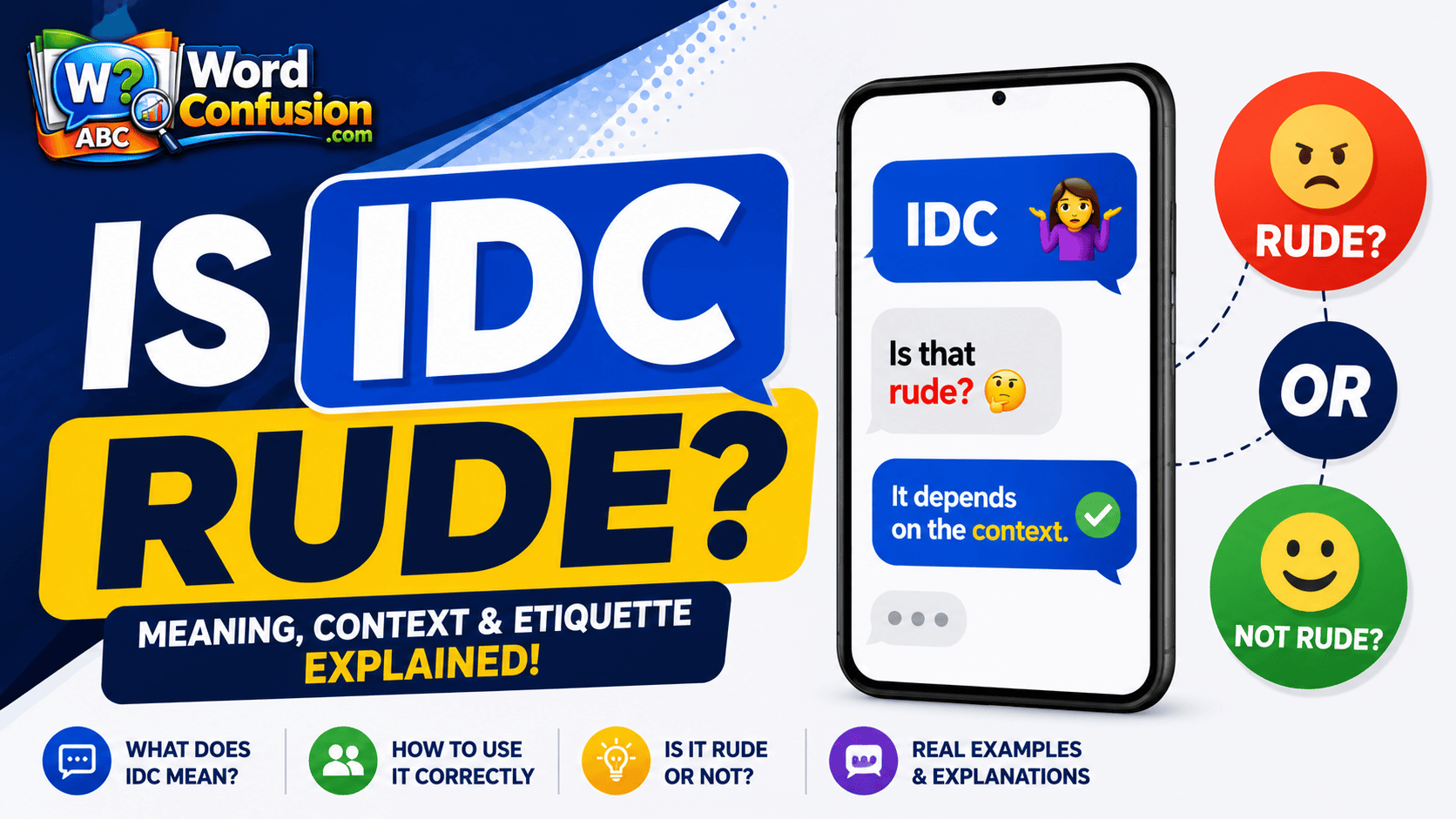
Not always.
Whether IDC sounds rude depends on who you’re talking to, what you’re discussing, and how it’s used.
Think of IDC as a phrase with three possible tones:
1. Friendly and Casual
When you’re talking with close friends or family, IDC often means you genuinely don’t mind.
Example
Friend: Should we watch a comedy or an action movie?
You: IDC. You choose.
This sounds relaxed and cooperative.
2. Neutral
Sometimes IDC simply means the outcome doesn’t matter to you.
Example
Coworker: Should we start at 9 or 10?
You: IDC. Either time works.
Even though it’s neutral, writing the full sentence—“Either time works for me”—is usually better in professional settings.
3. Blunt or Dismissive
In emotional conversations, IDC can feel harsh because it may suggest that you don’t care about the other person’s feelings.
Example
Friend: I’m really upset today.
You: IDC.
This response is likely to hurt the other person’s feelings and should generally be avoided.
When Should You Use IDC?
Using IDC is appropriate when:
- You’re chatting with friends.
- You’re discussing casual topics.
- You genuinely have no preference.
- The conversation isn’t emotionally sensitive.
- Everyone understands informal texting language.
When Should You Avoid IDC?
Avoid using IDC if you’re:
- Replying to your boss or manager.
- Emailing a client.
- Talking with a teacher.
- Responding to someone’s emotional message.
- Handling a serious discussion.
In these situations, a more thoughtful response creates a better impression.
Better Alternatives to IDC
If you don’t want to sound too blunt, try one of these alternatives instead.
| Instead of IDC | Try Saying |
| IDC | Either option works for me. |
| IDC | I’m fine with whatever you choose. |
| IDC | I don’t have a preference. |
| IDC | Your choice is okay with me. |
| IDC | I’m happy with either option. |
These phrases communicate the same idea while sounding friendlier and more considerate.
Other Meanings of IDC
Although “I Don’t Care” is by far the most common meaning in texting and social media, IDC can have different meanings in professional or technical fields.
Some examples include:
| Industry | Possible Meaning |
| Technology | International Data Corporation |
| Healthcare | Initial Data Collection (varies by organization) |
| Business | Industry-specific abbreviations depending on context |
If you see IDC in a report, academic paper, or workplace document, don’t automatically assume it means “I Don’t Care.” Always consider the context to determine the correct meaning.
Can IDC Have Multiple Meanings?
Yes, but context is everything.
In text messages, social media, online chats, and messaging apps, IDC almost always means “I Don’t Care.”
In professional documents or specialized industries, however, the abbreviation may represent something entirely different.
A simple rule to remember is:
- Casual conversation → I Don’t Care
- Professional or technical document → Check the context
More Real-World Examples
Example 1
Anna: Which restaurant should we book?
Mia: IDC. I’m excited to try anything.
Example 2
Jake: Should I wear the blue shirt or the black one?
Chris: IDC. Both look good on you.
Example 3
Friend: Everyone is arguing about that movie.
You: IDC. I haven’t even seen it.
Example 4
Teammate: Which map do you want to play?
You: IDC. Surprise me.
Example 5
Friend: They’re changing the concert date.
You: IDC. I’m free either day.
IDC vs Similar Texting Abbreviations
Many texting abbreviations look similar, but they have very different meanings. Understanding the differences helps you avoid misunderstandings and use the right expression in the right situation.
| Abbreviation | Full Form | Meaning | Example |
| IDC | I Don’t Care | Shows no preference or interest | IDC. You decide. |
| IDK | I Don’t Know | Indicates you don’t know the answer | IDK where she went. |
| IKR | I Know, Right? | Expresses agreement or excitement | IKR! That was amazing. |
| TBH | To Be Honest | Introduces an honest opinion | TBH, I liked the first movie more. |
| NVM | Never Mind | Tells someone to ignore or drop a topic | NVM, I figured it out. |
IDC vs IDK
These two abbreviations are often confused because they start with the same letters.
- IDC means “I Don’t Care.”
- IDK means “I Don’t Know.”
Example
Friend: Which movie should we watch?
- IDC → You can choose. I have no preference.
- IDK → I don’t know which one is better.
The first shows indifference, while the second shows uncertainty.
IDC vs IKR
IKR means “I Know, Right?” It’s used when you strongly agree with someone.
Example
Friend: That game was incredible!
You: IKR!
By contrast, IDC doesn’t express agreement—it simply shows that the topic doesn’t matter to you.
IDC vs TBH
TBH means “To Be Honest.” It’s commonly used before sharing a genuine opinion.
Example
TBH, I liked the first season better.
Meanwhile, IDC communicates that you don’t have a strong opinion or don’t care about the outcome.
IDC vs NVM
NVM stands for “Never Mind.” It’s used to end a conversation or withdraw a question.
Example
Friend: What’s wrong?
You: NVM. I solved it.
Unlike IDC, NVM doesn’t express indifference—it simply tells someone to ignore the previous message.
Common Mistakes When Using IDC
Although IDC is easy to understand, it’s not always the best response. Here are a few common mistakes to avoid.
Using IDC in Professional Conversations
Because IDC is informal, avoid using it in:
- Work emails
- Business chats
- School assignments
- Professional meetings
Instead, say:
- “Either option works for me.”
- “I don’t have a preference.”
- “I’m happy with whichever you choose.”
These alternatives sound more respectful and professional.
Responding to Emotional Messages with IDC
If someone shares personal news or feelings, replying with IDC can come across as uncaring.
Less thoughtful:
Friend: I’m having a really difficult day.
You: IDC.
Better response:
I’m sorry to hear that. Do you want to talk about it?
Showing empathy helps maintain healthy conversations.
Assuming Everyone Knows Internet Slang
Not everyone is familiar with texting abbreviations. When chatting with older family members, new colleagues, or people who don’t often use internet slang, writing the full phrase can prevent confusion.
Overusing IDC
Using IDC too often may make you seem uninterested or disengaged, even if that’s not your intention.
A good conversation includes thoughtful responses, not just shortcuts.
Pro Tips for Using IDC Naturally
Here are a few practical tips to help you use IDC appropriately.
✔ Use It in Casual Conversations
It’s perfect for texting friends, siblings, classmates, or teammates.
✔ Consider the Tone
Before sending IDC, think about how the other person might interpret it.
✔ Be Careful During Serious Discussions
If someone is talking about an important issue, a more considerate response is usually better.
✔ Use Friendlier Alternatives When Needed
Instead of saying:
IDC.
You could say:
- “I’m okay with either option.”
- “Whatever works best for you.”
- “You can decide.”
- “I’m happy with either.”
These phrases communicate the same idea without sounding dismissive.
✔ Remember That Context Matters
The same abbreviation can feel polite in one conversation and blunt in another. Always consider the relationship, the topic, and the overall tone.
Frequently Asked Questions
What does IDC mean in text?
IDC means “I Don’t Care.” It’s used in text messages and online chats to show that someone has no preference or isn’t concerned about a particular topic.
What does IDC stand for?
IDC stands for “I Don’t Care.”
What does IDC mean in texting?
In texting, IDC expresses indifference or a lack of preference. It can also mean that the sender isn’t interested in discussing the topic further.
What does IDC mean on Snapchat?
On Snapchat, IDC still means “I Don’t Care.” People commonly use it in chats and Story replies.
What does IDC mean on Instagram?
On Instagram, IDC appears in DMs, comments, and replies with the same meaning: “I Don’t Care.”
What does IDC mean on TikTok?
On TikTok, IDC is often used in captions and comments to show confidence, indifference, or a carefree attitude.
What does IDC mean in WhatsApp messages?
In WhatsApp chats, IDC simply means “I Don’t Care.” It usually indicates that the sender has no preference about a decision.
Is IDC a slang term?
Yes. IDC is a widely recognized piece of internet slang and a common texting abbreviation used in casual online communication.
Is IDC an abbreviation or an acronym?
IDC is generally referred to as a texting abbreviation or internet initialism because each letter is pronounced individually: I-D-C.
Can IDC have multiple meanings?
Yes. In texting, it almost always means “I Don’t Care.” In professional or technical fields, however, IDC may stand for different terms depending on the context.
How do you use IDC in a sentence?
Here are a few examples:
- IDC where we eat—you choose.
- IDC which movie we watch.
- IDC what people think about my outfit.
- IDC if it rains; we’ll still go.
When should you avoid using IDC?
Avoid using IDC in professional emails, formal conversations, or when someone is sharing something personal or emotional. In these situations, a more thoughtful response is usually more appropriate.
Conclusion
The IDC meaning in text is simple: “I Don’t Care.” It’s one of the most common internet slang abbreviations used in text messages, social media, and online chats to express indifference or show that someone has no preference.
Although IDC is quick and convenient, its tone depends on the context. Among friends, it often sounds casual and harmless. In serious or emotional conversations, however, it can come across as blunt or dismissive. Understanding when and how to use IDC will help you communicate more clearly and avoid misunderstandings.
Whether you see IDC on Snapchat, Instagram, TikTok, WhatsApp, Discord, or in a regular text message, it almost always carries the same meaning. By learning its definition, examples, and appropriate usage, you’ll feel more confident using and understanding this popular texting abbreviation.
If you’re learning English vocabulary and commonly confused words, you may also enjoy our guides on NFS Meaning, RT Meaning, and AWL Meaning. Understanding these distinctions will make your writing clearer, more accurate, and more professional.
Written by
 Abdul Moeed
Abdul Moeed is a professional content writer and SEO link-building specialist with 5+ years of experience. He creates search-optimized content and develops effective SEO strategies that improve website visibility, authority, and organic growth.
View LinkedIn profileLatest posts
 What Does PG Mean in Text? Meaning, Examples & Usage
 What Does OFCC Mean in Text? Meaning, Uses & Examples
 What Does MSG Mean in Text? Meaning, Examples & Usage
 What Does STY Mean in Text? Meaning, Examples & Usage
 What Does “Twin” Mean in Slang? Meaning, Text & Examples
 What Does LMC Mean in Text? Meaning, Examples & Usage