Hurly Burly Meaning: Definition, Origin, Synonyms & Examples

A reader opens Macbeth for a school assignment and stops at the witches’ strange line about the hurlyburly. Another reader hears a news anchor call election season “the usual hurly burly” and wonders what it means. Both readers want the same answer, and this guide explains the hurly burly meaning in plain, practical terms.
The phrase sounds playful, yet it carries a clear meaning that writers have used for nearly five centuries. This guide covers the definition, origin, pronunciation, grammar, synonyms, and dozens of example sentences. Fans of colorful expressions may also enjoy our kick rocks meaning guide, which explains another vivid phrase.
Each section answers one common question, so readers can skip straight to the part they need. The examples come from everyday speech, news writing, literature, and workplace conversations.
Quick Answer: What Is the Hurly Burly Meaning?
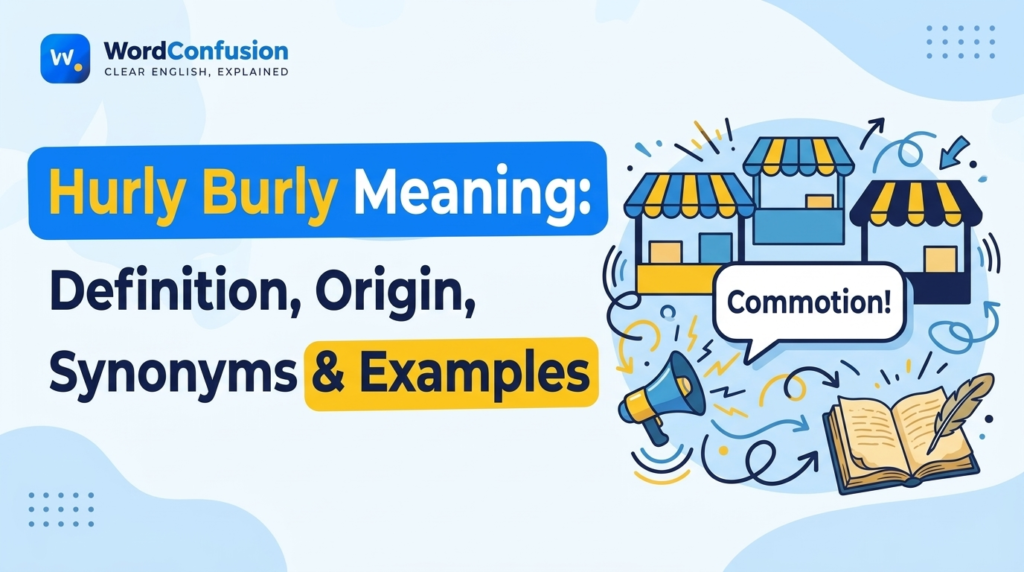
Hurly burly means noisy commotion, busy confusion, or a turbulent uproar of activity. People use it for crowded markets, hectic offices, political fights, and chaotic events of every size. The word usually sounds lighthearted, although Shakespeare used it for the confusion of battle in Macbeth. Dictionaries often join the two parts with a hyphen, but the meaning stays identical in every spelling.
Hurly Burly Meaning at a Glance
The table below gathers the core facts about the expression in one place for quick reference.
| Feature | Details |
|---|---|
| Part of speech | Noun, sometimes adjective |
| Core meaning | Noisy disorder or commotion |
| Tone | Informal, playful, slightly old fashioned |
| First recorded | Around the 1530s |
| Famous use | Macbeth, Act 1, Scene 1 |
| Common spellings | hurly burly, hurlyburly, hyphenated form |
| Close synonyms | Commotion, uproar, tumult, hubbub |
The table shows a simple pattern: the expression always points to loud, busy, disorderly activity.
What Does Hurly Burly Mean?
Hurly burly is a noun that describes loud, confused, and restless activity among people. It often refers to a crowd, an event, or a period of life filled with noise and movement. Writers choose it when they want a livelier word than “commotion” or “disorder.”
The expression rarely describes danger or violence directly in modern everyday use. Instead, it paints a picture of bustle, chatter, and general disorder that feels lively more than threatening. A busy train station at rush hour fits the phrase perfectly in every way.
In simple words, hurly burly means a noisy, busy, confusing scene full of people and activity.
Hurly Burly as an Adjective
Writers sometimes place hurly burly before a noun to describe something noisy and chaotic. Phrases such as “the hurly burly world of politics” or “a hurly burly market day” show this pattern. In that position, the expression works as an adjective meaning turbulent, hectic, or disorderly.
This adjective use appears most often in journalism, travel writing, and personal essays. It adds color without sounding too formal or academic for general readers.
Origin and History of Hurly Burly
The expression first appears in English writing around the 1530s, according to major historical dictionaries. Most etymologists connect it to an older phrase, “hurling and burling,” which described tumult. “Hurling” in that older sense meant commotion or violent movement, linked to the verb “hurl.”
English speakers love rhyming doubles, so “hurling and burling” gradually tightened into the catchier form. The second half, “burly,” carries no separate meaning here and exists mainly to echo the first part. Linguists call this pattern rhyming reduplication, and English contains dozens of similar pairs.
Hurly Burly in Macbeth
Shakespeare gave the phrase its most famous moment in the opening scene of Macbeth, written around 1606. The witches plan to meet “When the hurlyburly’s done, / When the battle’s lost and won.” In this context, the word refers to the noise and confusion of a battle raging nearby.
That single line turned the expression into a fixture of English classrooms worldwide. Many readers first meet the word through Macbeth, so they sometimes assume it always carries a dark tone. Modern usage feels lighter, though the battle sense still appears in historical writing.
Shakespeare also used it in Henry IV, Part 1, where a king mocks “hurlyburly innovation.” There it describes reckless political upheaval, which still matches one modern sense of the expression. Both plays show that the phrase covered noise and social turmoil from its earliest days.
Hurly Burly in Modern Culture
American playwright David Rabe titled his 1984 play “Hurlyburly,” a dark comedy about Hollywood figures. A film version followed in 1998, which kept the title in public memory for another generation. The title reflects the frantic, messy lives of its characters more than any literal battle.
Journalists also reach for the phrase when describing elections, stock markets, and crowded festivals. Its slightly old fashioned charm makes it popular in British newspapers and opinion columns.
How to Pronounce Hurly Burly
The expression has two rhyming halves, and each half carries the stress on its first syllable. Speakers say it roughly as HUR lee BUR lee, with a light pause between the two parts.
| Accent | Approximate pronunciation |
|---|---|
| American English | HER lee BER lee |
| British English | HUH lee BUH lee |
| Phonetic guide | Stress on “hur” and “bur” |
British speakers often soften the “r” sound, while American speakers usually pronounce it clearly.
Readers learning English should practice saying both halves at the same speed and rhythm. The rhyme makes the expression easy to remember once the stress pattern feels natural.
Hurly Burly Spelling: Which Form Is Correct?
Three spellings appear in print, and all three are acceptable in standard English writing. Dictionaries such as Merriam Webster and Oxford list the hyphenated form as the main headword. Shakespeare’s First Folio printed it as one closed word, which explains the “hurlyburly” spelling in Macbeth editions.
| Spelling | Where it appears |
|---|---|
| Hyphenated form | Most modern dictionaries and newspapers |
| hurlyburly | Shakespeare editions and the Rabe play title |
| hurly burly | Casual writing, blogs, and search queries |
Writers should pick one spelling and keep it consistent throughout a single document.
Style guides for newspapers usually follow the dictionary headword, so professional editors often prefer the hyphenated form. Casual writers and social media users tend to drop the hyphen without changing the meaning.
Hurly Burly vs Hustle and Bustle
People often confuse hurly burly with “hustle and bustle,” since both describe busy, active scenes. The difference lies mainly in the level of disorder and noise each phrase suggests.
| Feature | Hurly burly | Hustle and bustle |
|---|---|---|
| Core idea | Noisy confusion | Busy activity |
| Disorder level | High | Moderate |
| Tone | Playful or turbulent | Neutral, often positive |
| Typical setting | Crowds, politics, battles | Cities, shops, holidays |
Hustle and bustle describes energetic activity, while hurly burly adds stronger confusion and noise.
A city street at noon shows hustle and bustle, because people move with purpose and order. A street during a surprise parade, with crowds shouting and pushing, shows hurly burly instead. Writers should choose the phrase that matches the amount of chaos they want readers to picture.
Hurly Burly vs Hullabaloo
Hullabaloo is another playful word that sits close to hurly burly in meaning and sound. Both describe noisy excitement, yet they focus on slightly different features of a scene.
| Feature | Hurly burly | Hullabaloo |
|---|---|---|
| Main focus | General confusion and activity | Loud fuss or outcry |
| Common use | Busy events and periods | Public reactions and controversies |
| Example | The hurly burly of the trading floor | The hullabaloo over the new rule |
Hullabaloo points to a public fuss, while hurly burly describes the busy chaos itself.
A news story about angry reactions to a celebrity comment would use hullabaloo more naturally. A story about the frantic scene inside a newsroom on election night would favor hurly burly.
Hurly Burly vs Chaos
Chaos describes complete disorder, often with no structure or control at all. Our guide on chaos meaning explains that stronger word, its Greek roots, and its scientific uses. Hurly burly sits below chaos on the intensity scale that writers use for disorder. It usually describes lively disorder instead of a total collapse of order.
Writers can think of the two words as points on a scale of disorder. A busy kitchen during dinner service shows hurly burly, while a kitchen fire during service shows chaos. The milder phrase suits scenes that feel noisy and messy but still function.
Why Writers Still Love Hurly Burly
Old words survive when they offer something newer words cannot easily replace. Hurly burly survives because its sound mirrors its meaning, with bouncing syllables that feel busy and restless. Linguists call this effect sound symbolism, and many lasting English expressions rely on it.
The phrase also carries cultural weight from Shakespeare, which gives it a literary flavor without sounding stiff. Writers can borrow some of that classic charm while still describing a modern scene. A columnist describing a crowded airport can nod to Macbeth without readers needing any literary background.
Finally, the expression stays flexible across tones, from cozy family stories to sharp political commentary. That flexibility explains why the phrase keeps appearing in newspapers, novels, and speeches today. Few rhyming doubles cover such a wide range of situations while keeping a clear meaning. Teachers also enjoy the phrase, because students remember it after a single reading of Macbeth.
Synonyms for Hurly Burly
English offers many words that share part of the hurly burly meaning. Each synonym carries its own flavor, so writers should pick the one that fits the scene.
| Synonym | Best use |
|---|---|
| Commotion | Neutral, general disorder |
| Uproar | Loud anger or protest |
| Tumult | Formal, large scale disorder |
| Hubbub | Mixed noise of many voices |
| Bedlam | Wild, uncontrolled confusion |
| Pandemonium | Extreme, widespread chaos |
| Turmoil | Emotional or social unrest |
| Bustle | Busy, purposeful activity |
| Furor | Angry public excitement |
| Ruckus | Noisy small disturbance |
Hubbub and commotion sit closest to the everyday sense, while pandemonium and bedlam describe stronger chaos.
Informal Synonyms
Casual speech offers lighter options that sound friendly, relaxed, and conversational to listeners. Words such as “ruckus,” “to do,” “kerfuffle,” and “brouhaha” work well in relaxed writing. Kerfuffle and brouhaha also suggest a fuss that feels bigger than its real importance.
Antonyms for Hurly Burly
Antonyms help clarify meaning by showing exactly what hurly burly is not. The opposite of a noisy, busy scene is a calm, quiet, orderly one.
| Antonym | Meaning |
|---|---|
| Calm | Peaceful and still |
| Tranquility | Deep, settled quiet |
| Peace | Freedom from disturbance |
| Order | Organized arrangement |
| Serenity | Calm and untroubled state |
| Stillness | Absence of movement or sound |
Writers often contrast hurly burly with a leadingse words to highlight a change of mood.
A travel writer might trade the hurly burly of a city for a quiet mountain village. That simple contrast makes both scenes feel more vivid to the reader.
Rhyming Doubles Like Hurly Burly
Hurly burly belongs to a family of English expressions built from two rhyming or near rhyming halves. Linguists call this pattern reduplication, and it gives the language much of its playful character.
| Expression | Meaning |
|---|---|
| Helter skelter | Hurried and disorderly |
| Topsy turvy | Upside down or confused |
| Higgledy piggledy | Messy and jumbled |
| Hodgepodge | Random mixture |
| Hocus pocus | Trickery or fake magic |
| Willy nilly | Without plan or choice |
Many of these doubles describe disorder, which shows how English speakers enjoy rhyme for messy situations.
Learners who recognize this pattern can guess the tone of new doubles much faster. Most rhyming doubles sound informal, playful, and slightly old fashioned, like hurly burly.
How to Use Hurly Burly in a Sentence
The expression usually follows “the” and precedes “of,” as in “the hurly burly of city life.” That structure names the noisy activity and then names the place or situation causing it.
Everyday Examples
These examples show natural use in daily conversation and casual writing:
The hurly burly of the morning school run leaves most parents exhausted before nine o’clock. Grandma moved to the countryside to escape the hurly burly of London traffic and crowds. The kids loved the hurly burly of the fair, with its music, rides, and shouting vendors. After the wedding reception’s hurly burly, the couple enjoyed a quiet breakfast on the terrace.
Workplace Examples
Office writers use the phrase to describe busy periods without sounding too negative:
The sales team thrives in the hurly burly of the final week before quarterly targets close. New interns often find the hurly burly of the newsroom exciting during their first month. The manager scheduled a calm planning day after the hurly burly of the product launch.
News and Politics Examples
Journalists favor the expression for public events and political seasons:
Candidates returned to their home towns after months of campaign hurly burly across the country. The hurly burly of budget negotiations kept lawmakers in the capital through the holiday weekend. Analysts expect more hurly burly in the markets once the central bank announces its decision.
Literary Examples
Fiction writers use the phrase to set a scene quickly and vividly:
The detective slipped through the hurly burly of the docks, unnoticed among sailors and merchants. Inside the tavern, the hurly burly of voices drowned out the storm hammering the windows. She found an odd comfort in the hurly burly of the crowded festival square.
Is Hurly Burly Formal or Informal?
Hurly burly sits in a middle zone, usually described as informal or literary. It appears comfortably in newspapers, novels, and speeches, yet it rarely suits legal or technical writing. A scientific report would choose a neutral word such as “disorder” or “disruption.”
The phrase also sounds slightly old fashioned, which gives it charm in feature writing and essays. Young speakers use it less often in chat and prefer “chaos” or “madness.” That vintage feel explains why the expression appears often in British newspapers and travel columns.
| Context | Suitable? |
|---|---|
| Novels and short stories | Yes |
| News features and columns | Yes |
| Casual conversation | Yes, with a playful tone |
| Academic essays | Rarely, mainly in literary analysis |
| Legal or technical documents | No |
The expression works best where a writer wants color and personality more than precision.
Hurly Burly in Different Settings
The expression travels well across many settings, which explains its long life in English. Each setting below shows a slightly different shade of the same core meaning.
Family Life
Parents often describe busy households with the phrase, especially during holidays and school mornings. A home with three children, two dogs, and visiting cousins easily turns into a happy hurly burly. In this setting, the word sounds warm and affectionate instead of critical.
Sports and Events
Sports writers use the expression for crowded stadiums, final whistles, and wild celebrations on the field. The hurly burly after a championship win includes cheering fans, flashing cameras, and shouting reporters. Event planners also use it for busy festival grounds and packed conference halls.
Digital Life
Modern writers sometimes apply the phrase to online spaces full of constant notifications and loud debates. Social media feeds during breaking news create a digital hurly burly of opinions, rumors, and reactions. Many people take short breaks from screens to escape that online hurly burly.
Real World Example: Hurly Burly in a News Feature
Consider a reporter writing about a busy farmers market on the first warm Saturday of spring. The opening line reads, “By eight o’clock, the hurly burly had already swallowed the town square.” That single sentence tells readers about crowds, noise, movement, and cheerful disorder at once.
The reporter could have written “the market was busy,” but the result would feel flat and forgettable. The rhyming phrase gives the scene energy and a slightly old fashioned charm that suits the topic. Editors usually keep such lines, because they pull readers into the story within seconds.
Tips for Remembering the Hurly Burly Meaning
These tips help learners recall the meaning and use it naturally in their own writing:
- Picture a crowded market with shouting vendors, because that image holds the full meaning in one picture.
- Remember the witches in Macbeth, since their famous line links the phrase to noisy battle confusion.
- Connect the first half with the verb “hurl,” which suggests wild and forceful movement.
- Compare the phrase with hustle and bustle, then add extra noise and confusion to the picture.
- Practice writing three sentences that start with “the hurly burly of” and a familiar place.
Practice Questions on Hurly Burly
Short practice questions help learners test their knowledge of the expression before using it in writing.
Question 1: Which Scene Fits Best?
Which scene fits hurly burly best: a quiet library, a crowded train station, or an empty beach? The crowded train station fits best, because it combines noise, movement, and some confusion.
Question 2: Which Word Is Stronger?
Which word describes stronger disorder in a scene: hurly burly or pandemonium? Pandemonium describes stronger disorder, while hurly burly suggests lively confusion that still mostly functions.
Question 3: Which Sentence Is Correct?
Which sentence is correct: “The crowd hurly burlied outside” or “The hurly burly outside grew louder”? The second sentence is correct, since the expression works as a noun and not as a verb.
How to Use Hurly Burly Step by Step
Writers who want to use the phrase correctly can follow a few simple steps.
Step 1: Check the Scene
Confirm that the scene involves noise, movement, and some confusion among people or events. A silent but messy room does not fit, because the phrase needs activity and sound.
Step 2: Choose the Structure
Use “the hurly burly of” followed by a place, event, or period of time. This structure sounds most natural to native speakers, English teachers, and editors.
Step 3: Pick a Spelling
Choose the hyphenated form, the closed form, or the open form, then keep it consistent. Formal publications usually prefer the dictionary headword with a hyphen in print. Blogs and social media posts often accept the simpler open form without complaint.
Step 4: Match the Tone
Use the phrase in friendly, descriptive, or literary writing instead of strict technical documents. The expression adds warmth and color, so it fits stories, essays, and features best.
Step 5: Read the Sentence Aloud
Say the full sentence aloud to check its rhythm, flow, and overall sound. The rhyme should feel natural and unforced within the surrounding words and clauses.
Common Mistakes With Hurly Burly
1. Using It for Quiet Disorder
Some writers use hurly burly for messy but silent situations, such as a cluttered desk. The phrase needs noise and activity, so a cluttered desk calls for “mess” or “jumble” instead.
2. Treating It as a Verb
Do not use hurly burly as a verb, because standard English treats it as a noun or adjective. A sentence like “the crowd hurly burlied through the gates” sounds wrong to editors and readers.
3. Mixing Spellings in One Document
Switching between the closed, open, and hyphenated spellings in one article looks careless. Pick one form at the start and apply it everywhere in the text.
4. Assuming It Always Means Battle
Readers who know Macbeth sometimes assume the phrase always refers to fighting or war. Modern usage mostly describes busy, noisy everyday scenes such as markets, offices, and festivals.
5. Overusing It in One Piece
The expression stands out because of its rhyme, so repeated use quickly feels gimmicky. One or two uses in a long article usually provide enough color.
6. Using It in Formal Reports
Legal briefs, scientific papers, and official reports need precise and neutral vocabulary at all times. Neutral words such as “disruption” or “instability” suit those documents far better.
Hurly Burly Usage Checklist
Use this checklist before placing the phrase in any piece of writing:
- Confirm that the scene includes noise, movement, and some confusion among people or events.
- Use the structure “the hurly burly of” followed by a place, event, or time period.
- Choose one spelling and keep it consistent across the entire document or article.
- Match the phrase to friendly, descriptive, or literary writing instead of strict technical reports.
- Avoid using the expression as a verb, since standard English treats it as a noun.
- Limit the phrase to one or two uses so the rhyme keeps its charm and impact.
- Pick a stronger word such as chaos or pandemonium when the disorder becomes extreme.
Frequently Asked Questions
What Is the Simple Hurly Burly Meaning?
The simple hurly burly meaning is noisy, busy confusion among people or events. It describes scenes such as crowded markets, hectic offices, and loud festivals. Most modern uses sound lighthearted and friendly instead of dark or threatening.
Where Does Hurly Burly Come From?
Hurly burly comes from the older English phrase “hurling and burling,” which described tumult and strife. The expression appears in English writing from around the 1530s and onward. Shakespeare made the word famous in the opening scene of his play Macbeth.
What Does Hurly Burly Mean in Macbeth?
In Macbeth, hurly burly refers to the noise and confusion of a battle taking place nearby. The witches say they will meet again once the hurlyburly ends and the fighting stops. The line suggests that the fighting, and its outcome, will soon be settled.
Is Hurly Burly a Real Word?
Yes, hurly burly is a real word listed in major dictionaries such as Merriam Webster and Oxford. It has appeared in English books and plays for nearly five centuries. Dictionaries usually list the hyphenated spelling as the main entry for the word.
Is Hurly Burly Hyphenated?
Most dictionaries list hurly burly with a hyphen as the standard spelling. The closed form appears in Shakespeare editions, while casual writers often use an open form. All three spellings carry exactly the same meaning in modern English writing.
What Is a Synonym for Hurly Burly?
Common synonyms for hurly burly include commotion, hubbub, uproar, tumult, and bustle. Bedlam and pandemonium work better when the disorder becomes wild or extreme. Kerfuffle and ruckus suit lighter, more playful situations in casual writing and speech.
What Is the Opposite of Hurly Burly?
The opposite of hurly burly is calm, quiet, and peaceful order in a place. Words such as tranquility, serenity, and stillness express that contrast clearly and simply. Writers often pair the two ideas to show a change of scene or mood.
Is Hurly Burly Formal or Informal?
Hurly burly is usually considered informal or literary instead of strictly formal. It fits novels, news features, personal essays, speeches, and friendly everyday conversation. Legal and technical documents should use neutral words such as disorder or disruption.
How Do People Use Hurly Burly in a Sentence?
People usually write “the hurly burly of” followed by a place or event. One example is “she left the hurly burly of the city for a quiet village.” This structure names the noisy activity and its source in one smooth phrase.
What Is the Difference Between Hurly Burly and Hustle and Bustle?
Hustle and bustle describes busy, purposeful activity without much confusion or noise. Hurly burly adds stronger noise and disorder to the same busy scene. A calm shopping street shows hustle and bustle, while a crowded protest shows hurly burly.
Key Takeaways
- Hurly burly means noisy commotion, busy confusion, or a turbulent uproar of activity among people.
- The expression first appears in English around the 1530s and comes from “hurling and burling.”
- Shakespeare used the word in Macbeth to describe the noise and confusion of a nearby battle.
- Modern usage usually sounds playful and describes markets, offices, festivals, and political seasons.
- Dictionaries list the hyphenated form as standard, although closed and open spellings also appear.
- Hurly burly suggests more disorder than hustle and bustle but less intensity than true chaos.
- Close synonyms include commotion, hubbub, uproar, and tumult, each with a slightly different flavor.
- The phrase usually works as a noun, sometimes as an adjective, and never as a verb.
- Writers should use the expression sparingly in friendly, descriptive, or literary writing for the best effect.
Final Thoughts
The hurly burly meaning sticks once the picture forms: noise, movement, and lively confusion together. The expression has traveled from sixteenth century English through Shakespeare’s witches into modern newspapers and novels. Its rhyme gives it charm, while its meaning gives writers a vivid alternative to plain words like commotion.
Use the phrase for busy, noisy scenes, keep the spelling consistent, and save stronger words for true chaos. Readers who follow those simple rules will use the expression with confidence in stories, essays, and conversation. Explore more English vocabulary and phrase guides on Word Confusion, where every entry explains meanings clearly.
Written by
 Bilal Internee
Latest posts
 Solace Meaning: Definition, Origin, Usage & Examples
 LLM Meaning: Definition, Examples, Uses & How It Works
 Solve vs. Evaluate vs. Simplify: What Do Math Questions Really Ask?
 ICYMI Meaning: Definition, Origin, Usage & Examples
 Fatigue Meaning: Definition, Types, Origin & Examples
 Bussin Meaning: Definition, Origin, Examples & Usage