Dieing vs Dying: Understanding the Correct Spelling and Usage

Have you ever wondered whether the correct spelling is dieing or dying? You’re not alone. This is one of the most common spelling mistakes in English because the usual spelling rule seems to change unexpectedly.
Quick Answer
Dying is the correct present participle and gerund form of the verb die. In most situations, if you’re talking about death, the end of life, or something stopping to exist, dying is the correct spelling.
Dieing is usually a spelling mistake. However, it can occasionally be used in manufacturing contexts related to a die (a tool used for cutting, shaping, or stamping materials).
| Word | Meaning | Correct Usage |
| Dying | The process of dying or approaching death | ✅ Common English usage |
| Dieing | Working with a manufacturing die | ✅ Rare technical usage |
| Dieing | Intended to mean “dying” | ❌ Usually incorrect |
Featured Snippet Answer
The correct spelling is dying when referring to death or the process of ceasing to live. English changes die to dying by replacing the ending ie with y before adding -ing. While dieing exists as a rare manufacturing term, it is usually considered a spelling mistake in everyday English.
What Is the Difference Between Dieing and Dying?
The main difference is simple:
- Dying relates to the verb die.
- Dieing is a rare technical term connected to a manufacturing die.
Most people searching for this topic are trying to write sentences such as:
The plant is dying.
The battery is dying.
The patient is dying.
In all of these examples, dying is correct.
Side-by-Side Comparison
| Feature | Dying | Dieing |
| Commonly used? | Yes | Rarely |
| Refers to death? | Yes | No |
| Present participle of “die”? | Yes | No |
| Accepted in everyday English? | Yes | No |
| Technical manufacturing term? | No | Yes |
What Does Dying Mean?
Dying Definition
The Dying present participle of the verb die, meaning:
- To stop living
- To approach death
- To cease functioning
- To disappear gradually
Dying Pronunciation
Dying is pronounced:
/ˈdaɪ.ɪŋ/
It sounds like:
DYE-ing
This pronunciation often contributes to spelling confusion because people may assume the spelling should remain closer to die.
Examples of Dying in Sentences
- The flowers are dying because they need water.
- His phone battery is dying.
- Many ancient traditions are slowly dying out.
- The patient was dying when doctors arrived.
- The fire is dying down.
Figurative Uses of Dying
English speakers frequently use dying figuratively:
- I’m dying to know the answer.
- She’s dying for a cup of coffee.
- We were dying of laughter.
In these examples, nobody is literally dying. The word simply emphasizes a strong feeling or desire.
What Does Dieing Mean?
Is Dieing a Real Word?
Surprisingly, yes.
Although many people assume dieing is always incorrect, it does exist as a legitimate word in specialized industries.
However, this usage is extremely uncommon compared to dying.
Manufacturing Meaning of Dieing
A die is a tool used to:
- Cut materials
- Shape metal
- Stamp patterns
- Form industrial products
In manufacturing, dieing may refer to activities involving a die.
Because this meaning is highly specialized, most English learners and writers will rarely encounter it.
Examples of Dieing in Sentences
- The factory is dieing metal sheets using a precision stamping process.
- Workers monitored the dieing operation closely.
These examples belong to technical or industrial contexts.
For everyday writing, you almost always want dying.
Why Is Dying Spelled With a Y Instead of IE?
This is the question that confuses most learners.
The English Grammar Rule
When certain verbs end in -ie, English often changes ie to y before adding -ing.
Instead of:
❌ die + ing = dieing
English uses:
✅ die → dying
This change prevents awkward letter combinations and improves readability.
Why Die Becomes Dying
The spelling transformation follows this pattern:
| Base Verb | Incorrect | Correct |
| die | dieing | dying |
| lie | lieing | lying |
| tie | tieing | tying |
This spelling change is considered a standard English rule.
Similar Examples
Lie → Lying
✅ He is lying on the couch.
❌ He is lieing on the couch.
Tie → Tying
✅ She is tying her shoes.
❌ She is tieing her shoes.
Seeing these examples together makes it easier to remember why dying is correct.
Die Verb Forms Explained
Understanding all forms of the verb helps eliminate confusion.
Verb Forms Table
| Verb Form | Word |
| Base Form | Die |
| Third-Person Singular | Dies |
| Past Tense | Died |
| Past Participle | Died |
| Present Participle | Dying |
Examples
- I may die someday.
- She dies in the story.
- The plant died last week.
- Many species have died out.
- The leaves are dying.
Dieing vs Dying vs Dyeing
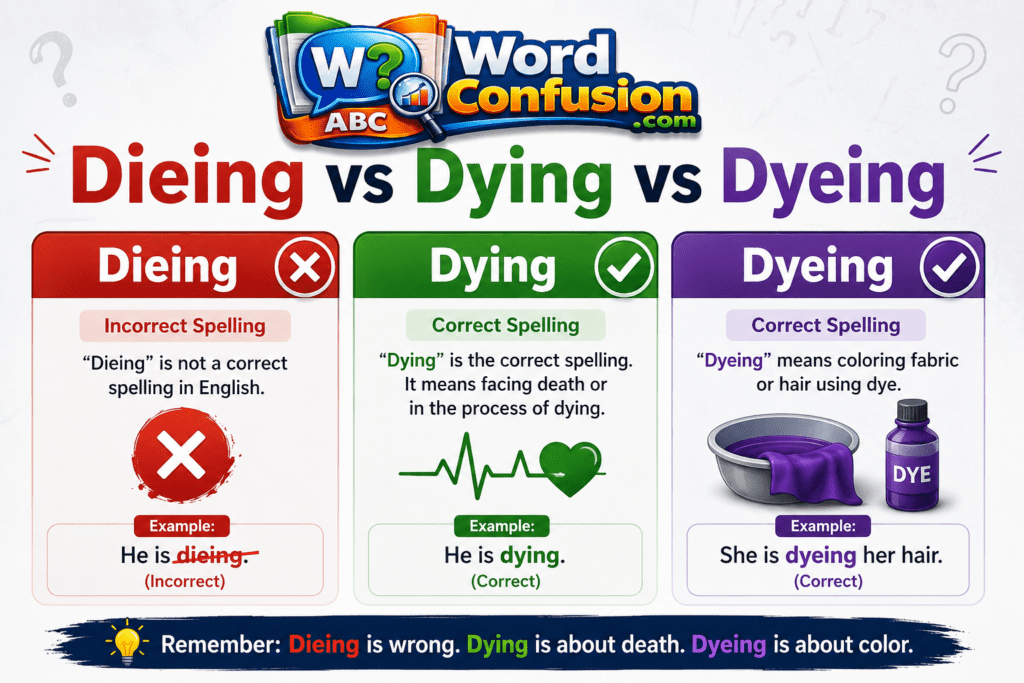
Another common confusion involves dyeing.
These three words look similar but have different meanings.
Comparison Table
| Word | Meaning | Example |
| Dying | Approaching death or ending | The flowers are dying. |
| Dieing | Working with a manufacturing die | The metal is dieing. |
| Dyeing | Coloring fabric, hair, or materials | She is dyeing her hair. |
How to Avoid Confusing Them
Remember:
- Dying = death or ending
- Dyeing = adding color
- Dieing = rare manufacturing term
Examples
She is dyeing her hair blue.
The battery is dying.
The machine is dieing steel components.
Common Mistakes With Dieing and Dying
Many writers accidentally choose the wrong spelling.
Writing Errors
Incorrect
- My phone is dieing.
- The flowers are dieing.
- He is dieing of laughter.
Correct
- My phone is dying.
- The flowers are dying.
- He is dying of laughter.
Why the Mistake Happens
People often assume:
die + ing = dieing
That seems logical, but English applies the ie → y spelling rule.
As a result:
die → dying
not
die → dieing
How to Remember the Correct Spelling
Memory Trick #1
Think of:
die → dying
the same way you think of:
lie → lying
If you know “lying” is correct, you’ll remember that “dying” follows the same pattern.
Memory Trick #2
Ask yourself:
Am I talking about death, ending, or stopping?
If yes, the correct spelling is almost certainly dying.
Common Expressions Using Dying
Dying to Know
Meaning: Extremely eager to learn something.
Example:
- I’m dying to know what happened.
Dying for Something
Meaning: Wanting something very badly.
Example:
- I’m dying for a cold drink.
Dying of Laughter
Meaning: Laughing extremely hard.
Example:
- Everyone was dying of laughter after the joke.
These expressions are common in spoken and written English.
When Should You Use Dying?
Everyday English
Use dying whenever you refer to:
- People
- Animals
- Plants
- Batteries
- Traditions
- Businesses
- Fires
Examples:
- The tree is dying.
- My laptop battery is dying.
- That tradition is dying out.
Formal Writing
In academic, journalistic, and professional writing, dying remains the correct form.
Examples:
- The species is dying out rapidly.
- The patient was dying from complications.
Creative Writing
Writers often use dying literally and figuratively.
Example:
- The kingdom was dying from years of war.
- She was dying to hear the secret.
Quick Grammar Checklist for Writers
Before publishing, check the following:
Are you talking about death or something ending?
Did you write dying instead of dieing?
Are you confusing dying with dyeing?
Did you follow the ie → y + ing rule?
If the answer is yes, your spelling is probably correct.
Common Mistakes and Corrections
| Mistake | Correction |
| dieing plant | dying plant |
| dieing battery | dying battery |
| dieing out | dying out |
| dieing of laughter | dying of laughter |
| dieing species | dying species |
Frequently Asked Questions
Is it dieing or dying?
Dying is the correct spelling when referring to death, ending, or ceasing to exist. Dieing is usually a spelling mistake.
Why is dying spelled with y?
English changes verbs ending in -ie to -y before adding -ing. Therefore, die becomes dying.
Is dieing a real word?
Yes, but only in rare manufacturing contexts involving a die. It is not the correct form of the verb die.
What is the present participle of die?
The present participle of die is dying.
What is the difference between dying and dyeing?
Dying relates to death or ending, while dyeing means coloring hair, fabric, or other materials.
How do you spell dying correctly?
The correct spelling is:
D-Y-I-N-G
Why does die become dying?
English follows a spelling rule that changes ie to y before adding -ing.
Can dieing ever be correct?
Yes, but only in specialized manufacturing contexts. In nearly all everyday situations, dying is the correct choice.
Final Verdict: Dieing vs Dying
If you’re talking about death, the end of life, something stopping, fading away, or disappearing, dying is the correct spelling.
The confusion occurs because English changes die to dying by replacing ie with y before adding -ing. This is the same pattern seen in lie → lying and tie → tying.
While dieing does exist as a rare manufacturing term, it is not the word most writers need. For everyday English, professional communication, academic writing, and creative content, dying is almost always the correct choice.
When in doubt, remember this simple rule:
If it relates to death or something ending, use “dying,” not “dieing.”
If you’re learning English vocabulary and commonly confused words, you may also enjoy our guides on Less Than and Greater Than, Breakroom or Break Room, and At Least vs Atleast. Understanding these distinctions will make your writing clearer, more accurate, and more professional.
Written by
 Abdul Moeed
Abdul Moeed is a professional content writer and SEO link-building specialist with 5+ years of experience. He creates search-optimized content and develops effective SEO strategies that improve website visibility, authority, and organic growth.
View LinkedIn profileLatest posts
 What Does PG Mean in Text? Meaning, Examples & Usage
 What Does OFCC Mean in Text? Meaning, Uses & Examples
 What Does MSG Mean in Text? Meaning, Examples & Usage
 What Does STY Mean in Text? Meaning, Examples & Usage
 What Does “Twin” Mean in Slang? Meaning, Text & Examples
 What Does LMC Mean in Text? Meaning, Examples & Usage