Combatting or Combating: Which Spelling Is Correct?

Introduction
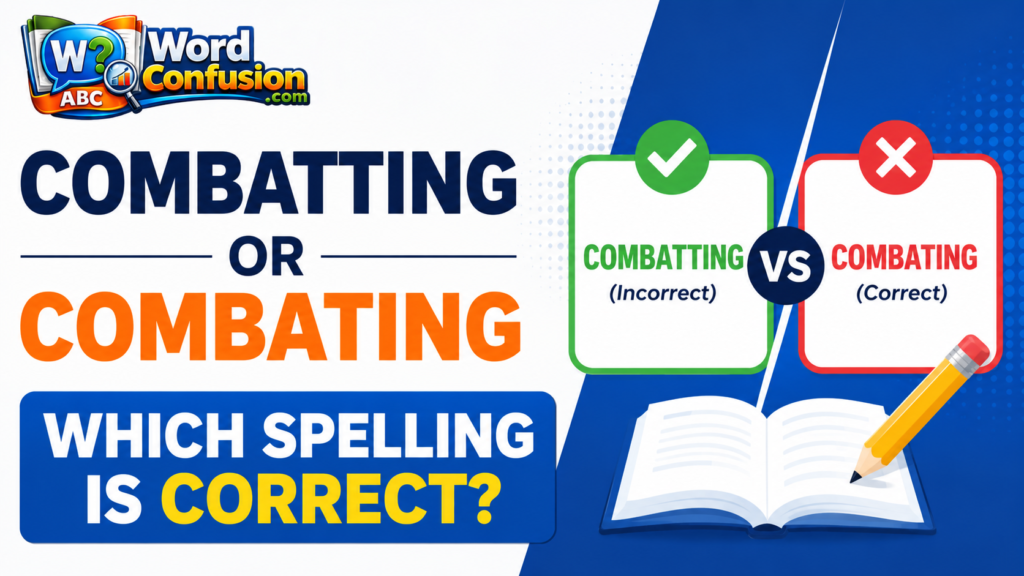
If you’ve ever stopped mid-sentence and wondered whether to write “combatting” or “combating,” you’re not alone. Both forms appear in books, articles, and online writing, which creates confusion for students, writers, and even native speakers. The good news is that both spellings are used in English, but they follow different usage patterns based on spelling conventions and grammar rules.
Quick Answer: Combatting or Combating?
Both “combatting” and “combating” are correct, but:
- Combating → more common in American English
- Combatting → sometimes used in British English, especially when applying consonant-doubling rules
👉 In modern writing, “combating” is generally preferred worldwide for simplicity and consistency.
Featured Snippet Answer
“Combating” and “combatting” are both acceptable spellings of the verb “combat” in -ing form. “Combating” is more widely used in American English, while “combatting” follows British English conventions where consonants may be doubled before adding “-ing” to preserve pronunciation clarity.
What Does Combating / Combatting Mean?
Both forms come from the verb “combat,” which means:
- To fight against something
- To oppose or struggle against a problem
Examples of meaning:
- combating disease → fighting disease
- combating crime → opposing crime
- combatting corruption → working against corruption
So, the meaning does not change—the spelling is the only difference.
Why Are There Two Spellings?
The confusion exists because English spelling rules vary between regions and grammar traditions.
Two main influences are:
- American English simplification trends
- British English spelling preservation rules
Some British-style writing retains the double consonant (combatting) to reflect pronunciation and syllable stress, while American English tends to simplify to combating.
English Spelling Rule: -ing and Consonant Doubling
To understand this difference, you need to know a basic grammar rule:
📌 The Rule
When adding -ing to a verb:
- If a verb ends in a single vowel + consonant, the consonant is often doubled
- But only if the stress is on the final syllable
Example pattern:
- run → running
- sit → sitting
- begin → beginning
Now apply it:
- combat → combating / combatting
Because “combat” is two syllables, English allows variation:
- US English: usually no doubling → combating
- Some UK English usage: may double → combatting
British vs American English Usage
| Form | Region | Usage Frequency | Notes |
| combating | American English | Very common | Standard global form |
| combatting | British English | Less common | Style-dependent |
👉 Important: Even in British English, “combating” is widely accepted.
Dictionary and Style Guide Insights

Most modern dictionaries and writing guides prefer:
- Combating as the primary entry
- Combatting as a variant spelling
Style guides (especially academic and digital publishing standards) often recommend consistency over preference, meaning:
Choose one form and use it consistently throughout your writing.
Common Mistakes Writers Make
Here are frequent errors people make with this word:
❌ Mistake 1: Assuming one is wrong
Both are correct, so neither should be treated as “incorrect.”
❌ Mistake 2: Mixing both forms in one article
Example:
- “Combating climate change is important, but combatting pollution is harder.” ❌ inconsistent
❌ Mistake 3: Over-applying doubling rules
Not all verbs ending in consonants double before -ing.
Examples in Everyday Sentences
Here are correct uses of both forms:
Using “combating”
- Governments are combating climate change through new policies.
- The organization focuses on combating poverty in rural areas.
- Scientists are combating infectious diseases worldwide.
Using “combatting”
- The charity is combatting illiteracy in remote regions.
- Authorities are combatting corruption in public institutions.
- The team is combatting misinformation online.
Usage Trends (Modern English – 2026 Insight)
Modern usage data shows:
- Combating dominates global writing
- Digital publishing, SEO writing, and journalism strongly prefer “combating”
- “Combatting” appears mainly in older British-style publications or stylistic preferences
👉 Conclusion: Combating is the modern standard form.
How to Choose Which Form to Use
Use this simple decision rule:
✔ Use “combating” if:
- Writing for global audience
- Writing SEO content
- Writing academic or business content
- Unsure which style guide to follow
✔ Use “combatting” if:
- Following a strict British style guide that requires it
- Matching an existing document that already uses it
👉 Otherwise, stick with “combating.”
Common Spelling Rule Explained (Simple Version)
Think of it like this:
English sometimes doubles consonants for pronunciation clarity, but modern usage often simplifies spelling for efficiency.
So:
- Traditional style → combatting
- Modern global style → combating
FAQs
Is it spelled combating or combatting?
Both are correct, but “combating” is more commonly used in modern English.
Why does combatting have two t’s?
It follows a spelling pattern where some British English forms double consonants before adding -ing.
Is combating American or British English?
“Combating” is mainly American English but is now widely used globally.
What is the meaning of combatting?
It means fighting against or dealing with something harmful or difficult.
Which spelling should I use in writing?
Use “combating” for most modern, global, and SEO writing contexts.
Conclusion
Both “combatting” and “combating” are correct, but modern English strongly favors “combating” due to simplicity and global usage. The difference comes from spelling traditions between British and American English, not meaning.
If you want clarity, consistency, and modern acceptance in writing, “combating” is the safer choice.
If you’re learning English vocabulary and commonly confused words, you may also enjoy our guides on Goomar Mean, Ninth vs Nineth, and PMO Meaning . Understanding these distinctions will make your writing clearer, more accurate, and more professional.
Written by
 Abdul Moeed
Abdul Moeed is a professional content writer and SEO link-building specialist with 5+ years of experience. He creates search-optimized content and develops effective SEO strategies that improve website visibility, authority, and organic growth.
View LinkedIn profileLatest posts
 What Does PG Mean in Text? Meaning, Examples & Usage
 What Does OFCC Mean in Text? Meaning, Uses & Examples
 What Does MSG Mean in Text? Meaning, Examples & Usage
 What Does STY Mean in Text? Meaning, Examples & Usage
 What Does “Twin” Mean in Slang? Meaning, Text & Examples
 What Does LMC Mean in Text? Meaning, Examples & Usage