Less Than and Greater Than Symbols Explained & Examples

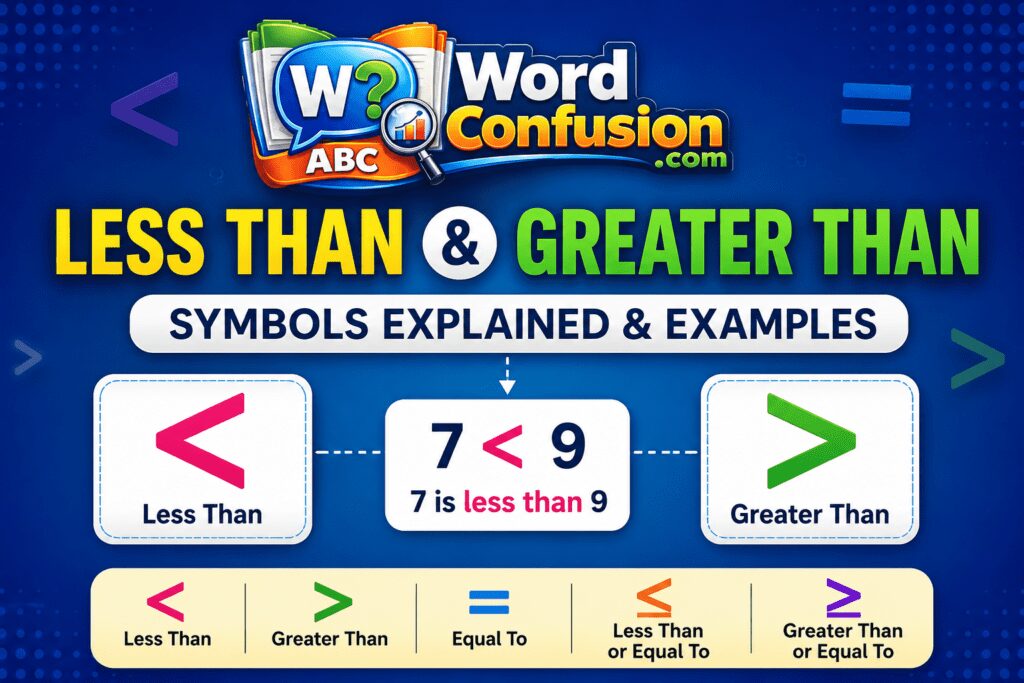
Learning the difference between less than and greater than is one of the first steps in understanding mathematical comparisons. These symbols help us compare numbers, quantities, percentages, fractions, decimals, and even values used in algebra and programming.
If you’ve ever wondered which symbol means “bigger” or “smaller,” or how to remember them easily, this guide will explain everything in a simple and beginner-friendly way.
Quick Answer
The less than symbol (<) means one value is smaller than another value, while the greater than symbol (>) means one value is larger than another value.
Examples:
- 3 < 5 → 3 is less than 5
- 10 > 7 → 10 is greater than 7
- 0.25 < 0.5 → 0.25 is less than 0.5
The open side of the symbol always faces the larger number.
Featured Snippet Answer
Less than (<) and greater than (>) are mathematical comparison symbols used to compare values. The less than sign indicates that one number is smaller than another, while the greater than sign indicates that one number is larger. For example, 4 < 9 means 4 is less than 9, and 12 > 8 means 12 is greater than 8.
What Do Less Than and Greater Than Mean?
Mathematics often requires comparing two numbers to determine which is larger or smaller. This is where comparison symbols become useful.
Less Than Symbol Definition (<)
The less than symbol (<) shows that the number on the left is smaller than the number on the right.
Examples:
- 2 < 6
- 14 < 20
- 50 < 100
In each example, the left number is smaller than the right number.
Greater Than Symbol Definition (>)
The greater than symbol (>) shows that the number on the left is larger than the number on the right.
Examples:
- 8 > 3
- 25 > 12
- 150 > 75
In each case, the left number is larger than the right number.
Quick Comparison Examples
| Expression | Meaning |
| 4 < 9 | 4 is less than 9 |
| 12 > 7 | 12 is greater than 7 |
| 100 > 50 | 100 is greater than 50 |
| 1 < 3 | 1 is less than 3 |
Less Than vs Greater Than: Key Differences
Although these symbols look similar, they represent opposite relationships.
Comparison Table
| Symbol | Name | Meaning | Example |
| < | Less Than | Smaller than | 3 < 8 |
| > | Greater Than | Larger than | 8 > 3 |
When to Use Each Symbol
Use < when:
- The first number is smaller.
- Comparing lower values.
- Showing a smaller quantity.
Use > when:
- The first number is larger.
- Comparing higher values.
- Showing a greater quantity.
Examples:
- 6 < 9
- 15 > 10
- 25% < 40%
Less Than and Greater Than Symbols Chart
The less than and greater than signs belong to a larger family of mathematical comparison symbols.
Symbol Meanings
| Symbol | Meaning |
| < | Less Than |
| > | Greater Than |
| = | Equal To |
| ≠ | Not Equal To |
| ≤ | Less Than or Equal To |
| ≥ | Greater Than or Equal To |
Less Than or Equal To and Greater Than or Equal To
Sometimes values can be equal as well as larger or smaller.
Examples:
- x ≤ 10 means x is less than or equal to 10.
- x ≥ 5 means x is greater than or equal to 5.
These are known as inequality symbols.
How to Use Less Than and Greater Than Correctly
Comparing Whole Numbers
Whole numbers are the easiest to compare.
Examples:
- 7 < 10
- 22 > 18
- 105 > 99
Simply identify which number is larger.
Comparing Decimals
Look at each decimal place from left to right.
Examples:
- 0.7 > 0.5
- 0.25 < 0.50
- 1.75 > 1.25
Comparing Fractions
Convert fractions to decimals or find common denominators.
Examples:
- 1/2 > 1/4
- 3/8 < 1/2
- 5/6 > 2/3
Comparing Percentages
Percentages represent parts out of 100.
Examples:
- 20% < 35%
- 90% > 75%
- 50% = 50%
Comparing Negative Numbers
Negative numbers often confuse beginners.
Remember:
The number closer to zero is greater.
Examples:
- -3 > -8
- -1 > -10
- -15 < -5
Easy Tricks to Remember Less Than and Greater Than
Many students struggle to remember which symbol is which. These memory tricks can help.
Alligator Mouth Trick
Imagine the symbol is an alligator’s mouth.
The alligator always wants to eat the bigger number.
Examples:
- 8 > 3 → The mouth opens toward 8.
- 12 > 4 → The mouth opens toward 12.
L Shape Method
The less than symbol resembles the letter “L.”
Think:
- L = Less
- < = Less Than
This simple visual cue works well for many learners.
Number Line Trick
On a number line:
- Numbers increase as you move right.
- Numbers decrease as you move left.
This helps you quickly determine which number is greater.
Open Side Faces the Larger Number
The easiest rule:
The open side always points toward the larger number.
Example:
5 < 9
The open side faces 9 because 9 is larger.
Step-by-Step Process for Comparing Numbers
Step 1: Compare Digits
Look at the size of each number.
Example:
12 and 20
Since 20 is larger:
12 < 20
Step 2: Check Place Value
Compare thousands, hundreds, tens, and ones.
Example:
245 and 254
Hundreds are equal.
Compare tens:
4 < 5
Therefore:
245 < 254
Step 3: Choose the Correct Symbol
Insert:
- < if smaller
- if larger
- = if equal
Example:
50 __ 80
Answer:
50 < 80
Less Than and Greater Than Examples With Answers
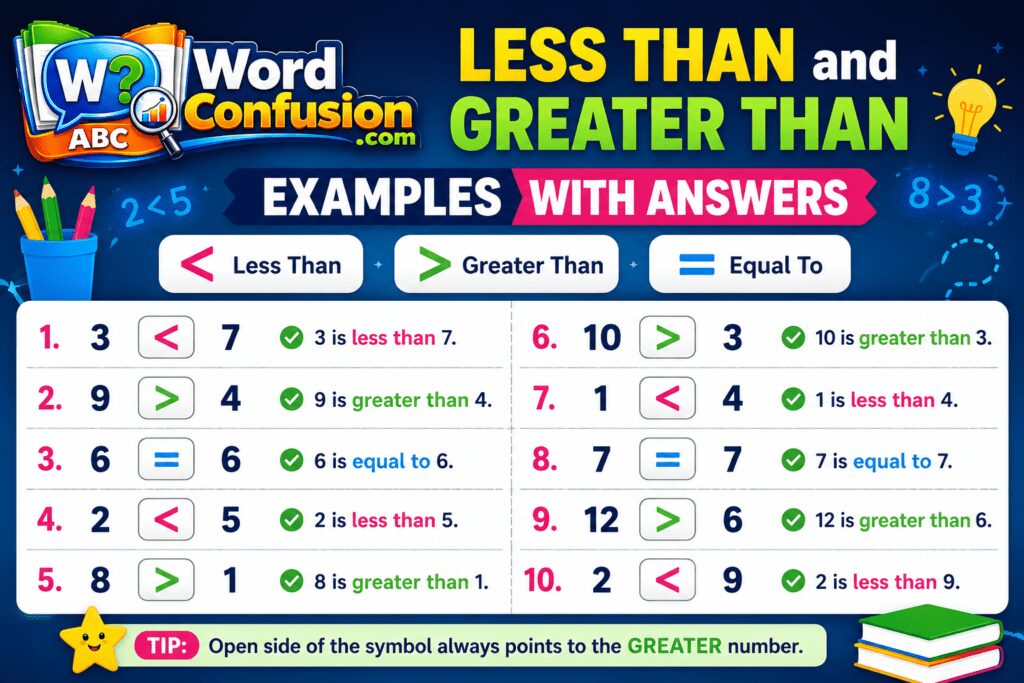
Beginner Examples
- 2 __ 5 = <
- 8 __ 3 = >
- 10 __ 12 = <
- 20 __ 15 = >
- 4 __ 9 = <
Intermediate Examples
- 0.4 __ 0.8 = <
- 75% __ 50% = >
- 3/4 __ 1/2 = >
- -2 __ -6 = >
- 125 __ 215 = <
Practice Questions
Try solving these yourself:
- 16 __ 18
- 0.9 __ 0.7
- -4 __ -9
- 40% __ 55%
- 5/8 __ 3/8
Answer Key
- 16 < 18
- 0.9 > 0.7
- -4 > -9
- 40% < 55%
- 5/8 > 3/8
Real-Life Uses of Less Than and Greater Than
These symbols are not limited to classrooms.
Shopping Prices
Example:
- $25 < $40
This means the first item costs less.
Exam Scores
Example:
- 92 > 85
The first score is higher.
Sports Statistics
Example:
- Team A scored 5 goals.
- Team B scored 3 goals.
Therefore:
5 > 3
Budgeting and Finance
Example:
Income > Expenses
This generally means you’re saving money rather than losing it.
Less Than and Greater Than in Algebra
Basic Inequalities
Algebra often uses comparison symbols.
Examples:
- x > 10
- y < 5
- a ≥ 7
These statements describe ranges of possible values.
Graphing Inequalities
Inequalities can be represented on a number line.
Example:
x > 4
A circle is placed at 4, and the line extends to the right.
Solving Simple Inequality Problems
Example:
x + 3 > 10
Subtract 3 from both sides:
x > 7
The solution includes all numbers greater than 7.
Less Than and Greater Than in Programming
Comparison operators are used in many programming languages.
Common Comparison Operators
| Operator | Meaning |
| < | Less Than |
| > | Greater Than |
| <= | Less Than or Equal To |
| >= | Greater Than or Equal To |
| == | Equal To |
Coding Example
age = 18
if age > 16:
print(“Eligible”)
The condition checks whether age is greater than 16.
Programming languages use these operators to make decisions and control program behavior.
Common Mistakes and How to Avoid Them
Reversing Symbols
Incorrect:
8 < 3
Correct:
8 > 3
Ignoring Decimal Places
Incorrect:
0.15 > 0.5
Correct:
0.15 < 0.5
Comparing Negative Numbers Incorrectly
Incorrect:
-10 > -2
Correct:
-10 < -2
Confusing ≤ With <
Remember:
- < means strictly less than.
- ≤ means less than or equal to.
Pro Tips for Remembering Comparison Symbols
Use a Number Line
Visualizing numbers makes comparisons easier.
Focus on the Open Side
The wider opening always faces the larger number.
Practice Daily
A few comparison exercises each day improve speed and accuracy.
Learn the Symbol Family Together
Study:
- <
- ≤
- ≥
- =
Understanding them together reduces confusion.
Frequently Asked Questions
What does less than mean?
Less than means one value is smaller than another value. It is represented by the symbol <.
What does greater than mean?
Greater than means one value is larger than another value. It is represented by the symbol >.
How do you use less than and greater than symbols?
Place the symbol between two values to compare them. Use < when the left value is smaller and > when the left value is larger.
What is the easiest way to remember the symbols?
Remember that the open side of the symbol always faces the larger number.
What are inequality symbols?
Inequality symbols show that values are not equal. Examples include <, >, ≤, and ≥.
Is 0.5 greater than 0.05?
Yes. Since five tenths is larger than five hundredths, 0.5 > 0.05.
How do you compare fractions?
You can compare fractions by finding common denominators or converting them into decimals.
What does less than or equal to mean?
It means a value can be smaller than another value or exactly equal to it.
What does greater than or equal to mean?
It means a value can be larger than another value or exactly equal to it.
Why are less than and greater than symbols important?
They help compare numbers, solve math problems, analyze data, write algebraic inequalities, and create logical conditions in programming.
Final Thoughts
Understanding less than and greater than is essential for comparing numbers accurately. The less than symbol (<) shows that one value is smaller, while the greater than symbol (>) shows that one value is larger. By learning simple memory tricks, practicing comparisons, and understanding related inequality symbols, you can confidently use these mathematical comparison signs in school, everyday life, algebra, and programming.
The easiest rule to remember is this: the open side of the symbol always faces the larger number.
If you’re learning English vocabulary and commonly confused words, you may also enjoy our guides on Breakroom or Break Room, At Least vs Atleast, and IICYIFY Meaning in Text. Understanding these distinctions will make your writing clearer, more accurate, and more professional.
Written by
 Abdul Moeed
Abdul Moeed is a professional content writer and SEO link-building specialist with 5+ years of experience. He creates search-optimized content and develops effective SEO strategies that improve website visibility, authority, and organic growth.
View LinkedIn profileLatest posts
 What Does PG Mean in Text? Meaning, Examples & Usage
 What Does OFCC Mean in Text? Meaning, Uses & Examples
 What Does MSG Mean in Text? Meaning, Examples & Usage
 What Does STY Mean in Text? Meaning, Examples & Usage
 What Does “Twin” Mean in Slang? Meaning, Text & Examples
 What Does LMC Mean in Text? Meaning, Examples & Usage