Investor vs Investee: Meaning, Differences, Roles, and Examples
 Abdul Moeed
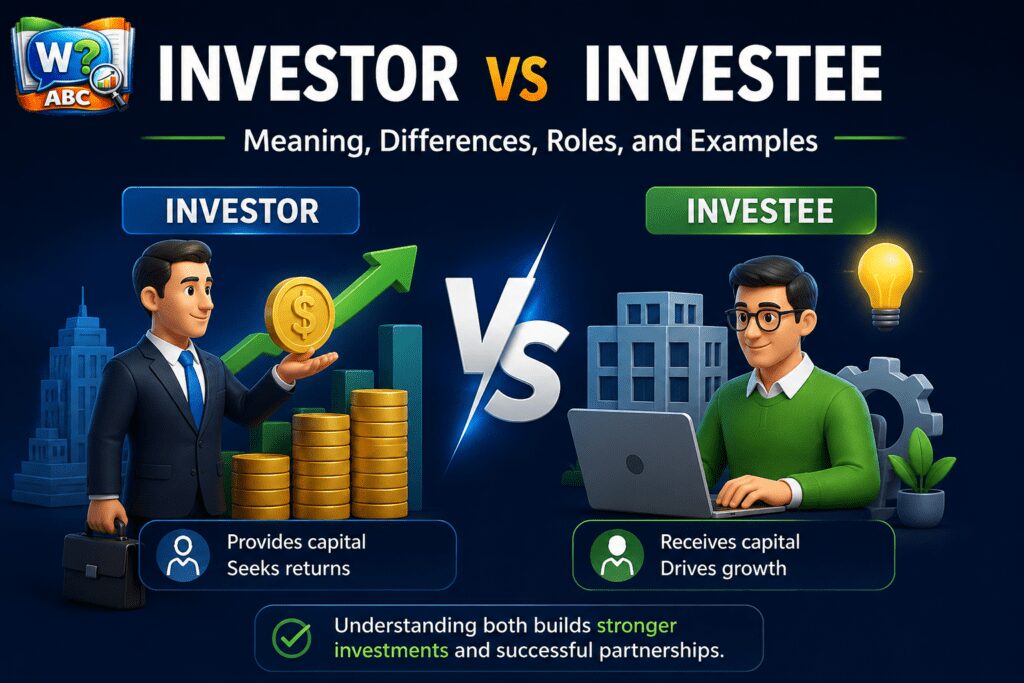
When discussing business funding, startups, or financial investments, the terms investor and investee often appear together. Because they are closely related, many people mistakenly use them interchangeably. However, they refer to two completely different roles in an investment relationship.
An investor provides money or resources with the expectation of earning a return, while an investee is the person, company, or organization that receives that investment.
Understanding the distinction is important for business owners, startup founders, students, and anyone learning investment terminology.
Quick Answer: Investor vs Investee
The difference between an investor and an investee is simple:
- Investor: The individual or organization providing funds.
- Investee: The business, startup, or entity receiving those funds.
In short, the investor supplies capital, and the investee receives it to support growth, operations, or development.
Featured Snippet Answer
An investor is a person, company, or institution that puts money into a business, project, or asset to earn future returns. An investee is the company or organization receiving that investment. The investor provides capital, while the investee uses the funds to grow, operate, or achieve specific business goals.
What Does Investor Mean?
Investor Definition
An investor is a person, company, or financial institution that commits money to an asset, business, startup, or project expecting future profits, income, or capital appreciation.
Investors may invest in:
- Startups
- Public companies
- Real estate
- Mutual funds
- Bonds
- Private businesses
Real-Life Examples of Investors
- An angel investor funding a new startup.
- A venture capital firm investing in a technology company.
- An individual buying shares of a public corporation.
- A corporation investing in another business.
Example Sentence
“The investor provided $500,000 to help the startup expand its operations.”
What Does Investee Mean?
Investee Definition
An investee is the company, organization, project, or entity that receives investment from an investor.
The investee uses the funds for purposes such as:
- Business expansion
- Product development
- Hiring employees
- Marketing
- Research and development
Examples of Investees
- A startup receiving seed funding.
- A company receiving venture capital.
- A growing business accepting private equity investment.
- A corporation receiving strategic funding from another company.
Example Sentence
“The startup became the investee after securing funding from several angel investors.”
Investor vs Investee Comparison Table
| Feature | Investor | Investee |
| Definition | Provides money or capital | Receives money or capital |
| Primary Goal | Earn returns | Obtain funding |
| Role | Capital provider | Capital recipient |
| Ownership Interest | May receive ownership | May give ownership |
| Risk | Risk of losing investment | Risk of failing to meet expectations |
| Examples | Angel investor, VC firm, shareholder | Startup, growing business, corporation |
Key Differences Between Investor and Investee
Purpose
An investor seeks financial returns, while an investee seeks funding for growth or operations.
Financial Role
The investor contributes capital. The investee uses that capital to achieve business objectives.
Ownership Position
Many investments provide investors with an ownership stake in the investee company.
For example:
- Investor provides $1 million.
- Investee grants 10% equity ownership.
Risk and Reward
Investors risk losing their money if the investment fails.
Investees risk losing control, missing growth targets, or facing pressure from investors.
Understanding the Investor-Investee Relationship
The investor-investee relationship is one of the most important relationships in business finance.
How the Relationship Works
- The investor identifies an opportunity.
- The investor provides capital.
- The investee uses the funding.
- The business grows.
- The investor receives returns if the investment succeeds.
Why Both Sides Need Each Other
Investors need opportunities that can generate returns.
Investees need funding to achieve growth.
Without investors, many businesses would struggle to scale. Without investees, investors would have no opportunities to grow their capital.
Investor vs Investee in Startup Funding
Startup funding provides one of the easiest ways to understand these terms.
Angel Investors
Angel investors use their own money to fund early-stage startups.
Example:
Sarah invests $50,000 into a new software company.
- Sarah = Investor
- Software company = Investee
Venture Capital Investors
Venture capital firms invest larger amounts into startups with high growth potential.
Example:
A venture capital firm invests $5 million into a fintech startup.
- Venture capital firm = Investor
- Fintech startup = Investee
Startup as the Investee
Startups often act as investees because they require funding to:
- Build products
- Hire employees
- Expand operations
- Enter new markets
Investor vs Investee in Accounting
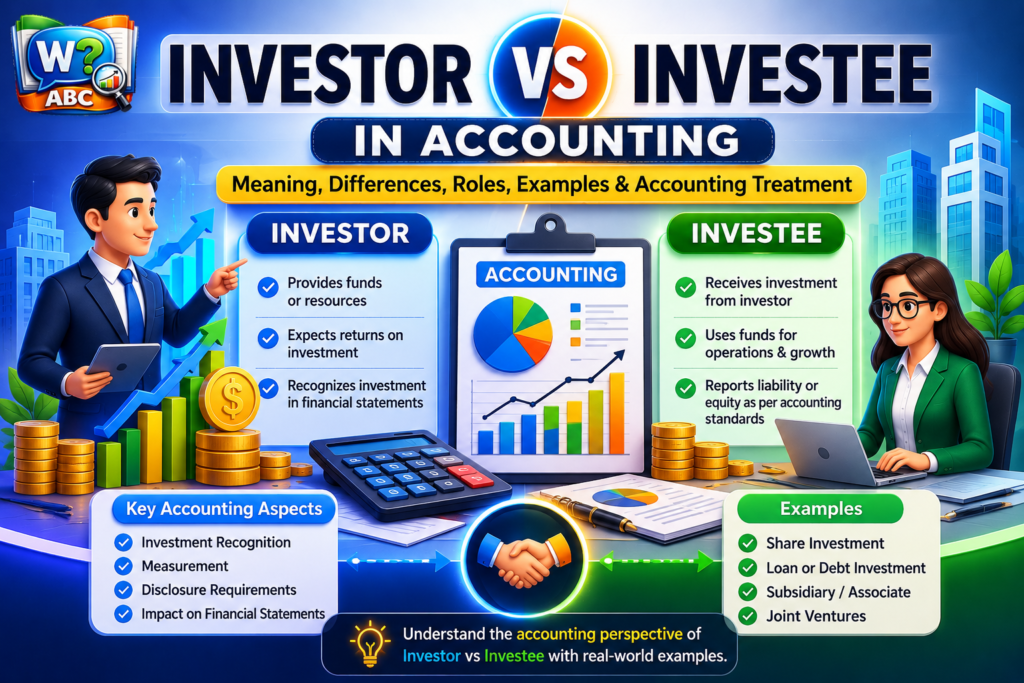
Accounting standards frequently use the terms investor and investee.
Minority Ownership
If an investor owns a small percentage of a company, the investment is often recorded as a financial asset.
Significant Influence
When ownership becomes substantial, the investor may gain significant influence over the investee’s decisions.
Parent-Subsidiary Relationships
If ownership exceeds a controlling threshold, the investor may become the parent company and the investee may become a subsidiary.
This accounting treatment affects:
- Financial reporting
- Consolidated statements
- Ownership disclosures
Investor vs Shareholder: Are They the Same?
Many people confuse investors and shareholders.
Key Similarities
Both can:
- Own part of a company
- Seek financial returns
- Benefit from company growth
Important Differences
| Investor | Shareholder |
| Broad term | Specific term |
| May invest in many asset types | Owns company shares |
| Can invest before shares exist | Must hold shares |
Every shareholder is an investor, but not every investor is necessarily a shareholder.
Can a Company Be Both an Investor and an Investee?
Yes.
A company can simultaneously act as both.
Real Business Example
Company A receives investment from a private equity firm.
At the same time, Company A invests in a smaller startup.
In this situation:
- Company A is an investee when receiving funding.
- Company A is an investor when funding another business.
Corporate Investment Chains
Large corporations often participate in complex investment structures where they both receive and make investments.
This creates multiple investor-investee relationships throughout the business ecosystem.
Common Mistakes When Using Investor and Investee
Mistake #1: Using the Terms Interchangeably
Incorrect:
“The investee provided funding to the investor.”
Correct:
“The investor provided funding to the investee.”
Mistake #2: Assuming an Investee Is Always a Startup
An investee can be:
- A startup
- A corporation
- A partnership
- A nonprofit organization
- A real estate project
Mistake #3: Confusing Investee with Shareholder
A shareholder owns shares.
An investee receives investment.
These are entirely different concepts.
Easy Memory Trick to Remember the Difference
Investor Gives
Think of the ending -or.
An investor is the person who performs the action of investing.
Investee Receives
Think of the ending -ee.
In English, words ending in -ee often refer to the receiver of an action.
Examples:
- Employer → Employee
- Trainer → Trainee
- Lessor → Lessee
- Investor → Investee
This pattern makes the distinction much easier to remember.
Pro Tips for Using These Terms Correctly
Tip 1
Ask:
Who is providing the money?
That party is the investor.
Tip 2
Ask:
Who is receiving the money?
That party is the investee.
Tip 3
Remember the language pattern:
- Investor = Gives capital
- Investee = Receives capital
Tip 4
In startup discussions, founders usually represent the investee company, while venture capital firms and angel investors represent investors.
Frequently Asked Questions
What is the difference between investor and investee?
An investor provides funds to earn future returns, while an investee receives those funds to support growth, operations, or business activities.
Who is considered an investor?
An investor can be an individual, corporation, investment fund, venture capital firm, or institution that commits capital expecting financial returns.
Who is called an investee?
An investee is the company, organization, project, or entity receiving investment from an investor.
Can a company be both an investor and an investee?
Yes. Many companies receive funding from one source while investing in other businesses simultaneously.
Is an investee the same as a shareholder?
No. An investee receives investment, whereas a shareholder owns shares in a company.
How do investors make money?
Investors may earn money through dividends, interest, profit-sharing, capital gains, or increased company value.
What is an investor-investee relationship?
It is the financial relationship between a capital provider (investor) and a capital recipient (investee).
Why are investors important for startups?
Investors provide the funding startups need to develop products, hire employees, expand operations, and achieve growth.
Final Thoughts
The distinction between investor and investee is straightforward once you understand the direction of the investment. The investor supplies money with the goal of earning returns, while the investee receives that money to grow, operate, or achieve specific objectives.
Whether you’re studying finance, exploring startup funding, reviewing investment agreements, or improving your business vocabulary, knowing the difference between these two terms will help you communicate more accurately and confidently.
If you’re learning English vocabulary and commonly confused words, you may also enjoy our guides on Platform vs Flatform, Encode vs Incode, and Dought vs Doubt. Understanding these distinctions will make your writing clearer, more accurate, and more professional.