What Does T-Minus Mean? Definition, Examples & T-0 Explained
 Abdul Moeed
T-minus means the amount of time remaining before a planned event occurs. For example, T-minus 10 minutes means an event will happen in 10 minutes. The T represents the target or reference time, while the minus sign indicates that the event has not happened yet.
The expression is best known from rocket and space-launch countdowns, but today it is also used for deadlines, product launches, events, travel, and everyday conversations. For more simple explanations of English vocabulary and everyday expressions, explore WordConfusion.T-0 marks the target moment, while T-plus describes time after that event.
What Does T-Minus Mean?
T-minus refers to the amount of time remaining before a scheduled or planned event occurs.
For example:
- T-minus 10 minutes = 10 minutes before the event
- T-minus 1 day = 1 day before the event
- T-minus 30 seconds = 30 seconds before the event
The expression is commonly associated with countdowns, especially rocket launches, but it can also be used informally for upcoming events, deadlines, and launches.
What Does the T in T-Minus Mean?
In countdown notation, T represents the target or reference time of the event. The number following T-minus shows how much time remains before that reference point.
For example:
- T-minus 10 minutes = 10 minutes remain
- T-minus 1 hour = 1 hour remains
- T-0 = the target or reference moment
- T-plus 10 minutes = 10 minutes have passed after the reference point
Why Is T Used?
A countdown needs a fixed point from which time can be measured. T provides that reference point, while the number and plus or minus sign show the timing in relation to the event.
Before the event, you may see:
- T-minus 60 minutes
- T-minus 30 minutes
- T-minus 10 seconds
After the event, you may see:
- T-plus 5 minutes
- T-plus 30 minutes
- T-plus 1 hour
This makes it easy to describe when something happens without repeatedly stating the exact clock time.
T Minus Meaning in a Countdown
A countdown tracks the remaining time until an event occurs.
T-minus serves as the standard way of expressing that remaining time.
How Countdown Systems Work
Imagine a rocket launch scheduled for noon.
At 11:50 AM:
T-10 minutes
At 11:59 AM:
T-1 minute
At noon:
T-0
The countdown reaches zero when the event occurs.
Understanding T-0
T-0 (T Zero) is the exact moment an event happens.
T-0 represents liftoff during a rocket launch.
In product releases, it marks the launch moment.
For conferences, it indicates the official start time.
The Origin of T Minus
The phrase T-minus did not begin as casual slang.
Its roots are found in military operations and aerospace engineering.
Military Origins
Before becoming associated with rockets, countdown systems were used in military planning and coordinated operations.
Military teams often needed precise timing to synchronize activities.
Using a reference time allowed everyone involved to follow the same schedule.
Aerospace Development
As rocket technology advanced during the mid-20th century, engineers adopted countdown systems to manage launch preparations.
Hundreds of tasks had to be completed before liftoff.
Using T-minus made it easier to coordinate those activities.
NASA Adoption
NASA popularized the phrase through televised rocket launches.
people became familiar with the term. As audiences watched missions launch into space, they frequently heard announcements like:
- T-minus 60 seconds
- T-minus 30 seconds
- T-minus 10 seconds
Over time, the phrase entered everyday language.
T-Minus Meaning in NASA and Space Launches
The phrase T-minus is strongly associated with rocket launches and space missions. NASA and other space programs use countdown terminology to coordinate activities leading up to a scheduled launch.
During a launch countdown, T-minus shows how much time remains before the planned launch time.
For example:
- T-minus 1 hour = one hour remains before launch
- T-minus 10 minutes = 10 minutes remain before launch
- T-minus 1 minute = one minute remains before launch
- T-0 = the scheduled launch time
How T-Minus Works During a Launch
A space launch involves many tasks that must happen at specific times. Countdown notation gives mission teams a common reference point for coordinating those activities.
A simplified countdown might look like this:
| Countdown | Meaning |
|---|---|
| T-minus 2 hours | Two hours remain before the scheduled launch |
| T-minus 30 minutes | 30 minutes remain |
| T-minus 10 minutes | 10 minutes remain |
| T-minus 1 minute | One minute remains |
| T-0 | The target launch time |
The countdown can continue through seconds as the launch approaches:
T-10 → T-9 → T-8 → T-7 → … → T-1 → T-0
At T-0, the countdown reaches the target time.
Did NASA Invent T-Minus?
Not necessarily. The terminology has roots in earlier military and aerospace countdown practices. However, NASA space launches and televised mission coverage helped make T-minus familiar to the general public.
That is why many people immediately associate expressions such as “T-minus 10 seconds” with rocket launches.
Today, the same basic countdown idea is also used outside aerospace for events, deadlines, product launches, and other situations where people want to emphasize the time remaining.
T-Minus vs T-Plus: What’s the Difference?
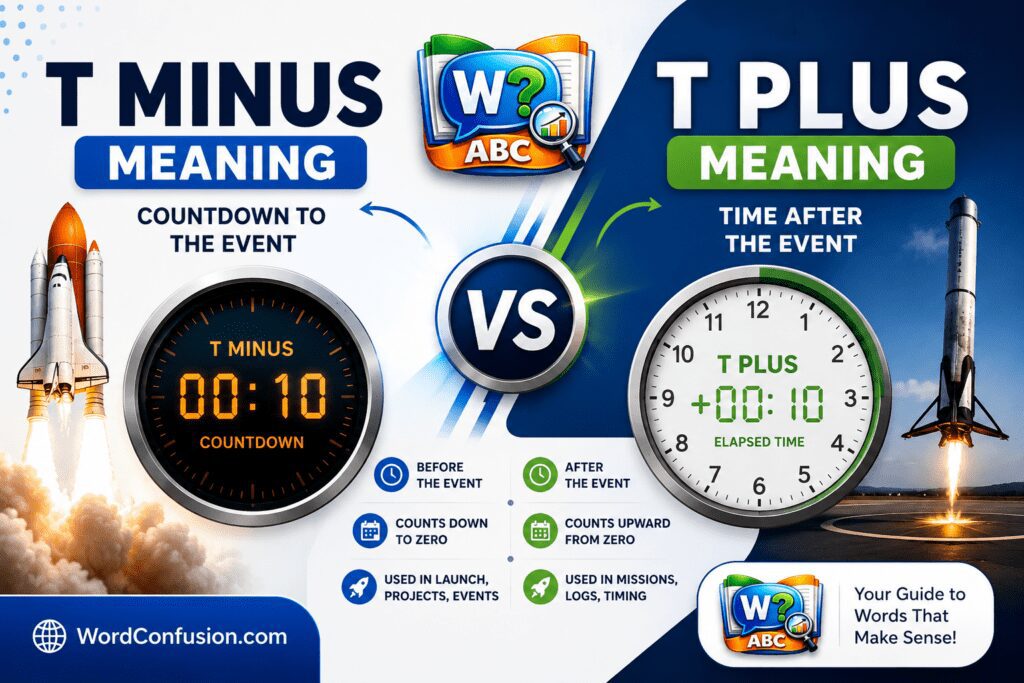
T-minus and T-plus use the same reference point, but they describe opposite sides of an event.
| Term | Meaning | Example |
|---|---|---|
| T-minus | Time before the event | T-minus 10 minutes = 10 minutes before |
| T-0 | The target event time | T-0 = the event occurs |
| T-plus | Time after the event | T-plus 10 minutes = 10 minutes after |
T-Minus: Before the Event
Use T-minus when the event has not happened yet and you are counting down to it.
For example:
- T-minus 3 days = three days before the event
- T-minus 2 hours = two hours before the event
- T-minus 15 minutes = 15 minutes before the event
T-0: The Target Moment
T-0 marks the reference point itself—the scheduled time of the event.
For example, if a rocket is scheduled to launch at noon:
- 11:59:50 AM = T-minus 10 seconds
- 12:00 PM = T-0
- 12:00:10 PM = T-plus 10 seconds
T-Plus: After the Event
Use T-plus when measuring time after the target event has occurred.
For example:
- T-plus 10 minutes = 10 minutes after the event
- T-plus 1 hour = one hour after the event
- T-plus 24 hours = 24 hours after the event
Easy Way to Remember
Think of the target event as zero:
T-minus → T-0 → T-plus
Before → Event → After
So, T-minus means time remaining, T-0 marks the target moment, and T-plus measures elapsed time after that moment.
T-Minus Examples: Days, Hours & Minutes
The meaning of T-minus stays the same regardless of how much time is shown. The number simply tells you how much time remains before the target event.
| Countdown | Meaning |
|---|---|
| T-minus 1 week | One week remains before the event. |
| T-minus 1 day | One day remains before the event. |
| T-minus 24 hours | 24 hours remain before the event. |
| T-minus 12 hours | 12 hours remain before the event. |
| T-minus 5 hours | Five hours remain before the event. |
| T-minus 1 hour | One hour remains before the event. |
| T-minus 30 minutes | 30 minutes remain before the event. |
| T-minus 10 minutes | 10 minutes remain before the event. |
| T-minus 5 minutes | Five minutes remain before the event. |
| T-minus 1 minute | One minute remains before the event. |
| T-minus 30 seconds | 30 seconds remain before the event. |
| T-0 | The target event time has arrived. |
Examples in Sentences
- “We are T-minus 1 day until the conference.” This means the conference starts in one day.
- “T-minus 10 minutes until the meeting begins.” This means the meeting will begin in 10 minutes.
- “The launch is now T-minus 30 seconds.” This means only 30 seconds remain before the launch.
- “We have reached T-0.” This means the scheduled event time has arrived.
The same pattern works with almost any time period. T-minus 2 hours, T-minus 3 days, T-minus 48 hours, and similar expressions all indicate the amount of time remaining before the target event.
T-Minus in Everyday Language
Although T-minus is best known from rocket and space-launch countdowns, people also use the expression informally when talking about an upcoming event.
T-minus is usually informal in everyday conversation, much like other expressions people encounter in texting and online communication.
The phrase adds a sense of anticipation or urgency and simply tells the listener how much time remains.
Casual Conversations
People may use T-minus when counting down to something they are looking forward to:
- “T-minus two hours until vacation.”
- “T-minus one week until graduation.”
- “T-minus 30 minutes until dinner.”
Social Media
Creators and businesses often use countdown language to build excitement before an announcement, event, or product launch.
Examples:
- “T-minus 24 hours until the big reveal!”
- “T-minus 3 days until launch.”
Text Messages
In casual messages, T-minus can be used as a playful way to tell someone how long remains before something happens.
For example:
“T-minus 15 minutes until I arrive.”
This means the person expects to arrive in about 15 minutes.
In everyday use, T-minus is usually informal. It works especially well when the speaker wants to make an upcoming event sound exciting, important, or time-sensitive.
T-Minus in Business, Project Management & Marketing
Today, T-minus is often used outside aerospace to create a clear sense of how much time remains before an important deadline, launch, or event.
Business and Product Launches
Companies may use T-minus language when preparing for a new product, service, campaign, or major announcement.
Examples:
- “T-minus 30 days until the product launch.”
- “T-minus 7 days until our new service goes live.”
- “T-minus 24 hours until the big announcement.”
This type of countdown can help teams focus on the final stages of preparation.
Project Management
Project teams can also use T-minus informally when tracking deadlines and milestones.
For example:
“T-minus 2 weeks until final testing.”
This means two weeks remain before the planned testing milestone.
Other examples include:
- T-minus 30 days until project completion
- T-minus 7 days until the final review
- T-minus 1 day until the submission deadline
In formal project documentation, however, clearer wording such as “2 weeks remaining” may be preferable when precision matters.
Marketing and Promotions
Marketers often use countdown language to create anticipation around product releases, campaigns, events, or limited-time promotions.
Examples:
- “T-minus 14 days until launch.”
- “T-minus 72 hours until registration closes.”
- “T-minus 24 hours until the offer ends.”
Here, T-minus emphasizes that the deadline is approaching and encourages people to pay attention to the remaining time.
Why Businesses Use T-Minus
The expression is useful because it communicates three things quickly:
- A specific event or deadline exists.
- The event has not happened yet.
- A certain amount of time remains.
Because of this, T-minus can make ordinary countdowns sound more energetic and memorable, although it is generally more informal than simply saying “X days remaining.”
T Minus in Project Management

Project managers frequently work with deadlines and milestones.
Scheduling Tasks
T-minus terminology helps teams understand how much time remains before a key deliverable.
Example:
“T-minus 2 weeks until final testing.”
Tracking Milestones
Projects often include multiple countdown stages.
Examples:
- The countdown may begin 90 days before the deadline.
- After that, teams often focus on the 30-day milestone.
- Finally, the last 7 days become critical for project completion.
This keeps teams focused on upcoming deadlines.
Real-Life Examples of T-Minus
The expression T-minus can be used informally for many upcoming events. Here are some natural examples:
School
“T-minus 3 days until the final exam.”
This means the final exam is three days away.
Work
“T-minus 1 hour until the client presentation.”
This means one hour remains before the presentation.
Events
“T-minus 2 weeks until the wedding.”
This means the wedding will take place in two weeks.
Travel
“T-minus 12 hours until departure.”
This means 12 hours remain before the planned departure.
Product Launch
“T-minus 7 days until our new app launches.”
This means the app is scheduled to launch in seven days.
These examples show that T-minus can be used whenever you want to emphasize the time remaining before an upcoming event. In casual situations, it often adds excitement or anticipation to an ordinary countdown.
Is T-Minus Only Used for Rockets?
No. Although T-minus became widely associated with rocket launches and space missions, the expression can also be used for other upcoming events.
Common examples include:
- Business — “T-minus 30 days until the product launch.”
- Events — “T-minus 2 weeks until the conference.”
- Education — “T-minus 3 days until the final exam.”
- Travel — “T-minus 12 hours until departure.”
- Sports — “T-minus 10 minutes until kickoff.”
- Social media — “T-minus 24 hours until the announcement.”
- Everyday conversation — “T-minus 20 minutes until dinner.”
In these situations, T-minus simply emphasizes how much time remains before something happens.
However, it is generally an informal or conversational expression outside technical countdown systems. In formal writing, phrases such as “10 minutes remaining” or “three days before the event” may be clearer.
Common Mistakes When Using T-Minus
Although T-minus is simple, a few common mistakes can cause confusion.
1. Confusing T-Minus and T-Plus
T-minus refers to time before an event, while T-plus refers to time after it.
Correct:
“T-minus 10 minutes until launch.”
This means the launch is 10 minutes away.
Different meaning:
“T-plus 10 minutes after launch.”
This means 10 minutes have passed since the launch.
2. Thinking T-0 Means Nothing Happens
T-0 does not mean that the event has been canceled or that nothing happens.
It marks the target or reference moment of the countdown.
For example, in a launch countdown, T-0 is the scheduled launch time.
3. Assuming T-Minus Is Only for Rockets
T-minus is strongly associated with space launches, but it can also be used informally for events, deadlines, product launches, travel, and other upcoming activities.
4. Using T-Minus When a Simple Countdown Is Clearer
T-minus can add excitement or emphasis, but it is not always necessary.
For example:
- Informal: “T-minus 2 days until vacation!”
- Neutral: “Two days until vacation.”
Both communicate the same basic idea. The first simply gives the countdown a more playful or dramatic tone.
5. Treating Every T-Minus Expression as a Technical Term
Outside aerospace and other formal countdown systems, T-minus is often conversational rather than technical.
If you’re writing a formal report, schedule, or business document, “2 hours remaining” may be clearer than “T-minus 2 hours.”
How to Use T-Minus Naturally
T-minus works best when you are counting down to a specific event and want to emphasize the time remaining.
Use T-Minus for Upcoming Events
Use the expression when something has not happened yet and you want to show how much time remains.
Example:
“T-minus 2 hours until the concert.”
This means the concert is two hours away.
Choose a Clear Time Unit
Use a time unit that matches how close the event is:
- Longer countdown: T-minus 30 days
- Medium countdown: T-minus 2 weeks
- Short countdown: T-minus 1 hour
- Immediate countdown: T-minus 10 seconds
Use T-Minus in Informal Situations
Outside technical countdown systems, T-minus is usually conversational and can make a message sound more exciting or playful.
Example:
“T-minus 5 days until vacation!”
For formal writing, a simpler phrase such as “5 days remaining” may be more appropriate.
Don’t Overcomplicate the Expression
You normally only need T-minus + the amount of time.
Natural:
“T-minus 10 minutes until the show starts.”
Simpler alternative:
“10 minutes until the show starts.”
The meaning is essentially the same; T-minus simply gives the countdown a more dramatic or energetic tone.
Frequently Asked Questions
What does T-minus mean?
T-minus means the amount of time remaining before a planned event occurs. For example, T-minus 10 minutes means 10 minutes remain before the event.
What does the T in T-minus mean?
In countdown notation, T represents the target or reference time of the event. The number and minus sign show how much time remains before that reference point.
What does T-minus 10 minutes mean?
T-minus 10 minutes means 10 minutes remain before the planned event. It is commonly used in countdowns and can also be used informally for upcoming events.
What does T-minus 1 day mean?
T-minus 1 day means one day remains before the planned event. For example, “T-minus 1 day until the concert” means the concert is one day away.
What does T-0 mean?
T-0 marks the target or reference moment of the countdown. In a rocket launch, for example, it represents the scheduled launch time.
What is the difference between T-minus and T-plus?
T-minus refers to time before an event, while T-plus refers to time after an event. For example, T-minus 10 minutes means 10 minutes before an event, while T-plus 10 minutes means 10 minutes after it.
Why do people say T-minus?
People say T-minus to emphasize how much time remains before an upcoming event. The expression became widely associated with aerospace countdowns and is now also used informally for launches, deadlines, events, travel, and other occasions.
Is T-minus only used for rockets?
No. T-minus is strongly associated with rocket launches, but people also use it informally for business deadlines, product launches, events, travel, school, sports, and everyday conversations.
How do you use T-minus in a sentence?
You can use T-minus before an amount of time to indicate how long remains before an event.
Example: “T-minus 30 minutes until the meeting starts.”
Is T-minus formal or informal?
T-minus is technical in formal countdown systems, especially aerospace, but it is generally informal or conversational when used in everyday situations.
English contains many popular expressions and slang phrases. For example, you can also learn about the meaning of Kick Rocks and how it is used in everyday conversations.
If you’re interested in improving your English vocabulary, you may also want to learn the difference between Moment vs Momment, one of the most common spelling confusions.
Conclusion
T-minus means the amount of time remaining before a planned event occurs. The T represents the target or reference time, while the minus sign shows that the event has not yet reached that point.
You may see T-minus in rocket launches and other countdown systems, but the expression is also used informally for events, deadlines, product launches, travel, sports, and everyday conversations.
Remember the basic pattern:
T-minus → T-0 → T-plus
Before the event → Target moment → After the event
So, when someone says “T-minus 10 minutes,” they simply mean that 10 minutes remain before the event.
If you’re exploring more English expressions and confusing terms, WordConfusion also covers everyday phrases and commonly confused words.