Solve vs. Evaluate vs. Simplify: What Do Math Questions Really Ask?

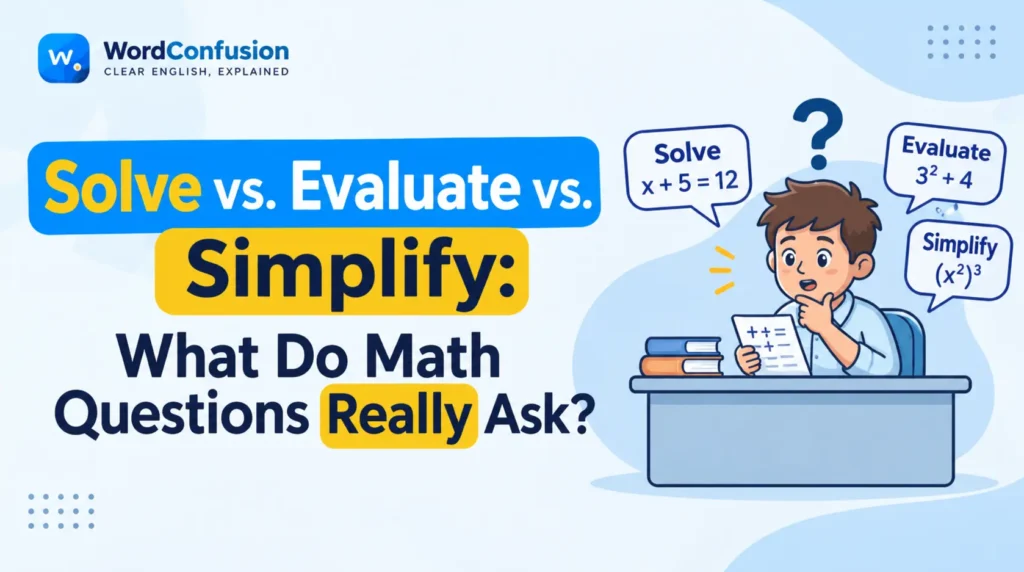
Solve, evaluate and simplify sound like they mean the same thing: “do the math.” They don’t. Each word asks for a different kind of answer, and mixing them up is one of the most common reasons students lose marks on problems they actually understood.
Think of these words as instructions, not decoration. In English, “read the letter” and “write the letter” use the same noun but ask for opposite actions. Math instructions work the same way. The expression on the page may look identical, but the verb in front of it decides what your final answer should look like.
In this guide, we’ll break down what each word really means, show simple examples, and give you a quick way to tell them apart in any homework or exam question.
What Does “Solve” Mean in Math?
Solve means find the value of the unknown that makes a statement true. You will almost always see an equals sign (=) or an inequality sign (<, >, ≤, ≥), and at least one variable such as x or y.
Your final answer is not a number on its own. It is a value for the variable, like x = 4.
Example: Solve 3x + 5 = 17.
- Subtract 5 from both sides: 3x = 12
- Divide both sides by 3: x = 4
You can check your answer by putting it back into the original equation: 3(4) + 5 = 17. It works, so x = 4 is the solution.
Key signs that a question wants you to solve:
- There is an equation or inequality, not just an expression
- There is an unknown you don’t have a value for
- The question may say “find x,” “what is the value of y,” or “determine the solution”
What Does “Evaluate” Mean in Math?
Evaluate means calculate the value of an expression. If the expression has variables, the question will give you their values. Your job is to plug them in and work out one final number.
There is usually no equals sign to balance. You are not looking for an unknown; you already know everything.
Example: Evaluate 2a² − 3b when a = 3 and b = 4.
- Substitute the values: 2(3)² − 3(4)
- Square first: 2(9) − 3(4)
- Multiply: 18 − 12
- Subtract: 6
The answer is simply 6. Not a = 3, not an expression, just a number.
Key signs that a question wants you to evaluate:
- You are given an expression, not an equation
- Values for every variable are provided (“when x = 2” or “if y = −1”)
- The question may say “find the value of,” “calculate,” or “compute”
What Does “Simplify” Mean in Math?
Simplify means rewrite an expression in a shorter, cleaner form without changing its value. You combine like terms, reduce fractions, expand or cancel where possible. You do not find a value for x, and you do not plug anything in.
Your final answer is usually still an expression, just a tidier one.
Example: Simplify 4x + 3 − 2x + 7.
- Group like terms: (4x − 2x) + (3 + 7)
- Combine them: 2x + 10
The answer is 2x + 10. The x stays, because nobody told you what x is.
Another example: Simplify 12/18. Divide top and bottom by 6 to get 2/3.
Key signs that a question wants you to simplify:
- You see an expression with repeated or similar terms
- No values are given for the variables
- The question may say “reduce,” “combine like terms,” “write in simplest form,” or “expand”
Solve vs. Evaluate vs. Simplify: Side-by-Side
The fastest way to tell them apart is to ask one question: what should my final answer look like?
| Word | What you start with | What you do | What your answer looks like |
| Solve | An equation or inequality with an unknown | Find the value that makes it true | x = 4 |
| Evaluate | An expression plus values for the variables | Substitute and calculate | 6 |
| Simplify | An expression with no values given | Rewrite it in a shorter form | 2x + 10 |
Same numbers, three different questions
Look how the instruction word changes the job, even with very similar math:
- Solve 2x + 6 = 10 → x = 2
- Evaluate 2x + 6 when x = 5 → 16
- Simplify 2x + 6 + 3x → 5x + 6
If you answered “16” to the first question or “x = 2” to the third, you’d be marked wrong, even though your arithmetic was fine.
Common Mistakes Students Make
- Solving when asked to simplify. Seeing x and rushing to “find x.” If there is no equals sign, there is nothing to solve.
- Simplifying when asked to evaluate. Stopping at 2x + 10 when the question gave you x = 3. Always finish the calculation.
- Adding an equals sign that isn’t there. Writing 4x + 8 = 0 just to make an expression “solvable” changes the question.
- Ignoring order of operations when evaluating. Powers and brackets come before multiplication and addition. Skipping this gives the wrong number.
Tips to Read Math Questions Correctly
- Circle the instruction word first. Solve, evaluate, simplify, factor, expand: each one is a different task.
- Look for an equals sign. Equals sign plus unknown usually means solve. No equals sign usually means evaluate or simplify.
- Check whether values are given. Values provided means evaluate. No values means simplify.
- Picture the final answer before you start. A variable value, a single number, or a shorter expression?
- Check your work step by step. If you’re unsure whether you followed the instruction correctly, a free math solver can show each step, so you can see exactly where the solve, evaluate or simplify process went differently from yours.
Used this way, a math tool works like a dictionary does for English: it helps you check meaning and learn the pattern, not skip the thinking.
Frequently Asked Questions
Is “solve” the same as “find”? Often, yes. “Find x” and “solve for x” ask for the same thing. But “find the value of 3x + 2 when x = 4” is an evaluate question, so read the full sentence.
Can you simplify an equation? Yes. You can simplify each side of an equation before solving it. But a question that says “simplify” usually gives you an expression, not an equation.
What is the difference between evaluate and calculate? In most school math, they mean the same thing: work out a single numerical value.
Does simplify ever give a number? Sometimes. Simplifying 3 + 4 × 2 gives 11, because there are no variables left. If variables remain, the answer stays an expression.
Conclusion
Solve, evaluate and simplify are three different instructions, and the difference is all in the final answer. Solve gives you a value for the unknown. Evaluate gives you a single number. Simplify gives you a shorter expression.
Like any confusing set of English words, the trick is to slow down and read the instruction before you act. Once you know what the question really asks, the math itself gets much easier.
Written by
 Bilal Internee
Latest posts
 Solace Meaning: Definition, Origin, Usage & Examples
 LLM Meaning: Definition, Examples, Uses & How It Works
 ICYMI Meaning: Definition, Origin, Usage & Examples
 Hurly Burly Meaning: Definition, Origin, Synonyms & Examples
 Fatigue Meaning: Definition, Types, Origin & Examples
 Bussin Meaning: Definition, Origin, Examples & Usage