What Does MSG Mean in Text? Meaning, Examples & Usage

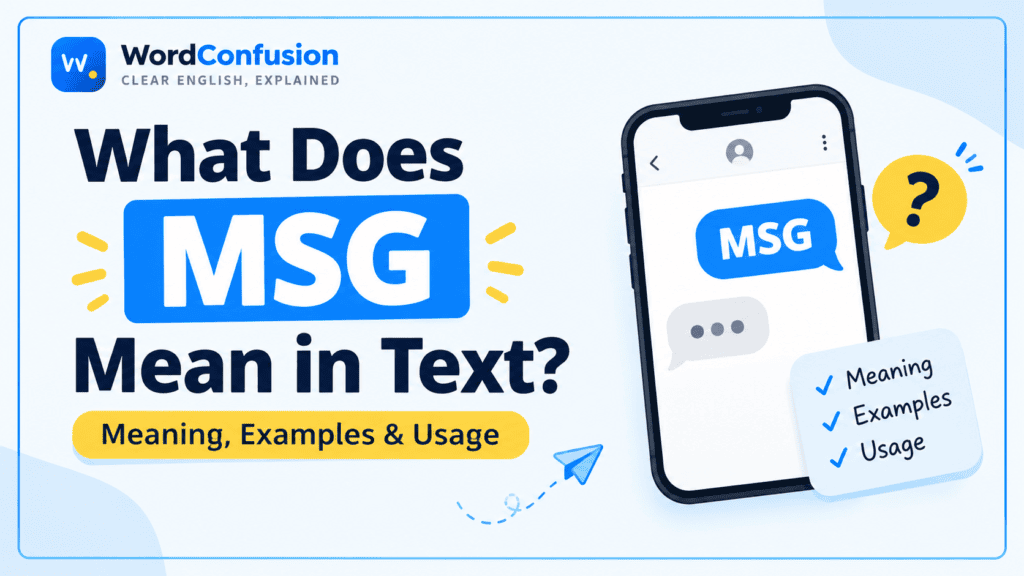
If you’ve seen MSG in a text message, chat, or social media conversation, it usually means “message.” It is an informal abbreviation people use to save time when referring to a text, chat, or written communication.
For example, “Did you get my msg?” simply means “Did you get my message?”
The meaning is usually straightforward, but understanding how MSG is used can help you tell the difference between casual texting shorthand and standard English.
Quick Answer: What Does MSG Mean in Text?
MSG usually means “message” in texting and online chat. It is an informal abbreviation used to refer to a text, chat, or other written communication.
For example:
“Send me a msg when you get home.”
means:
“Send me a message when you get home.”
MSG can be used as either a noun or an informal verb, depending on the sentence.
What Does MSG Stand For in Texting?
In texting, MSG stands for “message.”
It is simply a shortened form of the word. Unlike some texting abbreviations that create an entirely new expression, MSG retains the basic meaning of the original word.
| Abbreviation | Meaning |
|---|---|
| MSG | Message |
| msg me | Message me / Send me a message |
| my msg | My message |
| your msg | Your message |
You may see MSG in text messages, group chats, social media comments, direct messages, gaming chats, and other informal digital conversations.
WordConfusion’s broader Text Meanings collection covers many other abbreviations used in modern online communication.
What Does “Msg Me” Mean?
“Msg me” means “message me” or “send me a message.”
It is one of the most common ways MSG appears as an informal verb.
For example:
“Msg me when you’re free.”
This means:
“Message me when you’re free.”
Another example:
“Msg me the address.”
means:
“Send me the address in a message.”
The expression is casual and usually appears in conversations where both people are already communicating electronically.
How Is MSG Used in Texting?
MSG can work as a noun or as an informal verb.
MSG as a Noun
When MSG refers to a message itself, it functions as a noun.
Examples:
“Did you get my msg?”
“I sent you a msg earlier.”
“Check your msg.”
In each case, MSG means message.
MSG as a Verb
In very casual digital communication, MSG can also be used as a verb meaning to message someone.
Examples:
“Msg me later.”
“I’ll msg you tonight.”
“Can you msg Sarah?”
Although this usage is common in informal communication, the full verb message is preferable when writing formally.
Examples of MSG in Text Conversations
Here are some natural examples of how you might see MSG used:
| Text | Meaning |
|---|---|
| “Did you get my msg?” | Did you get my message? |
| “Msg me later.” | Message me later. |
| “I sent you a msg.” | I sent you a message. |
| “Check your msg.” | Check your message. |
| “Thanks for the msg.” | Thanks for the message. |
| “I’ll msg you when I arrive.” | I’ll message you when I arrive. |
The abbreviation is especially useful when people are typing quickly and the context already makes the meaning obvious.
Is MSG Slang or an Abbreviation?
MSG is best described as an informal abbreviation or shorthand for “message.”
People sometimes group it under texting slang or internet slang because it is commonly used in casual digital communication. However, there is an important distinction.
Slang can have a specialized, informal meaning that differs from standard language. MSG does not normally create a new meaning. It simply shortens message.
For comparison, an abbreviation such as FRL meaning in texting represents the phrase “for real” and can express agreement, emphasis, or surprise depending on the context.
MSG is much more straightforward:
MSG = message
So, calling it texting slang is understandable, but informal abbreviation is the more precise description.
Is MSG Formal or Informal?
MSG is informal.
It works well when you’re communicating casually with people who are familiar with texting shorthand.
MSG is suitable for:
- Text messages
- Casual group chats
- Friendly DMs
- Social media conversations
- Gaming chats
- Informal online communication
Use “message” instead in:
- Formal emails
- Academic assignments
- Job applications
- Business documents
- Official correspondence
- Professional reports
For example, this is fine in a casual chat:
“Msg me when you get there.”
But in a professional email, write:
“Please message me when you arrive.”
The issue isn’t that MSG is grammatically “wrong.” The main issue is register: the abbreviation is much more casual than the full word.
WordConfusion explains this same distinction across other texting abbreviations, such as TBF meaning in text, where the abbreviation is useful in casual communication but less appropriate in formal writing.
MSG vs. DM vs. PM vs. SMS
MSG, DM, PM, and SMS are related to messaging, but they do not mean exactly the same thing.
| Term | Full Form | Meaning |
|---|---|---|
| MSG | Message | General shorthand for a message |
| DM | Direct Message | A private message sent through a platform |
| PM | Private Message | A private message or private conversation |
| SMS | Short Message Service | The technical system used for traditional mobile text messages |
👉MSG
MSG is simply shorthand for message.
“I sent you a msg.”
It does not necessarily tell you what type of message it is.
DM
DM means Direct Message and is commonly used for private communication on social platforms.
“DM me the details.”
PM
PM usually means Private Message in online communication. WordConfusion’s PM meaning in text guide explains how PM is used for private conversations and how it compares with DM.
SMS
SMS stands for Short Message Service. It refers to the technology behind traditional mobile text messaging rather than simply being a casual abbreviation for the word “message.”
So, while all four terms are related to communication, they are not interchangeable in every situation.
Does MSG Mean the Same Thing on WhatsApp, Instagram, Snapchat, and TikTok?
Usually, yes.
If someone writes MSG on WhatsApp, Instagram, Snapchat, TikTok, Discord, or in a regular text conversation, it will generally mean message.
The platform usually does not create a special meaning for MSG.
For example:
“Check your msg.”
has essentially the same meaning whether it appears in a WhatsApp conversation or a social media chat.
This is an important point when interpreting texting abbreviations: the surrounding conversation is often more important than the platform itself.
WordConfusion’s guide to CMP meaning in text provides another example of why context matters when interpreting short abbreviations.
Does MSG Have Other Meanings?
Yes.
Although message is the relevant meaning when you’re reading a text or chat, MSG can also stand for monosodium glutamate, a flavor enhancer used in food.
Context makes the difference.
Compare:
“Send me a msg.”
Here, MSG clearly means message.
But:
“This soup contains MSG.”
Here, MSG means monosodium glutamate.
So you should not automatically assume that MSG means “message” whenever you see the three letters. Look at the topic and surrounding words first.
Common Mistakes When Interpreting MSG
1. Assuming MSG Is Always Formal
MSG is widely understood, but it is still informal shorthand.
Use message when clarity and professionalism matter.
2. Thinking MSG and SMS Mean the Same Thing
They are related but different.
MSG is shorthand for message, while SMS refers to Short Message Service, the technology associated with traditional text messaging.
3. Assuming MSG and DM Are Exact Synonyms
A DM is a specific type of private message on a digital platform.
MSG is simply a general abbreviation for message.
4. Calling MSG a Completely Separate Slang Word
MSG does not normally have a special slang definition in texting. It is simply a shortened form of message.
5. Ignoring Context
If you’re unsure what an abbreviation means, read the complete sentence and the surrounding conversation.
Context can make the intended meaning obvious.
This principle is particularly important with abbreviations that have multiple interpretations, such as those discussed in WordConfusion’s SMD meaning in text guide.
Can You Use MSG in Professional Communication?
You can encounter MSG in informal workplace chats, but whether you should use it depends on the audience and communication style.
For example, a casual internal chat might contain:
“I’ll msg you after the meeting.”
People may understand it without difficulty.
However, a formal email would normally be clearer as:
“I’ll message you after the meeting.”
When communicating with clients, employers, teachers, customers, or unfamiliar readers, spelling out message is the safer choice.
The general rule is simple:
Use MSG when the conversation is casual. Use “message” when the communication needs to sound formal, polished, or professional.
Frequently Asked Questions About MSG
What does MSG mean in texting?
MSG usually means “message” in texting. It is an informal abbreviation used to refer to a text, chat, or other written communication.
What does MSG stand for?
In texting, MSG stands for “message.” In other contexts, it can have different meanings, including monosodium glutamate.
Is MSG short for message?
Yes. MSG is commonly used as a shortened form of “message” in casual texting and online communication.
What does “msg me” mean?
“Msg me” means “message me” or “send me a message.”
For example:
“Msg me when you’re home.”
means:
“Send me a message when you’re home.”
What does MSG mean in chat?
In chat, MSG usually means message.
For example:
“I sent you a msg.”
means:
“I sent you a message.”
What does MSG mean on social media?
MSG generally means message on social media as well. The abbreviation can appear in comments, chats, DMs, or other casual conversations.
Is MSG slang?
MSG is more accurately described as an informal abbreviation or shorthand for “message.” It is often grouped with texting slang because of how frequently it appears in casual digital communication.
Is MSG formal?
No. MSG is generally considered informal. In professional, academic, or official writing, spelling out message is usually better.
Is MSG the same as DM?
No. MSG simply means message. DM means Direct Message, usually referring to a private message sent through a social or online platform.
A DM is a type of message, while MSG is a general abbreviation for the word message.
Is MSG the same as SMS?
No.
MSG means message.
SMS means Short Message Service, the technical system used for traditional mobile text messages.
Can MSG mean something other than message?
Yes. In a food-related context, MSG can mean monosodium glutamate.
The surrounding context tells you which meaning is intended.
Key Takeaway
MSG usually means “message” in text messages, chats, and social media conversations.
It is informal shorthand that can function as either a noun or, in very casual communication, a verb:
- “Did you get my msg?” → Did you get my message?
- “Msg me later.” → Message me later.
- “I sent a msg.” → I sent a message.
For casual conversations, MSG is easy to understand and widely used. For formal or professional writing, spelling out message is the clearer choice.
If you’re exploring more texting abbreviations and everyday English usage, WordConfusion has a growing collection of plain-English explanations and practical examples.
Written by
 Muhammad Bilal
Latest posts
 What Does PG Mean in Text? Meaning, Examples & Usage
 What Does OFCC Mean in Text? Meaning, Uses & Examples
 What Does STY Mean in Text? Meaning, Examples & Usage
 What Does “Twin” Mean in Slang? Meaning, Text & Examples
 What Does LMC Mean in Text? Meaning, Examples & Usage
 How SaaS Businesses Can Build a Scalable Growth Strategy