ILYSM Meaning in Text: What It Means & How to Reply
 Abdul Moeed
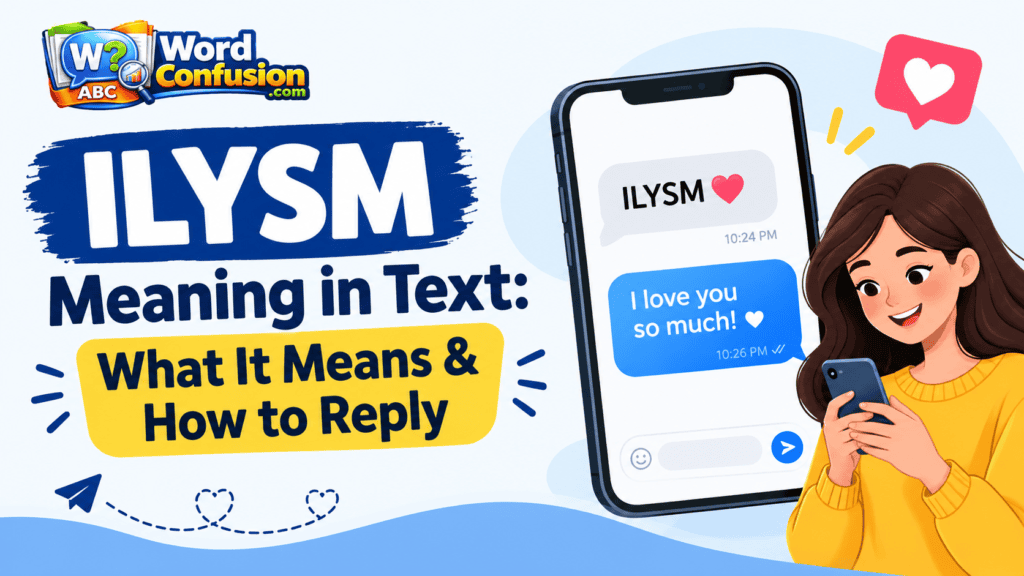
If someone texts you “ILYSM”, they’re saying “I love you so much.” It is an informal texting abbreviation used to express strong affection, love, appreciation, or emotional closeness. Depending on the relationship and conversation, ILYSM can be romantic, friendly, familial, or playful.
So, does ILYSM always mean romantic love? Not necessarily. The words themselves express strong affection, but the relationship and context usually tell you what the sender means.
For more explanations of everyday English, vocabulary, and modern text language, you can also explore WordConfusion.
What Does ILYSM Mean in Text?
ILYSM means “I love you so much.”
It is a shortened form of a sentence people commonly use in text messages, chats, DMs, and social media conversations.
The letters represent:
- I = I
- L = Love
- Y = You
- S = So
- M = Much
For example:
“Thanks for being there for me. ILYSM ❤️”
Here, the sender is expressing strong affection and appreciation.
Quick Answer
| Abbreviation | Full meaning | Typical tone |
| ILYSM | I love you so much | Strong and affectionate |
| ILY | I love you | Direct and affectionate |
| ILU | I love you | Casual and affectionate |
ILYSM is generally more emphatic than ILY because adding “so much” intensifies the feeling being expressed.
What Does ILYSM Stand For?
ILYSM stands for “I love you so much.”
It is best described as an informal initialism or texting abbreviation. People use the individual letters as shorthand rather than typing the complete phrase.
You might see it in:
- Text messages
- Private chats
- Group chats
- Instagram DMs
- Snapchat messages
- TikTok comments
- WhatsApp conversations
- Other casual online communication
For example:
“You seriously made my whole day. ILYSM!”
The abbreviation makes the message shorter while keeping its emotional meaning.
What Does ILYSM Mean Depending on Context?
Although the literal meaning stays the same, the emotional meaning can vary with context.
Romantic use
Between romantic partners, ILYSM usually expresses genuine love and strong affection.
Example:
“Goodnight, baby. ILYSM ❤️”
In this context, the romantic meaning is clear because of the relationship and surrounding language.
Between close friends
Friends can also use ILYSM to express deep affection or appreciation.
Example:
“You helped me through all of that. ILYSM!”
Here, it doesn’t necessarily mean romantic love. It can simply mean:
“I care about you so much.”
Family use
Parents, siblings, children, and other close family members may use ILYSM as an affectionate message.
Example:
“Have a safe flight! ILYSM ❤️”
Again, the relationship provides the context.
Playful or affectionate use
Sometimes people use ILYSM casually or playfully after someone does something kind, funny, or helpful.
Example:
“You brought me coffee? ILYSM 😂”
The message expresses appreciation rather than necessarily declaring romantic love.
What Does ILYSM Mean From a Girl?
When a girl sends ILYSM, the basic meaning is still “I love you so much.”
There isn’t a separate dictionary meaning based on the sender being a girl.
What it means emotionally depends on the relationship and conversation.
For example:
- A girlfriend might use ILYSM romantically.
- A close female friend might use it affectionately.
- A sister might use it to show family love.
- A friend might use it playfully after receiving a favor.
If you’re wondering whether she is romantically interested, don’t rely on ILYSM alone. Look at the broader conversation and your existing relationship.
What Does ILYSM Mean From a Guy?
When a guy sends ILYSM, it also generally means “I love you so much.”
The abbreviation itself doesn’t have a special male-specific meaning.
For example:
“You mean so much to me. ILYSM.”
could be romantic if sent by a partner, while:
“Bro, you saved me today. ILYSM 😂”
could simply be playful appreciation between friends.
The sender’s gender isn’t the deciding factor. Context is.
Is ILYSM Romantic?
It can be, but it isn’t automatically romantic.
ILYSM expresses strong affection, so it can sound romantic when used between people who are dating or interested in each other.
However, close friends and family members can also use it.
The best clues are:
- Your relationship with the sender
- What was being discussed
- The messages before and after ILYSM
- Other affectionate language
- Emojis and overall tone
An emoji can reinforce a tone, but it doesn’t prove romantic intent by itself.
For example:
“ILYSM ❤️”
may sound romantic between partners.
But:
“You are literally the best friend ever. ILYSM 😂”
is much more likely to be friendly.
ILYSM vs. ILY vs. ILU
These abbreviations are closely related, but they don’t always feel exactly the same.
| Expression | Full meaning | Typical feeling |
| ILYSM | I love you so much | Stronger or more emphatic affection |
| ILY | I love you | Direct declaration of affection |
| ILU | I love you | Casual texting shorthand |
ILYSM vs. ILY
ILY means “I love you.”
ILYSM means “I love you so much.”
The second expression adds emphasis.
Compare:
“ILY ❤️”
with:
“ILYSM ❤️🥹”
Both express love, but ILYSM can sound more emotionally intense or enthusiastic.
👉ILYSM vs. ILU
ILYSM and ILU both communicate affection, but ILU is simply shorthand for “I love you.”
ILYSM adds “so much,” making the expression more emphatic.
There isn’t a strict rule that one must always be more romantic than the other. Tone and context still matter.
How Do You Respond to ILYSM?
Your response depends on how you feel and what kind of relationship you have with the sender.
If you feel the same
You can simply say:
“ILYSM too ❤️”
Or:
“I love you so much too!”
If it’s a close friend
You might reply:
“Aww, love you too!”
or:
“ILYSM too 😂❤️”
If you’re unsure what they mean
A warm but neutral response can work:
“Aww, that’s so sweet!”
This acknowledges the affection without making assumptions about whether the message is romantic.
If you don’t want to return the romantic feeling
You can remain kind without saying “I love you too.”
For example:
“That’s really sweet of you.”
This is useful when you appreciate the message but don’t want to send a stronger romantic signal.
When Should You Use ILYSM?
ILYSM works best in informal conversations where affection is already appropriate.
You might use it with:
- A romantic partner
- A close friend
- A family member
- Someone you have a strong emotional connection with
For example:
“Thanks for helping me study. ILYSM!”
or:
“Good luck tomorrow! ILYSM ❤️”
The abbreviation is especially natural when the conversation is already casual and affectionate.
When Should You Avoid ILYSM?
Because ILYSM is highly informal and emotionally expressive, it usually doesn’t belong in professional or academic communication.
Avoid it in:
- Business emails
- Formal letters
- Academic assignments
- Job applications
- Professional client communication
- Official documents
Instead of:
“ILYSM for your support!”
a professional message might say:
“Thank you very much for your support.”
The appropriate choice depends on your audience and the relationship.
ILYSM Examples in Real Conversations
Seeing the abbreviation in context makes its meaning easier to understand.
Example 1: Romantic
A: “I had such a great time with you tonight.”
B: “Me too. ILYSM ❤️”
Meaning: A romantic expression of love and affection.
Example 2: Close friends
A: “I picked up your favorite snack.”
B: “You remembered! ILYSM 😂”
Meaning: Strong appreciation and affection between friends.
Example 3: Family
Mom: “Call me when you arrive.”
Daughter: “I will. ILYSM ❤️”
Meaning: Family affection.
Example 4: Emotional support
A: “Thank you for listening to me when I needed someone.”
B: “Always. ILYSM.”
Meaning: Deep affection and appreciation.
Example 5: Playful
A: “I sent you the notes from class.”
B: “OMG ILYSM 😂”
Meaning: Enthusiastic appreciation, not necessarily romantic.
Example 6: Social media
“Everyone who supported me through this journey, ILYSM! ❤️”
Here, ILYSM is being used broadly to express appreciation and affection toward a group of people.
Why Do People Use ILYSM Instead of “I Love You So Much”?
There are several simple reasons.
It’s quicker
Typing five letters can be easier than typing the entire sentence.
It feels casual
ILYSM fits naturally into informal digital conversations.
It expresses emotion efficiently
A short abbreviation can communicate a strong emotional message without requiring a long sentence.
It’s familiar online language
People who regularly use texting abbreviations may immediately understand ILYSM without needing the phrase spelled out.
The same general principle applies to many other online abbreviations. For example, WordConfusion’s guide to TF meaning in text explains how a short abbreviation can communicate a specific tone or emotion depending on context.
Common Mistakes When Interpreting ILYSM
1. Assuming ILYSM is always romantic
It isn’t.
Friends and family members can use it too.
2. Assuming the sender’s gender changes the meaning
It doesn’t.
ILYSM has the same basic meaning whether it comes from a girl, guy, friend, partner, or family member.
3. Treating one emoji as proof of romantic intent
A heart emoji may reinforce affection, but emojis aren’t reliable proof of someone’s intentions.
4. Ignoring the surrounding conversation
The messages around ILYSM often tell you much more about the intended tone than the abbreviation itself.
5. Using it in formal communication
ILYSM is casual and emotionally expressive. It is generally inappropriate for professional or academic writing.
Is ILYSM Slang or an Abbreviation?
ILYSM is best described as an informal texting abbreviation or initialism.
It is often grouped with internet slang because it is strongly associated with casual digital communication.
That distinction matters because not every short expression used online is technically “slang.” Some are simply abbreviations of ordinary phrases.
For example, WordConfusion’s guide to OOTD meaning in text explains that OOTD is more precisely an informal abbreviation or initialism for “Outfit of the Day.”
ILYSM works in a similar way: it shortens an established phrase rather than creating a completely different meaning.
Can You Use ILYSM on Snapchat, Instagram, or TikTok?
Yes.
The meaning generally remains “I love you so much” across messaging and social platforms.
You may encounter it in:
- Snapchat messages
- Instagram DMs
- TikTok comments
- WhatsApp chats
- iMessage
- Group chats
- Social media captions
The platform itself usually doesn’t change the meaning.
For example:
“ILYSM for always supporting me ❤️”
has essentially the same meaning whether it appears in an Instagram DM or a private text message.
What can change is the context and tone, depending on who is communicating and what they are discussing.
Key Takeaways
- ILYSM means “I love you so much.”
- It is an informal texting abbreviation or initialism.
- It can express romantic love, friendship, family affection, appreciation, or playful affection.
- ILYSM does not have a different meaning when sent by a girl or a guy.
- Context is more important than the sender’s gender when interpreting it.
- ILYSM is more emphatic than ILY because it includes “so much.”
- ILYSM is appropriate for casual communication, not formal or professional writing.
- If you’re unsure how to respond, a warm but neutral reply such as “Aww, that’s so sweet!” can avoid making assumptions.
Frequently Asked Questions About ILYSM
What does ILYSM mean in text?
ILYSM means “I love you so much.” It is an informal texting abbreviation used to express strong affection, love, appreciation, or emotional closeness.
What does ILYSM stand for?
ILYSM stands for “I love you so much.”
What does ILYSM mean from a girl?
It means “I love you so much.” The meaning doesn’t change simply because a girl sent it. Whether it is romantic, friendly, or familial depends on the relationship and context.
What does ILYSM mean from a guy?
A guy using ILYSM is generally saying “I love you so much.” The emotional meaning depends on the relationship and surrounding conversation, not simply the sender’s gender.
Is ILYSM romantic?
It can be romantic, especially between partners or people with romantic feelings, but friends and family members can also use ILYSM affectionately.
Can friends use ILYSM?
Yes. Close friends may use ILYSM to express strong affection, appreciation, or gratitude without intending romantic love.
Is ILYSM the same as ILY?
Not exactly. ILY means “I love you,” while ILYSM means “I love you so much.” ILYSM adds extra emphasis to the expression.
What is the difference between ILY and ILYSM?
ILY means “I love you.” ILYSM means “I love you so much.” Both express affection, but ILYSM can sound more emphatic or emotionally intense.
What is the difference between ILYSM and ILU?
Both express love. ILU is shorthand for “I love you,” while ILYSM means “I love you so much,” adding emphasis.
How do you respond to ILYSM?
If you feel the same, you can say “ILYSM too ❤️” or “I love you so much too!” If you’re unsure, “Aww, that’s so sweet!” is a friendly and neutral response.
When should you use ILYSM?
Use ILYSM in informal conversations with people you’re comfortable expressing affection toward, such as romantic partners, close friends, or family members.
Can you use ILYSM professionally?
Generally, no. ILYSM is informal and emotionally expressive, so it is not appropriate for most professional emails, academic writing, business communication, or official documents.
Final Thoughts
ILYSM means “I love you so much.” It is a simple but emotionally expressive abbreviation commonly used in texts, chats, DMs, and social media.
The important thing to remember is that ILYSM doesn’t automatically mean romantic love. A partner may use it romantically, while a friend or family member may use it to show affection or appreciation.
If you’re trying to understand what someone meant by ILYSM, look beyond the abbreviation itself. Consider your relationship, the surrounding conversation, and the overall tone. Those clues will usually tell you more than the five letters alone.
For more practical explanations of English words, expressions, and texting language, explore WordConfusion.