WTF Meaning in Text: What It Means, Uses & Examples

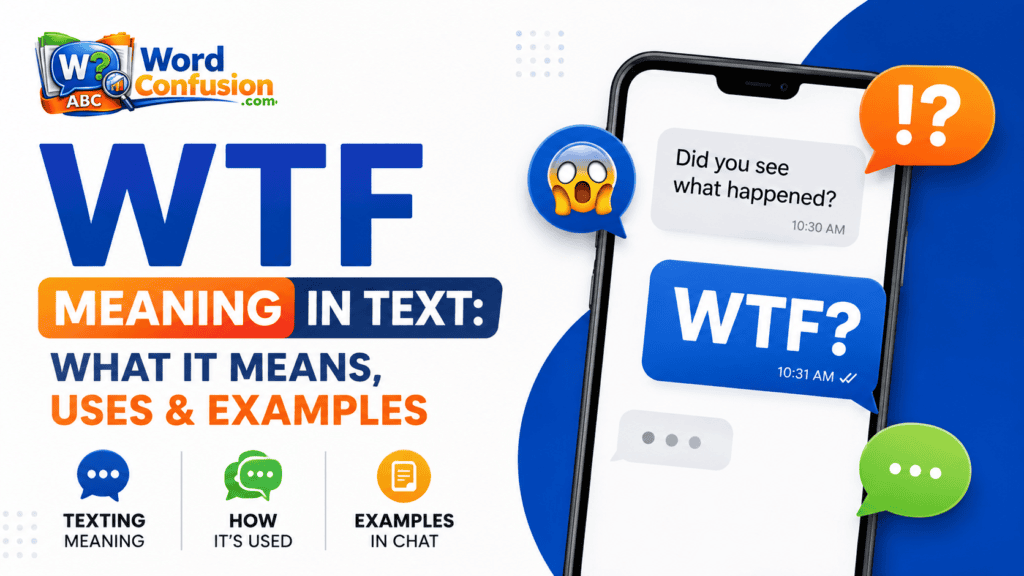
If you saw “WTF” in a text message, chat, or social media post, it usually means “what the fuck.” It is an informal slang abbreviation used to express strong surprise, confusion, disbelief, frustration, annoyance, or sometimes humor.
The exact tone depends on the context. For example, “WTF?!” may show shock, while “WTF 😂” can be a playful reaction. Because the full phrase contains profanity, WTF can sound rude or offensive in formal or unfamiliar situations.
📖 See also:Busyness vs Business: Which Is Correct? Meaning & Examples
What Does WTF Mean in Text?
WTF means “what the fuck.” It is a common informal abbreviation used in texting, online chats, comments, and social media.
People typically use WTF as a strong reaction to something unexpected or difficult to understand.
For example:
“WTF just happened?”
Here, the sender is probably expressing shock or confusion.
Another example:
“WTF 😂 I can’t believe you did that.”
In this case, WTF may communicate amused disbelief rather than genuine anger.
So, although the full form stays the same, the emotion behind WTF can change with context.
What Does WTF Stand For?
WTF stands for “what the fuck.”
It is an informal, profanity-based expression. The abbreviation is especially common in digital communication because shortening the phrase makes it quick to type.
WTF is best understood as internet and texting slang, not standard formal English.
You may see it in:
- Text messages
- Group chats
- WhatsApp conversations
- Instagram DMs and comments
- Snapchat messages
- TikTok comments
- Online forums
- Gaming chats
What Does WTF Mean in Texting?
In texting, WTF usually acts as an emotional reaction rather than having one fixed emotional meaning.
Depending on the situation, it can express:
Surprise or Shock
“WTF?! You actually won?”
The sender is surprised by the unexpected result.
Confusion
“WTF is going on here?”
Here, WTF emphasizes that the person does not understand what is happening.
Disbelief
“WTF, I can’t believe this.”
The sender finds something difficult to believe.
Frustration or Annoyance
“WTF is taking so long?”
In this context, WTF adds frustration to the question.
Humor
“WTF 😂 How did you even do that?”
The expression can be playful when the surrounding conversation is clearly humorous.
The important point is that WTF does not automatically mean anger. The surrounding words, punctuation, emojis, and relationship between the people communicating all help determine the tone.
How to Understand the Tone of “WTF”
The same abbreviation can sound very different in different messages.
| Example | Likely Tone |
| “WTF?!” | Strong surprise or shock |
| “WTF 😂” | Playful disbelief |
| “WTF is this?” | Confusion or annoyance |
| “WTF happened?” | Shock or confusion |
| “WTF was that?” | Surprise or disbelief |
| “WTF is wrong with you?” | Anger or confrontation |
| “WTF 😭” | Dramatic disbelief or frustration |
Punctuation matters
Compare:
“WTF?”
with:
“WTF?!”
The second version usually feels more intense.
Similarly:
“WTF…”
may suggest disbelief, disappointment, or a person struggling to process what happened.
Emojis can change the tone
An emoji can make an otherwise strong expression feel more playful or emotional.
For example:
- WTF 😂 — amused disbelief
- WTF 😭 — dramatic reaction
- WTF 😳 — shock
- WTF 😡 — anger
The abbreviation itself has not changed. The context has.
Is WTF Rude, Offensive, or a Bad Word?
Is WTF rude?
It can be.
WTF is informal and contains an abbreviation of a profanity. Among close friends, it may be used casually. In a conversation with a stranger, teacher, customer, manager, or professional contact, it can sound disrespectful.
Is WTF offensive?
It can be offensive depending on the audience and context.
Some people use WTF casually without intending to insult anyone. However, the underlying phrase contains a swear word, so it should not be treated as neutral or formal language.
Is WTF a bad word?
The abbreviation itself is not the complete swear phrase, but WTF represents “what the fuck,” which contains profanity.
A useful rule is:
Abbreviating a swear phrase does not automatically make it polite.
If you would avoid saying the full phrase in a particular situation, it is usually safer to avoid WTF there as well.
📖 See also:MBN Meaning in Text: What “Must Be Nice” Really Meanst Does CM Mean?
When Is It Appropriate to Use WTF?
WTF is generally most appropriate in casual communication with people who are comfortable with informal language.
Usually acceptable in casual situations
- Friends’ group chats
- Casual text messages
- Informal social media conversations
- Humorous conversations
- Online communities where profanity is normal
Usually best avoided in formal situations
- Job applications
- Academic assignments
- Formal emails
- Business proposals
- Customer communication
- Professional reports
- Interviews
- Communication with people you do not know well
When in doubt, choose a neutral expression instead.
WTF Examples in Texting
Here are some natural examples showing different uses.
With Friends
“WTF, you got tickets?!”
Meaning: The sender is surprised and excited.
Reacting to Unexpected News
“WTF? They canceled the event?”
Meaning: The sender is shocked by the news.
Showing Confusion
“WTF is happening with my phone?”
Meaning: The sender does not understand the problem.
Showing Frustration
“WTF is this app doing?”
Meaning: The sender is annoyed or confused.
Reacting to Something Funny
“WTF 😂 That was the funniest thing I’ve seen all day.”
Meaning: The sender is humorously surprised.
Showing Disbelief
“WTF, you really finished the whole project overnight?”
Meaning: The sender finds the achievement surprising or hard to believe.
What Does WTF Mean on WhatsApp, Instagram, Snapchat & TikTok?
The basic meaning of WTF does not change just because it appears on a different platform.
| Platform | Typical Use |
| Reactions in private chats and group conversations | |
| Reactions to posts, Stories, Reels, comments, or DMs | |
| Snapchat | Quick reactions to Snaps or messages |
| TikTok | Reactions to surprising, confusing, or funny videos |
For example, someone might comment:
“WTF is this 😂”
on a strange TikTok or Instagram Reel.
The platform provides the setting, but the surrounding context determines the intended emotion.
What Does WTF Mean From a Girl, Guy, or Friend?
WTF does not have a special meaning simply because the sender is a girl or a guy.
The relationship and conversation matter more than gender.
For example:
A friend: “WTF 😂 You actually did it!”
This is likely playful surprise.
A stranger: “WTF are you doing?”
This may sound confrontational.
A partner: “WTF happened?”
This could express concern, confusion, or frustration depending on the situation.
So if someone sends you WTF, look at what they said before and after it rather than trying to interpret the abbreviation based on their gender.
WTF vs. WTH vs. OMG vs. SMH
These expressions can all appear as reactions, but they are not interchangeable.
| Expression | Common Meaning | Typical Tone |
| WTF | What the fuck | Strong, profane |
| WTH | What the heck / what the hell | Milder |
| OMG | Oh my God | Surprise, excitement, shock |
| SMH | Shaking my head | Disbelief or disapproval |
| Seriously? | A reaction showing disbelief or frustration | Variable |
WTF vs. WTH
WTH is generally a milder alternative to WTF.
WTF is happening? — stronger and profane
WTH is happening? — softer
If you want the same general reaction without using strong profanity, WTH is often the safer choice.
WTF vs. OMG
OMG usually expresses surprise, excitement, shock, or amazement.
WTF tends to sound stronger and can communicate confusion, frustration, or disbelief.
“OMG, that’s amazing!”
sounds excited.
“WTF, what just happened?”
sounds shocked or confused.
WTF vs. SMH
SMH usually expresses disbelief, disappointment, or disapproval.
“SMH, you forgot your keys again.”
WTF is generally more intense and profane.
📖 See also:CM Meaning in Text: What Does CM Mean?
What Are Polite Alternatives to WTF?
If you want to express surprise or confusion without profanity, try:
- What on earth?
- What the heck?
- Seriously?
- What happened?
- What’s going on?
- I can’t believe it.
- What is this?
- How did that happen?
For example:
Instead of:
“WTF just happened?”
you could say:
“What just happened?”
For a stronger but still relatively mild reaction:
“What on earth just happened?”
These alternatives are much safer in professional, academic, or mixed-company conversations.
How Do You Use WTF in a Sentence?
WTF is most commonly used at the beginning of an informal question or as a standalone reaction.
Examples:
- “WTF just happened?”
- “WTF is going on?”
- “WTF was that?”
- “WTF are you doing?”
- “WTF? I can’t believe this.”
It can also appear after another phrase:
“I have no idea WTF is happening.”
However, these examples are very informal and are better suited to casual digital communication than formal writing.
Common Mistakes When Using WTF
1. Assuming WTF always means anger
It can express surprise, confusion, disbelief, frustration, or humor too.
2. Treating WTF as polite because it is abbreviated
WTF still represents a profanity-based expression.
3. Using WTF in professional communication
Even if you use it casually with friends, a workplace audience may interpret it as inappropriate.
4. Assuming the sender is angry
Look at the whole message.
“WTF 😂”
can be playful.
“WTF is wrong with you?”
is much more likely to be confrontational.
5. Assuming the platform changes the meaning
WTF means essentially the same thing on WhatsApp, Instagram, Snapchat, TikTok, and other platforms. Context changes the tone.
Does WTF Always Mean “What the Fuck”?
Usually, yes. In modern texting and internet slang, WTF most commonly stands for “what the fuck.”
However, abbreviations can occasionally have other meanings in specialized contexts. When you see WTF in an ordinary text message, chat, or social media conversation, “what the fuck” is the overwhelmingly likely interpretation.
Quick Summary
WTF means “what the fuck.” It is an informal, profanity-based texting and internet abbreviation used to express strong surprise, confusion, disbelief, frustration, annoyance, or sometimes humor.
Its exact tone depends on context.
- WTF?! → shock or surprise
- WTF 😂 → playful disbelief
- WTF is happening? → confusion
- WTF is wrong with you? → confrontation or anger
Because WTF represents a profanity, avoid it in formal, academic, or professional communication. If you want a milder alternative, try WTH, “what on earth,” “seriously?”, or “what happened?”
📖 See also:Contractor vs Contracter: Which Spelling Is Correct?
Frequently Asked Questions
What does WTF mean in text?
WTF usually means “what the fuck.” It is an informal slang abbreviation used to express surprise, confusion, disbelief, frustration, annoyance, or humor in texts and online conversations.
What does WTF stand for?
WTF stands for “what the fuck.” It is a common informal abbreviation used in texting, chats, social media, and other casual digital communication.
What does WTF mean in texting?
In texting, WTF is usually a strong reaction to something unexpected, confusing, surprising, frustrating, or unbelievable. The exact emotion depends on the surrounding conversation.
Is WTF a bad word?
WTF represents “what the fuck,” which contains profanity. Although the phrase is abbreviated, it should still be considered informal and potentially offensive language.
Is WTF rude?
WTF can be rude, especially when directed at someone or used in a formal setting. Among close friends, however, it may be used casually or humorously.
Is WTF offensive?
It can be. The abbreviation represents a profanity, so some people may consider it offensive even when no insult is intended.
What does WTF mean on WhatsApp?
On WhatsApp, WTF generally means “what the fuck.” Someone might use it to express surprise, confusion, disbelief, frustration, or humor in a private or group chat.
What does WTF mean on Instagram?
On Instagram, WTF has the same basic meaning: “what the fuck.” It may appear in comments, DMs, Stories, or reactions to surprising, strange, or funny content.
What does WTF mean from a girl or guy?
WTF has no special meaning based on whether the sender is a girl or guy. The intended tone depends on the message, relationship, punctuation, emojis, and situation.
Can WTF be used casually?
Yes. WTF is commonly used casually among friends and in informal online conversations. However, it is still profanity-based slang and may not be appropriate for every audience.
What is a polite alternative to WTF?
Common alternatives include “What the heck?”, “What on earth?”, “Seriously?”, “What happened?”, and “What’s going on?” The best choice depends on how strong you want your reaction to sound.
How do you use WTF in a sentence?
Common examples include “WTF just happened?”, “WTF is going on?”, and “WTF was that?” These are highly informal expressions and are generally best kept to casual communication.
Final Takeaway
When you see WTF in a text, the safest interpretation is “what the fuck.” The abbreviation itself is straightforward; the tricky part is understanding the tone.
It can signal shock, confusion, disbelief, frustration, annoyance, or even playful humor. Pay attention to the surrounding words, punctuation, emojis, and relationship between the people involved.
And remember: WTF is informal and profanity-based, so it is best reserved for situations where that level of casual language is appropriate.
Looking for more English word meanings, grammar tips, and commonly confused words? Visit the WordConfusion homepage to explore our latest language guides, spelling differences, vocabulary explanations, text abbreviations, and practical examples. Whether you’re learning English or improving your writing skills, you’ll find clear, easy-to-understand resources for everyday communication.
Written by
 Abdul Moeed
Abdul Moeed is a professional content writer and SEO link-building specialist with 5+ years of experience. He creates search-optimized content and develops effective SEO strategies that improve website visibility, authority, and organic growth.
View LinkedIn profileLatest posts
 What Does PG Mean in Text? Meaning, Examples & Usage
 What Does OFCC Mean in Text? Meaning, Uses & Examples
 What Does MSG Mean in Text? Meaning, Examples & Usage
 What Does STY Mean in Text? Meaning, Examples & Usage
 What Does “Twin” Mean in Slang? Meaning, Text & Examples
 What Does LMC Mean in Text? Meaning, Examples & Usage