Busyness vs Business: Which Is Correct? Meaning & Examples

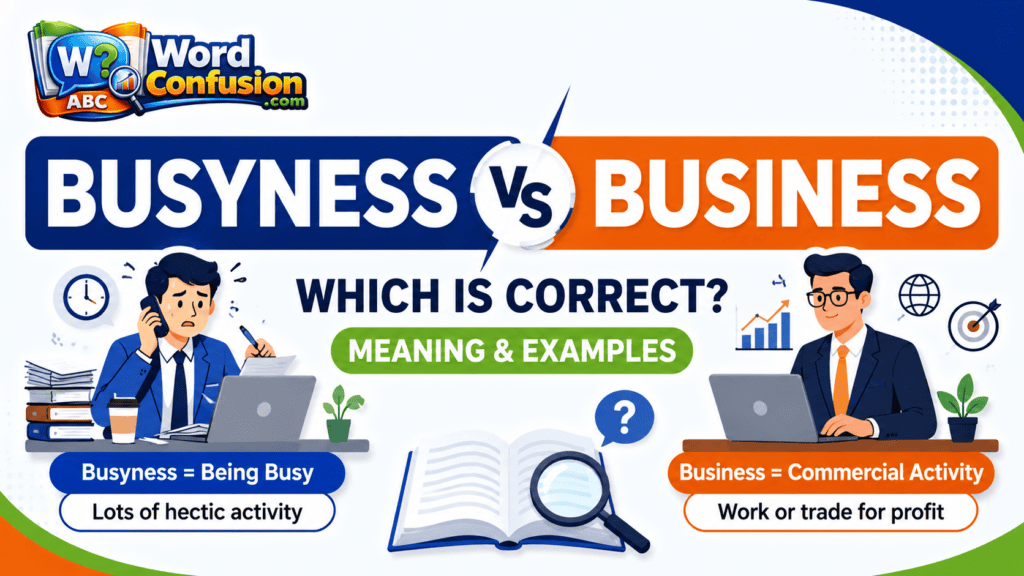
If you are unsure whether busyness or business is the right word, you are not alone. The two words look very similar, but they have different meanings.
Busyness means the state of being busy or occupied with many activities. Business usually refers to work, commercial activity, a company, or a particular matter. Both are correct English words, but they are not interchangeable.
For example:
- The busyness of the city can be exhausting.
- She owns a small business.
The easiest way to remember the difference is: busyness is about being busy, while business is usually about work, trade, a company, or a matter.
📖 See also:MBN Meaning in Text: What “Must Be Nice” Really Meanst Does CM Mean?
Busyness vs Business: Quick Comparison
| Word | Part of Speech | Main Meaning | Example |
| Busyness | Noun | The state of being busy | The busyness of the office increased before the deadline. |
| Business | Noun | Work, commercial activity, a company, or a matter | She started a new business. |
| Busy | Adjective | Occupied or having a lot to do | I am busy today. |
The simple rule
Busy → busyness
Business → company, commercial activity, work, or matter
What Does “Busyness” Mean?
Busyness is a noun that means the state or condition of being busy.
It describes a situation in which someone, somewhere, or something has a lot of activity, tasks, movement, or things happening at once.
For example:
- The busyness of the city made it difficult to relax.
- I enjoy the busyness of the holiday season.
- The busyness of her schedule left little time for rest.
- He was tired from the constant busyness of his daily routine.
Here, busyness does not mean a company or commercial organization. It describes how busy something is.
Is “Busyness” a Real Word?
Yes. Busyness is a real and grammatically correct English word.
It is formed from busy + -ness, where -ness turns an adjective into a noun describing a state or quality.
Compare:
- happy → happiness
- kind → kindness
- dark → darkness
- busy → busyness
Although busyness is correct, it is much less common in everyday English than business. In some situations, speakers may naturally choose expressions such as a busy schedule, a hectic routine, a heavy workload, or constant activity instead.
So, a word can be correct without being the most common choice in every context.
What Does “Business” Mean?
Business is also a noun, but it has several meanings.
1. A Company or Organization
Business can refer to a company or organization that sells products or services.
For example:
- She owns a successful business.
- They started a family business.
- His business is growing quickly.
Here, business can be counted:
- a business
- two businesses
- several businesses
2. Commercial Activity
Business can also mean commercial activity in general.
For example:
- Business is slow during the winter.
- The company is doing good business overseas.
- International business has changed significantly.
In this meaning, business is generally used as an uncountable noun.
3. Work or Professional Activity
Business can refer more generally to someone’s work or professional affairs.
- I have some business to take care of.
- She travels frequently on business.
- He is away on business this week.
4. A Particular Matter or Concern
Business can also mean a matter that concerns someone.
- That’s none of your business.
- We need to discuss an important business matter.
So, business does not simply mean “company.” Its meaning depends on the context.
What Is the Difference Between Busyness and Business?
The main difference is what each noun describes.
Busyness describes the state of being busy.
Business usually describes work, commercial activity, a company, or a matter.
Compare these sentences:
The busyness of the office was overwhelming.
This means the office was full of activity.
The business has 20 employees.
This means the company has 20 employees.
The words may look similar, but replacing one with the other changes the meaning.
A Simple Way to Remember
Think about the word busy.
Busy → busyness → being busy
Think about a company or work.
Business → company/work/commercial activity
This simple association can help you choose the right word quickly.
Busy vs Busyness vs Business
These three words are closely related in appearance but have different grammatical roles and meanings.
Busy
Busy is an adjective.
It describes someone or something that has a lot to do or is occupied.
- I am busy today.
- The restaurant is busy.
- She has a busy schedule.
Busyness
Busyness is a noun.
It refers to the state or condition of being busy.
- The busyness of the restaurant surprised me.
- His constant busyness made it difficult to relax.
Business
Business is a noun with several meanings, including a company, commercial activity, work, or a matter.
- She runs a small business.
- He is traveling on business.
- That is none of your business.
A useful pattern is:
busy → busyness
but
business → company/work/commercial activity
📖 See also:CM Meaning in Text: What Does CM Mean?
How to Use “Busyness” in a Sentence
Use busyness when you are talking about the condition or experience of being busy.
Everyday examples
- The busyness of the morning made me forget my appointment.
- I don’t enjoy the busyness of crowded shopping centers.
- The busyness of city life can be stressful.
Workplace examples
- The busyness of the office increased before the deadline.
- She struggled with the busyness of her new job.
- The team was not prepared for the busyness of the holiday season.
Personal-life examples
- Despite the busyness of everyday life, he makes time for his family.
- I need a break from the busyness of my routine.
Notice that busyness focuses on the condition of being busy, rather than the work itself.
How to Use “Business” in a Sentence

Use business when you mean a company, commercial activity, work, or a particular matter.
Company
- My sister owns a small business.
- The business employs ten people.
- They opened a new business last year.
Commercial activity
- Business has been slow this month.
- The company is expanding its business overseas.
Work
- She is traveling on business.
- He has some business to finish before lunch.
Matter or concern
- That is none of your business.
- We need to discuss some important business.
Common Mistakes With Busyness and Business
Mistake 1: Using “Business” When You Mean Being Busy
Incorrect:
Sorry for my business this week.
If you mean that you have had many tasks or have been occupied, business is not the right word.
Better:
Sorry for my busyness this week.
However, in natural everyday English, you might more commonly say:
Sorry I’ve been so busy this week.
The second version is often more conversational.
Mistake 2: Using “Busyness” for a Company
Incorrect:
She started a new busyness.
Correct:
She started a new business.
A company or commercial organization is a business, not a busyness.
Mistake 3: Treating the Words as Synonyms
Although the spelling looks similar, busyness and business do not have the same meaning.
You cannot freely substitute one for the other.
Is “Busyness” Correct English?
Yes. Busyness is correct English.
It is a legitimate noun meaning the state of being busy.
However, it is less common than business, and native speakers may sometimes choose a different expression depending on the sentence.
For example, instead of:
The busyness of my week was overwhelming.
A speaker might naturally say:
My schedule was extremely busy this week.
Or:
I had a very hectic week.
This does not make busyness incorrect. It simply shows that English offers several ways to express the same general idea.
📖 See also:Contractor vs Contracter: Which Spelling Is Correct?
Busyness vs Business: Spelling and Pronunciation
The spelling difference is important:
- busyness
- business
Busyness is connected directly to the adjective busy.
Business, despite its spelling, is pronounced differently from what many English learners might expect. Its common pronunciation is approximately BIZ-niss.
Busyness is approximately BIZ-ee-niss.
The spelling of business can be particularly confusing because its pronunciation does not closely follow the way the word appears on the page.
If you are learning English, it is useful to remember the words as complete vocabulary items rather than trying to pronounce business letter by letter.
Are “Busyness” and “Business” Countable Nouns?
There is an important grammar difference here.
Busyness is generally used as an uncountable noun when it means the state of being busy.
For example:
The busyness of the city was exhausting.
You would not normally say:
three busynesses
Business, however, can be either countable or uncountable depending on its meaning.
Countable
When business means a company:
She owns a business.
The city has thousands of small businesses.
Uncountable
When business means commercial activity:
Business is improving.
This distinction is useful because it shows that business has several grammatical uses, while busyness has a much narrower meaning.
Business vs Busyness: Correct Examples
| Meaning | Correct Example |
| State of being busy | The busyness of the city was overwhelming. |
| Busy lifestyle | She dislikes the constant busyness of modern life. |
| Company | He owns a successful business. |
| Commercial activity | Business has been slow this month. |
| Professional work | She is away on business. |
| Personal matter | That is none of your business. |
A Quick Memory Trick
If you mean “the state of being busy,” think:
busy → busyness
If you mean “a company, work, trade, or a matter,” think:
business
Another easy test is to ask yourself:
Can I replace the word with “being busy”?
If yes, busyness may be the word you need.
If you can replace it with company, work, commercial activity, or matter, you probably need business.
What Is the Correct Word for Being Busy?
The noun busyness can describe the state of being busy.
However, depending on the sentence, these alternatives may sound more natural:
- a busy schedule
- a hectic schedule
- a heavy workload
- a demanding routine
- constant activity
- a packed calendar
For example:
The busyness of my schedule is exhausting.
is grammatically possible, but:
My busy schedule is exhausting.
sounds more natural in many everyday situations.
The best choice depends on the context and the style of writing.
FAQs
Is business the same as busyness?
No. Busyness means the state of being busy, while business can mean a company, commercial activity, work, or a particular matter.
Is busyness a proper word?
Yes. Busyness is a legitimate English noun. It means the state or condition of being busy.
Is it spelled business or busyness?
Both business and busyness are correctly spelled words. They have different meanings, so the correct spelling depends on what you want to say.
Is busyness correct English?
Yes. Busyness is correct English, although it is less common than business and may sometimes be replaced by phrases such as a busy schedule or a hectic routine.
What does busyness mean?
Busyness means the state of being busy or occupied with many activities, tasks, or responsibilities.
What does business mean?
Business can mean a company, commercial activity, work, occupation, or a particular matter, depending on the context.
How do you use busyness in a sentence?
You can use busyness to describe a state of being busy. For example: The busyness of city life can be exhausting.
How do you use business in a sentence?
Use business when referring to a company, commercial activity, work, or a matter. For example: She owns a small business.
Is busyness the same as being busy?
They are closely related, but they are not the same grammatical form. Busy is an adjective, while busyness is a noun meaning the state of being busy.
What is the noun form of busy?
Busyness is a noun formed from busy. It refers to the state or condition of being busy.
📖 See also:WYM Meaning in Text: What Does WYM Mean?
Conclusion
Busyness vs business is an easy confusion to solve once you focus on meaning.
Busyness means the state of being busy. Business can mean a company, commercial activity, work, or a particular matter.
Remember:
Busy → busyness
Company/work/trade → business
Both words are correct, but they should not be used interchangeably. When you are talking about someone’s packed schedule or the general state of being busy, busyness can be correct. When you mean a company, commercial activity, professional work, or a matter, choose business.
If you’re unsure, look at the meaning first rather than the spelling. That simple habit will help you choose the right word.
Looking for more English word meanings, grammar tips, and commonly confused words? Visit the WordConfusion homepage to explore our latest language guides, spelling differences, vocabulary explanations, text abbreviations, and practical examples. Whether you’re learning English or improving your writing skills, you’ll find clear, easy-to-understand resources for everyday communication.
Written by
 Abdul Moeed
Abdul Moeed is a professional content writer and SEO link-building specialist with 5+ years of experience. He creates search-optimized content and develops effective SEO strategies that improve website visibility, authority, and organic growth.
View LinkedIn profileLatest posts
 What Does PG Mean in Text? Meaning, Examples & Usage
 What Does OFCC Mean in Text? Meaning, Uses & Examples
 What Does MSG Mean in Text? Meaning, Examples & Usage
 What Does STY Mean in Text? Meaning, Examples & Usage
 What Does “Twin” Mean in Slang? Meaning, Text & Examples
 What Does LMC Mean in Text? Meaning, Examples & Usage