Scarey or Scary? The Correct Spelling Explained

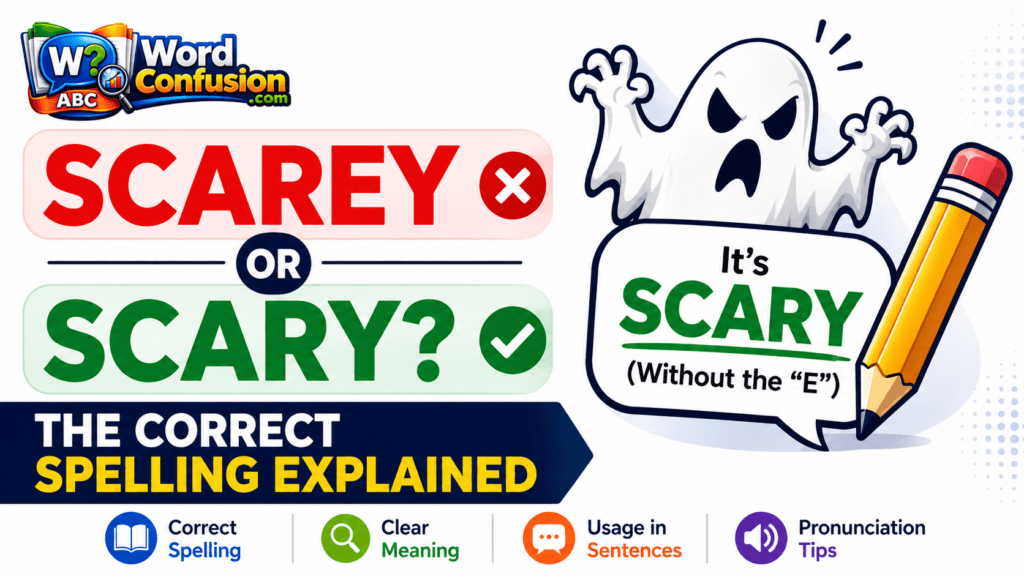
If you are wondering whether the correct spelling is scarey or scary, the answer is a little more nuanced than simply calling one spelling “wrong.”
Scary is the standard and much more widely used spelling in modern English. Scarey is also recorded as a variant spelling, particularly in British English, but it is much less common. For everyday, academic, professional, and general modern writing, scary is the best choice. Cambridge Dictionary lists scarey as a UK variant of scary.
📖 See also:Unkept or Unkempt? Meaning, Difference & Correct Usage
Scarey or Scary: Which Spelling Should You Use?
| Spelling | Status | Meaning | Best choice? |
| scary | Standard, widely used spelling | Frightening or causing fear | Yes |
| scarey | Recorded variant spelling, especially in UK English | Same meaning as scary | Usually no |
So, if you are writing an email, essay, article, school assignment, business document, or social media post, use scary.
Correct:
That was a scary movie.
Variant:
That was a scarey movie.
The second spelling can be found in English, but scary is the normal modern choice.
Is “Scarey” a Word?
Yes, “scarey” is a recorded variant spelling of “scary.” It is not accurate to say that scarey does not exist at all.
Cambridge Dictionary labels scarey as a UK variant of scary. The main entry defines scary as an adjective meaning “frightening.”
However, there is an important difference between being a recognized variant and being the preferred spelling.
In most modern writing, scary is the safer and more familiar form. If your goal is clear, conventional English, choose scary.
In simple terms:
Scary = standard and preferred
Scarey = recognized but uncommon variant
That distinction explains why you may occasionally see scarey in books, websites, or other English-language writing even though most people write scary.
What Does “Scary” Mean?
Scary is an adjective that means frightening or causing fear. Cambridge Dictionary gives scary the meaning “frightening” and includes examples such as a scary movie and a scary story.
For example:
- The horror movie was scary.
- That was a scary experience.
- The dark forest looked scary at night.
- Driving through the storm was scary.
- She told us a scary story.
The word can describe something that makes people feel afraid, nervous, or uneasy.
How Do You Spell “Scary”?
The correct spelling is:
S-C-A-R-Y
Scary
The word is related to the verb scare, which means to make someone feel frightened.
It is easy to mistakenly write scarey because the base word is scare. The extra e can feel natural when you are adding a -y ending.
But the established spelling of the adjective is:
scary
not:
scarey in ordinary modern usage.
You should therefore memorize the spelling as S-C-A-R-Y rather than trying to reconstruct it every time.
How Do You Pronounce “Scary”?
Scary has two syllables:
SCAR-y
Cambridge gives these pronunciations:
- UK: /ˈskeə.ri/
- US: /ˈsker.i/
The pronunciation differs slightly between British and American English, but the word is easily recognizable in both varieties.
Example:
That movie was scary.
The pronunciation does not change simply because the spelling is sometimes written as scarey.
📖 See also:GTB Meaning in Text: What Does GTB Mean in Texting?
Scary vs Scarey: What’s the Difference?
The main difference is spelling preference and usage, not meaning.
| Feature | Scary | Scarey |
| Meaning | Frightening | Frightening |
| Part of speech | Adjective | Variant adjective spelling |
| Modern usage | Very common | Much less common |
| British English | Common | Recorded variant |
| American English | Standard choice | Unusual |
| Formal writing | Recommended | Generally avoid |
| Everyday writing | Recommended | Generally avoid |
The easiest rule to remember
Use “scary” unless you have a specific reason to reproduce the variant spelling “scarey.”
Scary vs Scared: Don’t Confuse These Words
Scary and scared are related, but they describe different things.
A simple way to remember the difference is:
Scary = causes fear
Scared = feels fear
Compare these sentences:
The horror movie was scary.
The movie caused fear.
I was scared while watching the movie.
I experienced the fear.
Cambridge defines scared as an adjective meaning frightened or worried.
More examples
- The thunderstorm was scary.
- The children were scared by the thunderstorm.
- The strange noise sounded scary.
- I was scared when I heard it.
This distinction is particularly useful for English learners.
How to Use “Scary” in a Sentence
Here are some natural examples of scary in everyday English.
Everyday conversation
That dog looks scary, but it is actually very friendly.
Movies
We watched a scary movie last night.
Stories
My brother told me a scary story before bed.
Weather
The storm became scary when the wind grew stronger.
Personal experience
It was scary to be alone in the building.
Travel
Driving on that narrow mountain road was scary.
Business or professional context
The sudden drop in sales was a scary moment for the company.
Descriptive writing
A scary shadow appeared behind the window.
Notice that scary normally comes before a noun when it functions as an attributive adjective:
a scary story
a scary experience
a scary situation
It can also appear after a linking verb:
The situation was scary.
📖 See also:Wack or Whack? The Difference, Meaning & Correct Spelling
Common Spelling Mistakes with “Scary”
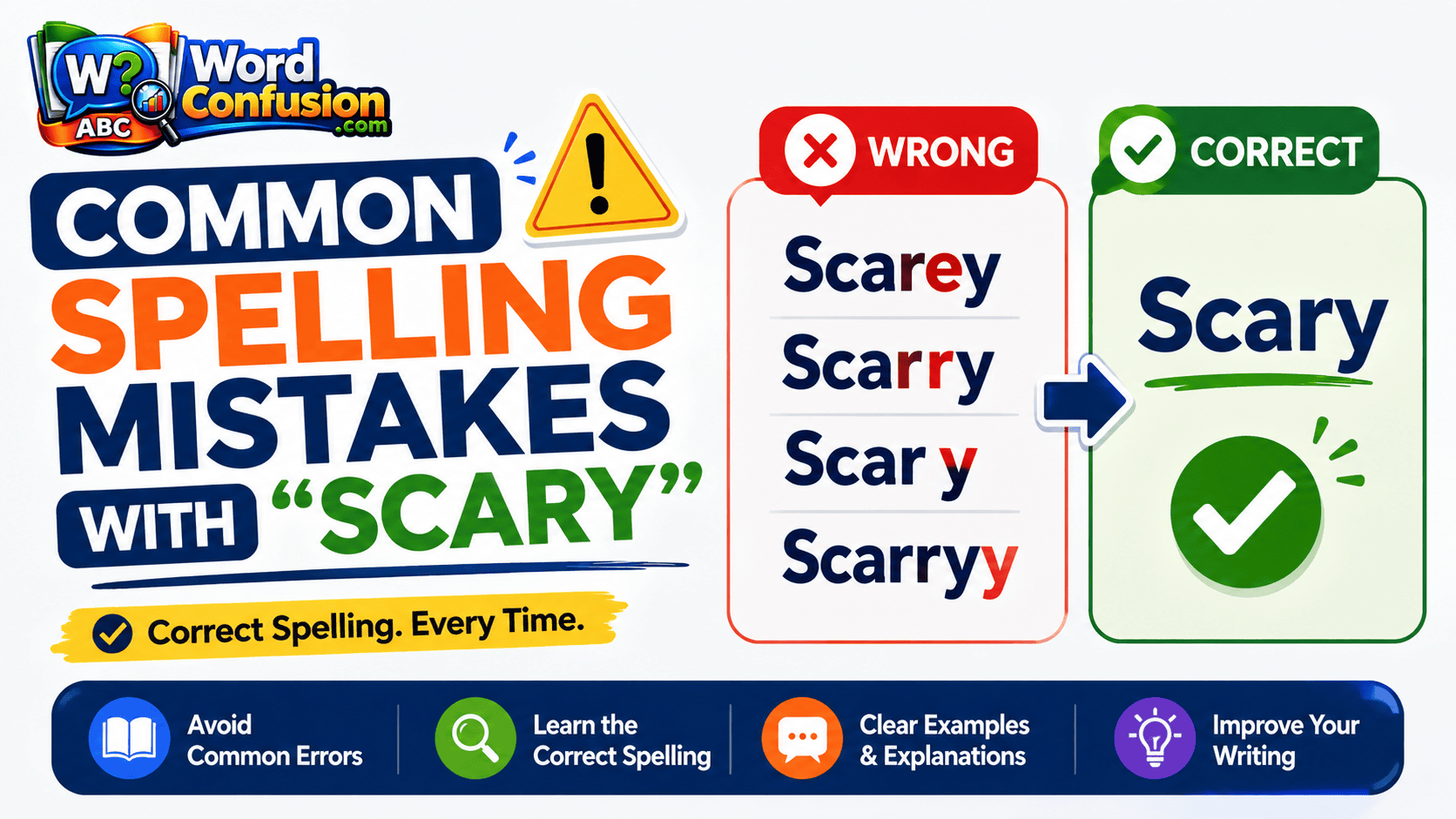
Because scare contains an e, people sometimes transfer that spelling into the adjective.
1. Scarey
Scarey is a recognized variant, but scary is the preferred modern spelling for general writing.
2. Scarry
Scarry adds an unnecessary second r.
Correct:
scary
Incorrect:
scarry
3. Scaryy
Adding an extra y is simply a spelling error.
Correct:
scary
Incorrect:
scaryy
4. Scare-y
Writing scare-y is unnecessary when you mean the normal adjective.
Correct:
a scary movie
Not normally:
a scare-y movie
British vs American English: Scary or Scarey?
There is a small regional point worth knowing.
Scary is used in both British and American English.
Cambridge Dictionary specifically identifies scarey as a UK variant of scary.
That does not mean British writers generally need to use scarey. In fact, scary remains the much more useful spelling for general modern English.
So if you are learning English or writing for an international audience, scary is the clearest choice.
Quick rule
British English: scary is normal; scarey is a recognized variant.
American English: scary is the normal spelling.
International writing: use scary.
Synonyms for “Scary”
Depending on the context, you can replace scary with several related adjectives.
Frightening
Used for something that causes fear.
It was a frightening experience.
Terrifying
Stronger than scary.
The thought of being trapped was terrifying.
Creepy
Often describes something strange, disturbing, or unpleasant in a way that creates discomfort or fear.
That old house looks creepy.
Spooky
Often associated with ghosts, strange places, Halloween, or an eerie atmosphere.
The abandoned house looked spooky.
Chilling
Can describe something that creates a strong feeling of fear or unease.
She told us a chilling story.
Alarming
Often focuses on something that causes concern or worry rather than ordinary fear.
The sudden change in the weather was alarming.
These words overlap with scary, but they are not always interchangeable. The best choice depends on the situation.
Is “Scary” an Adjective?
Yes. Scary is an adjective.
It describes a person, thing, situation, experience, story, movie, sound, or other noun that causes fear or makes someone feel frightened.
Examples:
- a scary movie
- a scary story
- a scary noise
- a scary situation
- a scary experience
The adjective also has comparative and superlative forms:
- scary
- scarier
- scariest
For example:
This movie is scarier than the first one.
That was the scariest moment of my life.
An Easy Way to Remember the Spelling
If you often hesitate between scarey and scary, remember this:
Scary has no extra E: S-C-A-R-Y.
Think of the word as one complete spelling rather than trying to build it from scare + y.
Quick memory sentence:
A scary story is spelled S-C-A-R-Y.
Writing the word correctly several times can also help make the spelling automatic.
Quick Summary
So, scarey or scary?
Scary is the standard and preferred spelling in modern English.
Scarey is not simply a nonexistent spelling; it is recorded as a variant, particularly in British English. However, it is much less common, so scary is the best choice for most everyday, academic, professional, and general writing.
Remember:
- Scary = standard spelling
- Scarey = recognized variant, but uncommon
- Scary = frightening or causing fear
- Scary = adjective
- Scared = feeling frightened
- Scarier = comparative form
- Scariest = superlative form
If you are unsure which spelling to use, choose scary.
📖 See also:Different or Diffrent? Correct Spelling, Meaning & Usage
Frequently Asked Questions
Is it scary or scarey?
Scary is the standard and preferred spelling. Scarey is also recorded as a variant spelling, particularly in British English, but it is much less common.
Is “scarey” a word?
Yes. Scarey is a recognized variant spelling of scary. However, scary is the much more common spelling and is the better choice for general modern writing.
What is the correct spelling of scary?
The standard spelling is scary: S-C-A-R-Y.
How do you spell scary?
You spell it S-C-A-R-Y.
What does scary mean?
Scary means frightening or causing fear. It is an adjective.
How do you pronounce scary?
In British English, scary is pronounced /ˈskeə.ri/. In American English, it is /ˈsker.i/.
Is scary an adjective?
Yes. Scary is an adjective used to describe something that causes fear or is frightening.
What is the difference between scary and scared?
Scary describes something that causes fear, while scared describes someone who feels fear.
The movie was scary.
I was scared.
Is scarey accepted in British English?
Scarey is recorded as a UK variant of scary, but it is not the spelling you normally need to use. Scary remains the safer and more widely used choice.
What are some synonyms for scary?
Common synonyms include frightening, terrifying, creepy, spooky, chilling, and alarming. The best synonym depends on the context.
Final Answer
When choosing between scarey and scary, use scary.
Although scarey is a recognized variant spelling, especially in British English, scary is the standard form most readers will expect. It means “frightening” or “causing fear” and functions as an adjective.
Correct for general modern writing: scary
Recognized variant: scarey
So if you are proofreading an essay, writing an email, publishing an article, or simply trying to spell the word correctly, scary is the spelling to choose.
Looking for more English word meanings, grammar tips, and commonly confused words? Visit the WordConfusion homepage to explore our latest language guides, spelling differences, vocabulary explanations, text abbreviations, and practical examples. Whether you’re learning English or improving your writing skills, you’ll find clear, easy-to-understand resources for everyday communication.
Written by
 Abdul Moeed
Abdul Moeed is a professional content writer and SEO link-building specialist with 5+ years of experience. He creates search-optimized content and develops effective SEO strategies that improve website visibility, authority, and organic growth.
View LinkedIn profileLatest posts
 What Does PG Mean in Text? Meaning, Examples & Usage
 What Does OFCC Mean in Text? Meaning, Uses & Examples
 What Does MSG Mean in Text? Meaning, Examples & Usage
 What Does STY Mean in Text? Meaning, Examples & Usage
 What Does “Twin” Mean in Slang? Meaning, Text & Examples
 What Does LMC Mean in Text? Meaning, Examples & Usage