Wack or Whack? The Difference, Meaning & Correct Spelling

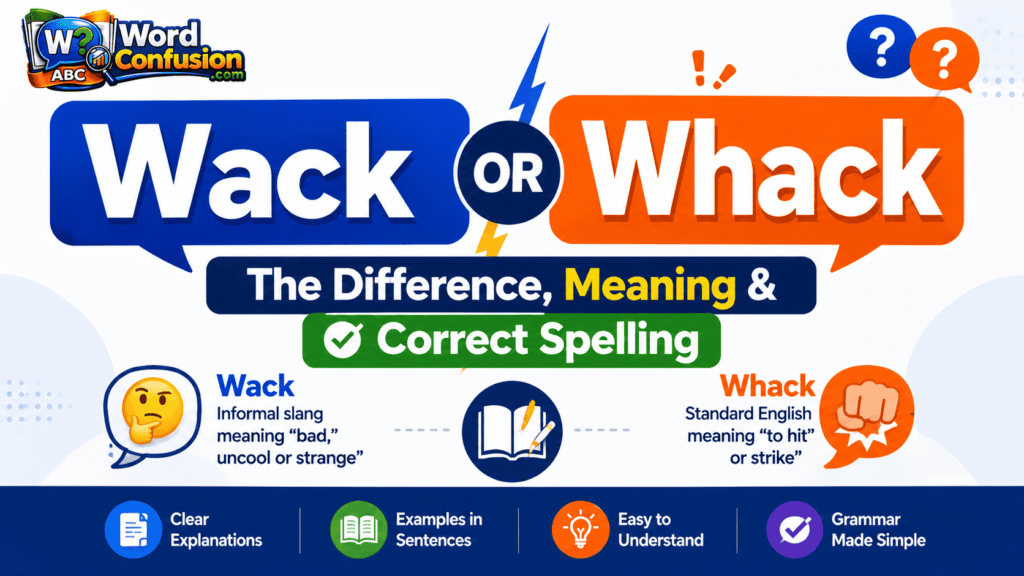
If you are wondering whether the correct spelling is wack or whack, the answer depends on what you mean.
Whack is the standard English word used for hitting or striking something, a hard blow, and expressions such as “out of whack.” Wack is commonly used as informal slang to describe something as bad, inferior, lame, disappointing, or uncool.
📖 See also:Different or Diffrent? Correct Spelling, Meaning & Usage
The two words are generally pronounced the same: /wæk/. That is why the spelling can be confusing.
| Word | Common meaning | Example |
| whack | To hit or strike; a hard blow | “He whacked the ball.” |
| wack | Slang for bad, inferior, lame, or uncool | “That movie was wack.” |
One important point: wack is not simply a misspelling of whack. It is an established informal/slang word, although dictionaries also record some overlap between the two spellings.
What Does Whack Mean?
Whack is a standard English word that can function as both a verb and a noun.
As a verb, whack means to hit or strike something, usually with considerable force.
As a noun, a whack can mean a hard hit or blow.
Whack as a verb
Examples:
- “She whacked the ball over the fence.”
- “He whacked the table with his hand.”
- “The branch whacked me in the face.”
- “The boxer whacked his opponent with a powerful punch.”
In these sentences, whack describes an action involving hitting or striking.
Whack as a noun
When used as a noun, whack can refer to a hit, blow, attempt, or share, depending on the context.
Examples:
- “He gave the door a hard whack.”
- “Let me have a whack at the problem.”
- “I’ll take a whack at fixing the computer.”
The expression “take a whack at something” means to try to do something or attempt to solve a problem.
What Does Wack Mean?
Wack is most commonly encountered as informal slang meaning something like:
- bad
- inferior
- lame
- disappointing
- ridiculous
- uncool
For example:
- “That movie was wack.”
- “The concert was wack.”
- “I can’t believe they served us that wack food.”
- “His excuse was pretty wack.”
In modern informal English, particularly in American slang, wack can be used to criticize something or describe it negatively.
Because it is slang, it is generally more appropriate in casual conversation, social media, music, entertainment, and other informal contexts than in formal academic or professional writing.
Wack vs Whack: What’s the Difference?
The easiest way to remember the main difference is this:
Whack is normally associated with hitting or striking.
Wack is commonly associated with something being bad, lame, or uncool.
Consider these examples:
- “He whacked the ball.” → He hit the ball.
- “That game was wack.” → The game was bad or disappointing.
The spelling changes, and so does the meaning.
However, there is an important linguistic nuance. Wack should not automatically be treated as an incorrect spelling. Dictionaries recognize wack as an established slang term, and some dictionary entries also record wack as a variant spelling of whack in certain uses.
So the safest rule is to look at the meaning and context, rather than assuming that every occurrence of wack is a spelling error.
Wack vs Whack: Quick Comparison
| Feature | Wack | Whack |
| Main use | Informal slang | Standard English |
| Common meaning | Bad, inferior, lame, uncool | Hit, strike, blow |
| Part of speech | Commonly an adjective in slang | Verb and noun |
| Pronunciation | /wæk/ | /wæk/ |
| Formal writing | Usually avoid when slang is intended | Appropriate when the meaning fits |
| Example | “That song is wack.” | “He whacked the ball.” |
| Common expression | — | “out of whack” |
| Can refer to hitting? | Not usually in modern slang usage | Yes |
Are Wack and Whack Pronounced the Same?
Yes. In their common modern uses, wack and whack are generally pronounced /wæk/.
The vowel sound is the same one you hear in words such as back, black, and track.
So if someone says:
“That movie was wack.”
and
“He gave the door a whack.”
you normally cannot tell which spelling they mean just from the pronunciation.
The spelling and context provide the distinction.
📖 See also:OTS Meaning in Text: What Does OTS Mean in Texting & Chat?
When Should You Use Wack or Whack?
Use this simple rule:
Use “whack” when you mean hit or strike.
- “Don’t whack the table.”
- “He whacked the ball.”
- “The branch whacked against the window.”
You should also use whack in established expressions such as “out of whack.”
Use “wack” when you mean bad or uncool in slang.
- “That movie was wack.”
- “Their new song sounds wack.”
- “The service at that restaurant was wack.”
Because wack is informal slang, choose a more standard adjective in formal writing.
Instead of:
“The report was wack.”
a professional writer would normally say:
“The report was poor.”
or:
“The report was badly written.”
Common Phrase: “Out of Whack”
One of the most common expressions containing whack is “out of whack.”
It means that something is not working properly, not balanced, or not in its normal condition.
Examples:
- “My sleep schedule is completely out of whack.”
- “The printer settings are out of whack.”
- “After traveling, my routine was out of whack.”
Notice the spelling:
out of whack ✅
out of wack ❌
When you mean this established expression, use whack.
“Take a Whack at It” Meaning
Another useful expression is “take a whack at something.”
It means to try something or make an attempt.
For example:
“I’ve never repaired a bike before, but I’ll take a whack at it.”
Here, whack does not mean that the person is going to hit the bike. It is part of an idiomatic expression meaning try.
You may also hear:
- “Have a whack at it.”
- “Give it a whack.”
- “I’ll take another whack at the problem.”
The exact meaning depends on the context.
Wack and Whack Example Sentences
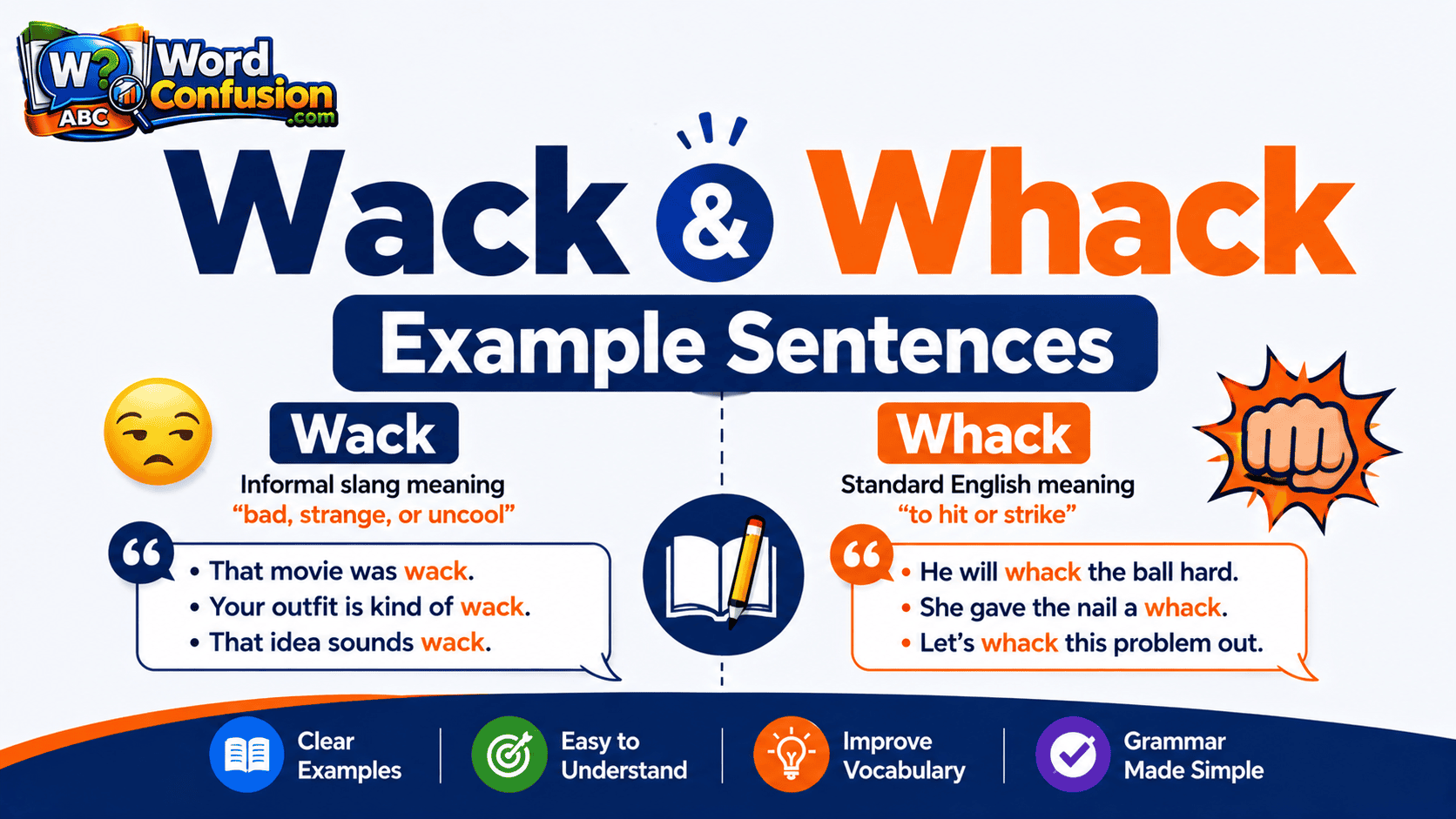
Examples with “wack”
- “That new restaurant is wack.”
- “The movie had a wack ending.”
- “I thought the game was pretty wack.”
- “That is a wack excuse.”
- “The whole situation was wack.”
These examples use wack in an informal, slang sense.
Examples with “whack”
- “He whacked the ball with his racket.”
- “She accidentally whacked her elbow against the door.”
- “The hammer gave the nail one final whack.”
- “My schedule is completely out of whack.”
- “I’ll take a whack at solving the problem.”
These examples show the standard meanings and common expressions associated with whack.
Is Wack a Real Word?
Yes, wack is a real word in English, particularly as an informal slang term.
It is not accurate to say that wack is always an incorrect spelling of whack.
Modern dictionaries recognize wack with slang meanings such as bad, inferior, or not good. Some dictionaries also record wack in other senses or as a variant of whack.
That means the better distinction is:
Wack = an established informal/slang form with its own common meaning.
Whack = the standard spelling for the common “hit,” “strike,” and “blow” senses.
If you are writing a formal essay, business report, academic paper, or professional document, however, slang such as wack is usually best avoided unless you are discussing the word itself or quoting informal language.
📖 See also:Sapphire or Saphire? The Correct Spelling Explained
Is Whack Correct English?
Yes. Whack is a standard English word.
It can be used as both a verb and a noun.
As a verb:
“He whacked the ball.”
As a noun:
“I heard a loud whack.”
It also appears in established expressions such as:
“The system is out of whack.”
So if you are trying to spell the word meaning hit, strike, or blow, whack is normally the spelling you want.
Why Do People Confuse Wack and Whack?
The confusion mainly comes from pronunciation.
Both forms are generally pronounced /wæk/, so someone who has only heard the word spoken may not know whether it contains w or wh.
There is also a second reason: wack has become familiar through informal English and slang.
When people encounter expressions such as:
- “That is wack.”
- “This is so wack.”
- “What a wack movie.”
they may naturally connect the spelling with whack, especially because the two forms sound alike.
The result is a common spelling confusion.
A Note About Formal and Informal English
Register matters when choosing between the words.
Whack is perfectly normal English and can appear in everyday, professional, literary, and descriptive contexts when its meaning is appropriate.
Wack, when used to mean “bad” or “uncool,” is slang.
For example, in casual conversation:
“That idea is wack.”
But in formal writing:
“That idea is ineffective.”
or:
“That proposal has several serious weaknesses.”
The second versions communicate the criticism more precisely and professionally.
Where Did Whack Come From?
The history of whack is older than the modern slang use of wack.
The verb whack is recorded from the early 18th century and is generally considered likely to have an imitative origin. Its sound naturally fits the idea of a sudden hit or blow.
Over time, the word developed several related uses as both a verb and noun.
This helps explain why whack is so strongly associated with hitting, striking, and blows.
Where Did Wack Come From?
The history of wack is more complicated because the spelling has appeared in different uses.
Modern American slang uses wack to mean something like bad, inferior, strange, or uncool. The term became particularly familiar through informal speech and popular culture.
The important point for modern English learners is not to memorize a complicated history but to recognize the common distinction:
wack → slang describing something negatively
whack → hit, strike, blow, or related expressions
Common Mistakes With Wack and Whack
Mistake 1: Using “wack” for “hit”
Incorrect:
“He wacked the ball.”
Better:
“He whacked the ball.”
When you mean hit, use whack.
Mistake 2: Writing “out of wack”
Incorrect:
“My schedule is out of wack.”
Correct:
“My schedule is out of whack.”
The established expression is out of whack.
Mistake 3: Calling every “wack” a spelling mistake
This is also misleading.
If someone writes:
“That movie is wack.”
they may be deliberately using slang to mean bad or uncool.
In that context, wack is not simply a typo for whack.
Mistake 4: Using slang in formal writing
Even though wack is recognized as a word, its slang use is informal.
For academic, business, or professional writing, choose a more precise standard adjective such as:
- poor
- inferior
- ineffective
- disappointing
- unreasonable
- unusual
depending on what you actually mean.
An Easy Memory Trick
Use this simple memory aid:
WHACK → H for Hit
If you mean hit, strike, or blow, think of the H in whack.
He whacked the ball.
If you mean bad or uncool in slang, think:
That movie was wack.
This is only a memory trick, not a complete rule for every historical or dictionary use of the two spellings.
Wack or Whack: Which One Is Correct?
Both wack and whack can be correct, but they are not normally interchangeable in everyday modern usage.
Use whack for the standard word meaning to hit or strike, for a blow, and in expressions such as out of whack.
Use wack when you are using the informal slang adjective meaning bad, inferior, lame, disappointing, or uncool.
So:
“He whacked the ball.” ✅
“That movie was wack.” ✅
“My schedule is out of whack.” ✅
The key is not simply the spelling. The meaning determines the word.
📖 See also:What Does WFH Mean in Text? Meaning, Examples & Usage
FAQs
Is it wack or whack?
Both spellings exist, but they are commonly used for different meanings. Whack is normally used for hitting, striking, a blow, and expressions such as “out of whack.” Wack is commonly used as slang meaning bad, inferior, lame, or uncool.
What is the difference between wack and whack?
Whack is the standard English word associated with hitting, striking, or a blow. Wack is commonly an informal slang adjective meaning bad, inferior, or uncool. Both are generally pronounced /wæk/.
Is wack a correct spelling?
Yes. Wack is an established informal/slang word. It should not automatically be treated as a misspelling of whack. However, if you mean “hit” or “strike,” whack is normally the appropriate spelling.
Is whack the correct English spelling?
Yes. Whack is the standard spelling for the common verb meaning “to hit or strike” and the related noun meaning “a blow.” It also appears in expressions such as out of whack.
What does wack mean?
In slang, wack commonly means bad, inferior, lame, disappointing, or uncool.
Example:
“That movie was wack.”
What does whack mean?
Whack can mean to hit or strike something, or it can refer to a hard hit or blow.
Example:
“He whacked the ball.”
Does wack mean hit?
Usually, no—not in the common modern slang use. If you mean hit or strike, use whack. However, some dictionaries record wack as a variant of whack in certain uses, so the complete linguistic picture is more nuanced.
Is wack a slang word?
Yes. Wack is commonly used as informal slang for something that is bad, inferior, lame, or uncool.
Are wack and whack pronounced the same?
Yes. In their common modern uses, both are generally pronounced /wæk/. The spelling is therefore not obvious from hearing the word.
When should I use wack?
Use wack when you intentionally mean the informal slang sense of bad, inferior, lame, or uncool.
When should I use whack?
Use whack when you mean hit, strike, blow, or when using expressions such as out of whack or take a whack at something.
How do you spell whack?
The standard spelling is whack: W-H-A-C-K.
How do you spell wack?
The slang spelling is wack: W-A-C-K.
Final Takeaway
The easiest way to remember wack vs whack is:
WHACK = hit, strike, blow, or related expressions
WACK = slang for bad, lame, inferior, or uncool
Both are generally pronounced /wæk/, which explains why they are so often confused.
Most importantly, don’t assume that wack is always a misspelling. It is an established informal word with its own slang meaning, while whack is the standard spelling for the common “hit” or “strike” sense.
When in doubt, focus on the meaning:
“He whacked it.” → He hit it.
“That was wack.” → That was bad or uncool.
That simple distinction will help you choose the right word in most everyday situations.
Looking for more English word meanings, grammar tips, and commonly confused words? Visit the WordConfusion homepage to explore our latest language guides, spelling differences, vocabulary explanations, text abbreviations, and practical examples. Whether you’re learning English or improving your writing skills, you’ll find clear, easy-to-understand resources for everyday communication.
Written by
 Abdul Moeed
Abdul Moeed is a professional content writer and SEO link-building specialist with 5+ years of experience. He creates search-optimized content and develops effective SEO strategies that improve website visibility, authority, and organic growth.
View LinkedIn profileLatest posts
 What Does PG Mean in Text? Meaning, Examples & Usage
 What Does OFCC Mean in Text? Meaning, Uses & Examples
 What Does MSG Mean in Text? Meaning, Examples & Usage
 What Does STY Mean in Text? Meaning, Examples & Usage
 What Does “Twin” Mean in Slang? Meaning, Text & Examples
 What Does LMC Mean in Text? Meaning, Examples & Usage