What Does JFC Mean in Text? Meaning, Slang & Examples

If someone texts you “JFC”, they are usually expressing a strong reaction such as shock, frustration, disbelief, annoyance, or exasperation. JFC stands for “Jesus fucking Christ” and is commonly used as an informal, vulgar expression in texting, chats, comments, and social media.
Because the phrase contains profanity, JFC is generally best reserved for casual conversations rather than professional, academic, or formal communication.
📖 See also:Implicit vs Complicit: Meaning, Differences & Examples
What Does JFC Mean in Text?
JFC in text usually means “Jesus fucking Christ.” It is an internet slang initialism used as a strong emotional reaction.
Depending on the context, someone might use JFC to express:
- Shock
- Surprise
- Frustration
- Disbelief
- Annoyance
- Exasperation
- Amusement or disbelief at something unexpected
For example:
“JFC, that was expensive!”
Here, JFC emphasizes the speaker’s frustration or surprise about the price.
The exact emotion depends on the rest of the conversation, punctuation, emojis, and the relationship between the people communicating.
What Does JFC Stand For?
JFC stands for “Jesus fucking Christ.”
The expression uses the name Jesus Christ as an exclamation, while the added profanity makes the reaction much stronger.
JFC is generally considered an initialism because the letters are normally pronounced individually: J-F-C.
You may also see it described as a slang abbreviation or texting acronym. In everyday internet communication, these labels are often used interchangeably.
What Does JFC Mean in Texting and Chat?
In texting, JFC usually works as an emotional reaction rather than a literal statement.
For example:
“JFC, you scared me!”
The sender isn’t necessarily making a religious statement. They are using JFC to emphasize how strongly they reacted.
Similarly:
“JFC, look at that traffic.”
This could communicate frustration, surprise, or disbelief.
The meaning becomes clearer when you consider the surrounding message.
JFC can communicate different emotions
| Context | Likely meaning |
| Unexpected news | Shock or surprise |
| Something goes wrong | Frustration |
| An unbelievable story | Disbelief |
| Someone repeats a mistake | Annoyance or exasperation |
| An impressive result | Strong surprise |
| A funny situation | Exaggerated reaction |
So, JFC does not always mean that someone is angry. Context matters.
JFC Text Message Examples
Here are some natural examples of how JFC can appear in casual messages:
1. Surprise
“JFC, you actually won!”
2. Frustration
“JFC, this computer keeps crashing.”
3. Disbelief
“JFC, did you really pay $500 for that?”
4. Shock
“JFC! I just saw what happened.”
5. Annoyance
“JFC, I’ve told him three times already.”
6. Exasperation
“JFC, this day couldn’t get any worse.”
7. Reaction to something impressive
“JFC, that car is fast.”
8. Humor
“JFC 😂 I can’t believe you actually did that.”
9. Social media reaction
“JFC, this video is wild.”
10. Bad news
“JFC, I’m sorry. That’s terrible.”
These examples show why the surrounding conversation matters. The same abbreviation can communicate different shades of emotion.
Is JFC a Bad Word or Offensive?
JFC is generally considered vulgar and potentially offensive because the full expression contains profanity.
That does not mean everyone will react to it in the same way. Some people use JFC casually with close friends and may not consider it particularly serious. Others may find the expression offensive because of the profanity or its religious reference.
A useful rule is:
Treat JFC as strong informal language, not as a neutral abbreviation.
It is usually safer in casual conversations with people who are comfortable with profanity.
Avoid using it when communicating with:
- Employers
- Customers
- Teachers
- Professors
- Professional contacts
- People you do not know well
- Formal or conservative audiences
What Does JFC Mean in a Text From a Girl or Guy?
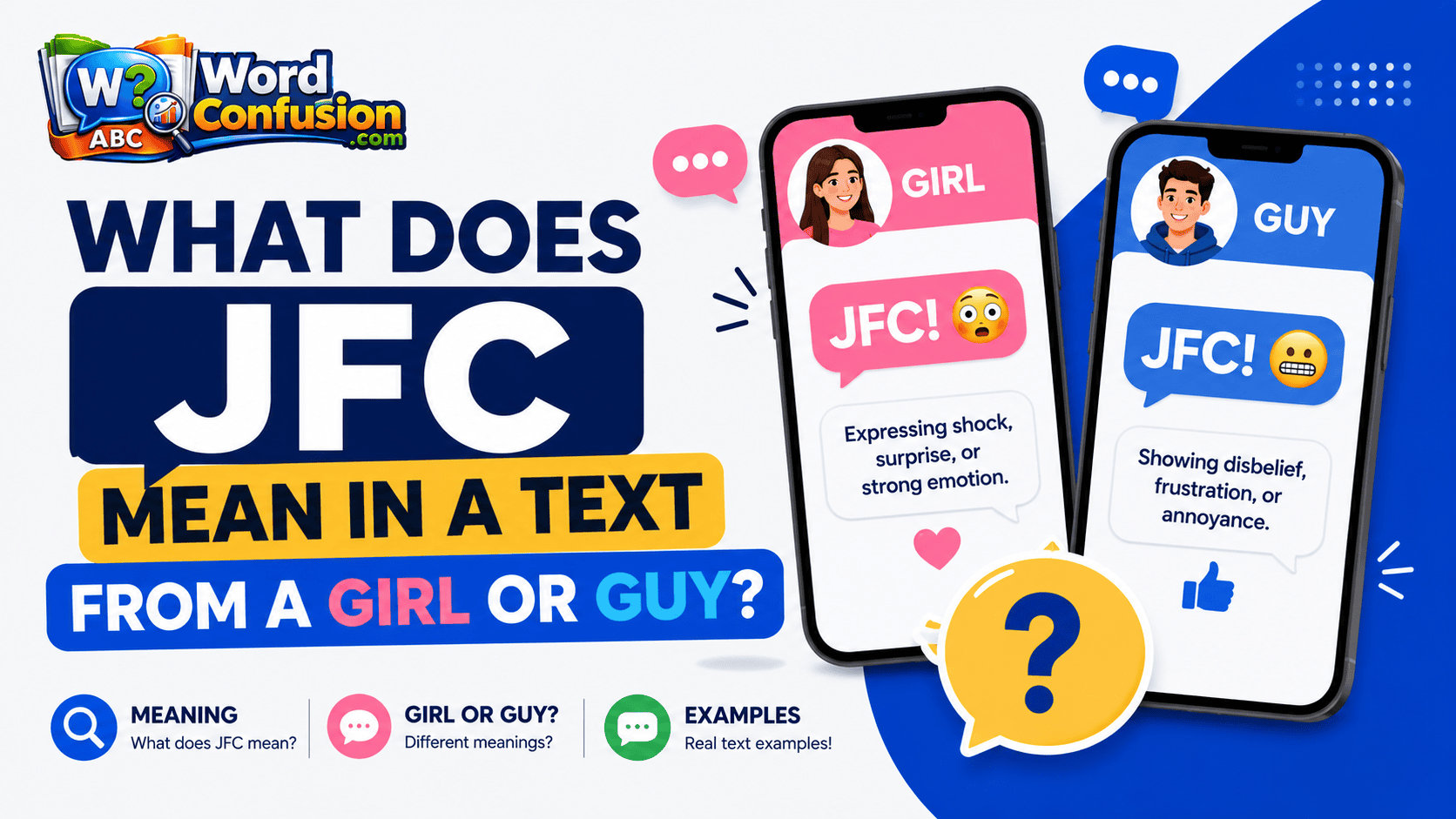
The basic meaning of JFC does not change based on whether the sender is a girl or a guy.
If someone texts:
“JFC, you’re crazy 😂”
the meaning depends on the conversation, not the sender’s gender.
For example:
- “JFC, that’s amazing!” → strong excitement or surprise
- “JFC, I’m so tired.” → frustration or exhaustion
- “JFC, are you serious?” → disbelief
- “JFC 😂” → amused shock or disbelief
- “JFC, stop doing that.” → annoyance or frustration
If you’re unsure what the sender means, look at the messages immediately before and after JFC.
📖 See also:Notable vs Noteable: Which Spelling Is Correct?
What Does JFC Mean on Snapchat, Instagram, or TikTok?
JFC has essentially the same slang meaning on Snapchat, Instagram, TikTok, Facebook, and other social platforms.
It can appear in:
- Direct messages
- Comments
- Captions
- Group chats
- Replies
- Text messages
For example:
“JFC this video 😂”
could mean the person is shocked, amused, impressed, or overwhelmed by what they saw.
The platform itself usually doesn’t change the meaning. Context determines the tone.
How Do You Respond to JFC?
Your response should depend on what emotion the person is expressing.
If they are surprised
“I know! I couldn’t believe it either.”
If they are frustrated
“Yeah, that’s seriously annoying.”
If they are joking
“I know 😂 That was wild.”
If they are reacting to good news
“Right?! I was shocked too.”
If you’re not sure what they mean
“Wait, are you surprised or annoyed?”
You don’t need to respond to the abbreviation itself. Respond to the situation or emotion behind it.
JFC vs. OMG vs. WTF
JFC, OMG, and WTF can all appear when someone has a strong reaction, but they aren’t identical.
| Expression | Common meaning | Typical tone | Formal? |
| OMG | Surprise, excitement, shock | Mild to moderate | No |
| JFC | Shock, frustration, disbelief, exasperation | Strong and vulgar | No |
| WTF | Confusion, surprise, disbelief, anger | Strong and vulgar | No |
| Jeez | Surprise, annoyance, frustration | Mild | Informal |
| Good grief | Surprise or frustration | Mild | More socially acceptable |
In general, JFC sounds stronger than OMG because of the profanity in its full form.
Can You Use JFC in Formal Communication?
Generally, no.
JFC is not appropriate for most formal writing or professional communication.
Avoid it in:
- Business emails
- Job applications
- Academic assignments
- Official documents
- Customer-service communication
- Professional reports
- Formal presentations
Instead, choose a neutral expression such as:
- “Wow”
- “That’s surprising.”
- “I can’t believe it.”
- “That’s unbelievable.”
- “Seriously?”
- “Oh my gosh.”
- “That’s frustrating.”
The safer alternative depends on the emotion you want to express.
Does JFC Have Other Meanings?
Yes. Like many abbreviations, JFC can have different meanings outside texting and internet slang.
For example, in computing, JFC can refer to Java Foundation Classes, a group of Java technologies associated with building graphical user interfaces.
Therefore, context is important.
If you see JFC in a casual text message such as:
“JFC, what just happened?”
it almost certainly refers to the slang expression.
If you see JFC in a programming or software-development discussion, it could have an entirely different meaning.
Common Mistakes When Interpreting JFC
Mistake 1: Assuming JFC always means anger
It doesn’t. JFC can express shock, disbelief, frustration, amusement, or surprise.
Mistake 2: Assuming the abbreviation is not offensive
The shortened form still represents a vulgar expression. Abbreviating profanity doesn’t automatically make it appropriate for formal situations.
Mistake 3: Assuming the sender is insulting you
Someone may use JFC as a reaction to a situation rather than as a personal attack.
For example:
“JFC, that’s expensive!”
The speaker is reacting to the price, not necessarily criticizing the person.
Mistake 4: Ignoring context
“JFC 😂” and “JFC, what the hell are you doing?” can have very different tones.
Look at the complete conversation before deciding what the sender means.
📖 See also:What Does EYP Mean in Text? Meaning, Slang & Examples
Frequently Asked Questions
What does JFC mean in text?
JFC usually means “Jesus fucking Christ.” It is an informal and vulgar expression used to communicate strong emotions such as shock, frustration, disbelief, annoyance, or exasperation.
What does JFC stand for?
JFC stands for “Jesus fucking Christ.” In texting and online communication, it is normally used as a strong emotional exclamation.
What does JFC mean in texting?
In texting, JFC is commonly used to show a strong reaction. Depending on context, it can express surprise, frustration, disbelief, annoyance, shock, or amusement.
Is JFC a slang word?
Yes. JFC is commonly used as internet and texting slang. More precisely, it is an initialism representing a vulgar expression.
Is JFC offensive?
JFC can be offensive because its full form contains profanity and uses a religious reference. How offensive it seems depends on the audience, context, and personal sensitivity.
What does JFC mean from a girl?
The meaning is generally the same regardless of the sender’s gender. The surrounding conversation determines whether the sender is expressing surprise, frustration, disbelief, amusement, or another strong emotion.
What does JFC mean from a guy?
It generally has the same meaning: a strong informal reaction such as shock, frustration, disbelief, or annoyance. The context matters more than the sender’s gender.
How do you respond to JFC?
Respond according to the situation. If the person is shocked, you can acknowledge the surprise. If they are frustrated, respond to the problem. .If you’re unsure about their tone, ask what they mean.
Can JFC be used in formal communication?
It is best avoided in formal or professional communication because it is vulgar and highly informal. Use neutral expressions such as “Wow,” “Seriously?” or “I can’t believe it” instead.
Final Takeaway
JFC usually means “Jesus fucking Christ” in texting and online slang. It is a strong, vulgar expression used to communicate emotions such as shock, frustration, disbelief, annoyance, or exasperation.
The best way to understand JFC is to look at the context and surrounding conversation. While it may be perfectly normal between friends who regularly use profanity, it is generally inappropriate for professional, academic, or formal communication.
Looking for more English word meanings, grammar tips, and commonly confused words? Visit the WordConfusion homepage to explore our latest language guides, spelling differences, vocabulary explanations, text abbreviations, and practical examples. Whether you’re learning English or improving your writing skills, you’ll find clear, easy-to-understand resources for everyday communication.
Written by
 Abdul Moeed
Abdul Moeed is a professional content writer and SEO link-building specialist with 5+ years of experience. He creates search-optimized content and develops effective SEO strategies that improve website visibility, authority, and organic growth.
View LinkedIn profileLatest posts
 What Does PG Mean in Text? Meaning, Examples & Usage
 What Does OFCC Mean in Text? Meaning, Uses & Examples
 What Does MSG Mean in Text? Meaning, Examples & Usage
 What Does STY Mean in Text? Meaning, Examples & Usage
 What Does “Twin” Mean in Slang? Meaning, Text & Examples
 What Does LMC Mean in Text? Meaning, Examples & Usage