Uninclined vs. Disinclined: Differences, Usage, and Examples

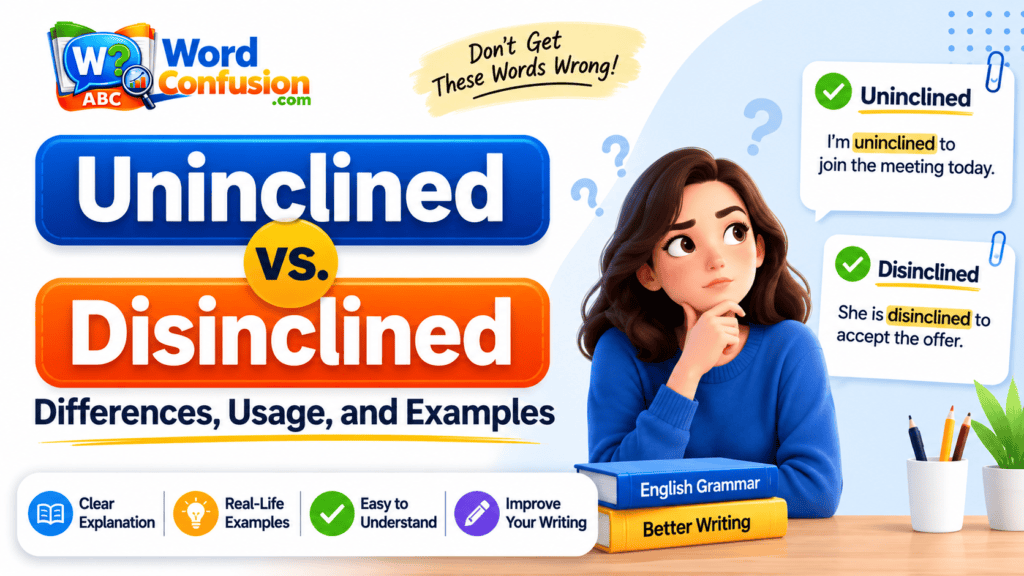
Have you ever wondered whether uninclined and disinclined mean exactly the same thing? At first glance, they both describe a lack of willingness, so it’s easy to confuse them. However, there is a subtle difference in meaning and tone that can make one word a better choice than the other.
In this guide, you’ll learn the meaning of each word, how they differ, when to use them, and how to avoid common mistakes. By the end, you’ll know which word fits best in everyday conversations, academic writing, and professional communication.
📖 See also: Using or Useing: Which Spelling Is Correct?
Quick Answer
The main difference between uninclined and disinclined is the degree of unwillingness they express.
- Uninclined means not naturally interested, willing, or motivated to do something. It usually suggests mild hesitation or a simple lack of desire.
- Disinclined means reluctant or unwilling to do something. It often conveys a stronger and more deliberate resistance.
Although the two words are closely related, disinclined generally carries a firmer negative tone than uninclined.
Key takeaway: If someone simply lacks interest, uninclined is often the better choice. If they actively resist or are reluctant, disinclined is usually more accurate.
Featured Snippet
Uninclined and disinclined both describe a lack of willingness, but they differ in strength. Uninclined usually means not naturally interested or motivated, while disinclined suggests stronger reluctance or unwillingness. Although they are similar, disinclined often expresses a more deliberate resistance than uninclined.
Uninclined vs. Disinclined: Quick Comparison
| Feature | Uninclined | Disinclined |
| Basic meaning | Not willing or interested | Reluctant or unwilling |
| Strength | Mild | Stronger |
| Tone | Neutral | More negative |
| Suggests resistance | Usually no | Often yes |
| Common in formal writing | Yes | Yes |
| Typical pattern | Be uninclined to + verb | Be disinclined to + verb |
| Example | She was uninclined to argue. | She was disinclined to accept the offer. |
What Does Uninclined Mean?
Definition
Uninclined means not naturally willing, interested, or likely to do something. It describes a person who simply does not feel motivated or eager to act.
Unlike stronger words such as reluctant or disinclined, uninclined often sounds calm and neutral rather than resistant.
Simple definition
Uninclined = not interested enough or not willing enough to do something.
When to Use Uninclined
Use uninclined when someone:
- lacks enthusiasm
- has little interest
- doesn’t feel motivated
- prefers not to do something without strongly opposing it
The word often describes a temporary attitude rather than a firm refusal.
Common grammar pattern
Be + uninclined + to + base verb
Examples:
- She was uninclined to complain.
- I’m uninclined to believe the rumor.
- They seemed uninclined to continue the discussion.
Tone of Uninclined
One of the easiest ways to remember this word is by its tone.
It usually sounds:
- neutral
- polite
- restrained
- mildly hesitant
It rarely suggests anger or strong opposition.
For example:
The manager was uninclined to schedule another meeting.
This sentence suggests the manager simply didn’t think another meeting was necessary—not that they strongly objected to it.
Examples of Uninclined in Sentences
Everyday Conversation
- I’m uninclined to go out tonight because I’m tired.
- She seemed uninclined to watch another movie.
- He was uninclined to join the discussion.
Workplace
- The team was uninclined to change the project timeline without evidence.
- Our client appeared uninclined to approve additional spending.
Academic Writing
- Some researchers remain uninclined to accept the hypothesis without further evidence.
- The committee was uninclined to revise the grading policy this semester.
Professional Communication
- Investors were uninclined to support the proposal after reviewing the risks.
- The board seemed uninclined to delay the decision.
Common Synonyms
Depending on the context, uninclined can be similar to:
- unwilling
- uninterested
- hesitant
- reluctant
- not eager
- indifferent
However, these words are not always interchangeable.
For example, indifferent focuses on a lack of concern, while uninclined emphasizes a lack of willingness to act.
What Does Disinclined Mean?
Definition
Disinclined means reluctant or unwilling to do something. It usually suggests that a person has considered the situation and prefers not to take a particular action.
Compared with uninclined, disinclined often expresses a stronger feeling of resistance.
Simple definition
Disinclined = reluctant or unwilling because you do not want to do it.
When to Use Disinclined
Choose disinclined when someone:
- deliberately avoids doing something
- feels reluctant
- resists an idea
- prefers not to participate
- is unwilling after considering the situation
It often appears in formal English, journalism, business writing, and academic contexts.
Common Grammar Pattern
Be + disinclined + to + base verb
Examples:
- She was disinclined to negotiate further.
- They are disinclined to invest at the moment.
- He seemed disinclined to answer additional questions.
Tone of Disinclined
Compared with uninclined, disinclined usually sounds:
- firmer
- more deliberate
- slightly more formal
- more resistant
It doesn’t necessarily mean complete refusal, but it clearly signals stronger reluctance.
For example:
The witness was disinclined to discuss the incident publicly.
📖 See also: Encode vs Incode: Which Is Correct? Meaning, Usage & Examples
This suggests the witness consciously preferred not to speak about it.
Examples of Disinclined in Sentences
Everyday Conversation
- I’m disinclined to lend money again.
- She felt disinclined to attend the reunion.
Workplace
- Management is disinclined to approve unnecessary expenses.
- The company remains disinclined to expand into new markets this year.
Academic Writing
- Several scholars remain disinclined to accept the revised interpretation.
- Participants were disinclined to change their responses after the experiment.
Business Communication
- Investors appeared disinclined to support the acquisition.
- The board was disinclined to postpone the vote.
Common Synonyms
Depending on the context, disinclined may be similar to:
- reluctant
- unwilling
- resistant
- hesitant
- opposed
- averse
Among these, reluctant is usually the closest in meaning.
However, averse often expresses much stronger dislike than disinclined, while hesitant may simply indicate uncertainty rather than unwillingness.
Uninclined vs. Disinclined: Key Differences
Although uninclined and disinclined are closely related, they are not always interchangeable. The biggest difference lies in how strongly they express unwillingness.
- Uninclined suggests a mild lack of interest or willingness.
- Disinclined suggests a more deliberate reluctance or resistance.
Think of them as different points on the same scale:
Inclined → Uninclined → Disinclined
Someone who is inclined wants to do something. .Someone who is uninclined simply doesn’t feel like doing it. .Someone who is disinclined has a clearer preference not to do it.
Side-by-Side Comparison Table
| Feature | Uninclined | Disinclined |
| Meaning | Not naturally willing or interested | Reluctant or unwilling |
| Degree of unwillingness | Mild | Moderate to strong |
| Emotional tone | Neutral | More negative |
| Suggests active resistance | Rarely | Often |
| Typical contexts | Everyday, academic, formal writing | Formal, academic, business, journalism |
| Implies a conscious decision | Not necessarily | Usually |
| Grammar pattern | Be uninclined to + verb | Be disinclined to + verb |
| Example | She was uninclined to argue. | She was disinclined to cooperate. |
The Difference in Tone
Tone is often the deciding factor when choosing between these words.
Use Uninclined for a Softer Tone
This word works well when someone simply lacks enthusiasm or interest.
Examples
- I’m uninclined to stay out late tonight.
- She seemed uninclined to comment on the issue.
- They were uninclined to make quick decisions.
None of these sentences suggests strong opposition. They simply describe a lack of desire.
Use Disinclined for Stronger Reluctance
Choose disinclined when you want to emphasize a conscious unwillingness.
Examples
- The company was disinclined to negotiate further.
- He appeared disinclined to apologize.
- Investors remained disinclined to accept the proposal.
These examples communicate a firmer attitude than uninclined.
Are They Interchangeable?
Sometimes—but not always.
In many situations, either word is grammatically correct, but the tone changes.
Example 1
She was uninclined to answer the question.
Meaning:
She simply didn’t feel like answering.
She was disinclined to answer the question.
Meaning:
She deliberately preferred not to answer.
The difference is subtle, but readers often perceive disinclined as expressing stronger reluctance.
Example 2
The students were uninclined to participate.
This suggests low enthusiasm.
The students were disinclined to participate.
This suggests they actively preferred not to participate.
Which Word Should You Choose?
If you’re unsure which adjective fits your sentence, ask yourself one question:
How strong is the unwillingness?
Choose Uninclined when someone is:
- not especially interested
- mildly hesitant
- lacking motivation
- politely declining
- simply not eager
Examples
- I’m uninclined to watch another episode tonight.
- She was uninclined to change her routine.
- They seemed uninclined to travel during the winter.
Choose Disinclined when someone is:
- reluctant
- resistant
- intentionally unwilling
- consciously avoiding something
- expressing a firmer refusal
Examples
- He was disinclined to compromise.
- The board remained disinclined to postpone the meeting.
- They were disinclined to share confidential information.
Quick Decision Guide
Do you mean a simple lack of interest?
│
Yes
│
Use “Uninclined”
│
No
│
Do you mean deliberate reluctance?
│
Yes
│
Use “Disinclined”
Grammar Rules
Both uninclined and disinclined are adjectives.
They most commonly appear after linking verbs such as:
- be
- seem
- become
- remain
- appear
- feel
Common Sentence Pattern
Subject + linking verb + adjective + to + base verb
Examples:
- She is uninclined to complain.
- They seem disinclined to cooperate.
- We remain uninclined to interfere.
- He appeared disinclined to continue.
This is the most natural and widely accepted structure in modern English.
Grammar Tips
✔ Correct
- She was uninclined to participate.
- They were disinclined to invest.
✘ Less Natural
- She was an uninclined person toward participating.
- They were disinclined about investing.
Using to + base verb produces clearer, more idiomatic English.
Formal vs. Informal Usage
Both words are understood in everyday English, but they appear more often in formal writing than in casual conversation.
| Context | Better Choice |
| Casual conversation | Usually simpler words like don’t want to, not interested, or reluctant |
| Workplace communication | Both are appropriate |
| Academic writing | Both are appropriate |
| Journalism | Both are common |
| Legal or official writing | Both work well |
In informal speech, native speakers often prefer:
- don’t want to
- not interested
- reluctant
- unwilling
Instead of:
- uninclined
- disinclined
Professional Writing Tips
Choose uninclined when you want your writing to sound objective and neutral.
Example
The committee was uninclined to revise the policy without additional evidence.
Choose disinclined when you want to emphasize a stronger position.
Example
The committee was disinclined to approve the proposal because of budget concerns.
Both are correct, but the second sentence communicates greater resistance.
Common Usage Patterns
Uninclined
- uninclined to agree
- uninclined to argue
- uninclined to participate
- uninclined to believe
- uninclined to continue
- uninclined to interfere
Disinclined
- disinclined to cooperate
- disinclined to negotiate
- disinclined to invest
- disinclined to discuss
- disinclined to disclose
- disinclined to accept
These combinations are common in formal English and sound natural to both native speakers and advanced English learners.
Mini Summary
The easiest way to remember the difference is this:
- Uninclined = not especially willing (mild, neutral)
- Disinclined = reluctant or unwilling (stronger, more deliberate)
Both words are grammatically correct, but choosing the right one depends on the tone and degree of reluctance you want to express.
Sentence Examples
The best way to understand the difference between uninclined and disinclined is to see how they work in real-life situations. Notice how the tone changes depending on which word is used.
Everyday Conversation Examples
Uninclined
These examples express a mild lack of interest or enthusiasm.
- I’m uninclined to cook tonight, so let’s order dinner.
- She was uninclined to go shopping after work.
- He seemed uninclined to join us for coffee.
- We were uninclined to watch another movie.
- My brother is uninclined to wake up early on weekends.
Disinclined
These examples suggest stronger reluctance or a deliberate choice not to do something.
- I’m disinclined to lend money again after my last experience.
- She is disinclined to discuss her personal life.
- He seemed disinclined to apologize.
- They were disinclined to attend the meeting.
- We’re disinclined to make any changes at this stage.
Workplace Examples
Uninclined
- The team was uninclined to change the project schedule without evidence.
- Our manager seemed uninclined to approve unnecessary expenses.
- Employees were uninclined to adopt the new process immediately.
- The client appeared uninclined to request additional features.
- She was uninclined to interrupt the presentation.
Disinclined
- The board was disinclined to postpone the vote.
- Management remained disinclined to increase the budget.
- Investors were disinclined to support the proposal.
- The company was disinclined to disclose confidential information.
- The director appeared disinclined to negotiate further.
Academic Writing Examples
Uninclined
- Some researchers remain uninclined to accept the theory without stronger evidence.
- Students were uninclined to participate in optional workshops.
- The committee seemed uninclined to revise the curriculum.
- Participants were uninclined to alter their responses.
- Several reviewers were uninclined to recommend publication.
Disinclined
- Scholars were disinclined to support the proposed interpretation.
- Reviewers appeared disinclined to overlook methodological weaknesses.
- Participants remained disinclined to share personal information.
- The panel was disinclined to extend the deadline.
- Researchers were disinclined to draw conclusions without additional data.
Business Communication Examples
Uninclined
- The supplier was uninclined to revise the pricing agreement.
- Customers seemed uninclined to purchase the premium package.
- The marketing team was uninclined to launch the campaign early.
- Executives were uninclined to alter the company’s strategy.
- Our partners appeared uninclined to expand the project this year.
Disinclined
- The investor was disinclined to finance another startup.
- The company remained disinclined to enter a high-risk market.
- The board was disinclined to approve additional hiring.
- Clients were disinclined to sign a long-term contract.
- Executives appeared disinclined to discuss the merger publicly.
Creative Writing Examples
Uninclined
- Emma felt uninclined to leave the quiet village she loved.
- The old sailor was uninclined to trust strangers.
- Daniel seemed uninclined to challenge tradition.
- The prince was uninclined to seek power.
- She remained uninclined to reveal her secret.
Disinclined
- The detective was disinclined to believe the suspect’s story.
- The queen appeared disinclined to forgive the betrayal.
- The villagers were disinclined to welcome outsiders.
- He was disinclined to abandon his lifelong dream.
- The captain remained disinclined to surrender.
Common Mistakes
Because these words are similar, writers sometimes choose the wrong one. Here are the most common mistakes and how to avoid them.
Mistake 1: Treating Them as Perfect Synonyms
❌ The committee was disinclined to comment because it simply had no opinion yet.
✔ The committee was uninclined to comment because it had not reached a decision.
Why?
A simple lack of readiness or interest is better expressed with uninclined. Disinclined suggests a more deliberate unwillingness.
Mistake 2: Using Disinclined for Mild Situations
❌ I’m disinclined to watch TV tonight because I’m a little tired.
✔ I’m uninclined to watch TV tonight because I’m a little tired.
If the hesitation is minor, uninclined sounds more natural.
Mistake 3: Confusing Disinclined with Averse
These words are related but not identical.
📖 See also: Leafs or Leaves? Which Is the Correct Plural of Leaf?
Disinclined
Means reluctant or unwilling.
She was disinclined to travel this winter.
Averse
Means strongly opposed or having a strong dislike.
She is averse to taking unnecessary risks.
Averse expresses a much stronger feeling than disinclined.
Mistake 4: Overusing Either Word in Casual English
While both words are correct, native speakers often use simpler alternatives in everyday conversation.
Instead of:
- I’m uninclined to go.
Many people simply say:
- I don’t feel like going.
Instead of:
- She’s disinclined to help.
People often say:
- She’s reluctant to help.
Choosing the simpler expression can make your writing sound more natural when the context is informal.
Related Words and Their Differences
Understanding nearby words helps you choose the most precise expression.
| Word | Meaning | Compared with Uninclined and Disinclined |
| Reluctant | Hesitant because of doubt or discomfort | Very close to disinclined, but more common in everyday English. |
| Unwilling | Not willing to do something | Stronger than uninclined and often similar to disinclined. |
| Hesitant | Unsure or uncertain | Focuses on doubt rather than unwillingness. |
| Averse | Strongly opposed or having a strong dislike | Much stronger than disinclined. |
| Opposed | Against an idea or action | Suggests direct disagreement rather than simple reluctance. |
Choosing the Right Word
Use this simple scale to remember the differences:
Interested
│
Inclined
│
Uninclined
│
Disinclined
│
Unwilling
│
Averse
As you move down the scale, the feeling of resistance becomes stronger.
Memory Trick
Here’s an easy way to remember the difference.
Think About the Prefixes
Un- often means not.
So:
Uninclined = not inclined
This suggests a neutral lack of interest.
Dis- often suggests separation, opposition, or moving away from something.
So:
Disinclined = moving away from being inclined
This naturally sounds stronger and more resistant.
A Simple Sentence to Remember
Uninclined means “I don’t really want to.”
Disinclined means “I’d rather not.”
That small shift in attitude captures the difference surprisingly well and makes it easier to choose the right word in context.
Writer’s Tip
If both words seem possible, ask yourself:
“Am I describing a lack of enthusiasm or an active reluctance?”
- Lack of enthusiasm → Uninclined
- Active reluctance → Disinclined
This question will help you select the more precise word in most situations.
Frequently Asked Questions
What is the difference between uninclined and disinclined?
The main difference is the degree of unwillingness. Uninclined suggests a mild lack of interest or motivation, while disinclined implies a stronger, more deliberate reluctance. Although they are similar, disinclined usually conveys firmer resistance.
Is uninclined the same as disinclined?
No. Both words describe a lack of willingness, but they are not exact synonyms. Uninclined is generally softer and more neutral, whereas disinclined expresses a stronger preference not to do something.
Does uninclined mean unwilling?
Not exactly. Uninclined means someone is not naturally willing or interested, but it doesn’t always suggest outright refusal. Depending on the context, it can simply indicate low motivation or a lack of enthusiasm.
What does disinclined mean?
Disinclined means reluctant or unwilling to do something. It often describes a conscious decision to avoid an action or a stronger feeling of resistance than uninclined.
Can uninclined and disinclined be used interchangeably?
Sometimes, but not always.
If the difference in tone isn’t important, either word may work. However, if you want to show stronger reluctance, disinclined is usually the better choice. For a milder lack of interest, uninclined sounds more natural.
Which word is more formal?
Both words are common in formal English, including academic, legal, and professional writing. In everyday conversation, native speakers often prefer simpler alternatives such as reluctant, unwilling, or don’t feel like.
Is disinclined a negative word?
Not necessarily. Disinclined simply indicates reluctance or unwillingness. Whether it sounds negative depends on the context in which it is used.
What are some synonyms for uninclined?
Depending on the context, suitable synonyms include:
- not eager
- uninterested
- hesitant
- unwilling
- reluctant
- indifferent (in some situations)
Each has a slightly different nuance, so choose the one that best matches your intended meaning.
What are some synonyms for disinclined?
Common synonyms include:
- reluctant
- unwilling
- resistant
- hesitant
- opposed
- averse (stronger)
Remember that averse usually expresses a much stronger feeling than disinclined.
Are these words common in everyday English?
Both words are standard English, but they are more common in formal writing than in casual conversation. In spoken English, people often use simpler expressions like don’t want to, not interested, or reluctant.
Key Takeaways
- Uninclined and disinclined both describe a lack of willingness.
- Uninclined usually suggests a mild lack of interest or motivation.
- Disinclined expresses stronger reluctance or unwillingness.
- Both words are adjectives and commonly follow the pattern be + adjective + to + verb.
- They are more common in formal, academic, and professional writing than in everyday conversation.
- Choosing the right word depends on the degree of reluctance you want to communicate.
Final Thoughts
Although uninclined and disinclined are closely related, understanding their subtle difference can make your writing more precise. If you want to express a simple lack of interest, uninclined is usually the better choice. If you want to emphasize deliberate reluctance or unwillingness, disinclined is more appropriate.
Rather than treating the two words as perfect synonyms, pay attention to the tone of your sentence. A small change in word choice can make your meaning clearer and your writing more natural.
If you’re learning English vocabulary and commonly confused words, you may also enjoy our guides on HML Meaning, HBU Meaning, and WYLL Mean. Understanding these distinctions will make your writing clearer, more accurate, and more professional.
Written by
 Abdul Moeed
Abdul Moeed is a professional content writer and SEO link-building specialist with 5+ years of experience. He creates search-optimized content and develops effective SEO strategies that improve website visibility, authority, and organic growth.
View LinkedIn profileLatest posts
 What Does PG Mean in Text? Meaning, Examples & Usage
 What Does OFCC Mean in Text? Meaning, Uses & Examples
 What Does MSG Mean in Text? Meaning, Examples & Usage
 What Does STY Mean in Text? Meaning, Examples & Usage
 What Does “Twin” Mean in Slang? Meaning, Text & Examples
 What Does LMC Mean in Text? Meaning, Examples & Usage