No Cap Meaning: Origin, Examples, Replies & How to Use It

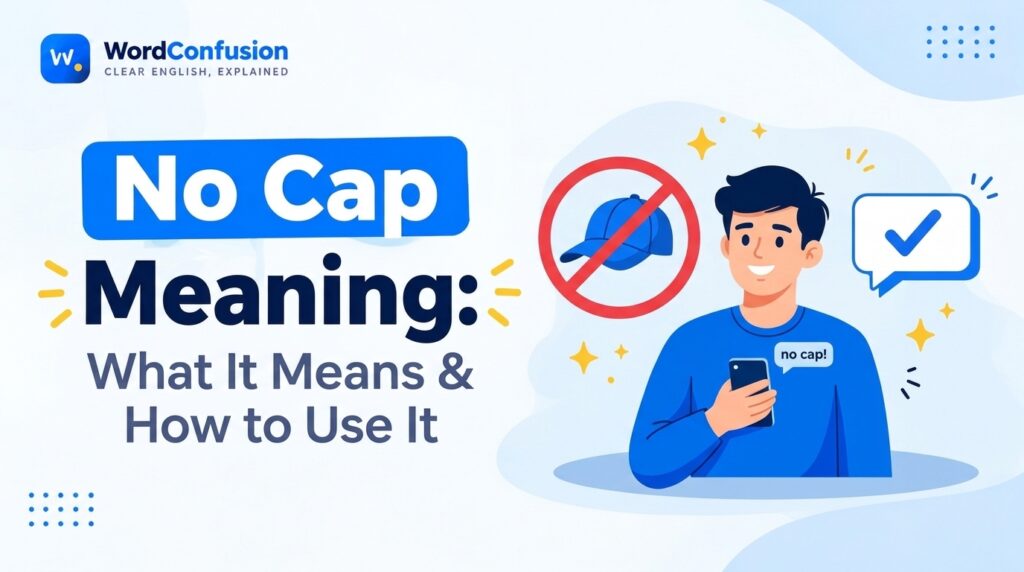
A friend texts a wild story about meeting a famous athlete, then adds “no cap” at the end. Readers new to the phrase may pause and wonder what a hat has to do with it. The answer has nothing to do with clothing and everything to do with honesty.
The no cap meaning is simple: the speaker promises that the statement is true and not exaggerated. This guide covers where the phrase came from, how people use it in texts, and how to reply. Fans of similar truth markers can also review fr fr meaning in text for a close cousin.
Each section below moves from the basic definition toward examples, comparisons, mistakes, and practical tips. By the end, any reader can spot the phrase, read its tone, and decide whether to use it.
Quick Answer: What Does No Cap Mean?
No cap means “no lie” or “for real,” and speakers use it to stress a true statement. The word “cap” means a lie or exaggeration in this slang, so “no cap” removes any doubt. Tone still depends on context, because friends sometimes use it playfully about small, silly claims.
No Cap Meaning at a Glance
The table below gives a fast summary of the phrase, its parts, and its common uses.
| Item | Details |
|---|---|
| Phrase | No cap |
| Plain meaning | No lie, for real, honestly |
| Opposite | Cap, meaning a lie or exaggeration |
| Part of speech | Interjection or adverb phrase |
| Common emoji | The blue cap emoji crossed out, or 🧢 for “cap” |
| Main platforms | Texts, TikTok, Instagram, X, Snapchat |
| Tone | Casual, emphatic, often playful |
| Formal writing | Not suitable |
In short, “no cap” works as a quick honesty stamp attached to the end of a casual claim.
Simple words: “cap” means a lie, so “no cap” means “I am not lying.”
What Does Cap Mean in Slang?
In modern slang, “cap” means a lie, a false claim, or a big exaggeration. People often say “that’s cap” when they doubt a story, a boast, or an unbelievable promise. The phrase “stop capping” tells someone to quit lying or overstating the facts.
The word also appears as a verb, so “he’s capping” means “he is lying or bragging falsely.” This single word creates a whole family of expressions, and “no cap” sits at the honest end.
Cap as a Noun
As a noun, “cap” names the lie itself, as in “that whole story was cap.” Speakers use it to judge a statement quickly without writing a long reply or argument.
Cap as a Verb
As a verb, “capping” describes the act of lying or exaggerating, as in “stop capping about your grades.” The verb form often sounds teasing between friends instead of angry or accusing.
The Cap Emoji
Many users send the 🧢 emoji instead of typing the word, especially in comments under posts. A single blue cap under a bold claim usually means the reader thinks the claim is false.
Where Did No Cap Come From?
The phrase grew from African American Vernacular English, where “capping” once described boasting and exaggerating. Earlier generations also used “capping” for trading playful insults, a verbal game similar to “the dozens.” Over time, the boasting sense narrowed toward lying, and “cap” became a short label for falsehood.
Dictionaries such as Merriam-Webster and Dictionary.com trace the modern spread to hip hop during the 2010s. Atlanta rappers in particular used “no cap” and “cap” often in lyrics, interviews, and social media posts. From there, the phrase moved to TikTok, gaming chats, and school hallways across the United States.
How Social Media Spread the Phrase
Short videos helped the phrase travel fast, because creators repeated it in captions, stitches, and comment threads. By the early 2020s, “no cap” appeared in brand ads, sports commentary, and classroom jokes alike. That broad reach explains why parents and teachers now search for its meaning so often.
Is No Cap Still Popular?
Yes, “no cap” remains common in casual speech, though some younger users now treat it as slightly dated. Trends move quickly online, so the phrase may sound fresh in one group and tired in another.
How Do People Use No Cap in Texts?
Most people place “no cap” at the start or end of a sentence to stress honesty. The position changes the rhythm slightly, but the meaning stays the same in both cases.
| Position | Example | Effect |
|---|---|---|
| End of sentence | That pizza was the best I’ve had, no cap. | Adds weight after the claim |
| Start of sentence | No cap, I finished the whole book today. | Sets an honest tone first |
| Standalone reply | No cap. | Confirms a previous claim |
| Question | No cap? | Asks if the claim is true |
Readers can treat each version as a promise of honesty with slightly different timing.
No Cap at the End of a Sentence
This position appears most often, because speakers make the claim first and then confirm it. “I ran five miles this morning, no cap” sounds proud and slightly playful at once.
No Cap at the Start of a Sentence
Starting with “no cap” warns the listener that something surprising or important follows next. “No cap, that test was the hardest one all year” prepares friends for a strong opinion.
No Cap as a Question
Adding a question mark turns the phrase into a request for confirmation from the other person. “No cap?” means “Are you serious?” or “Is that true?” in casual chats.
No Cap as a Standalone Reply
A friend may answer a doubtful “really?” with a simple “no cap” to confirm the story. This short reply works like “seriously” or “I swear” in older slang and spoken English.
Key Characteristics of No Cap
These key characteristics explain how the phrase behaves in real conversations and online posts:
- The phrase always signals honesty, even when the claim itself sounds small or silly.
- Speakers usually place it at the start or end of a sentence for extra weight.
- It belongs to casual speech and rarely appears in professional emails or school essays.
- Tone often depends on emojis, punctuation, and the relationship between the two people.
- The phrase works in texts, captions, comments, voice notes, and face to face talk.
- Its opposite, “cap,” lets listeners challenge claims quickly without a long or awkward reply.
No Cap Examples in Everyday Conversations
Real examples make the phrase easier to recognize, so the following scenes show common uses. Each example comes from a different setting, from food reviews to sports talk.
Food and Restaurants
“This new taco place is better than anything downtown, no cap.” The speaker wants friends to trust the recommendation and try the restaurant soon.
School and Study
“No cap, I studied for four hours and still forgot the first formula.” Here the phrase adds honesty to a frustrating moment, which invites sympathy from classmates.
Sports and Games
“He scored forty points last night, no cap, you should watch the highlights.” Sports fans use the phrase often, because stats and performances can sound unbelievable.
Compliments Between Friends
“That jacket looks great on you, no cap.” The phrase makes the compliment feel sincere instead of polite, which matters among close friends.
Shopping and Deals
“I got these sneakers for twenty dollars, no cap.” The speaker expects doubt about the low price, so the phrase answers that doubt early.
| Setting | Example | Purpose |
|---|---|---|
| Food | Best burger in town, no cap. | Sincere recommendation |
| School | No cap, that exam was brutal. | Honest reaction |
| Sports | He made ten threes, no cap. | Confirms a surprising stat |
| Compliment | Your art is amazing, no cap. | Sincere praise |
| Shopping | Paid half price, no cap. | Confirms a good deal |
Across every setting, the phrase does one job: it asks the listener to believe the speaker.
No Cap vs Cap: What Is the Difference?
“Cap” and “no cap” come from the same root, yet they carry opposite meanings in conversation. “Cap” calls something a lie, while “no cap” insists that something is true.
| Phrase | Meaning | Example |
|---|---|---|
| Cap | A lie or exaggeration | That story is cap. |
| No cap | No lie, for real | I saw it myself, no cap. |
| Capping | Lying or bragging | Stop capping about your score. |
| 🧢 | Visual “cap” judgment | Comment under a bold claim |
Recognizing which side a speaker takes helps readers reply with the right tone every time.
No Cap vs Fr Fr: Which One Means More?
“Fr fr” stands for “for real, for real,” and it also stresses honesty in casual texts. Both phrases overlap heavily, but small differences appear in tone and typical usage.
| Factor | No cap | Fr fr |
|---|---|---|
| Meaning | No lie | For real, for real |
| Origin | AAVE and hip hop | AAVE and texting |
| Typical spot | Start or end of sentence | End of sentence |
| Typed or spoken | Both | Mostly typed |
Many users pair them together, as in “no cap fr fr,” for double weight on honesty.
No Cap vs Deadass, Ngl, and Lowkey
Several slang terms sit near “no cap,” and mixing them up can change a message’s tone. The comparison below explains how each one differs from the main phrase.
| Term | Meaning | Tone compared with no cap |
|---|---|---|
| Deadass | Seriously, fully honest | Stronger, more intense |
| Ngl | Not gonna lie | Softer, often confessional |
| Lowkey | Quietly, slightly | Mild, not about honesty |
| On God | Swearing it is true | Stronger, more serious |
The middle ground belongs to “no cap,” which sounds firm without sounding overly dramatic.
The guide on ngl meaning in text explains that softer honesty marker in more detail. Readers comparing these terms will notice that “ngl” usually introduces an opinion, while “no cap” defends a claim.
How to Reply When Someone Says No Cap
Replies depend on whether the reader believes the claim, doubts it, or simply wants to agree. The steps below help readers choose a natural response in any casual chat.
Step 1: Read the Context
Check the topic, the emojis, and the friend’s usual style before replying to the message. A playful laughing emoji often means the speaker expects jokes, not a serious answer.
Step 2: Decide Whether to Believe It
If the claim sounds true, reply with agreement, such as “that’s wild” or “I believe you.” If it sounds doubtful, a teasing “that’s cap” or 🧢 emoji works between close friends.
Step 3: Match the Energy
Mirror the sender’s tone, because a calm reply to an excited message can feel cold. A quick “no cap, that’s amazing” shows shared excitement without adding much extra text.
Step 4: Ask for Proof Playfully
Some friends reply with “pics or it didn’t happen” when a claim sounds too good. This response keeps the chat fun while still asking for evidence in a friendly way.
| Situation | Good reply |
|---|---|
| Believable good news | That’s amazing, congrats! |
| Funny claim | No way 😂 |
| Doubtful boast | That’s cap 🧢 |
| Want proof | Send pics then! |
Most replies work best when they keep the same casual, friendly energy as the original message.
Is No Cap Rude or Offensive?
No, “no cap” is not rude or offensive in casual conversations among friends or classmates. It carries no insult, profanity, or adult meaning, so most families treat it as clean slang.
Context still matters, though, because the phrase sounds out of place in formal settings. Using it in a job application or a message to a manager may seem careless or unprofessional. Some older readers also may not know the phrase, which can cause small misunderstandings.
Cultural Respect and Origins
The phrase comes from Black American speech traditions, and many writers encourage users to respect that history. Using it naturally is common, yet mocking its origins or exaggerating an accent can offend people.
When Should You Avoid Using No Cap?
Slang works best when everyone in the chat shares the same casual style and vocabulary. These tips help readers decide when the phrase fits and when plain words work better:
- Avoid the phrase in job applications, cover letters, and emails to managers or clients.
- Skip it in school essays, research papers, and any writing that teachers will grade formally.
- Use plain words like “honestly” when chatting with older relatives who may not know slang.
- Keep it out of customer service replies unless the brand voice clearly welcomes playful slang.
- Choose clear language in legal, medical, or financial messages where accuracy matters most.
- Save the phrase for friends, group chats, comments, and relaxed social media captions.
No Cap Spelling Variations
Online writers spell the phrase in several ways, and each version carries the same basic meaning. Recognizing these forms helps readers decode comments, captions, and quick replies without confusion.
| Variation | Meaning | Where it appears |
|---|---|---|
| No cap | No lie | Texts and speech |
| Nocap | No lie | Hashtags and usernames |
| No cappin | Not lying at all | Spoken style in texts |
| No 🧢 | No lie | Comments and captions |
| Cap or no cap? | Is this true? | Polls and challenges |
Every variation points back to the same promise of honesty, so readers can treat them alike.
The Crossed Out Cap Style
Some users type “no” before the cap emoji, which reads as “no cap” without the word. Others add a red circle or prohibition emoji beside the cap to show the same idea visually.
Cap or No Cap Games
Creators often post a surprising fact and ask viewers to vote “cap or no cap” in comments. This format turns the slang into a quick quiz, and it helps the phrase reach new audiences.
No Cap Across Age Groups
Different generations read the phrase in different ways, and that gap explains many awkward moments. Teens and young adults usually treat it as normal speech, while older adults may need an explanation.
Gen Z users often use the phrase without thinking, much like older speakers say “honestly” or “seriously.” Millennials usually know the meaning, though many use it with a slightly ironic tone. Parents and grandparents may meet it first through their children’s texts, school chats, or viral videos.
| Group | Typical reaction | Common use |
|---|---|---|
| Teens | Normal, everyday slang | Texts and videos |
| Young adults | Familiar, sometimes playful | Group chats |
| Parents | Often new or unclear | Reading kids’ texts |
| Teachers | Familiar from classrooms | Hearing students talk |
Knowing the audience’s age helps readers decide whether the phrase will land or confuse people.
How Parents and Teachers Can Read No Cap
Parents and teachers sometimes worry when they see unfamiliar slang in a child’s messages or homework. In this case, the phrase carries no hidden danger, adult meaning, or harmful message at all. A student who writes “no cap” simply wants a friend to believe a story or opinion.
Adults can use the phrase as a friendly conversation starter instead of a reason for concern. Asking a teen to explain their favorite slang often opens a relaxed talk about online culture. That habit builds trust and keeps adults informed about how young people communicate today.
Should Students Use No Cap in Class?
Spoken use in class discussions usually feels fine, depending on the teacher and the classroom rules. Written assignments call for standard English, so students should replace the phrase with clearer words.
No Cap in Gaming and Sports Talk
Gaming chats use the phrase constantly, because players often brag about scores, ranks, and lucky moments. A teammate might type “I hit diamond rank last night, no cap” after a long session. Other players may answer with 🧢 until the teammate shares a screenshot as proof.
Sports fans use the phrase in a similar way when they debate players, trades, and game results. Commentators on podcasts and streams sometimes add it before bold predictions to sound sincere. In both spaces, the phrase helps people defend claims that listeners might otherwise doubt.
| Space | Example | Common reply |
|---|---|---|
| Online games | Won five matches straight, no cap. | Screenshot or it’s cap |
| Sports debates | He is the best guard today, no cap. | Counter stats |
| Fantasy leagues | My team scored the most, no cap. | Check the app |
These examples show how competitive settings make the honesty promise feel especially useful and lively.
How Brands and Creators Use No Cap
Brands sometimes borrow the phrase to sound young and relatable in ads, captions, and product launches. A snack company might write “best flavor yet, no cap” under a new product photo. When done well, the phrase feels playful, but forced slang often draws mockery in comment sections.
Creators use the phrase more naturally, because it already fits their spoken style and audience. Reviewers, gamers, and food bloggers often add “no cap” before strong opinions to sound sincere.
Real World Example: A Group Chat Story
Consider a group chat where Maya says she found a twenty dollar bill inside a library book. Jordan replies “cap 🧢,” because the story sounds too lucky to believe at first glance. Maya answers “no cap, look,” and sends a photo of the bill beside the book.
Jordan responds “okay, no cap, that’s lucky,” and the chat moves on with jokes about library treasure. This short exchange shows the full cycle: doubt, confirmation, proof, and agreement among friends.
Similar Phrases to No Cap
English offers many ways to stress honesty, and some fit formal settings better than slang. The table below groups common alternatives by tone, so readers can pick one quickly.
| Phrase | Tone | Best setting |
|---|---|---|
| Honestly | Neutral | Any setting |
| For real | Casual | Friends and family |
| I swear | Casual, emphatic | Spoken conversations |
| Truthfully | Formal | Work and writing |
| Seriously | Casual | Texts and speech |
| Fr fr | Extra casual | Texts and comments |
Readers can swap “no cap” for “honestly” whenever the audience or setting feels unsure.
Common Mistakes When Using No Cap
1. Using It in Formal Writing
The phrase signals casual speech, so it weakens emails, reports, and essays that need a professional tone. Use “honestly” or “truthfully” instead whenever the reader expects formal, polished language.
2. Confusing Cap With a Hat
New readers sometimes think “cap” refers to a baseball cap or a bottle cap. In this slang, the word means a lie, and the hat emoji only represents that meaning visually.
3. Mixing Up Cap and No Cap
Typing “cap” when meaning “no cap” flips the message from honesty to accusation instantly. Read the reply once before sending, especially when the conversation already feels tense.
4. Overusing the Phrase
Adding “no cap” to every sentence makes it lose force, and friends may stop taking it seriously. Save it for claims that truly need extra weight or might sound hard to believe.
5. Using It to Back a False Claim
Saying “no cap” while lying damages trust quickly, because the phrase promises honesty directly. Friends often remember these moments and doubt future claims from the same person.
6. Forcing Slang on Unfamiliar Audiences
Older relatives, international friends, or new coworkers may not know the phrase at all. Clear words avoid confusion and help every reader follow the conversation without extra searching.
Best Practices for Using Slang Naturally
Slang sounds best when it matches a speaker’s normal voice instead of appearing forced. Listen to how friends use a phrase before adding it to everyday texts or posts. Notice which groups use it often, and adjust word choices for each audience and setting.
Learning the background of popular slang also builds respect for the communities that created it. That knowledge helps readers use phrases thoughtfully instead of copying them without context.
Quick Self Check Questions
These short practice questions help readers test their knowledge of the phrase and its opposite.
What Does “That’s Cap” Mean?
“That’s cap” means the listener thinks the statement is a lie or a big exaggeration.
Is “No Cap?” a Question or a Statement?
With a question mark, “no cap?” asks whether the other person is serious about the claim.
Which Phrase Fits a Work Email Better?
“Honestly” fits a work email better, because “no cap” sounds too casual for professional messages.
No Cap Usage Checklist
Use this checklist before adding the phrase to a message, caption, or comment:
- Confirm the audience knows casual slang and will read the phrase as playful honesty.
- Check that the setting is relaxed, such as a group chat, comment section, or text.
- Make sure the claim is actually true before attaching a promise of honesty to it.
- Place the phrase at the start or end of the sentence for the clearest effect.
- Avoid stacking several slang terms, because too many can make the message hard to read.
- Switch to “honestly” or “truthfully” when the message goes to a teacher or employer.
Frequently Asked Questions
What does no cap mean in text?
In text, no cap means “no lie” or “for real,” and it confirms that a claim is true. Senders usually add it at the start or end of a message to stress honesty.
What does cap mean in slang?
In slang, cap means a lie or an exaggeration, so calling something cap means doubting it. The no cap meaning works as the opposite, promising that the speaker tells the truth.
Where did the phrase no cap come from?
No cap grew from African American Vernacular English, where capping once meant boasting or exaggerating. Hip hop artists, especially from Atlanta, spread the phrase widely during the 2010s.
What does the 🧢 emoji mean?
The blue cap emoji means “cap,” so users send it to call a claim false or exaggerated. A crossed out cap or the words no cap signal the opposite meaning of honesty.
Is no cap a bad word?
No, no cap is not a bad word and contains no profanity or adult meaning at all. It simply means “no lie,” though it still sounds too casual for formal writing.
How do you reply to no cap?
Reply to no cap by agreeing, reacting with excitement, or teasing with “cap” when the claim sounds doubtful. Matching the sender’s casual tone usually keeps the conversation friendly and natural.
Is no cap the same as fr fr?
No cap and fr fr carry nearly identical meanings, since both stress that a statement is honest. Fr fr means “for real, for real,” and many users combine the two for extra force.
Can adults use no cap?
Adults can use no cap in casual chats, especially with friends who already use similar slang. In professional settings, plain words like “honestly” usually work better than slang.
Is no cap still popular?
No cap remains common in texts, comments, and videos, though some younger users see it as slightly dated. Popularity changes quickly online, so usage varies across age groups and platforms.
What does no cap mean on TikTok?
On TikTok, no cap means the creator promises a claim is true, such as a review or story. Viewers often reply with 🧢 in the comments when they doubt the creator’s claim.
Key Takeaways
- The no cap meaning is “no lie,” and speakers use it to stress that a claim is true.
- The slang word “cap” means a lie or exaggeration, so “no cap” works as its opposite.
- The phrase grew from African American Vernacular English and spread widely through hip hop music.
- Atlanta rappers and social media creators helped the phrase reach mainstream audiences during the 2010s.
- People place “no cap” at the start or end of a sentence to add extra force.
- Adding a question mark turns “no cap?” into a request for confirmation from the other person.
- The 🧢 emoji usually means “cap,” so users send it to doubt someone’s claim in comments.
- The phrase is clean slang, but it sounds too casual for essays, job emails, and formal messages.
- Similar phrases include fr fr, deadass, honestly, and for real, each with a slightly different tone.
- Using the phrase while lying damages trust, because it directly promises the listener complete honesty.
Final Thoughts
The no cap meaning comes down to one promise: the speaker is telling the truth without exaggeration. Its roots in Black American speech and hip hop explain why it spread so far online. Use it with friends and casual chats, and choose plain words like “honestly” for formal settings.
Explore more slang guides on Word Confusion.
Written by
 Bilal Internee
Latest posts
 Bussin Meaning: Definition, Origin, Examples & Usage
 Insha Allah Meaning: Translation, Usage, Spelling & Replies
 Wallahi Meaning: Origin, Religious Use, Slang & Examples
 ACH Meaning: Banking, Text, Medical & Other Uses Explained
 Chaos Meaning: Definition, Origin, Examples & Usage Explained
 OBO Meaning: Definition, Marketplace Uses, Examples & Tips