OPT Meaning in Text: What Does OPT Mean in Chat?

If you see “OPT” in a text message, chat, or social media post, it usually refers to the English verb opt, meaning “choose” or “decide.” It is not automatically a special texting acronym or slang word.
For example:
“I’ll opt for the blue one.”
Here, opt means choose.
However, context matters. In some forms, schedules, notes, or shorthand, OPT or opt. can also mean “optional” or relate to “option.” Merriam-Webster lists opt as both a verb meaning “to make a choice” and an abbreviation that can represent “option” or “optional.”
So, if you are wondering what does OPT mean in text, the safest answer is: usually “choose” or “decide,” but the surrounding context determines the exact meaning.
Quick Answer: What Does OPT Mean in Text?
OPT in text usually means “choose” or “decide.” It is normally the standard English verb opt, rather than a fixed texting acronym. For example, “I’ll opt for pizza” means “I’ll choose pizza.” In certain shorthand contexts, OPT may also mean “optional.” The phrases opt for, opt to, opt in, and opt out have different meanings related to making a choice.
For more explanations of modern text abbreviations and online language, you can also explore WordConfusion.
What Does OPT Mean in Texting?
The word opt is a regular English verb meaning to choose one thing instead of another.
It is not slang by definition.
For example:
- “I’ll opt for the cheaper plan.”
- “She opted to stay home.”
- “We opted for dinner instead.”
- “He opted to work remotely.”
In each sentence, opt means something close to choose or decide.
Cambridge Dictionary defines opt as making a choice, particularly choosing one thing or possibility instead of others. It also gives the common structures opt for and opt to + verb.
A simple way to remember it
OPT = CHOOSE
If someone texts:
“I think I’ll opt for the first one.”
They are simply saying:
“I think I’ll choose the first one.”
Is OPT Slang or an Abbreviation?
Usually, opt is neither texting slang nor a special abbreviation. It is an ordinary English verb.
This distinction is important because not every short word appearing in a text message is a texting abbreviation.
For example:
- LOL = an internet abbreviation
- BRB = an internet abbreviation
- OOTD = an abbreviation for “Outfit of the Day”
- opt = a standard English verb meaning “choose”
For comparison, you can see how OOTD is used as an informal online abbreviation.
So if someone writes:
“I’ll opt for coffee.”
there is no hidden slang meaning. They are simply using the normal English word opt.
Is OPT an acronym?
Not usually when it means “choose.”
An acronym or initialism is formed from the initial letters of a longer expression. Opt is already a complete English word.
If OPT is being used as shorthand for optional or option in a particular document, it is functioning as an abbreviation rather than the verb opt. Merriam-Webster separately lists these abbreviation uses.
Does OPT Mean “Optional” in Text?
Sometimes, but not automatically.
This is one of the most important distinctions to understand.
Opt
Opt is a verb.
It means:
to choose or decide
Example:
“I opted for the morning class.”
Optional
Optional is an adjective.
It means:
not required or not compulsory
Example:
“Attendance is optional.”
Merriam-Webster defines optional as involving a choice or being not compulsory.
Option
Option is a noun.
It means:
a choice or something that can be chosen
Example:
“You have three options.”
Quick comparison
| Word | Part of Speech | Meaning | Example |
| opt | Verb | choose | I opted for tea. |
| optional | Adjective | not required | Attendance is optional. |
| option | Noun | a choice | Tea is one option. |
| OPT / opt. | Abbreviation in some contexts | option/optional | The extra activity is opt. |
The important point is that OPT does not automatically mean “optional” just because it appears in capital letters.
Context determines the meaning.
OPT Meaning in Chat, Messages, and Social Media
When opt appears in a normal sentence, its standard English meaning usually remains unchanged.
You might see it in:
- Text messages
- WhatsApp chats
- Instagram DMs
- Snapchat messages
- TikTok comments
- Discord conversations
- Group chats
- Online discussions
For example:
“I’m going to opt for the later train.”
This means:
“I’m going to choose the later train.”
The platform does not create a special Snapchat, Instagram, or TikTok meaning for opt.
This is different from some genuine texting abbreviations where the abbreviation itself carries a specific online meaning. For example, GTB can have several context-dependent meanings in texting.
Opt For, Opt To, Opt In, and Opt Out
These expressions are closely related, but they are not interchangeable.
What Does “Opt For” Mean?
Opt for means choose something.
Structure:
opt for + noun
Examples:
- “I opted for the cheaper hotel.”
- “She opted for the blue dress.”
- “We decided to opt for the earlier flight.”
Think:
opt for = choose
Cambridge gives opt for as a standard construction for choosing one possibility instead of another.
What Does “Opt To” Mean?
Opt to means choose to do something.
Structure:
opt to + verb
Examples:
- “I opted to stay home.”
- “She opted to work remotely.”
- “They opted to wait until Monday.”
Think:
opt to = choose to do
What Does “Opt In” Mean?
Opt in means choose to participate, join, receive, or be included.
For example:
“I opted in to receive email updates.”
This means:
“I chose to receive email updates.”
Cambridge defines opt in as choosing to be part of an activity or arrangement.
You might see it in messages about:
- Notifications
- Email subscriptions
- Privacy settings
- Memberships
- Surveys
- Promotions
- Online services
What Does “Opt Out” Mean?
Opt out means choose not to participate or stop being involved.
For example:
“I opted out of the email list.”
This means:
“I chose not to receive the emails.”
Cambridge defines opt out as choosing not to be part of an activity or stopping involvement in it.
Easy memory trick
👉Opt in = choose YES
👉Opt out = choose NO
OPT Meaning: Comparison Table
| Expression | Meaning | Example |
| opt | choose or decide | I’ll opt for the first one. |
| opt for | choose something | We opted for the cheaper plan. |
| opt to | choose to do something | She opted to stay home. |
| opt in | choose to participate | I opted in to the updates. |
| opt out | choose not to participate | He opted out of the program. |
| optional | not required | Attendance is optional. |
| option | a choice | You have another option. |
This is the easiest way to see why opt, optional, option, opt in, and opt out should not be treated as identical.
Real-Life Examples of OPT in Text Messages
Example 1: Choosing Food
Friend: “Pizza or burgers?”
You: “I’ll opt for pizza.”
Meaning: You choose pizza.
Example 2: Choosing an Activity
Friend: “Are you coming to the party?”
You: “I think I’ll opt to stay home tonight.”
Meaning: You choose to stay home.
Example 3: Choosing a Plan
Coworker: “Which plan should we use?”
You: “Let’s opt for the simpler one.”
Meaning: Choose the simpler plan.
Example 4: Notifications
Message: “Would you like to receive weekly updates?”
Reply: “Yes, I opted in.”
Meaning: You chose to receive the updates.
Example 5: Leaving a Program
Friend: “Are you still getting those emails?”
You: “No, I opted out.”
Meaning: You chose not to receive them.
Example 6: Optional Activity
Teacher: “The extra assignment is optional.”
Here, optional means the assignment is not required.
It would be incorrect to replace optional with the verb opt.
How to Use “Opt” Correctly in a Sentence
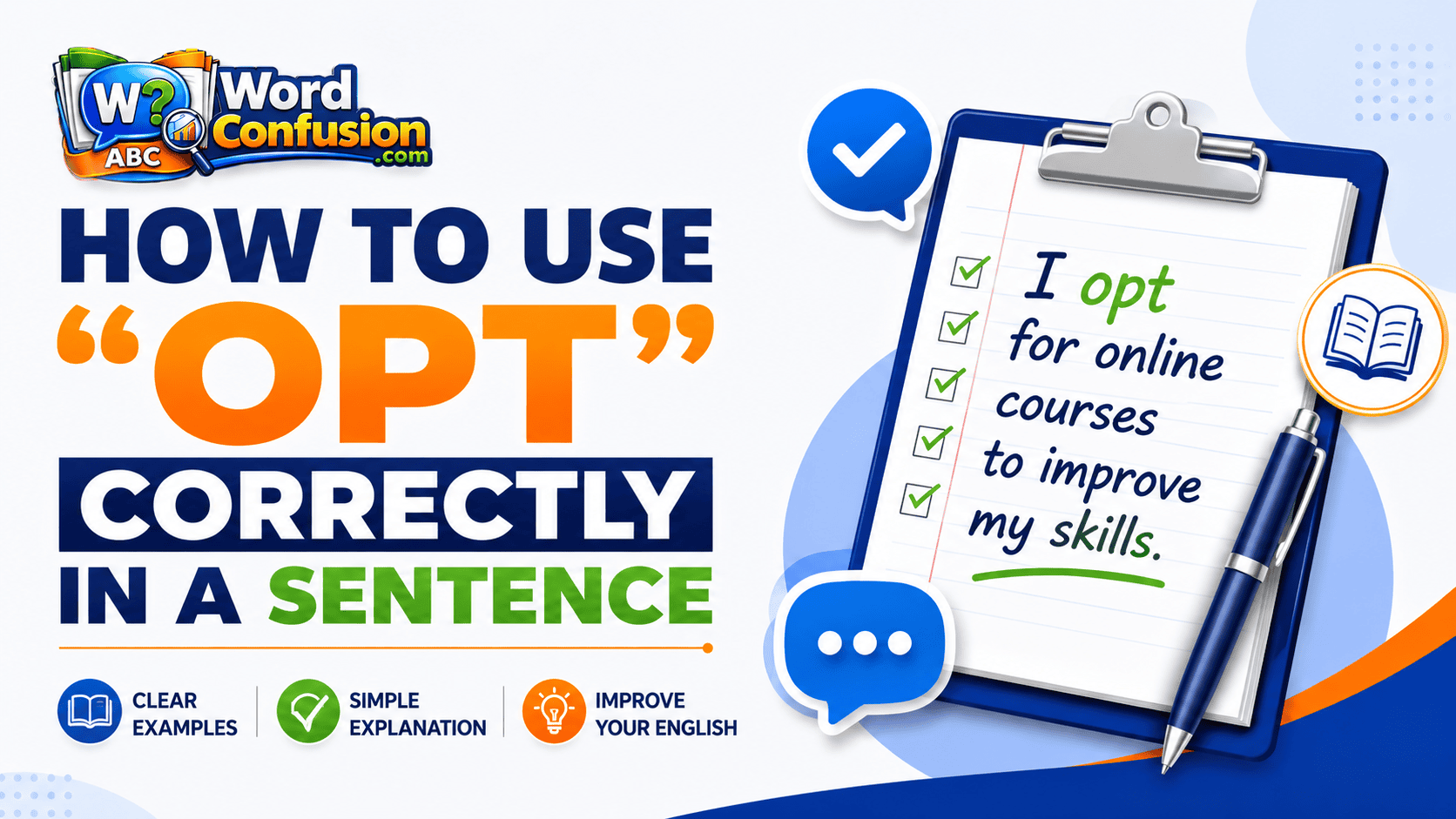
The most common structures are straightforward.
1. Opt for + noun
“I opted for the vegetarian meal.”
Not:
“I opted the vegetarian meal.”
2. Opt to + verb
“She opted to leave early.”
Not:
“She opted leaving early.”
3. Opt in
“I opted in to receive notifications.”
4. Opt out of + noun or -ing form
“He opted out of the program.”
“She opted out of receiving promotional emails.”
Learning these four structures will help you use opt naturally in both casual and professional English.
Is “Opt” Formal or Informal?
Opt is standard English and can be used in both formal and informal writing.
This is another important point: opt is not inherently casual.
You can use it in:
- Text messages
- Everyday conversations
- Business emails
- Reports
- Professional writing
- Academic writing
For example:
“The company opted for a more flexible schedule.”
That sentence is perfectly appropriate in professional English.
By contrast, a shorthand such as OPT = optional may be less clear in formal prose unless the abbreviation has already been defined or is standard in that particular context.
If you are writing for a professional audience, spelling out optional is usually clearer.
OPT Meaning on Snapchat, Instagram, TikTok, and WhatsApp
The basic meaning of opt does not normally change between these platforms.
Snapchat
If someone says:
“I’ll opt for the second one.”
they mean they will choose the second option.
In an Instagram DM:
“I opted to skip the event.”
means:
“I chose to skip the event.”
TikTok
A comment such as:
“I’d opt for the original version.”
means the commenter would choose the original version.
A WhatsApp message such as:
“We opted for Friday instead.”
means:
“We chose Friday instead.”
So, unlike some internet abbreviations, opt does not have a special platform-specific definition.
Common Mistakes With OPT
1. Assuming OPT Always Means “Optional”
This is the most common misunderstanding.
Opt means choose.
Optional means not required.
They are related words, but they are not interchangeable.
2. Assuming OPT Is Always Slang
It is not.
Opt is a standard English verb.
3. Calling OPT an Acronym
When opt means “choose,” it is simply an English word.
Capitalizing it as OPT does not automatically turn it into an acronym.
4. Confusing Opt In With Opt Out
Remember:
- Opt in = choose to participate
- Opt out = choose not to participate
5. Ignoring Context
If someone sends only:
“OPT”
the meaning may not be obvious.
It could refer to the verb opt, an abbreviation for optional, or something specialized in another context.
Look at the surrounding message before deciding what the sender means.
OPT vs Optional vs Option
These three words are closely related, which is why they are often confused.
| Word | Meaning | Example |
| Opt | To choose | We opted for the new design. |
| Optional | Not required | The meeting is optional. |
| Option | A choice | The blue design is another option. |
A useful memory trick is:
You opt.
You have options.
An option may be optional.
That simple relationship makes the three words much easier to remember.
A Note About Other Meanings of OPT
OPT can have specialized meanings outside ordinary texting.
For example, in education and immigration contexts, OPT can refer to Optional Practical Training. In technical or professional contexts, abbreviations can also have field-specific meanings.
Therefore, never interpret OPT from the letters alone.
Ask:
- What is the conversation about?
- Is OPT being used as a verb?
- Is it shorthand in a form or schedule?
- Is the conversation about a specialized subject?
Context is often enough to identify the intended meaning.
How People Actually Use OPT Online
One reason opt can feel like slang is that people increasingly use standard English words in short, conversational messages.
For example:
“I’ll opt for this one.”
is perfectly natural in a casual chat.
The word may appear alongside emojis, abbreviations, or informal expressions, but that does not make opt itself slang.
This is an important distinction when learning online English: the surrounding conversation can be informal even when an individual word is completely standard English.
If you want to compare this with a genuine internet abbreviation, see our guide to TBF meaning in text.
You can also compare it with TF meaning in text, which is a true informal texting abbreviation with a very different function.
Quick Usage Cheat Sheet
| If you see… | Think… |
| opt | choose |
| opt for | choose something |
| opt to | choose to do something |
| opt in | choose to participate |
| opt out | choose not to participate |
| optional | not required |
| option | a choice |
| OPT / opt. in a form | possibly optional/option; check context |
The fastest rule
OPT usually means “choose” when it is being used as the verb opt.
If it appears as shorthand in a form, list, or schedule, check the context because OPT can also be an abbreviation for optional or option.
Frequently Asked Questions About OPT Meaning in Text
What does OPT mean in text?
OPT usually means “choose” or “decide” when it represents the standard English verb opt. For example, “I’ll opt for the blue one” means “I’ll choose the blue one.” In some shorthand contexts, OPT can also mean “optional.”
What does OPT mean in texting?
In texting, opt generally has its normal English meaning: to choose or decide. It may appear in phrases such as “opt for,” “opt to,” “opt in,” and “opt out.”
Is OPT a slang word?
No, not usually. Opt is a standard English verb. People may use it in casual texts, but casual usage does not make the word slang.
Is OPT an acronym?
Not when it means “choose.” In that case, opt is simply an English word. OPT can function as an abbreviation for “option” or “optional” in some contexts.
Does OPT mean optional?
Sometimes, depending on context. In a form, schedule, or shorthand note, OPT or opt. may represent “optional.” But the ordinary English verb opt means “choose.”
What does opt for mean?
Opt for means choose something.
Example:
“We opted for the cheaper option.”
What does opt to mean?
Opt to means choose to do something.
Example:
“She opted to stay home.”
What does opt in mean?
Opt in means choose to participate or be included.
Example:
“I opted in to receive notifications.”
What does opt out mean?
Opt out means choose not to participate or stop being involved.
Example:
“He opted out of the program.”
Is opt formal or informal?
Opt is standard English and can be used in formal or informal communication. It is appropriate in professional and academic writing as well as everyday conversation.
What does OPT mean on Snapchat?
There is no standard Snapchat-specific meaning for opt. If it appears as the normal English word, it generally means choose or decide. Context should be used to interpret any unusual abbreviation.
What does OPT mean on Instagram?
On Instagram, opt generally has its normal English meaning of choose or decide. The platform itself does not give the word a separate standard definition.
What does OPT mean on TikTok?
On TikTok, opt generally means choose or decide when it is used as the English verb. The surrounding comment or conversation determines the intended meaning.
What does OPT mean in WhatsApp chat?
In WhatsApp messages, opt usually means choose.
For example:
“I’ll opt for the first one.”
means:
“I’ll choose the first one.”
How do you use opt in texting?
Use opt just as you would in standard English:
- “I’ll opt for pizza.”
- “I opted to stay home.”
- “We opted for the cheaper plan.”
- “I opted in to the updates.”
- “She opted out of the event.”
Is OPT rude?
No. The word opt is neutral and is not inherently rude, offensive, or slang.
Final Answer: What Does OPT Mean in Text?
So, what does OPT mean in text?
In most cases, opt means “choose” or “decide.” It is a normal English verb, not automatically a texting acronym or slang term. You will often see it in expressions such as opt for, opt to, opt in, and opt out.
The main confusion is between opt and optional. Opt is a verb meaning “choose,” while optional means “not required.” In some forms or shorthand contexts, OPT can also represent “optional” or “option,” so context matters.
The easiest rule to remember is:
opt = choose
Once you understand that distinction, most uses of OPT in text messages, chats, and social media become easy to interpret.
Written by
 Abdul Moeed
Abdul Moeed is a professional content writer and SEO link-building specialist with 5+ years of experience. He creates search-optimized content and develops effective SEO strategies that improve website visibility, authority, and organic growth.
View LinkedIn profileLatest posts
 What Does PG Mean in Text? Meaning, Examples & Usage
 What Does OFCC Mean in Text? Meaning, Uses & Examples
 What Does MSG Mean in Text? Meaning, Examples & Usage
 What Does STY Mean in Text? Meaning, Examples & Usage
 What Does “Twin” Mean in Slang? Meaning, Text & Examples
 What Does LMC Mean in Text? Meaning, Examples & Usage