Sleave or Sleeve: Which Spelling Is Correct?

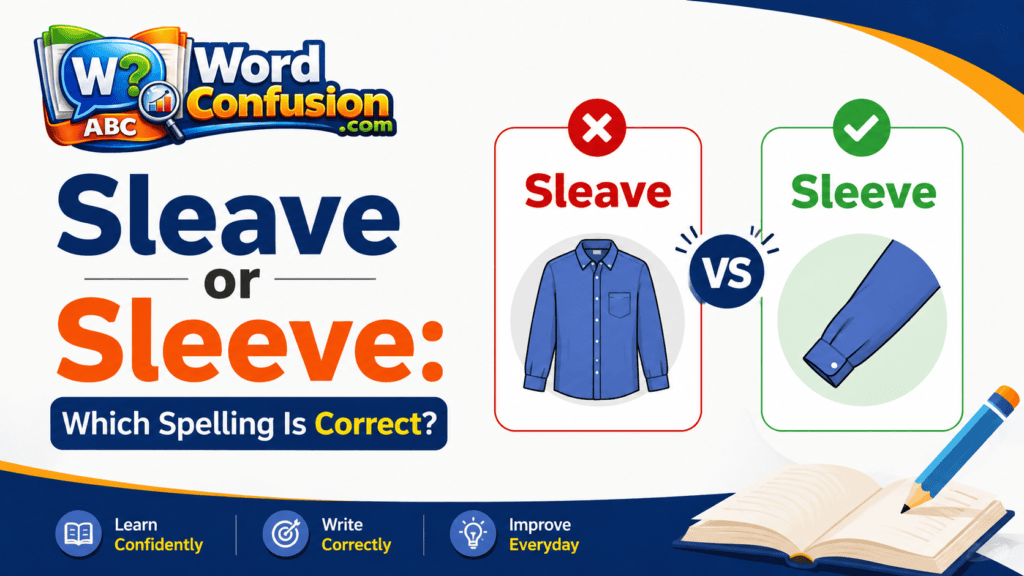
If you mean the part of a shirt, jacket, dress, or other garment that covers the arm, the correct modern spelling is sleeve. Sleave is also a real English word, but it is rare and archaic, with historical meanings connected to silk, thread, and textiles. So, in everyday English, use sleeve when talking about clothing.
📖 See also:HM Meaning in Text: What Does HM Mean in Texting?
Sleave or Sleeve: Which One Is Correct?
| Word | Correct for clothing? | Main meaning |
| Sleeve | Yes | A part of clothing that covers some or all of the arm |
| Sleave | No | A rare, archaic textile term related to thread or silk |
For example:
- Correct: “The sleeves of my shirt are too long.”
- Incorrect for clothing: “The sleaves of my shirt are too long.”
The important point is that sleave is not simply a misspelling. It is a legitimate but uncommon historical word. If you are writing about ordinary clothing, however, sleeve is the spelling you need.
What Does Sleeve Mean?
A sleeve is the part of a piece of clothing that covers some or all of the arm. It can be found on shirts, jackets, coats, dresses, sweaters, and many other garments.
For example:
- “This shirt has short sleeves.”
- “She rolled up her sleeves.”
- “His jacket has long sleeves.”
- “The dress has loose sleeves.”
The word can also be used for things that resemble a sleeve or act as a protective covering. Depending on the context, you may hear expressions such as record sleeve, laptop sleeve, or sleeve in technical and mechanical contexts.
The plural form is sleeves.
Common Types of Sleeves
Some everyday expressions include:
- long sleeve or long-sleeved — covering much of the arm
- short sleeve or short-sleeved — ending above the wrist
- shirt sleeve — the sleeve of a shirt
- dress sleeve — the sleeve of a dress
- sleeveless — having no sleeves
So if you are describing clothing, sleeve is the standard spelling in both British and American English.
What Does Sleave Mean?
Sleave is a real English word, but it is not the normal modern word for a clothing sleeve.
It is an archaic or historical textile term associated with fine thread, silk, or a skein of thread. Historical uses of sleave are connected with textile work and the handling of threads.
This is why saying simply “sleave is not a word” is inaccurate.
Instead, think of the distinction this way:
Sleeve = the modern word for part of a garment.
Sleave = a rare, historical textile word.
Because sleave is uncommon today, most people will encounter sleeve far more often.
Sleave vs. Sleeve: What Is the Difference?
The easiest way to understand the difference is to look at their modern usage.
| Feature | Sleeve | Sleave |
| Standard modern English | Yes | No |
| Used for clothing | Yes | No |
| Common today | Yes | Very rare |
| Historical textile meaning | No | Yes |
| Related to thread or silk | No primary meaning | Yes |
| Useful in everyday conversation | Yes | Rarely |
| Correct spelling for a shirt part | Yes | No |
For example:
Sleeve:
“She tore the sleeve of her jacket.”
Sleave:
The word may appear in historical or specialized writing about thread or textiles.
This distinction matters because sleave and sleeve are not interchangeable spellings.
Why Do People Confuse Sleave and Sleeve?
The confusion is understandable because the two words look very similar:
sleave
sleeve
Both contain the letters s-l-e- and end with -ve. The main visual difference is the vowel sequence in the middle.
There is another reason the confusion can persist: sleave is a genuine English word, even though it is extremely uncommon in modern everyday English. Someone who has encountered the word—or simply remembers seeing the spelling somewhere—may reasonably wonder whether it is an alternative spelling of sleeve.
It is not.
For modern clothing-related writing, use sleeve.
📖 See also:Grimey or Grimy? Which Spelling Is Correct?
How Do You Pronounce Sleeve?
Sleeve is pronounced like “sleeve” with a long ee sound.
A common dictionary pronunciation is approximately:
/sliːv/
The word has one syllable.
You can remember its sound by comparing it with words such as:
- leave
- weave
- believe
- achieve
For example:
“Please roll up your sleeves.”
The pronunciation does not change simply because the word is used in British or American English.
How to Use Sleeve in a Sentence
Here are some natural examples of sleeve in everyday English:
- My shirt has short sleeves.
- She rolled up her sleeves before starting work.
- The jacket has a tear in the left sleeve.
- He bought a long-sleeved sweater for winter.
- The dress has beautiful lace sleeves.
- Her sleeves were wet after walking in the rain.
- I need to shorten the sleeves of this coat.
- He pushed his sleeves up to his elbows.
You can also use sleeve in non-clothing contexts:
- I bought a protective laptop sleeve.
- The record came in a paper sleeve.
- The machine uses a metal sleeve to protect the component.
These examples show that sleeve has uses beyond clothing, although the clothing meaning is the one most people encounter.
Is Sleeve Spelled Differently in British and American English?
No. Sleeve has the same spelling in both British and American English.
You should write:
- British English: sleeve
- American English: sleeve
There is no standard British-American spelling variation such as sleave.
The difference between sleeve and sleave is therefore not a regional spelling difference. They are separate words with different histories and meanings.
Common Spelling Mistakes With Sleeve
Because sleeve contains the vowel combination ee, some learners may accidentally write:
- sleave
- sleve
- sleeve with missing letters
- other phonetic variations
The most important one to recognize is sleave.
Unlike an ordinary typo, sleave is a dictionary word in its own right. That can make the mistake particularly confusing.
If you mean a part of clothing, remember:
shirt sleeve
jacket sleeve
dress sleeve
Not:
shirt sleave
jacket sleave
dress sleave
📖 See also:OOTD Meaning in Text: What Does OOTD Stand For?
Is Sleave an Old Spelling of Sleeve?
Not exactly.
It is better to think of sleave as a separate historical word rather than simply an old spelling of modern sleeve.
The two words have different meanings and historical uses. Sleave is associated with textile terminology involving thread or silk, while sleeve developed into the familiar modern word for a part of a garment and related coverings.
This distinction is useful because it prevents an overly simple rule such as:
“Sleave is wrong.”
A more accurate rule is:
Sleave is a real but archaic word; sleeve is the standard modern word for clothing.
Easy Trick to Remember the Spelling
If you are talking about clothing, remember:
SLEEVE has two E’s together: EE.
Think:
SLEEVE → S + L + EE + V + E
You can connect it with familiar words that also contain the long ee sound:
sleeve → leave → weave
So when you mean the part of a shirt or jacket that covers your arm, choose sleeve.
Frequently Asked Questions
What is the correct spelling: sleave or sleeve?
Sleeve is the correct modern spelling when you mean the part of a shirt, jacket, dress, or other garment that covers the arm.
Is sleave a real word?
Yes. Sleave is a real but rare and archaic English word associated with textile terminology, including thread, silk, or a skein. It is not the normal modern spelling of sleeve.
What does sleave mean?
Historically, sleave has been used for fine or untwisted thread, silk, or a skein of thread, as well as in related textile contexts. Its use is now uncommon.
What does sleeve mean?
A sleeve is the part of a garment that covers some or all of the arm. The word can also describe various protective or covering structures that resemble a clothing sleeve.
How do you spell sleeve?
The correct spelling is:
S-L-E-E-V-E
Sleeve has two consecutive E’s after the L.
Is sleeve spelled differently in British and American English?
No. Sleeve is spelled the same way in British and American English.
Why do people spell sleeve as sleave?
The two spellings look very similar, and sleave is itself a genuine historical English word. This can make the spelling easy to confuse, especially for people who have encountered the rare word sleave.
How do you pronounce sleeve?
Sleeve is a one-syllable word, commonly represented as /sliːv/. It rhymes closely with words such as leave and weave.
Is sleave an old spelling of sleeve?
No. Although the words look similar, sleave is better understood as a separate historical textile word rather than simply an old spelling of sleeve.
📖 See also:Scarey or Scary? The Correct Spelling Explained
Final Answer: Sleave or Sleeve?
If you are talking about the part of a shirt, jacket, dress, or other garment that covers the arm, the correct spelling is sleeve.
Sleave is a genuine English word, but it is rare and archaic and has historical textile-related meanings.
So the simple rule is:
Clothing → sleeve
Historical textile term → sleave
For everyday modern English, sleeve is the word you should use.
Looking for more English word meanings, grammar tips, and commonly confused words? Visit the WordConfusion homepage to explore our latest language guides, spelling differences, vocabulary explanations, text abbreviations, and practical examples. Whether you’re learning English or improving your writing skills, you’ll find clear, easy-to-understand resources for everyday communication.
Written by
 Abdul Moeed
Abdul Moeed is a professional content writer and SEO link-building specialist with 5+ years of experience. He creates search-optimized content and develops effective SEO strategies that improve website visibility, authority, and organic growth.
View LinkedIn profileLatest posts
 What Does PG Mean in Text? Meaning, Examples & Usage
 What Does OFCC Mean in Text? Meaning, Uses & Examples
 What Does MSG Mean in Text? Meaning, Examples & Usage
 What Does STY Mean in Text? Meaning, Examples & Usage
 What Does “Twin” Mean in Slang? Meaning, Text & Examples
 What Does LMC Mean in Text? Meaning, Examples & Usage